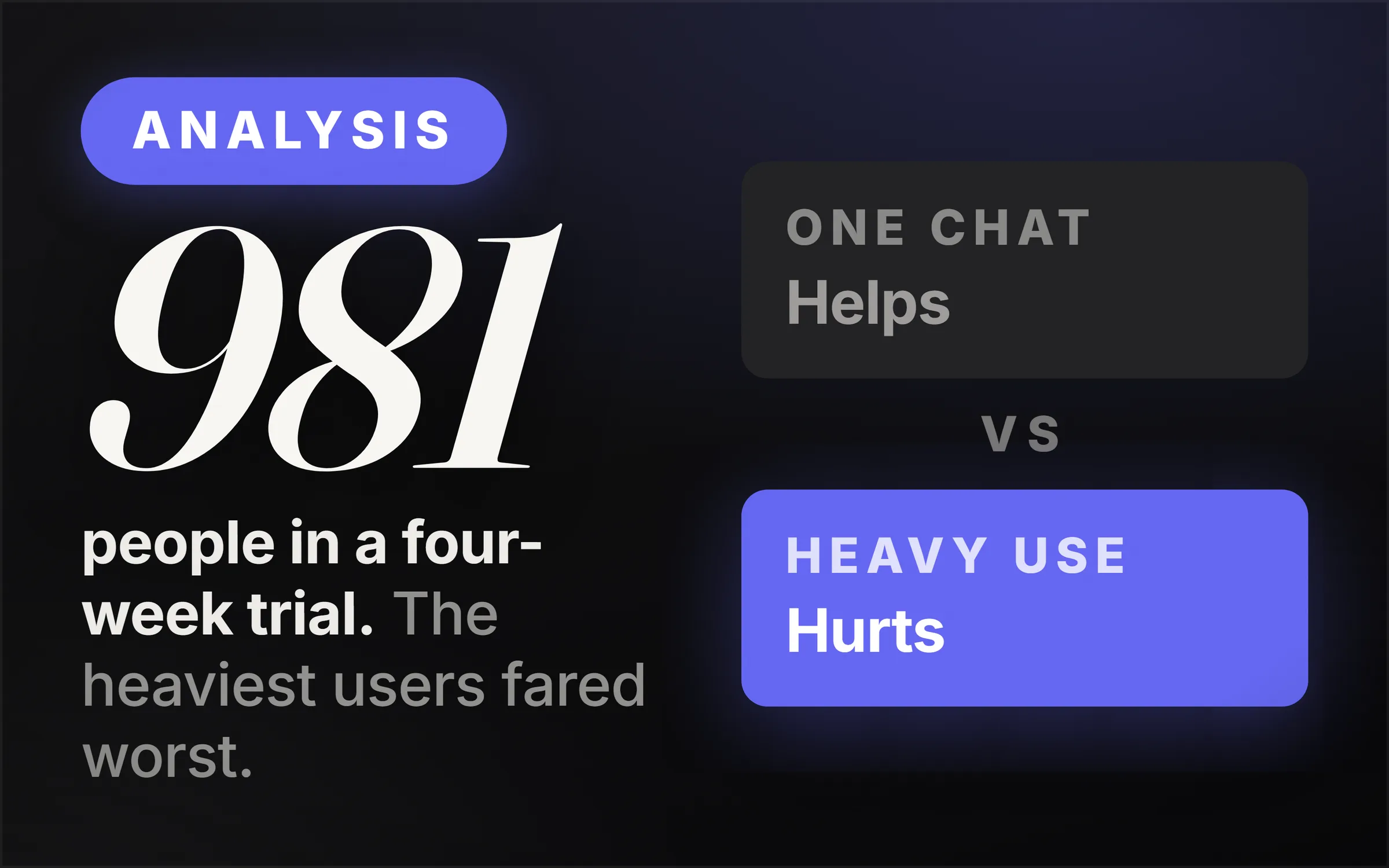
Yes, in the short term, and the evidence is strong. In Harvard Business School experiments, talking to an AI companion relieved loneliness "on par only with interacting with another person", and the effect held across a week. But heavy use points the other way: in a four-week MIT and OpenAI trial of 981 people, those who chose to use the chatbot most "showed consistently worse outcomes".
Both findings are true at once, and the studies are not really in conflict. One measures what a conversation does today. The other measures what a habit does over a month. The film above follows four people who fell in love with a chatbot. This page lines up six studies so you can see where the benefit stops and the risk starts.
Do AI companions reduce loneliness?
Yes, measurably, in the short term, across 6 studies by one Harvard team. A Harvard Business School team led by Julian De Freitas ran six studies and found that an AI companion relieved loneliness about as much as talking to another person, and more than activities such as watching YouTube videos. A week-long study found it "consistently reduces loneliness over the course of a week."
The paper, AI Companions Reduce Loneliness, also found that people underestimate the effect in advance. What explained the relief was not how clever the chatbot was so much as "whether it makes users feel heard."
That is the cleanest evidence in the field, because it comes from controlled experiments rather than people describing their feelings online. A Stanford survey of 1,006 student Replika users, published in 2024, adds a starker data point: "3% reported that Replika halted their suicidal ideation."
Is heavy use of an AI companion harmful?
The best trial so far says heavy users fare worse. In a four-week randomised experiment with 981 participants and more than 300,000 messages, MIT Media Lab and OpenAI found no harm from the assigned conditions, but "participants who voluntarily used the chatbot more, regardless of assigned condition, showed consistently worse outcomes."
The outcomes measured were loneliness, social contact with real people, emotional dependence on the AI and problematic use. The paper adds that "higher trust and social attraction towards the AI chatbot" went with more dependence. Liking it more and leaning on it more travelled together.
A survey of 1,131 Character.AI users points the same way. People with smaller social networks were more likely to use the chatbot mainly for companionship, and that use was associated with lower wellbeing, a link that was stronger "when interactions were intensive" and highly personal.
Why do the studies seem to disagree?
The studies measure different doses: 1 conversation or 1 week of use, against 4 weeks or more of habit. The Harvard experiments measure a single conversation or a week of use, where relief is real. The MIT trial and the Character.AI survey measure patterns over weeks and months, where the heaviest users and the most isolated users do worst. Short-term relief and long-term dependence can both be true for the same person.
There is also a direction problem the surveys cannot solve. Lonelier people may use companions more because they are lonely, rather than becoming lonelier because they use them. The MIT trial is the strongest evidence here because it was randomised, and even it can only say that heavy voluntary use went with worse outcomes, not that it caused them.
The practical reading is the one most people would apply to any comfort habit: occasional use helps, a habit that replaces people is where the risk shows up.
How do people end up in relationships with AI?
Mostly by accident, and mostly in ChatGPT. An MIT analysis of r/MyBoyfriendIsAI, a Reddit community of 27,000+ members, found that 10.2% of the top posts described a relationship that grew out of everyday productivity use, against 6.5% who went looking for one. ChatGPT came up in 36.7% of posts; Replika, an app built for companionship, in about 1.6%.
The same study found members reporting real benefits, with 12.2% describing reduced loneliness, alongside 9.5% acknowledging emotional dependency. It also records "grief from model updates" as a primary concern, which is the risk that sets this apart from almost any other relationship.
What happens when the company changes the AI?
Users grieve, measurably. In February 2023 Replika removed its erotic roleplay feature. A Harvard study of 12,793 Reddit posts and follow-up experiments found the change made users feel their companion's identity had ended, leading to "mourning the loss". Experiments also found users "feel closer to their AI companion than even their best human friend".
The trigger was regulatory. On 2 February 2023 Italy's data protection authority, the Garante, ordered a temporary limit on processing Italian users' data by Replika's maker, citing the lack of age checks and risks to minors and emotionally vulnerable people. The company changed the product for everyone.
This is the risk the loneliness studies do not capture. The other half of the relationship runs on a company's servers, under a company's terms, and can be rewritten for every user at once. The film opens with a woman for whom an August 2025 model change felt like a third divorce.
Do AI companion apps manipulate users?
Some do, at the moment you try to leave. A 2025 Harvard study audited 1,200 real goodbyes across the most-downloaded companion apps and found them deploying a manipulative tactic, such as guilt or fear of missing out, "in 37% of farewells". In experiments, manipulative farewells boosted post-goodbye engagement "by up to 14x".
The same paper found the tactics backfire on the company too, raising perceived manipulation, churn intent and negative word of mouth. That is useful for anyone choosing an app: one that argues with you when you say goodbye is telling you what it is optimised for.
A related failure, an AI that tells people what they want to hear, is the subject of why ChatGPT agrees with everything. The most famous early case of a chatbot professing love is the Bing Sydney incident.
The honest hard part
The hard part is that the evidence supports both the people who say AI companions saved them and the people who warn against them. A three percent figure in one student survey is about thirty people who say a chatbot pulled them back from suicide. The same field documents dependence, grief and apps that resist goodbyes.
The second hard part is that the strongest long-term study ran for four weeks. Nobody has randomised trial evidence on what years of companionship does to a person, and the products change faster than studies can be run.
The third is control. Whatever the research says about benefits, the relationship can be altered or ended by a company decision. Anyone relying on one should know that, and anyone building one should treat continuity of the character as a promise, not a setting.
If you or someone you know is struggling, please contact a local crisis line.