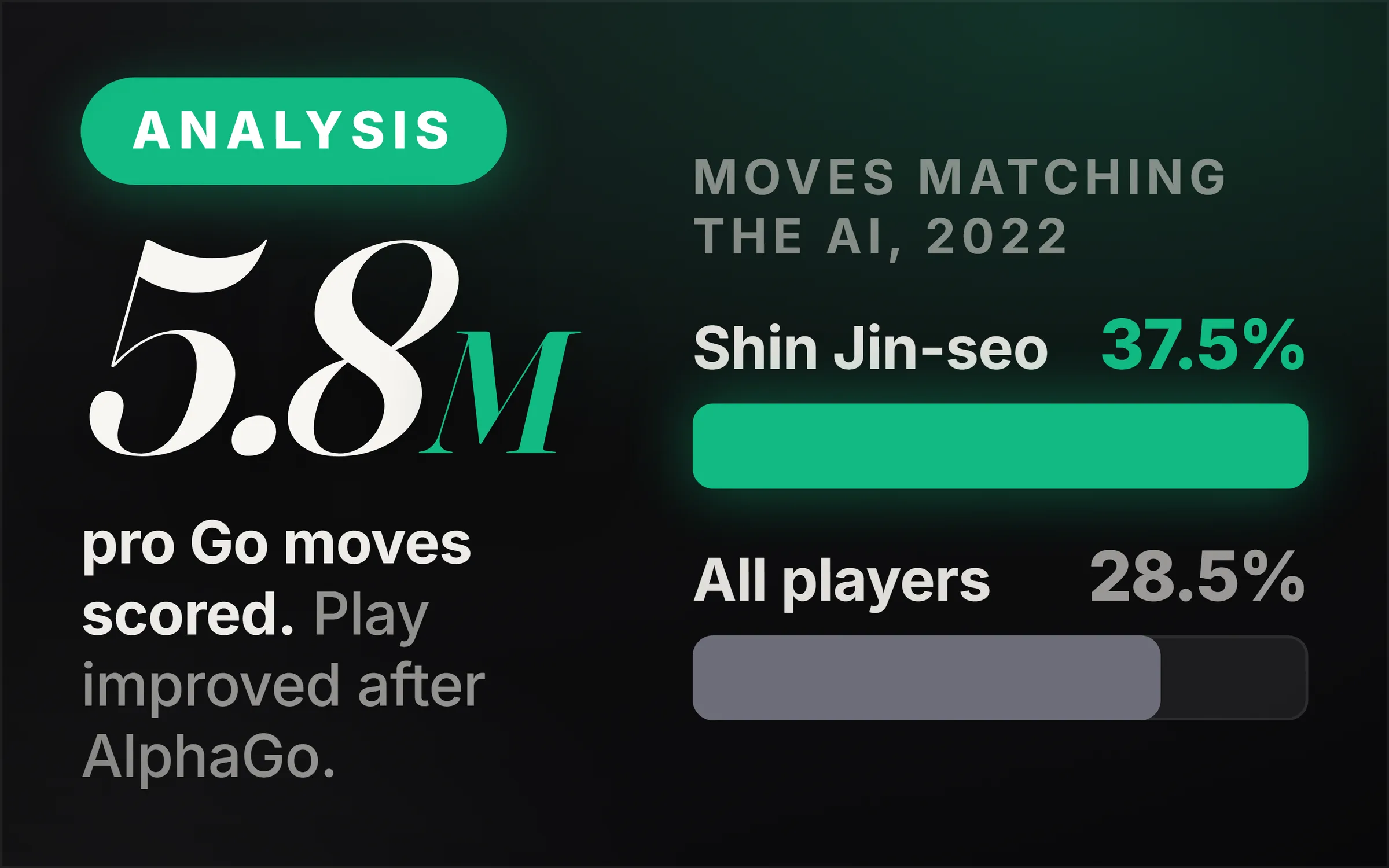
In Go, yes, measurably. A 2023 study in PNAS scored more than 5.8 million professional moves from 1950 to 2021 and found that "humans began to make significantly better decisions following the advent of superhuman AI." Human play had been roughly flat for decades, then improved after AlphaGo beat Lee Sedol in 2016.
Go matters because it is the cleanest test we have. Every move can be scored by a superhuman program, so researchers can measure what happened to human skill after the machine became unbeatable. The film above follows the players who lived through it. This page sets out what the data shows, what it does not, and what it suggests for any job where AI now outperforms people.
Does AI make humans smarter?
In the one field measured precisely, AI made human experts better. Minkyu Shin and colleagues analysed "more than 5.8 million move decisions made by professional Go players" from 1950 to 2021, scoring each against a superhuman program. They found that "humans began to make significantly better decisions following the advent of superhuman AI."
The PNAS paper generated 58 billion counterfactual game patterns to compare what humans played with what the AI would have played. The improvement appears after 2016, when AlphaGo beat Lee Sedol, the first time a program beat a top professional in a full match.
"Smarter" needs care, though. What improved was decision quality in Go, as judged by an AI. The study does not show that players became more intelligent in general, and the measure is the machine's own idea of a good move.
How did AI improve human decisions in Go?
By pushing players off well-worn paths after 2016. The same study found that "novel decisions (i.e., previously unobserved moves) occurred more frequently and became associated with higher decision quality after the advent of superhuman AI." Before AlphaGo, new moves were not reliably better. After it, they were.
The authors' reading is that the AI showed professionals that centuries of accepted strategy were not the ceiling, which "may have prompted human players to break away from traditional strategies and induced them to explore novel moves." Move 37 in the second game of the 2016 match, a move professionals first read as a mistake, became the symbol of that shift.
The mechanism matters for anyone using AI at work. The gain came from people studying the machine's choices and testing their own assumptions against them, not from handing decisions over.
Do people who learn from AI start thinking alike?
At the top level, partly yes. MIT Technology Review reported in February 2026 that, according to a 2022 Korean Baduk League study, the world number one Shin Jin-seo's moves "match AI's 37.5% of the time", well above the 28.5% average the study found among all players. He is nicknamed "Shintelligence".
The same report says players describe the opening of a game as converging on the machine: "The first 50 moves of each game are often identical to what AI suggests, many players say." The part of Go once valued for personal style is now often played by the book, and the book is written by a program.
Both findings can be true together. Novel moves rose across the field, while the very best players moved closer to the AI's choices. The film's reading is that the novelty came from players leaving human tradition, and the sameness from where they went.
Can humans still beat AI at Go?
Yes, by exploiting its blind spots or with a handicap. Researchers in 2022 trained "adversarial policies" that achieved "a >97% win rate against KataGo running at superhuman settings." The paper stresses: "Our adversaries do not win by playing Go well. Instead, they trick KataGo into making serious blunders."
Human players learned the trick. Ars Technica reported in 2023 that the amateur Kellin Pelrine "won 14 of 15 games" against a top Go program using the strategy, in games "undertaken without direct computer support." A 2024 follow-up tested three defences and found that "none withstand freshly trained adversaries."
In straight play, the machine still leads. In July 2026 Shin Jin-seo beat KataGo 2-1 in a three-game exhibition, playing with a two-stone handicap, the Korea Times reported. "I still can't say with confidence that I can consistently beat KataGo with a two-stone handicap," he said.
What does Go tell us about AI at work?
The gain goes to people who study the machine, not those who defer to it, if 71 years of Go data are a guide. In Go, quality rose because players examined the AI's moves and changed their own thinking. The same period produced a cost: Lee Sedol retired in 2019, saying of AI, according to CNN, "Even if I become the number one, there is an entity that cannot be defeated."
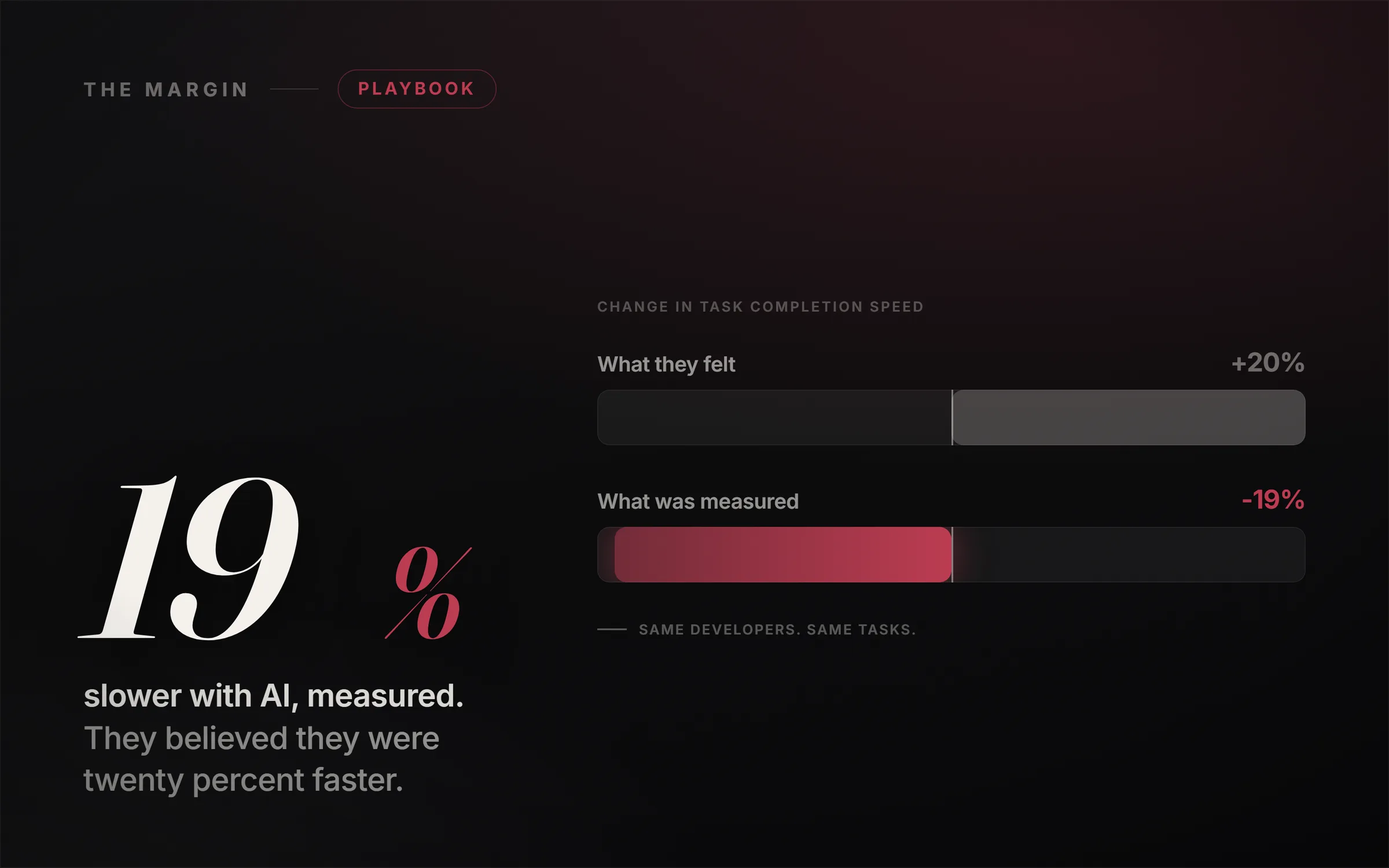
Most jobs are not like Go. There is no perfect scorer for a sales email or a medical judgement, so the clean before-and-after Go allows is rarely available. That makes it easy to assume AI is helping when it is not, the gap explored in why AI isn't saving you time and whether AI really makes coding faster.
The adversarial results add a second lesson. A system can be superhuman on average and still have failures a person can find and exploit. Using AI well includes knowing where it breaks.
The honest hard part
The hard part is that "better" in the PNAS study is defined by an AI. Human decisions improved by the measure of a superhuman program, which is a fair test of winning Go but says nothing about what players or audiences value in the game. Some professionals in the film say something was lost even as the scores rose.
The second hard part is that cheating became easier at the same time. With a superhuman program on any phone, a strong move is no longer proof of a strong player, and Go federations have had to deal with that.
The third is that Go is an unusually clean case. It has fixed rules, perfect information and an objective winner. Workplaces have none of those, so the Go result is a strong hint about what is possible, not a promise about what will happen in your job.