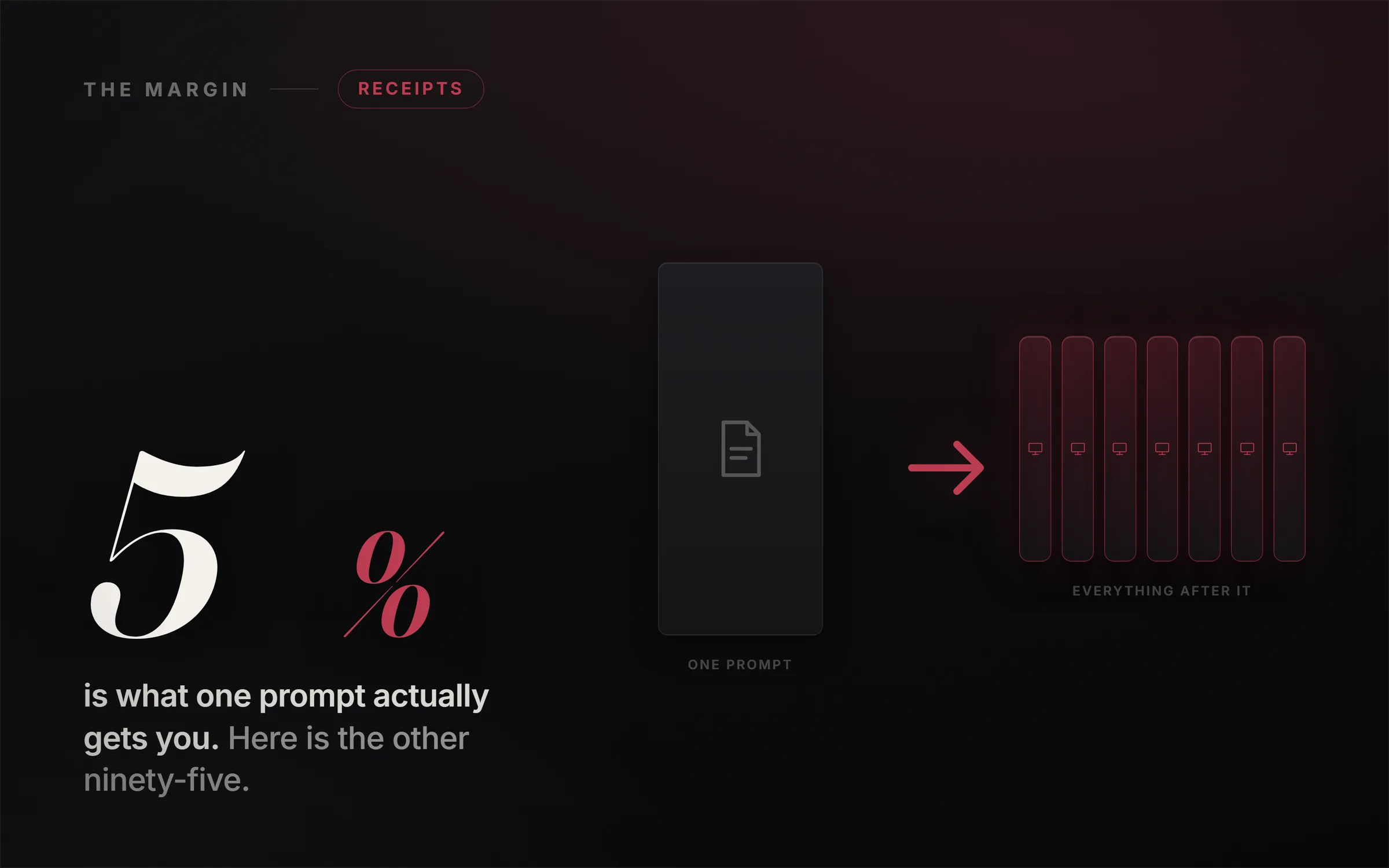
No, a single prompt does not make a finished longform video, and anyone who tells you it does is selling you the trailer and hiding the movie. A prompt can make a clip. A clip is not a video: a quality longform video takes 15 to 40 hours across five or six stages, and the prompt is maybe the first five percent.
We know because we just built a real one end to end, and the prompt was maybe the first five percent of the work. This post is the other ninety-five, with the real steps, the real time, and the real cost, so you can decide what you are actually signing up for before you believe the hype.
Here is the video where we say all of this out loud, with the actual receipts on screen.
So what can one prompt actually do?
It can hand you a few seconds of usable footage, and that is genuinely useful. Type a scene into a modern text-to-video model and you get a clip that would have cost real money and days of work three years ago. That part is not a lie, and we are not here to pretend the tools are bad. They are remarkable.
The sleight of hand is in the word "video." A clip is an ingredient. A finished longform video is a meal, plated, seasoned, and timed so a stranger sits through the whole thing. The industry consensus across the major tools is blunt about this: creators who ship good work treat AI output as raw footage and then do the human job of pacing, sound, story, and cut. The prompt did not remove that job. It moved to the front of it.
How is an AI video actually made? The real pipeline.
Here is the sequence we actually ran to build our last video. None of it is exotic. All of it is the part the "just a prompt" pitch quietly skips.
1. The idea and the angle
Before a single tool opens, someone decides what the video is for. What claim it makes, who it is aimed at, why anyone should care in the first three seconds. A model can brainstorm, but it cannot decide which of a hundred angles is the one worth your reputation. That call is the whole video in miniature, and it is yours to make. Get it wrong and every hour after it is wasted on a thing nobody wanted.
2. The script, written for the ear
This is where most AI video quietly falls apart, and it is invisible until you hear it. Writing for the ear is not writing for the page. We follow one hard rule that took real reps to learn: no two-to-four-word fragments. Short choppy lines look punchy in a doc and turn a synthetic voice into a robot, because the text-to-speech engine resets its cadence on every clipped fragment. So the lines flow at five words and up, written to be spoken, not read. A model will happily generate a script. It will not, on its own, know that the fragment "It's not enough" will wreck your voice track while "that is nowhere near enough on its own" will land clean. That is craft, and it is earned.
3. The voice, tuned not generated
You do not just pick a voice and press go. A raw AI voice track breathes wrong, pauses too long, and drags. We run the generated audio through real post-processing: trimming the dead silence between phrases so the read does not sag, then nudging the tempo up so it feels alive instead of sedated. The difference between "obviously a bot" and "a real presenter" is not the model you chose. It is the hour spent tuning the output after the model was done. The prompt gave us words. The tuning gave us a voice.
4. Real footage and design, never faked
Here is a line we will not cross: we do not zoom into a screenshot and call it footage. If we show a product, we capture it in real high definition, actually moving, actually being used. Blurry, upscaled, or zoomed-in stills read as cheap instantly, and the viewer feels it even if they cannot name it. This stage is real screen capture, real recording, and the design work that frames it: the on-screen text cards, the timing of each cut, the visual proof that matches what the voice is claiming. A prompt does not walk over to your product and film it well.
5. The build and the render
The pieces get assembled into an actual timed composition. We build in Remotion, which lets us program video as code so every cut, caption, and transition is precise and repeatable, then render it in the cloud so a two-minute piece does not melt a laptop for an hour. Alternatives here are the ordinary editors, Premiere Pro, DaVinci Resolve, CapCut, or Final Cut, if you would rather cut by hand than build in code. Either way, this is engineering and editing, not prompting. Nobody typed a sentence and received a rendered timeline.
6. QA, and the thumbnail nobody warns you about
Then you watch the whole thing, catch the audio glitch at 0:47, fix the caption that runs a frame too long, and render again. And then there is the thumbnail, which decides whether any of the previous work is ever seen. On our last video the thumbnail took five separate remakes before it earned the click. Five. For one image. That is not a rounding error on top of "just a prompt." That is a whole separate skill stacked on the end of an already long job.
A prompt is the spark. The video is the fire you still have to build, tend, and carry across the line by hand.
How long does an AI video really take, and what does it cost?
Longer and more than the pitch admits, in both. Professional editors put a polished video at roughly one to one and a half hours of editing per finished minute, and up to three or four for complex work, before you count scripting, recording, and the thumbnail. Add it up and a quality longform video lands somewhere between 15 and 40 hours of real human work. The prompt is free and instant. The other 39-and-change hours are the actual product.
The cost is not zero either. The tools carry subscriptions, the cloud renders cost pennies-to-dollars per video, and the largest line item by far is your time, which the "type one sentence" framing pretends does not exist. We are not saying this to discourage you. We are saying it because knowing the real number is the difference between a plan and a disappointment.
Are AI video generators actually good, and is AI video worth it?
The tools are good. The prompt-only strategy is a trap, and the platform has already started closing it. Two facts settle this.
First, the flood is real and it does not convert. On a fresh YouTube account, more than one in five of the first videos served were AI-generated "slop", according to a Kapwing study published in late 2025. When a thing is that common, it is worth nothing. Scarcity is where value lives, and prompt-only output is the opposite of scarce.
Second, the platform changed the rules. On July 15, 2025, YouTube updated its monetization policy to reclassify mass-produced and templated content as "inauthentic" and therefore ineligible for ad revenue. Read that carefully, because it matters: YouTube did not ban AI. AI-assisted work with genuine original value is fine and still gets paid. What got demonetized is exactly the "one prompt, mass-produce, upload a hundred" play. The platform now pays for the ninety-five percent, not the five.
So is it worth it? Yes, if you are willing to do the ninety-five. No, if you believed the sentence.
How many views does a carefully made AI video get?
Here is the receipt that earns us the right to say all of this. We do the full pipeline, and our videos still get modest views. Sometimes double digits. Sometimes a couple hundred. That is not a confession of failure, it is the normal starting reality that the highlight reels edit out. Accounts with a small audience average about 15.6 views per video, per Statista's read of a large 2024 dataset. And the bar to even earn ad revenue is 1,000 subscribers and 4,000 watch hours, which most channels grind at for many months or never reach.
We tell you our real, unglamorous numbers because a brand that shows its own eleven-view videos is a brand you can trust when it tells you a prompt is not a business. The people promising a finished video from a sentence rarely show you their analytics. We just did.
The bottom line
A prompt is a spark, not a fire. The tools are extraordinary at the five percent and completely silent for the other ninety-five, which is exactly where the video actually gets made: the angle worth making, the script written for the ear, the voice tuned by hand, the real footage, the built-and-rendered timeline, the QA, and the thumbnail that took five tries. That ratio is not a temporary gap the next model closes. It is the shape of the work. As we wrote in The Moat Moved, when a machine makes the easy part free, the hard part it cannot reach becomes the whole game, and the whole value.
Where the real depth lives
This post is the honest map. The actual click-by-click build, the exact script rules, the voice-tuning settings, the capture and render setup, the QA checklist, and the thumbnail moves, is what IdeasRepay is built on: real walkthroughs from people who did the thing and kept the receipts, not advice from people who prompted once and posted a thread. If you are done being sold the trailer and want the movie, start here.
The prompt was never the hard part. It was never even the point. The work is, and the work is what pays.