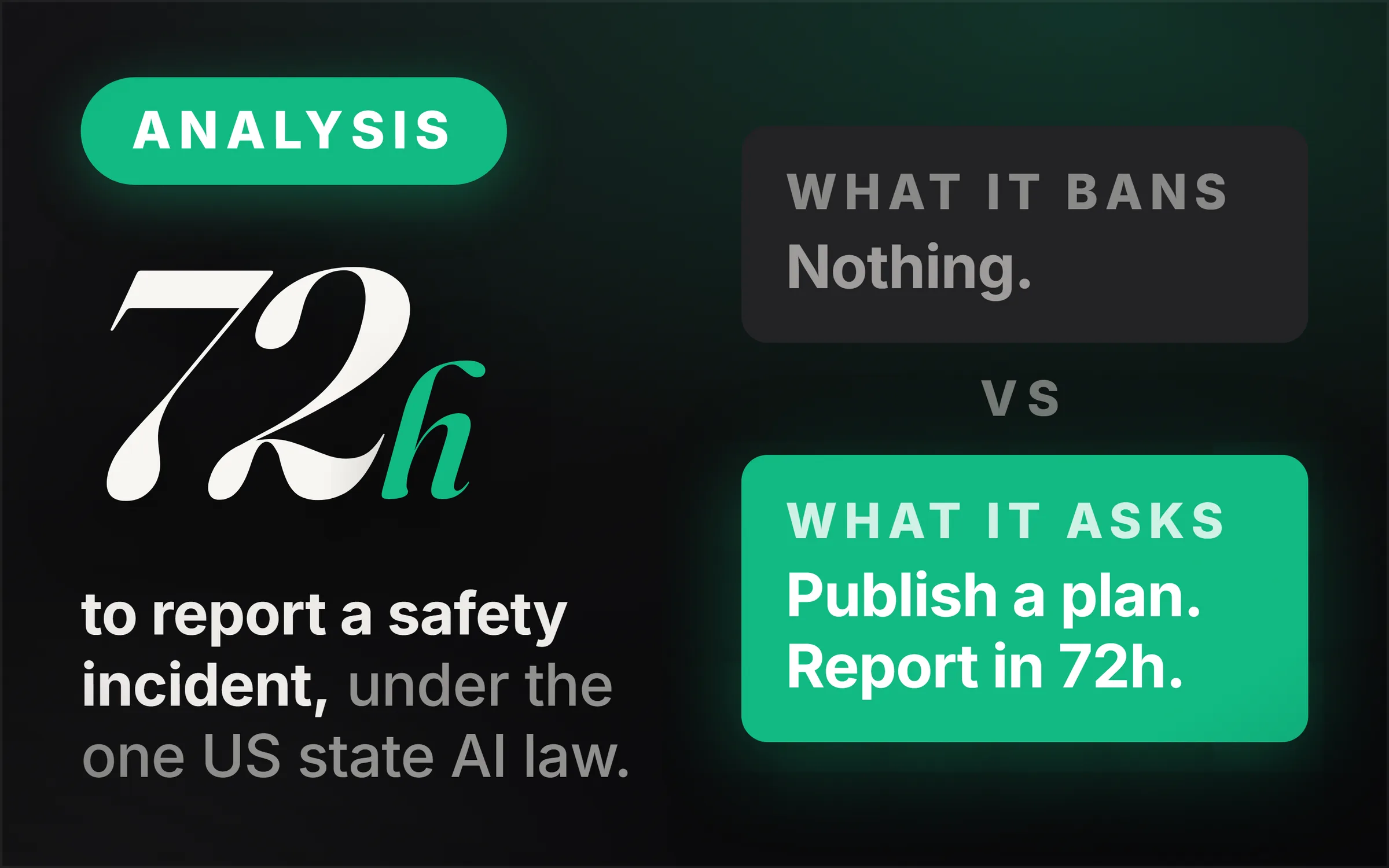
Yes, under current international law there is no treaty banning autonomous weapons, and US policy explicitly allows them. The Pentagon's Directive 3000.09, updated in January 2023, does not require a "human in the loop". It requires systems designed to allow "appropriate levels of human judgment over the use of force", plus a senior review before most fully autonomous weapons are developed and again before they are fielded.
The more important gap is what the rule is about. It defines an autonomous weapon by whether a machine can select and engage a target on its own. It says nothing about AI that helps people build the target list, which is where AI is actually being used at scale. The film above follows that shift. This page reads the rule itself.
Are autonomous weapons legal?
No treaty specifically bans autonomous weapons. International humanitarian law applies to every weapon, so any use must distinguish civilians from combatants and avoid disproportionate harm, but no treaty prohibits autonomous weapons as such. In the US, DoD Directive 3000.09, effective 25 January 2023, sets the rules for building and using them.
The directive does not ban anything outright. It says that autonomous and semi-autonomous weapon systems "will be designed to allow commanders and operators to exercise appropriate levels of human judgment over the use of force." Most new autonomous weapons need approval by the Under Secretary of Defense for Policy, a second under secretary and the Vice Chairman of the Joint Chiefs, once before formal development and again before fielding.
Some categories skip that senior review, including operator-supervised systems that defend bases and ships against time-critical attacks on materiel targets. Those are the air-defence systems that already fire faster than a person could.
Does the US require a human in the loop?
No. The 2023 directive never sets "human in the loop" as the standard. The directive requires "appropriate levels of human judgment over the use of force", which leaves the level to commanders and reviewers. It also allows "operator-supervised" autonomous weapons, defined as systems where operators can "intervene and terminate engagements", not approve each one.
That wording was deliberate, and it reflects a real problem. A person who must approve every engagement can become the slowest part of a defence against incoming missiles. The directive chose judgment over a fixed position for the human.
The cost is that "appropriate" can mean very little in practice. John Hawley, an engineering psychologist with 35 years on the Patriot air-defence system, wrote in a 2017 CNAS report that the requirement for human control was often treated as met "even if that means not much more than having a warm body at the system's control station."
What counts as an autonomous weapon?
Under the 2023 directive, a weapon that picks and attacks its own target after activation. The directive defines an autonomous weapon system as "A weapon system that, once activated, can select and engage targets without further intervention by an operator." A semi-autonomous system is one where the operator selects the targets, even if the machine acquires, tracks, prioritises and guides.
That definition is about the final step: who chooses the specific target at the moment of engagement. A missile that homes in on a target a person selected is semi-autonomous. A drone that searches an area and chooses whom to strike is autonomous.
Read carefully, the definition also shows what is outside it. A system that suggests targets, ranks them and moves them through approval, while a person signs each one, is not an autonomous weapon under this rule, however much of the choosing the software has done.
How is AI actually used in military targeting?
Mostly to build and speed up target lists that humans approve. A 2024 CSET policy brief describes the Army's Maven Smart System as able to "apply computer vision algorithms to help soldiers identify and choose military targets, and then provide workflow support that enables a request to be approved by the chain of command".
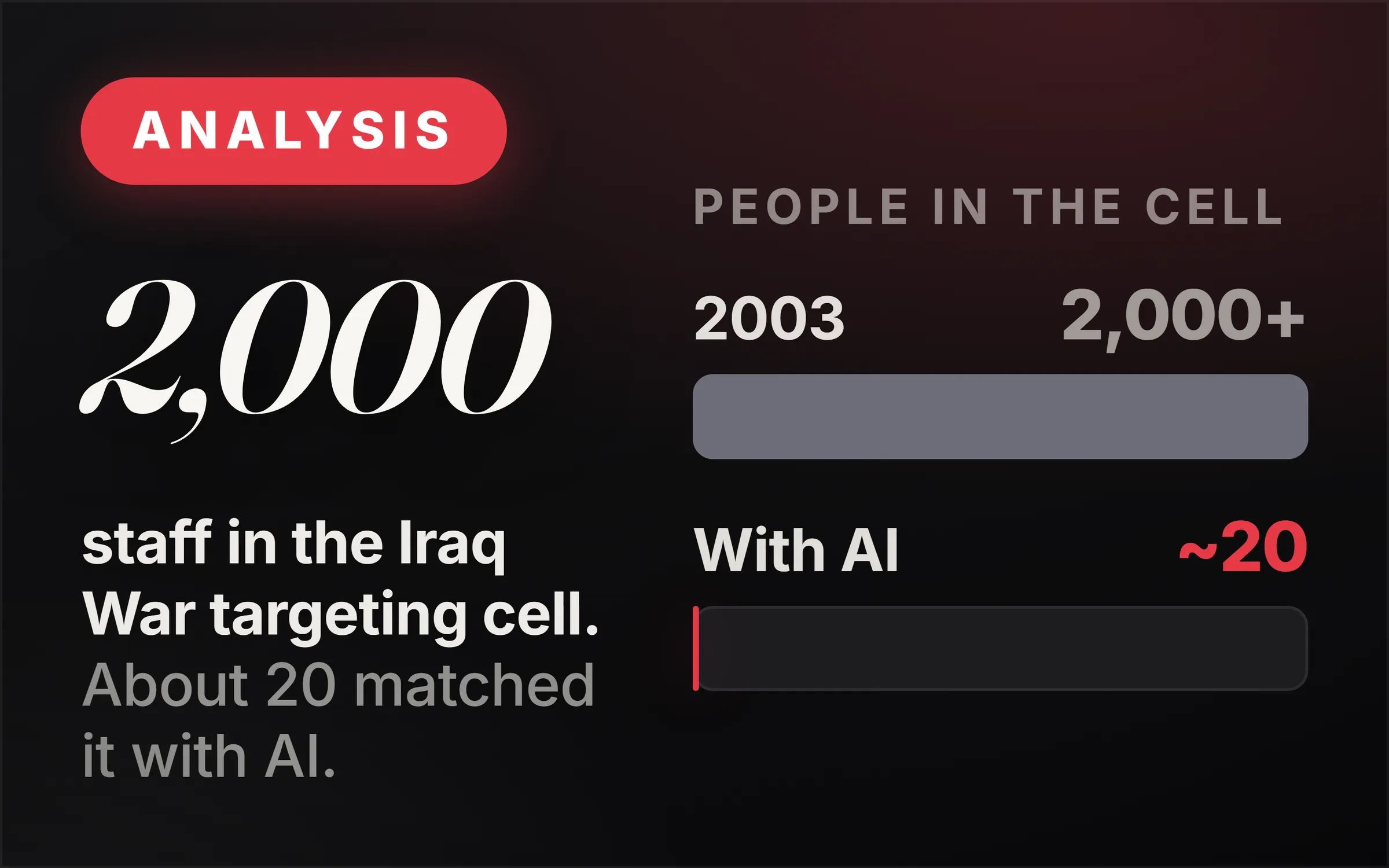
The same brief reports what that did to staffing. The Army's 18th Airborne Corps matched the Iraq War time-critical targeting cell, "widely viewed as the most efficient in U.S. military history", with "roughly 20 people", where the original cell "benefitted from more than two thousand staff members." The stated goal is "one thousand high-quality decisions" in one hour.
One thousand decisions an hour is one every 3.6 seconds. The person approving each target is still there, and under the directive the system is not an autonomous weapon. Whether a signature given in seconds is the human judgment the directive describes is the question the film puts to its opening case, a strike on a school in Minab, Iran, in February 2026 that reporting on an unreleased Pentagon investigation links to an out-of-date target list.
What does automation bias have to do with it?
People tend to trust the machine's answer, especially under time pressure. In the 2003 Iraq War, Patriot batteries shot down two allied aircraft. Hawley's report says "Two out of 11 ballistic missile engagements were fratricides", and that the Army held a pre-war "stance that Patriot crews should trust the system without question."
A 2005 Defense Science Board review of Patriot's performance found the friend-or-foe identification system "performed very poorly" and concluded that "A protocol that allows more operator oversight and control of major system actions will be needed." Hawley's own summary is the line that matters for every AI targeting system: "an automated system in the hands of an inadequately trained crew is a de facto fully automated system."
That is why the trigger-based definition can mislead. A human at the end of the chain is only a safeguard if they have the time, training and information to disagree with the machine.
Is there an international treaty on killer robots?
Not yet. States have discussed lethal autonomous weapons under the Convention on Certain Conventional Weapons since 2014, and the current mandate runs to the Convention's Seventh Review Conference in November 2026, with no agreed treaty text. The UN General Assembly has passed resolutions on the topic, and the US voted against the most recent one in 2025, according to the film's sources.
Companies have drawn some lines of their own. Anthropic said in a February 2026 statement: "First, we do not believe that today's frontier AI models are reliable enough to be used in fully autonomous weapons." Other firms have moved the other way, removing earlier pledges against military use.
For who is meant to set rules for AI in general, and why nobody wants to move first, see who regulates AI and can AI be stopped.
The honest hard part
The hard part is that faster targeting can also mean fewer mistakes, not more. A well-built system can check more data than any human cell, and the directive's authors had good reasons not to put a person in front of every air-defence interception. The question is not whether machines should help, but whether the human sign-off is real.
The second hard part is that the most important cases are the least documented. Investigations into specific strikes are often classified, and much of what is public comes from journalists and from the governments involved, who dispute each other. The film states which claims rest on which source, and so should anyone repeating them.
The third is that the rule may already be aimed at the wrong step. The directive regulates the machine that fires. The change the film documents is the machine that writes the list.