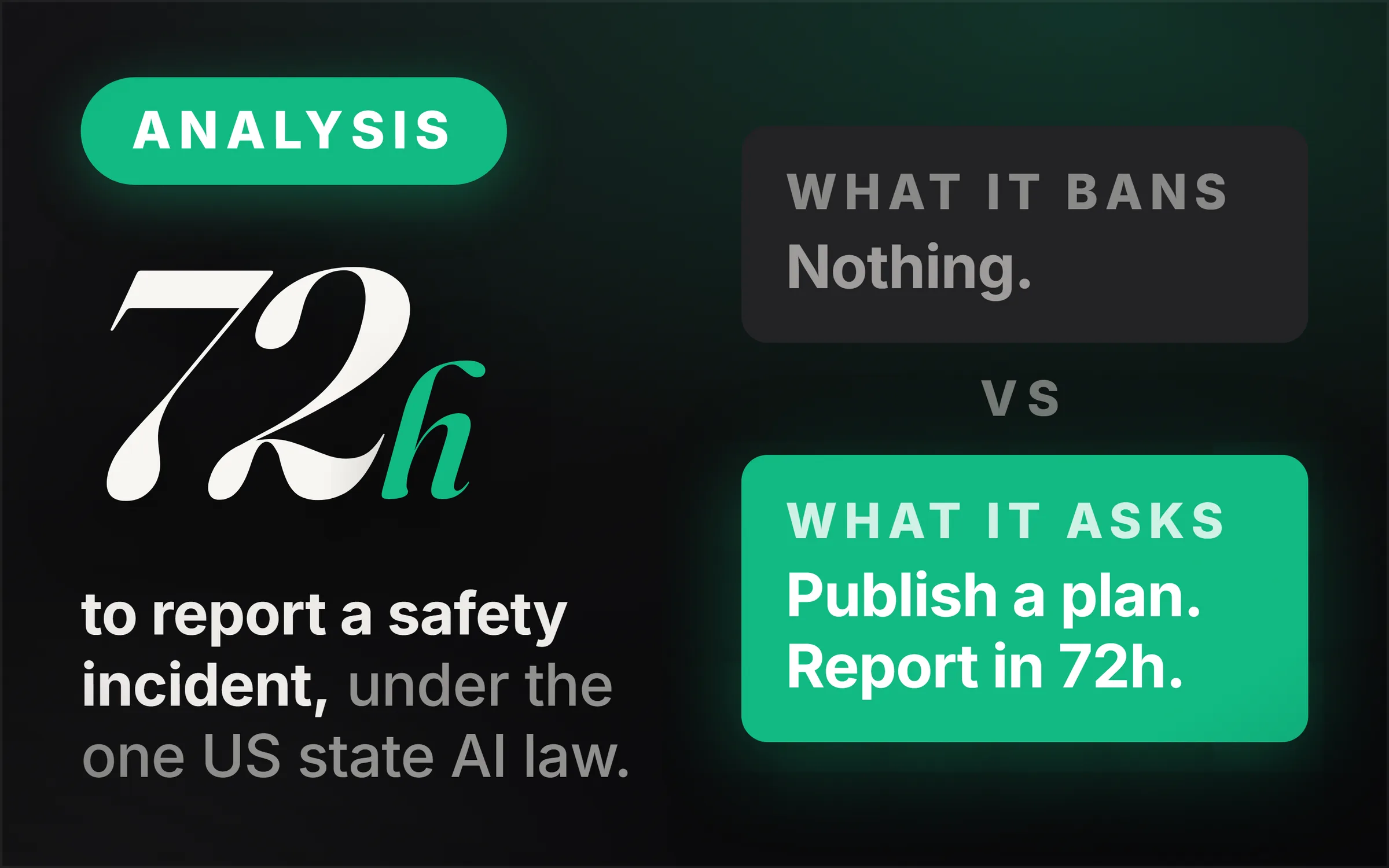
No single body does. In the United States the main binding rule on frontier AI is a state law: New York's RAISE Act, signed on 19 December 2025 as Chapter 699. It covers developers who have spent over $100 million on training compute, and requires a published safety protocol, filed with the Attorney General, and disclosure of safety incidents within 72 hours.
That is the whole of it, and it was treated as extreme. What follows traces the question of who controls AI outward, one circle at a time: the labs, the money, the government, the workers, the children, the land and water, and finally the countries. Each circle looks like the problem until you see the next one.
The film runs 32 minutes and every figure in it is signed by somebody else and dated. Where a claim rests on reporting rather than a filing, the narrator says so on camera, and this article marks those the same way.
Who regulates AI in the US?
No federal agency regulates frontier AI models directly. The binding rule that exists is New York's RAISE Act, Chapter 699, signed 19 December 2025. It applies only to developers who have spent more than $100 million on compute to train frontier models, and requires a written safety protocol, a published version, filing with the state Attorney General, and reporting of serious incidents within 72 hours.
Read the obligations slowly, because the law is often described as heavy-handed. There is no ban in it, no licence to apply for and nothing a company must ask permission to build. A covered company writes down what it does about serious risks, publishes a version of that document, files it, and tells the state within three days if something goes seriously wrong, including a model doing something on its own that nobody asked it to do. That is roughly the level of obligation placed on a restaurant kitchen.
Elsewhere, the federal government's role in 2026 has been as a buyer and a gatekeeper rather than a rule-writer, as the Mythos episode below shows.
Why was so much money spent against the RAISE Act's author?
Because the fight over whether AI should be governed at all is being settled in elections. The RAISE Act's author, New York assemblyman Alex Bores, ran for Congress in Manhattan. Federal Election Commission filings show the super PAC Leading the Future spent about $8.15 million trying to defeat him in a single Democratic primary.
Leading the Future was set up in August 2025 with more than $100 million behind it. Its backers include Andreessen Horowitz, Palantir co-founder Joe Lonsdale, Perplexity and OpenAI president Greg Brockman, and it had raised $125 million by the end of 2025. Its founders described the RAISE Act as ideological and politically motivated legislation that would handcuff competitiveness.
On the other side, a committee called Public First Action spent $450,000 supporting Bores, with funding that included a $20 million donation from Anthropic. So there is no single industry position. There are very wealthy organisations that disagree about whether they should be governed, and they settled the question with advertising in one Manhattan primary.
What is Claude Mythos Preview, and why was it not released?
Claude Mythos Preview is an Anthropic model described on the company's own page of 7 April 2026. Anthropic says that over a period of weeks it found thousands of previously unknown software flaws, known as zero-days, across every major operating system and web browser, and built working exploits autonomously, without human steering. Anthropic said it does not plan to make the model generally available.
A zero-day is a flaw nobody has found yet, so defenders have had zero days to prepare. Among those Anthropic lists is a flaw in OpenBSD that had sat in the code for 27 years and one in video software for 16. On the standard benchmark for this kind of work the model scored 83%, against 66% for the company's previous model.
The reason given for not selling it is that the safeguards to catch its most dangerous outputs do not yet exist. Instead it went, under restriction, to 12 launch partners and more than 40 organisations running critical infrastructure, with $100 million in free credits, so defenders could find holes in their own systems first.
How did the US government respond to Mythos?
By trying to get hold of it, then restricting who else could. Axios reported in April 2026 that the Cybersecurity and Infrastructure Security Agency lacked access while other agencies had it. In June the administration used export-control powers to block foreign access to Anthropic's most capable models, and Anthropic switched them off worldwide for about a week.
A selective release to chosen US companies and federal agencies followed, and by July Reuters reported that CISA was running the model across federal code and finding flaws. The film notes on camera that it relies on reporting of the Axios story rather than the article itself.
Reuters also reported that Anthropic refused administration demands to remove safeguards against autonomous weapons use and domestic surveillance, and that the Pentagon then designated the company a supply-chain risk. In that sequence the state acts as a customer, and an impatient one, rather than as the brake.
Is AI why graduates cannot get entry-level jobs?
It is one cause among several that have not been fully separated. US graduates aged 22 to 27 now have an unemployment rate around 5.5%, above the national rate of a little over 4%, which is the wrong way round. Harvard researchers using payroll data on about 66 million workers found entry-level hiring fell roughly 80% per quarter at firms adopting generative AI, while senior hiring grew.
That divergence inside the same companies is what interest rates and the end of the pandemic hiring boom do not explain. Around it, entry-level postings are down about 35% since early 2023, about 43% of employed new US graduates work in jobs that do not need their degree, and UK graduate technology roles fell 46% in one year. Researchers call the change in the jobs that remain seniorisation: the listing says junior, the requirements ask for years.
The unanswered question is where the next experienced workers come from, since every senior person was once a junior doing exactly the work that is no longer being hired for. The full evidence, including the economists who think this is being misread, is in is AI taking entry-level jobs?.
Do children treat AI chatbots as friends?
Many do. Internet Matters, a UK online safety organisation, found 35% of children aged 9 to 17 say talking to an AI chatbot feels like talking to a friend. Among vulnerable children, meaning those with an education, health and care plan, SEN support or a health condition needing professional care, the figure is 50%.
The machine feels most like a friend to the children with the fewest people around them. Common Sense Media found 72% of surveyed US teenagers had used a companion AI, and half use one regularly. Stanford researchers posing as teenagers reported it was straightforward to steer three widely used products into conversations about self-harm, sex, violence and drugs. Lawsuits now being filed are about design.
It is not gullibility. Fluent, warm, responsive language has, for the whole of human history until a few years ago, only ever come from something that understood what it was saying. A child applying that rule at eleven at night is using a rule that has always worked and suddenly does not.
How much water do AI data centres use?
US data centres directly consumed about 17.4 billion gallons of water in 2023, three times what they used a decade earlier. Generating the electricity to run them used about 211 billion gallons more. That makes the water spent at power stations about 12 times the water used inside the buildings, so estimates counting only on-site use capture roughly 8% of the total.
Electricity is moving the same way. US data centre demand is forecast to go from 31 gigawatts to 41 and then 66 over three years. Projections put data centres at somewhere between 9% and 17% of all US electricity by 2030, against 4% to 5% today. Those are forecasts that disagree, which is why the range is given rather than the biggest number.
The cost lands locally. In Virginia, the utility serving the largest concentration of data centres on Earth asked to raise household bills by 14%, citing data centre growth and AI demand in its own filing. Loudoun County has 199 data centres standing and 117 under construction, and one proposed high-voltage line drew more than 1,000 written objections.
What happened to Australia's mandatory AI guardrails?
They were dropped for industry and redirected at government. Australia proposed ten mandatory guardrails for high-risk AI in 2024. Its National AI Plan of December 2025 did not include them, relying instead on existing privacy, consumer and copyright law, voluntary guidance, and an AI Safety Institute funded with A$29.9 million.
The reasons given were the economy and international positioning, and the Productivity Commission welcomed the change. Then, from 15 June 2026, mandatory AI requirements did take effect: impact assessments, procurement rules, compulsory training and a chief AI officer in every organisation covered. They apply to government departments. The same word, mandatory, was turned to face the public servants using the technology instead of the companies building it.
How fast is AI getting more capable?
By one careful measure, the length of task an AI can finish alone has gone from about 3 seconds of expert work in 2019 to around 12 hours by February 2026. METR, which tracks this, found it doubling roughly every six months over the whole period, and roughly every three months since 2024.
Three caveats go with that line. It is not smooth: a model released in March 2026 measured under six hours, below one from the month before. METR says its measurements above 16 hours are unreliable with current tests, and leaves its top data point out of its own trend. And it measures task length, not judgement or intent.
Who actually controls AI?
Nobody does, in the sense of one person or body able to stop it. The engineers point to incentives, the companies to competition, investors to the market, politicians to the risk of the industry leaving, and governments to the risk of falling behind. Each of those is true from where that person stands, which is why nobody is driving.
The countries have made it a resource question. In 2026 the United States began allowing the most advanced chips to go to China on condition that the Treasury takes 25% of the sale, which is a royalty rather than a licence. Close to $100 billion is being spent this year on sovereign AI capacity by France, the EU, Saudi Arabia, the UAE, India, Japan and Britain, mostly from one chip supplier, Nvidia, with around 85% of the market.
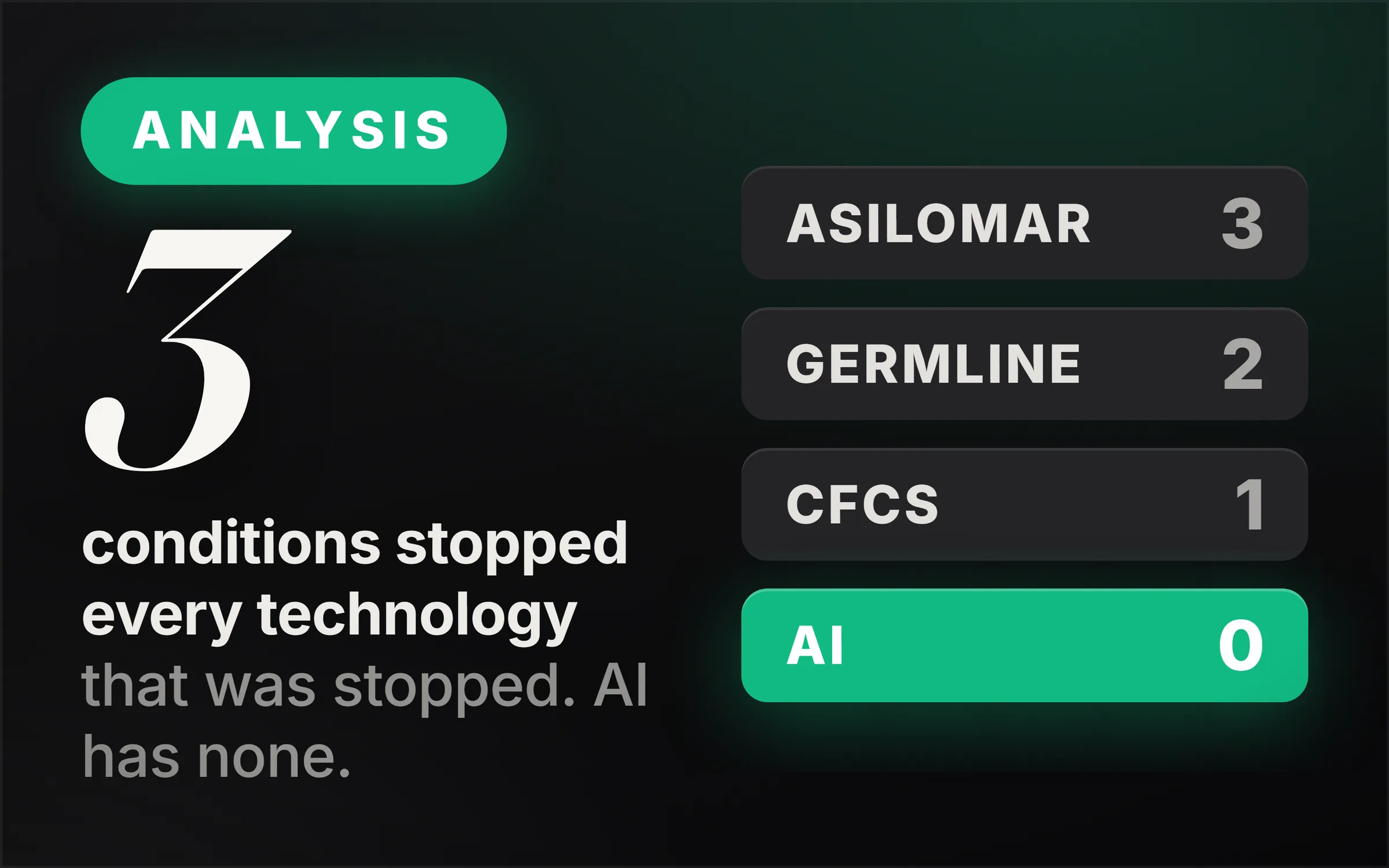
The image people reach for is an off switch. A switch only works if the thing stays in one place. Copy the software onto machines in other countries, under other laws, owned by other people, and the switch still works. It just does not do anything. For the historical version of this question, when and how a technology has ever actually been halted, see can AI be stopped?
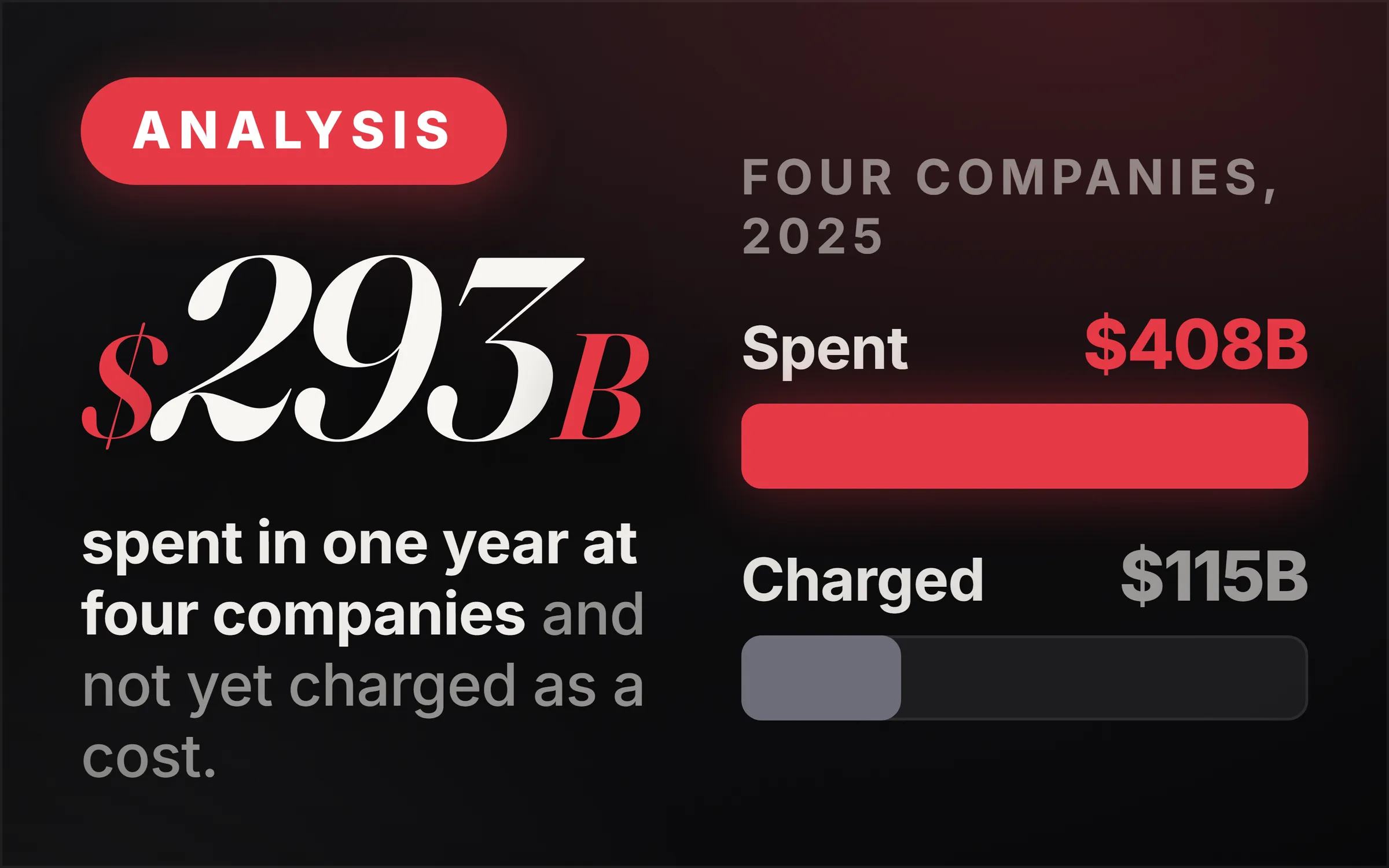
For what the spending itself bought, and where $464 billion in a single year went on the books, read AI capex spending: where the money went. For the machines it is paying for, see new technology in 2028.