In most of the United States, no. Police can search license plate reader data without a warrant, because no court has yet held that plate photos taken in public are a Fourth Amendment search. The closest test so far, a January 2026 federal ruling on Norfolk, Virginia's 176 Flock cameras, found no violation: "at least in Norfolk, Virginia, the answer is: not today."
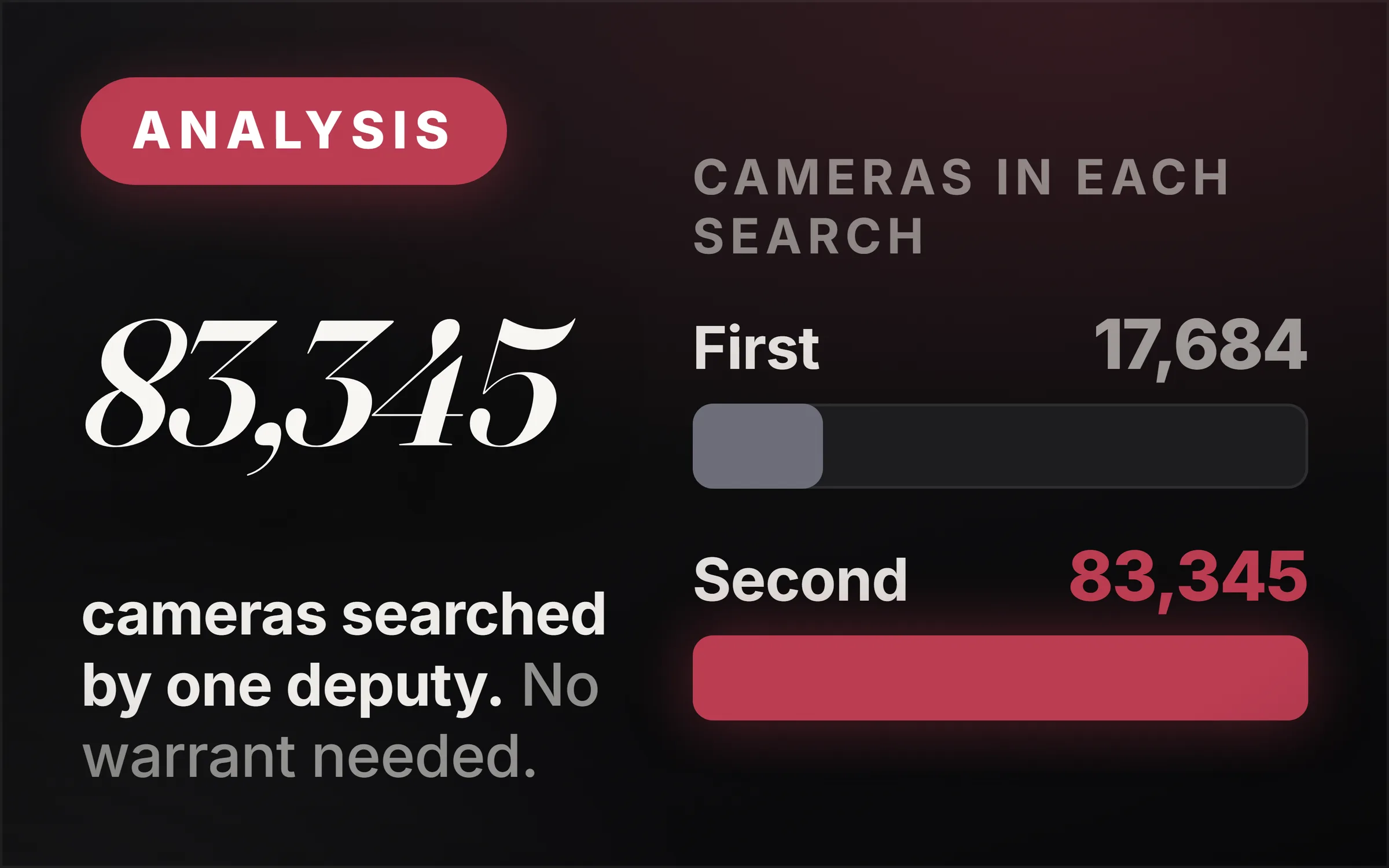
That is why a single deputy in Texas could search 83,345 cameras across the country for one woman in May 2025 without asking a judge. The film above follows how these networks were built and who searches them. This page answers the legal question directly, and sets out the rules that do apply instead.
Do police need a warrant for license plate readers?
Generally, no. In the US, police search license plate reader databases under department policy and state law, not with a warrant. Courts have treated a photo of a plate on a public road as information exposed to the public. In January 2026 Judge Mark Davis declined to hold Norfolk's 176-camera Flock network unconstitutional.
His ruling, reported by WHRO, turned on density. According to the film's reading of the case, the photos were too far apart, often forty or fifty minutes and several miles, to rebuild a whole day of someone's movements. The judge also left the door open: the question was whether the network had crossed the line, and "at least in Norfolk, Virginia, the answer is: not today."
The plaintiffs, Lee Schmidt and Crystal Arrington, plan to appeal. Until an appeals court says otherwise, the default rule stands.
What does the Carpenter case say about tracking?
Carpenter requires a warrant for historical phone location records, not plate photos. In Carpenter v. United States (2018), Chief Justice Roberts wrote that tracking a phone's location "achieves near perfect surveillance, as if it had attached an ankle monitor to the phone's user." The Court held that "the Government must generally obtain a warrant supported by probable cause before acquiring such records."
The argument against plate readers borrows that logic. A dense enough camera network could rebuild where a car goes all day, every day, which starts to look like the phone records the Court protected. The Norfolk ruling says a 176-camera network is not there yet. It does not say a denser one never could be.
So the honest answer is that the law is unsettled at the edges and settled in the middle: occasional photos of a plate are fair game, and a complete record of someone's movements may not be.
How many cameras can one search reach?
Tens of thousands, across state lines. In May 2025 a deputy in Johnson County, Texas, searched for a woman with the stated reason "had an abortion, search for female". The EFF reports the first search covered 1,295 networks and 17,684 cameras, and a second covered 6,809 networks including 83,345 cameras.
The reach comes from data sharing. A department that buys plate readers can share its network with others, and a search can then run across every shared network at once, including in states with very different laws about the reason for the search.
The overall scale is large. Senator Josh Hawley, speaking to Fox News in August 2026, said Flock boasts "more than 120,000 cameras across 49 states and more than 20 billion vehicle scans every month."
What rules limit license plate reader searches?
Mostly vendor settings, department policies and a patchwork of state laws. Flock announced on 13 August 2026 that it was moving its recommended default to a 7-day retention, that it would "require case codes for all law enforcement searches by the end of the year", and that "Abuse of Flock technology, at any level, is unacceptable."
Two details in the same post matter. Existing customers keep their current retention periods, and agencies can bypass the case-code requirement in emergencies. The company also says "an alert is a lead, not a conclusion, which should be confirmed by an officer", which is a policy, not a law.
State law is where binding limits exist. Illinois, for example, bars sharing plate reader data for immigration enforcement, and its Secretary of State acted in August 2025 after finding federal border access to the state's data, according to the film's sources. Outside those statutes, the rules are whatever the buyer and the vendor set.
What happens when a plate reader gets it wrong?
Police can stop the wrong person, and in a 2019 federal test of 189 face recognition algorithms, error rates varied widely. The film documents stops caused by misread plates, including a California city where an internal review found most of more than a thousand alerts were misreads. Flock disputes how those figures are characterised and says its reading accuracy is high in good conditions, and that city's police say no wrongful stops resulted.
The same pattern runs through facial recognition, the other half of the film. A 2019 NIST study of 189 algorithms found error rates varied widely by algorithm and by the race and sex of the person pictured, which is why Detroit's police settled to a rule that a face match alone is not grounds for arrest.
The practical safeguard in both cases is the one Flock itself states: treat the machine's answer as a lead and confirm it before acting. Whether that happens depends on the officer, because the law rarely requires it.
The honest hard part
The hard part is that these cameras do solve crimes, and the companies selling them can point to real cases. The film reports Flock's own figures and also CBS News's finding that the company describes those numbers as directional estimates, not audited totals. Both the benefit and the risk are real, and neither is precisely measured.
The second hard part is that the legal answer may change suddenly. One appeals ruling that a dense network amounts to Carpenter-style tracking would change the warrant question for every department using these systems. Until then, protection depends on settings and policies that can be changed without a vote.
The third is that most people will never know whether their car was searched. The searches are logged, but the logs are usually only visible through a public records request. For a wider look at documented cases where the suspicious version of a technology story turned out to be true, see AI conspiracies that turned out to be true, and for who is supposed to be setting these rules, who regulates AI.