The Fourth Turning theory, from Neil Howe and William Strauss's 1997 book, says American history runs in cycles of about 80 years, each with four seasons: a High, an Awakening, an Unravelling and a Crisis. It predicted a crisis starting in the mid-2000s, and the Great Recession began in December 2007. It also fails some obvious tests, including the First World War.
Both of those are true, and the useful thing is to hold them together. The dates are softer than the book admits, and it still named the decade of a crash eleven years early. Below is the pattern, the test, the four generational archetypes with the birth years the theory sets, and the mechanism that makes the cycle recur, which turns out not to be the crisis at all.
The 13-minute film uses only public-domain archival, dated on screen, and where the theory does not fit it says so on camera rather than around it. It is a test of the theory, not a sales pitch for it.
What is the Fourth Turning theory?
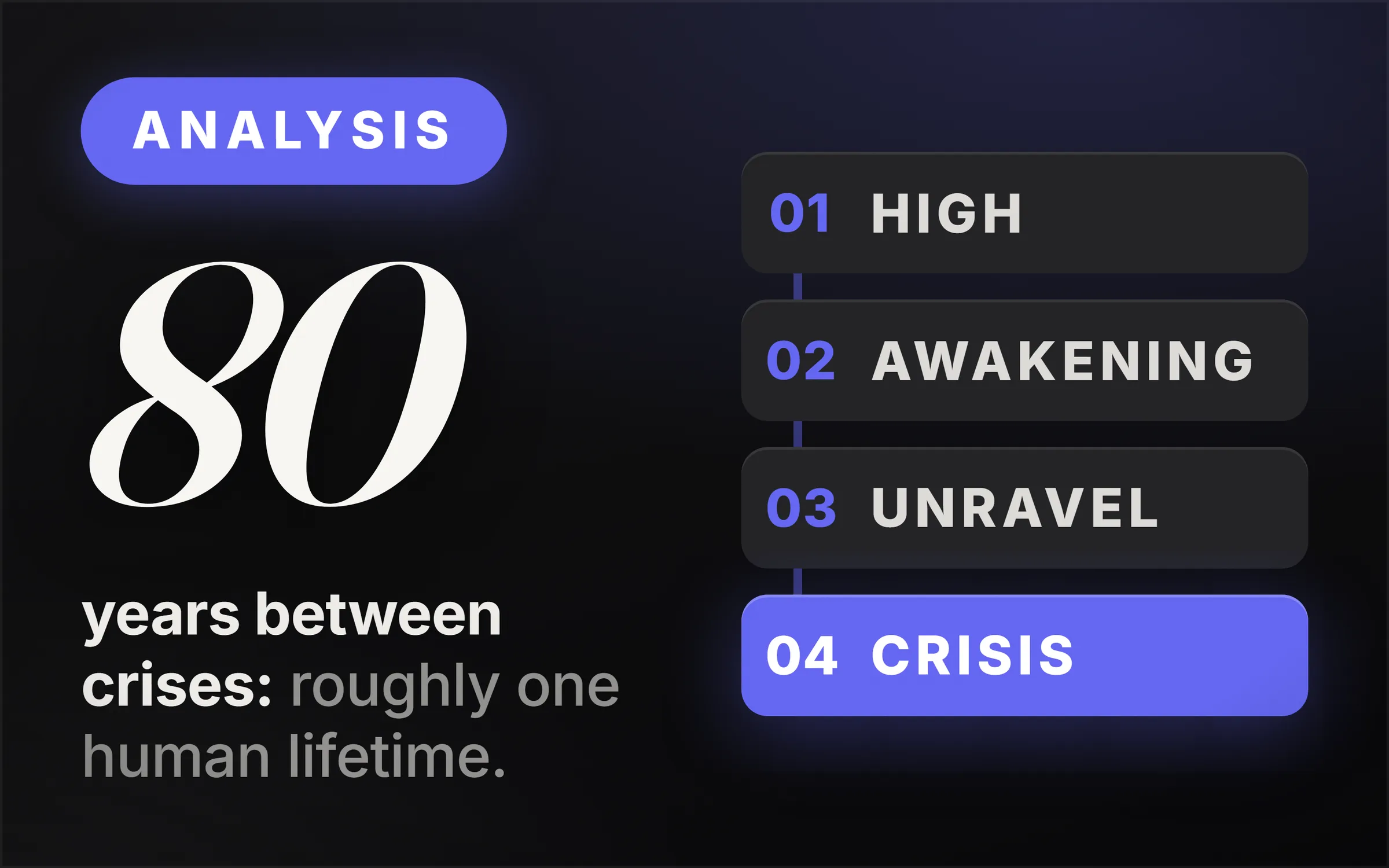
It is Neil Howe and William Strauss's claim, set out in "The Fourth Turning" (1997), that American history moves in cycles of roughly 80 years, each made of four turnings of about 20 years: a High, an Awakening, an Unravelling and a Crisis. The Crisis, the fourth turning, is when the old order is torn down and replaced.
Eighty years was not picked because it sounded right. It is roughly the length of a human life, and that is the whole mechanism. The intervals the authors pointed to: the Revolution settled in 1783, the Civil War ended in 1865, 82 years later, and the Second World War ended in 1945, 80 years after that.
The theory says each generation is shaped by the season it grows up in, then runs the country the way its childhood taught it, which makes the season for the next set of children. Four generations take about 80 years to pass.
What are the four turnings?
The High, the Awakening, the Unravelling and the Crisis, always in that order. In the current cycle the theory places the High from 1946, the Awakening from November 1963, the Unravelling through the 1980s to 2000s, and the Crisis from around 2008. Earlier cycles show the same four seasons eighty years apart.
The High begins when the last crisis ends. Everything is rebuilt at once and the country agrees on more than it has in a lifetime: in 1946, factories that made bombers start making washing machines. Eighty years earlier, the Civil War ends and railways cross the country. Eighty before that, a new nation writes a constitution. It ends when children who grew up safe inside it ask what it cost.
The Awakening in this cycle begins on 22 November 1963, then civil rights, Vietnam and the counterculture. The country is still rich and stable; people stop believing the story it tells about itself. It does not break the system. It asks questions the system cannot answer.
The Unravelling is when people stop believing institutions can be repaired, not that they are failing but that they are the problem. Trust drains out of government, the press, the police and the banks while the lights stay on.
The Crisis is something that cannot be argued with: 1775, a war that makes a country; 1861, one that nearly unmakes it; 1941, one that remakes the world. It is the most violent stretch of each cycle. The Civil War killed about 600,000 people out of 31 million, one American in fifty.
Did the Fourth Turning predict 2008?
It named the decade. The book, published in 1997, said the next crisis would begin around the middle of the 2000s and run into the early 2030s. The National Bureau of Economic Research dates the start of the Great Recession to December 2007, eleven years after publication.
William Strauss died in December 2007, the same month economists later settled on as the recession's start. He spent thirty years telling people what was coming and did not see a day of it. Howe and Strauss put the start of the current crisis at around 2008, which, if the cycle holds, puts us somewhere in the middle of one now.
Is the Fourth Turning theory accurate?
Only loosely. It named the decade of the 2008 crash eleven years early, but the First World War, then the largest war ever fought, falls in what the model calls a quiet season. The civil rights movement falls in the good years, intervals range from 80 to 90 years, and the boundaries shift depending on who draws them.
The deepest objection is the hardest to answer. If every event can be sorted into one of four seasons after it has happened, the pattern is not being found; it is being applied. Both things are true at once: the dates are softer than the book admits, and it still called the decade from eleven years out.
So the better question is not whether it predicts, but why anything in it recurs. That has a real answer.
Why would history repeat every 80 years?
Because people are largely formed by 20, and the theory's cycle is four generations of that. Children raised in a safe, rich High grow up looking for meaning. Those raised in an Awakening come out practical and unsentimental. Those raised in an Unravelling want to build something that works. Those raised in a crisis come out careful and attentive.
Each generation then runs the country the way its childhood taught it, which creates the weather for the next children. On that reading a crisis is not an accident that happens to a generation. It is the job that generation was built for, by a childhood it did not choose, forty years before anyone asked it to do anything.
Which generational archetype am I?
The theory sets the bands by birth year. Born 1943 to 1960, you are a Prophet. Born 1961 to 1981, a Nomad. Born 1982 to 2005, a Hero. Born 2006 or later, an Artist. In the previous cycle the Heroes were born 1901 to 1924 and the Artists, the Silent Generation, 1925 to 1942.
Prophet, born in a High: grows up wanting more than safety and by midlife has a vision of how everything ought to be, often right about the problem and dangerous about the solution. The theory's harder message for Prophets is that the vision is theirs and the building is not.
Nomad, born in an Awakening: raised in the chaos, unimpressed by everyone, and good at executing other people's visions. The theory points to Washington, Grant and Eisenhower, each born in an Awakening and each the general who became president after the war.
Hero, born in an Unravelling: told the country is failing, and adults when the crisis arrives, so they are the ones sent. Last cycle that was the generation that grew up in the Depression and went ashore in Normandy. The theory does not say this band does well. It says this band gets spent, and those who come through build what comes next.
Artist, born during the crisis: too young to be sent, old enough to remember, spending their lives making sense of something they could not affect. The theory credits the Silent Generation with the century's best songwriters and most careful lawyers.
What actually repeats in the Fourth Turning?
Forgetting. Eighty years is how long it takes for everyone who remembers the last crisis to die. The people who live through a crisis build protections so it cannot happen again; their children inherit the protections without the memory; their grandchildren take them apart as obstacles; and the fourth generation walks into something nobody alive has seen.
Every one of those generations believes it stands outside the pattern, and that belief is the pattern. Strauss, born in 1947, was a Prophet by his own table: the archetype that imagines the new order and hands it to someone younger to build. He was inside the pattern while he wrote it down.
That is why the dangerous part is not the crisis but the stretch just before it, when institutions still work, money still moves and there is nobody left in the room who remembers the last time. You cannot pick your role, and you cannot sit your turn out. What you can choose is whether you notice which season you are standing in. For a hard-number version of what changed in the American economy over the same decades, see the fading American dream.