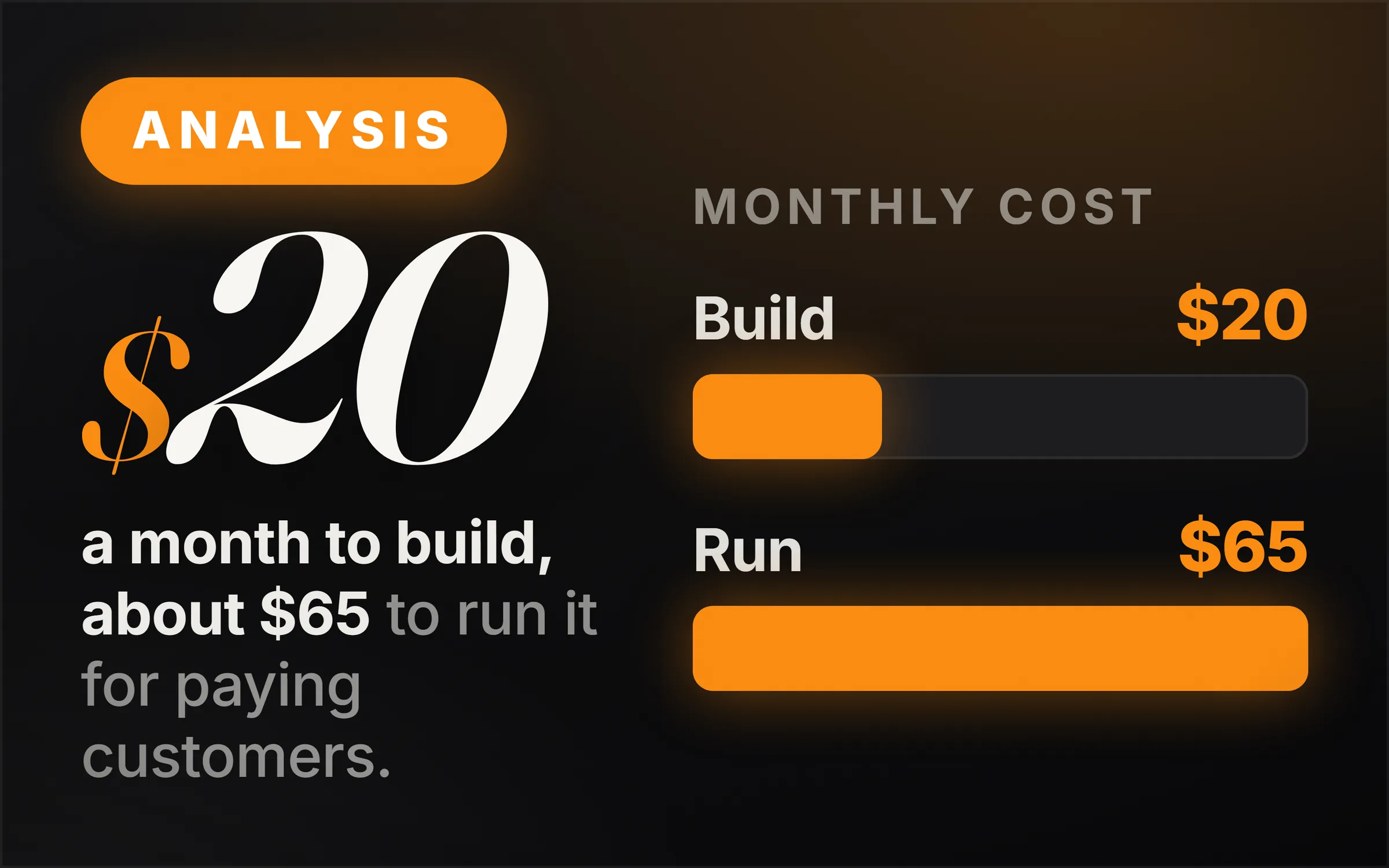
Building a small SaaS product with AI costs $0 to $20 a month while you build it, and about $40 to $65 a month once it has paying customers. The build costs one AI coding subscription: Claude Pro is $20 a month and includes Claude Code, and Cursor's individual plan is $20 a month. Running it for paying customers adds paid hosting, because Vercel's free Hobby plan is for non-commercial use only.
Then there is a fee on every sale. Paddle, which handles the payment and the sales tax for you, charges 5% plus 50 cents per transaction. On a $20 monthly subscription, that is $1.50 of every payment.
How much does it cost to build a SaaS with AI?
While you build it, $0 to $20 a month. The only paid tool you need is an AI coding subscription: Claude Pro is $20 a month ($17 a month billed yearly) and includes Claude Code, and Cursor's individual plan is $20 a month. Hosting and the database have free plans for a project that is not yet selling.
| What | Tool | Published price | Note |
|---|---|---|---|
| AI that writes the code | Claude Pro (includes Claude Code) | $20 a month, or $17 a month billed yearly | Max plans from $100 a month for heavier use |
| AI that writes the code | Cursor, Individual | $20 a month | Free Hobby plan to try it |
| Hosting while building | Vercel Hobby | $0 | Personal, non-commercial use only |
| Hosting once you charge | Vercel Pro | $20 a month | A free first-year domain on paid Pro |
| Database and logins | Supabase Free | $0 | 500 MB database, 50,000 monthly active users; pauses after 1 week inactive |
| Database for a live product | Supabase Pro | From $25 a month | No pausing |
| Taking payments | Paddle | 5% + 50¢ per transaction | No monthly fee; handles sales tax |
Prices from each company's own pricing page or documentation, 11 October 2026. US dollars, before tax.
You do not need both AI tools. Pick one. The heavier plans, such as Claude's Max from $100 a month, are for people building all day, every day, and are not a starting cost.
Want the whole build, step by step? The Vibe-Coded Micro-SaaS walkthrough lays it out click by click.
How much does it cost to run a SaaS with paying customers?
About $40 to $65 a month: $20 for the AI tool you keep using, $20 for Vercel Pro hosting, and $0 to $25 for the database. The jump from the build phase is mostly hosting, because Vercel's documentation says the Hobby plan "restricts users to non-commercial, personal use only."
That one sentence is the cost most build-in-a-weekend guides leave out. A product that charges customers is commercial use, so the free hosting plan is for building and testing, not for selling. The fix is $20 a month, and paid Pro comes with a free first-year domain.
The database is the other choice. Supabase's free plan pauses a project after a week with no activity and allows two active projects. That is fine for a product people use every day, and a risk for one they open once a month. Supabase Pro, from $25 a month, removes the pause.
How much does it cost to take payments for a SaaS?
On Paddle, 5% plus 50 cents per transaction, with no monthly fee. On a $20 monthly subscription that is $1.50, so you keep $18.50. Paddle is a merchant of record: it sells to the customer on your behalf and handles sales tax and VAT, which is why its fee is higher than a plain card processor's.
The alternative is a card processor such as Stripe, where you handle tax yourself. We could not read Stripe's US price list on the day we checked, because its pricing page redirected us to another country's version, so it is not in the table.
The fee matters most at low prices. The 50-cent part is 2.5% of a $20 payment and 10% of a $5 one, which is one more reason the walkthrough argues against pricing a product at $5.
How many customers does it take to break even?
Three to four customers at $20 a month. At $18.50 kept per customer after Paddle's fee, $40 of monthly costs needs 3 customers ($55.50) and $65 needs 4 ($74). From the fifth customer, almost all of each payment is profit before tax.
The arithmetic scales simply. At $20 a month, 100 customers is $2,000 a month and 250 is $5,000, against running costs that stay well under $100 until the product is large. That is why small software is described as an asset: the costs barely move as the customers add up.
What does not scale simply is finding the customers. The build is the cheap, quick part; the walkthrough spends most of its length on the idea and the first ten paying customers. The realistic earning side is in how to make money vibe coding.
Is it cheaper than hiring a developer?
By a wide margin, if the product is small. The BLS median pay for software developers is $64.44 an hour ($134,040 a year, May 2025). Two weeks of a developer's time at that wage is about $5,155, against $20 for a month of an AI coding tool.
That is a wage, not what a freelance developer or an agency charges, which is usually more. It is a fair floor for what a person's time costs.
The comparison is not the whole answer. AI writes code fast and can write it badly: it can introduce security holes, mishandle payments or lose data, and someone has to notice. Whether AI actually makes building faster, and where it does not, is in does AI make coding faster. For a small tool with a simple job, the AI route is cheap enough to try. For anything holding money or private data, plan for a careful review.
The honest hard part
The tools cost less than a phone bill. The hard part is everything they do not do: choosing a problem people will pay to solve, and getting the first ten of them to pay.
The second hard part is the costs that arrive later. A database that outgrows its free plan, an email service for password resets, a support inbox: none is expensive, and together they move the monthly bill. A list of those is in the hidden costs of starting a business.
The third is that prices change. AI coding plans have changed their limits and tiers repeatedly, and the figures here were read on one day. Check the plan pages before you budget.