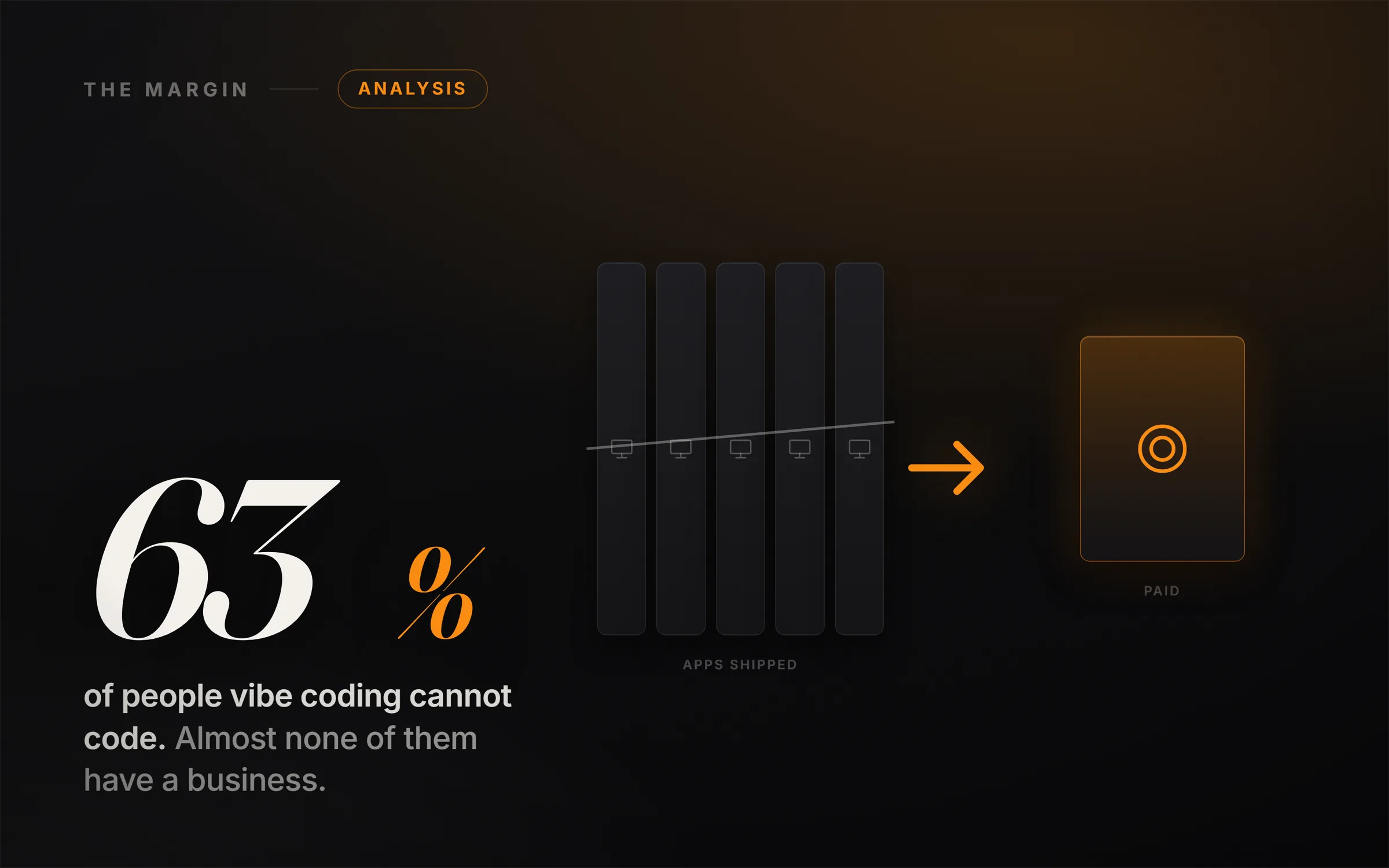
Can you make money vibe coding in 2026? A few people can, and almost nobody does. The building is genuinely real now: you describe an app in plain English, an AI writes the code, and by the weekend you have something that runs. Many of the people doing it cannot code at all. What almost none of them have is a business, and those two things are not the same.
Here is the sentence to hold onto, because it is the spine of everything below. Vibe coding removed the easy part of a software company and left the hard part completely intact. The code was never the business. Now that the code is nearly free, that is more true than it has ever been.
Why do most vibe-coded apps never make money?
Because building an app and selling one are different skills, and vibe coding only collapsed the first one. The market is now flooded. Vibe coding has produced a surge of new apps, and the dominant sentence of 2026 is blunt: everyone is vibe coding, nobody is making money. New apps sit with stagnant downloads and no subscription model, stuck in a monetization Catch-22.
The uncomfortable truth underneath the numbers is simple. An app with no audience and no specific problem is not a product. It is inventory nobody ordered. Making the building free did not create a wave of software founders. It created a wave of software, most of it looking for a customer who was never identified before the first line got written.
What is the "last 10 percent" of a vibe-coded app?
It is the part that turns a demo into a business, and it is exactly where the AI stops helping. Getting an app from zero to 90 percent is the easy, magical part everyone posts screenshots of. The last 10 percent, authentication, payment processing, edge cases, deployment, and the support that follows, is where things quietly break. AI can generate a working screen in minutes and then consistently fails at the unglamorous billing pipeline that actually collects money.
That last sliver is small in code and total in consequence. It is 10 percent of the work and 100 percent of whether you ever get paid. This is the same lesson we keep running into across every AI business: as we wrote in the AI receptionist breakdown, the build is the easy 20 percent and the business is the other 80. Vibe coding did not repeal that ratio. It just hid it behind a very convincing weekend.
Are vibe-coded apps safe to sell?
Often they are not, and that is a business risk, not just a technical footnote. Veracode's 2025 GenAI Code Security Report, which tested more than 100 models, found roughly 45 percent of AI-generated code introduced an OWASP Top 10 security flaw. Escape.tech's scan of around 5,600 publicly deployed vibe-coded apps surfaced 2,000 critical vulnerabilities, 400 exposed secrets including live API keys, and 175 leaks of personal data.
The moment you charge a stranger, you become responsible for their data and their trust. A faceless app cannot be held accountable when it leaks a customer list. You can. That accountability is not a burden to hide from. It is the human layer buyers quietly pay extra for, and it is the reason a careful operator beats a hundred careless ones shipping the same weekend build.
Who is actually making money from vibe coding?
The people selling the shovels. Cursor crossed $2 billion in annual recurring revenue, according to press reports. Lovable has said it reached $200 million ARR faster than any software company before it, then doubled it. Replit raised at a reported $9 billion valuation. The reliable fortune in any gold rush goes to whoever sells the picks and pans, and the mass of app-builders are the prospectors panning the same river.
This is not a reason to quit. Some prospectors strike gold. It is a reason to be clear-eyed about who the flood enriches by default, so you build for the version where you are the exception and not the average. The average vibe-coded app makes nothing. Understanding why is the entire edge.
When building becomes free, building stops being the business. The money moves to the two things a model cannot generate for you: a real problem, and the people who trust you to solve it.
Is vibe coding a real business or just a hobby?
It is a hobby by default and a business only on purpose. The line between them is a single fact: a specific person, with a specific problem, who will pay you to make it go away. Everything that makes vibe coding feel like a business, the fast build, the clean UI, the deploy button, sits on your side of that line. The thing that makes it an actual business sits on the customer's side, and no amount of prompting conjures it.
The realistic numbers are smaller and better than the hype implies. A focused micro-SaaS priced at $5 to $15 a month aiming for 10 to 20 paying users, a custom build sold for $300 to $800, an internal tool that commands $300 to $1,000 plus maintenance. None of these are lottery tickets. They are small, real, and they stack, which is the whole point. Five tiny recurring products behave very differently from five abandoned side projects.
How do you actually make money vibe coding?
Not by building faster. By reversing the order. The people who make this work find the paying problem first and build second, which is the exact opposite of what "just start building" advice tells you to do.
Before you vibe-code anything, ask
- Is there a specific person who already pays to solve this, in money or in visible pain?
- Can I reach them directly, without renting an algorithm's attention?
- Will they still need me after the app exists, for the support, the trust, and the last 10 percent?
If the answer to all three is yes, you have the makings of a business and the build is your easy 20 percent. If any answer is no, you have a hobby with a deploy button. Naming those three moves is simple. Running them well, validating that people will pay before you build, owning a channel to reach them, and finishing the hard last sliver, is the real work. That end-to-end sequence, with the validation process and the launch playbook, is what our vibe-coded micro-SaaS walkthrough lays out from a weekend build to paying customers.
Is it too late to start a micro-SaaS in 2026?
No. You are early in the part that actually matters, and late only to the part that no longer does. The flood of free building did not raise the wall in front of you. It cleared out everyone who was only ever going to ship a toy, and it made the few operators who solve a real problem for a real buyer stand out more, not less.
This is the same shift we traced in The Moat Moved. Knowing how to make software went from an edge to an ante the month the tools got this good. What is left, a narrow problem you understand, a channel you own, and the trust to be paid for the outcome, was never gated behind a technical skill. That is precisely why a determined beginner can win here, and why most people rushing to "just build" will not.
What does most vibe coding advice get wrong?
Here is the lesson buried under all the demo reels. Almost every guide sells you speed, and speed to build was never your constraint. It was already fast enough. Your constraint is a buyer, and no faster build finds one for you.
So do not sell software. Sell an outcome to a person who already wants it, and use vibe coding to deliver that outcome for almost nothing. Walk in knowing the specific pain you remove and the specific person who feels it, and the app is a formality by the time you open the editor. The tool is the easy part. The customer is the business.