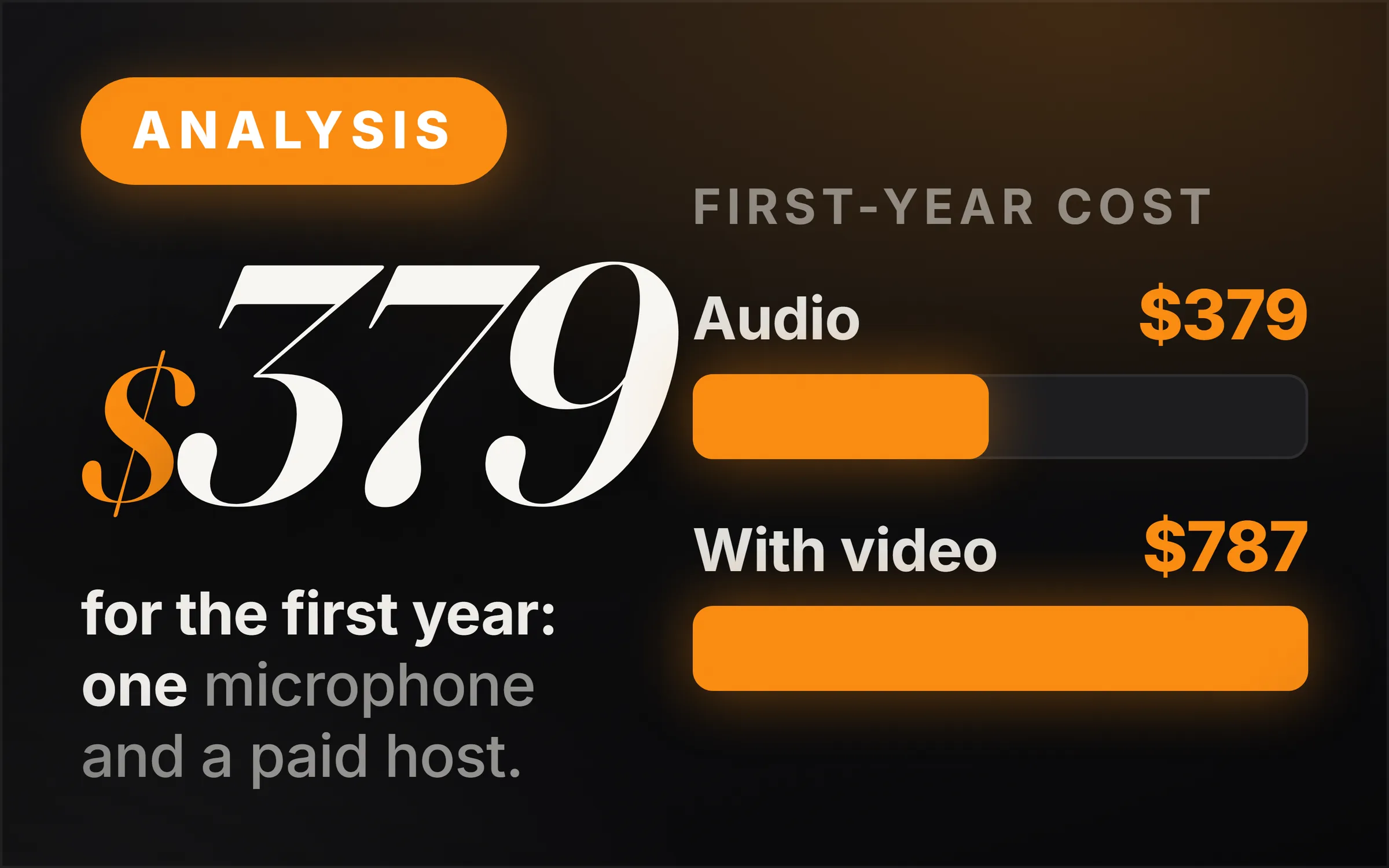
Starting a podcast costs $0 to about $800 in the first year, using published prices. Buzzsprout has a free hosting plan, and Descript has a free editing plan, so a show recorded on equipment you already own can start at $0, with limits. A typical audio setup, one Shure MV7X microphone at $199 and Buzzsprout's $15-a-month plan billed yearly, costs $379 in the first year. Adding Riverside for remote video interviews, at $24 a month billed yearly, and Buzzsprout's video plan brings it to $787.
After the first year, the microphone is paid for, so the running cost is the monthly subscriptions: $180 a year for audio hosting, or $588 with video and remote recording.
How much does it cost to start a podcast?
$0 to $787 in the first year, depending on what you buy. A free hosting plan and free editing software cost nothing. A $199 microphone and a $15-a-month host cost $379 for the year. Remote video recording and video hosting bring it to $787. Every number here comes from the vendor's own pricing page.
| Setup | What you buy | First-year cost |
|---|---|---|
| Free | Buzzsprout free plan, Descript Free, a microphone you already own | $0 |
| Audio | Shure MV7X ($199) and Buzzsprout Audio ($15 a month, billed yearly) | $379 |
| Audio, monthly billing | Shure MV7X ($199) and Buzzsprout Audio ($18 a month) | $415 |
| Video interviews | Shure MV7X ($199), Riverside Pro ($24 a month, billed yearly) and Buzzsprout Audio + Video ($25 a month, billed yearly) | $787 |
Our arithmetic on each vendor's published price, read on 22 October 2026: buzzsprout.com/pricing, riverside.com/pricing, descript.com/pricing and the Shure MV7X product page. None of the pages prints a date.
Those are the costs of one host on one microphone. A show with a guest in the same room needs a second microphone, which at the MV7X's price adds $199.
Want to get paid by podcasters instead of paying to run a show? The Podcast Amplification Service walkthrough lays it out step by step.
Can you start a podcast for free?
Yes, with limits. Buzzsprout's free plan "includes 2 hours of free podcast uploads each month, and we host your episodes for 90 days." Descript's Free plan, by its own FAQ, "includes everything you need to record, edit and mix audio and video content." Together, they cost $0.
The 90-day limit is the catch. Episodes on Buzzsprout's free plan come down after 90 days, so the free plan works for trying a show, not for building a back catalogue. Two hours a month is enough for two to four episodes of 30 to 60 minutes. When the show is worth keeping, moving to the $15 or $18 plan keeps every episode up.
How much does podcast hosting cost?
$15 to $36 a month at Buzzsprout, or $19 to $99 a month at Transistor. Buzzsprout's Audio plan is $18 a month, or $15 a month billed yearly, with up to 6 hours of uploads a month. Transistor's Starter plan is $19 a month, or $190 a year, and allows 20,000 downloads a month.
| Host and plan | Monthly billing | Billed yearly | Limit |
|---|---|---|---|
| Buzzsprout, free | $0 | $0 | 2 hours a month; episodes hosted 90 days |
| Buzzsprout, Audio | $18 | $15 a month | 6 hours a month (72 hours a year on yearly billing) |
| Buzzsprout, Audio + Video | $30 | $25 a month | 6 hours a month; publishes video to Apple Podcasts, Spotify and YouTube |
| Buzzsprout, Multi-Podcast | $36 | $30 a month | Up to 5 or 10 podcasts; 15 hours a month |
| Transistor, Starter | $19 | $190 a year | 20,000 downloads a month, unlimited podcasts |
| Transistor, Professional | $49 | $490 a year | 100,000 downloads a month |
From buzzsprout.com/pricing (read with both the monthly and yearly switch) and transistor.fm/pricing, 22 October 2026.
The two hosts limit different things. Buzzsprout limits how many hours you upload, and Transistor limits how many downloads your show gets. A new show with a few listeners and long episodes fits Transistor's limit easily; a show with short episodes and a growing audience fits Buzzsprout's. If you stop publishing, Buzzsprout offers an Archive plan "for $5/month" that keeps the show live.
How much does a podcast microphone cost?
$199 for the Shure MV7X, the price on Shure's own product page. Shure describes it as designed for podcasters recording on a budget. That is the single largest cost in the $379 first year, and it is paid once.
We checked one microphone, not the market, so treat $199 as one real, published price, not as the only option. Audio-Technica's ATR2100x page did not show a price to our reader, so we have not quoted it.
How much does remote recording and editing cost?
$0 to $29 a month. Descript's Free plan costs $0. Riverside's Pro plan, which records remote guests in "Studio-quality video & sound", costs $29 a month, or $24 a month billed yearly. Riverside's higher plans, at $39 and $99 a month, add live streaming and webinars.
| Tool | Monthly billing | Billed yearly | Used for |
|---|---|---|---|
| Descript, Free | $0 | $0 | Recording, editing and mixing |
| Riverside, Pro | $29 | $24 a month | Remote recording, up to 4K video, text-based editing |
| Riverside, $39 plan | $39 | $34 a month | Adds going live |
| Riverside, $99 plan | $99 | $79 a month | Adds webinars |
From riverside.com/pricing (read with the monthly switch selected) and descript.com/pricing, 22 October 2026.
Riverside's yearly Pro plan is $288 a year. For a show where every guest is remote, it is the difference between a call recording and two clean tracks.
How much does it cost to run a podcast after the first year?
$180 to $588 a year at the setups above. The microphone is a one-time cost, so year two is the subscriptions only: $180 for Buzzsprout Audio billed yearly, or $588 for Riverside Pro and Buzzsprout Audio + Video together, both billed yearly.
The cost that is not on any pricing page is time. Editing, show notes and clips take hours per episode, which is why some shows pay someone else to do it. What podcast editors charge per episode is in how much to charge for podcast editing, and the clipping side of the work is in the podcast clipping business.
The honest hard part
The money is not the hard part. At $379 for a year, a podcast is one of the cheapest things you can start. The hard part is the second year: the cost nobody publishes is the hours spent on each episode, and those keep coming after the gear is paid for.
The second hard part is being heard. Hosting lists the show in the podcast directories; it does not bring listeners. Clips and short videos cut from each episode are one way shows reach new people, and that is a job of its own, priced in how much to charge for video editing.
The third is the temptation to over-buy. A $199 microphone and a free editor are a complete starting setup, and the money is better kept until you know the show will last. For shows that later hire a narrator or an intro voice, see how much a voice-over artist charges.