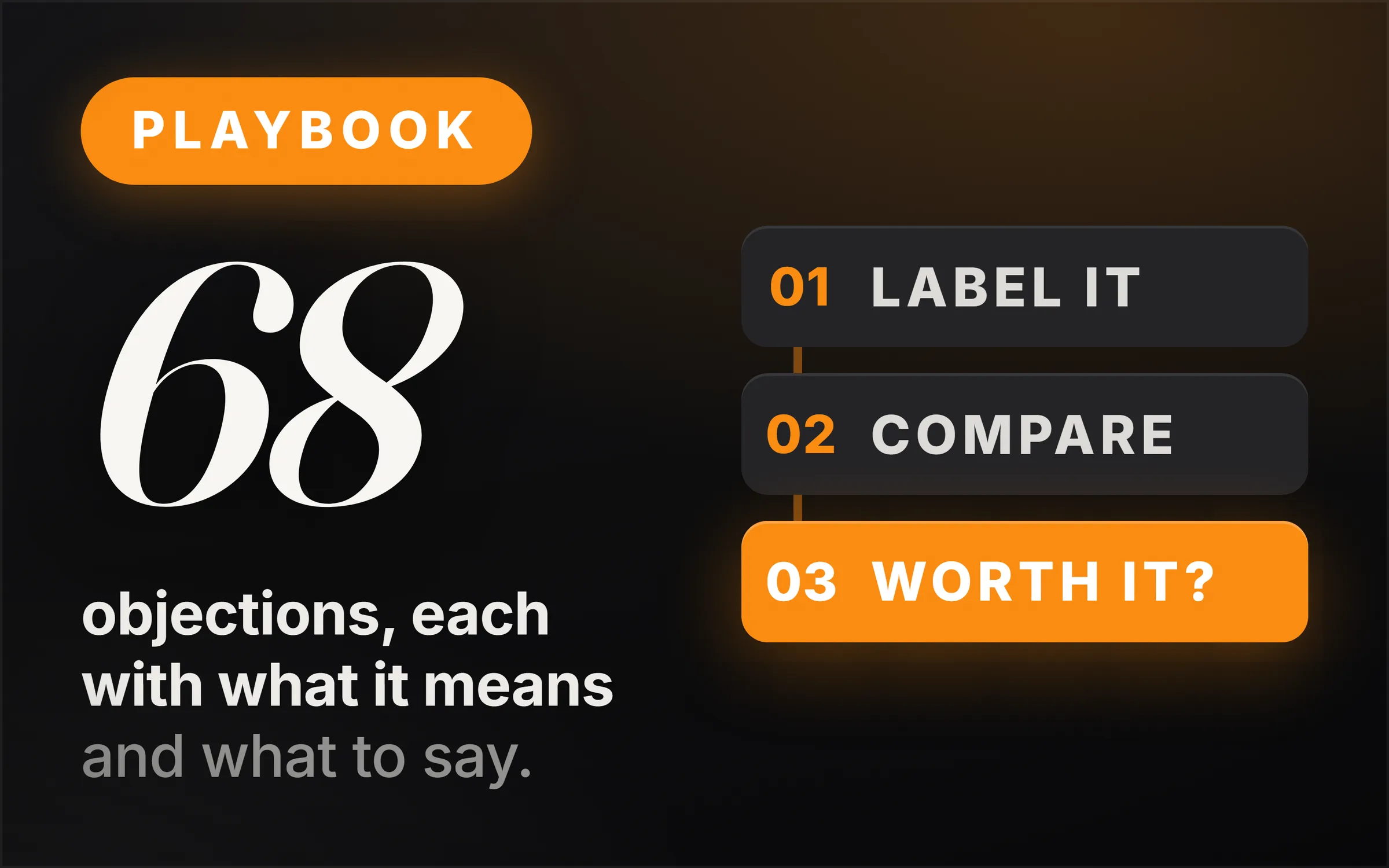
Treat "it's too expensive" as a doubt about the result, not the number. Label it ("it sounds like the value isn't there for you yet"), ask what they are comparing the price to, then ask: if this got you the result, would it be worth it? If yes, the objection is belief, so address that. Do not cut the price straight away.
That is the short version of what Alex Hormozi, Chris Voss's team, Jeremy Miner and Anthony Iannarino say about the most common objection in selling, and it sits on one card of a free tool we built that covers 68 objections in 13 categories. Below are the price objection and the four others people ask about most, each with what it usually means, what to say, what not to do, and who said it.
The 10-minute film walks through the tool card by card. The tool itself is free with no sign-up at ideasrepay.com/tools/objection-handling-scripts, and every video source in it opens at the exact second the point is made.
How do you handle price objections?
Handle a price objection by finding the doubt underneath it. Say "it sounds like the value isn't there for you yet," ask whether it is a lot of money to them or a lot compared with something else, then ask whether it would be worth it if it delivered the result. A yes means the real objection is belief.
The three lines, softer to firmer:
- "It sounds like the value isn't there for you yet. What would need to be true for this to be worth it?"
- "Is it a lot of money to you, or a lot compared with something else you're looking at?"
- "If this did get you the result, would it be worth it? If yes, then it isn't really the price. It's whether you believe it'll work, so let's talk about that."
The reasoning comes from several places that mostly agree. Hormozi argues money objections are really value objections. Chris Voss's Black Swan Group recommends labelling the value gap out loud instead of reaching for a cheaper product. Jeremy Miner says "too expensive" can mean three different things, so ask which before answering. Iannarino's rule is not to criticise competitors, defend your price or argue.
One source disagrees usefully. Keenan's position is that if a client's budget cannot solve their problem, that is not yours to fix by cutting your price. If they push back ("I still think it's too much"), the honest line is: "What would have to be true for it to be worth it to you? If the honest answer is nothing, I'd rather we both know now."
What should you not say when a client says it's too expensive?
Do not drop the price or pitch a cheaper package straight away. It tells the client your price was soft and it never touches the doubt that caused the objection. Also avoid defending your price by describing how much work goes into it: they are buying the result, not your hours.
Prevention works better than any reply. Sandler's advice is to talk about budget early, so the price is never a surprise, and to build the value before you say the number. For a service, put the result in numbers over a year: hours saved, clients won, mistakes avoided, against what the problem costs now. For a product, point to what they get that the cheaper option lacks, such as quality, guarantee or support, and if it genuinely is the same thing, say so. How to set a price you can defend in the first place is in pricing with no track record.
How do you respond to "let me think about it"?
Ask what they are weighing up, then make a clear recommendation. "Let me think about it" rarely means they need time. It usually means one unspoken concern or fear of choosing wrong. Matt Dixon's research across 2.5 million sales calls found 40% to 60% of qualified deals are lost to no decision.
Softer to firmer: "Of course. What are the main things you're weighing up?" Then: "What's the one thing that, if it went wrong, would make you regret saying yes?" Then: "If it helps, here's what I'd recommend in your position, and why."
Dixon's point is that the fear of messing up outweighs the fear of missing out, so indecisive buyers need a helping hand, not more options. David Sandler put it more bluntly, as quoted by HubSpot: most of the time it means no thanks. Hormozi's version is that decisions do not take time, they take information, so find the missing piece now. What not to do: "Great, I'll follow up next week." Nothing gets thought about. If they insist, book a short call to hear where they landed, whatever the answer.
What do you say when a client needs to ask their partner?
Treat it as reasonable and help them have the conversation. Ask "What do you think they might not like about it?", then "What would happen if they said no?", then whether their partner is happy with how things are now. Hormozi's framing is that the client wants support, not permission.
Keep it light, because people do not decide when it is tense. Robert Cialdini's consistency principle helps: asking what they would tell their partner draws on people's wish to stay consistent with what they have said.
Marcus Sheridan warns against the opposite extreme. Refusing to present unless both partners are present is a pressure tactic designed to block exactly this conversation. Offer to include the partner as an invitation, never a condition. For a service, give them a one-page summary of the problem, the price and what changes, so they can explain it well at home. For a product, hold the item or send the link with the returns policy.
How do you handle "Can I pay monthly?"
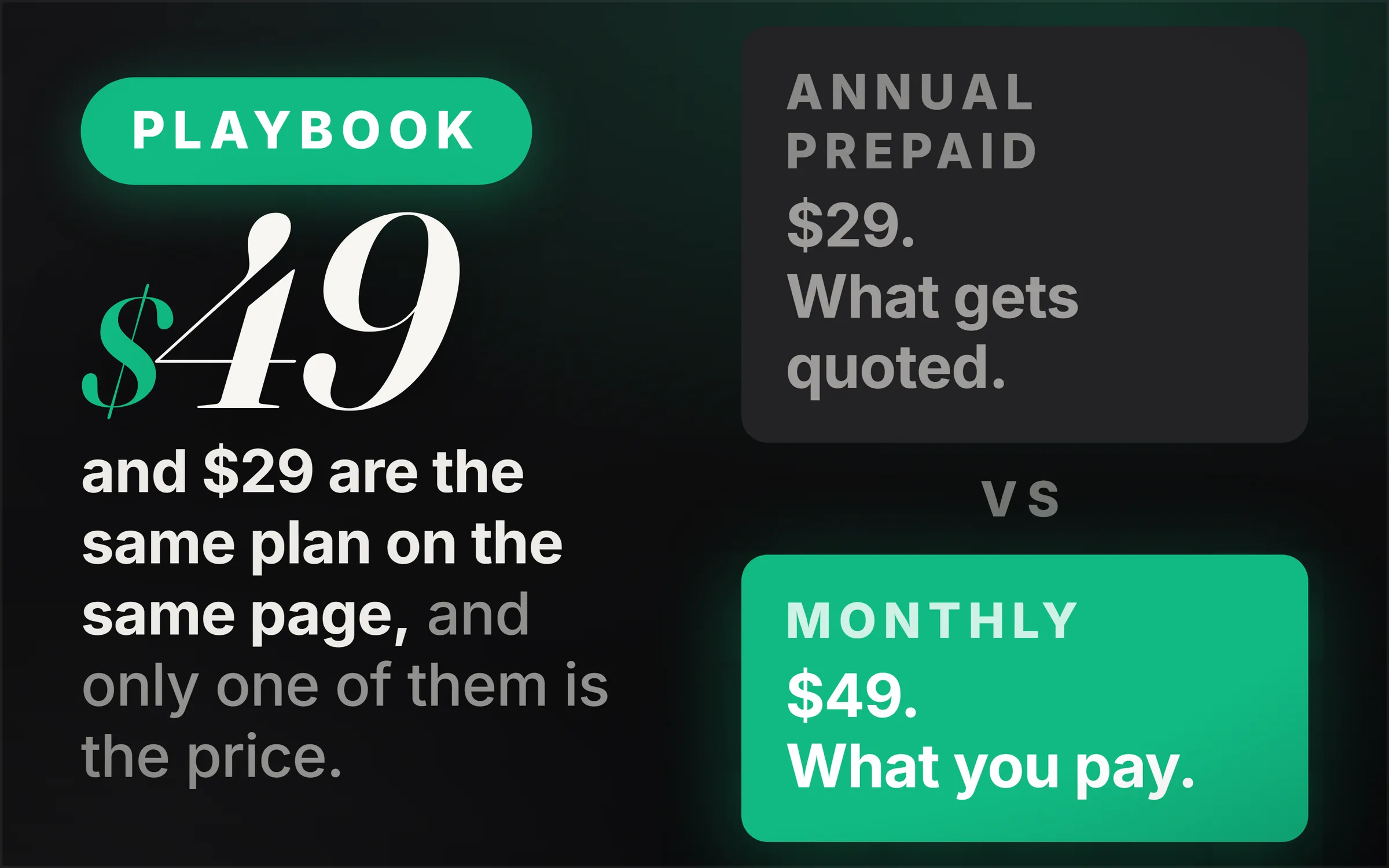
Say yes if you can, and see it as a buying signal: the price is acceptable, the timing of the money is not. Offer to spread the payments or to start with a smaller first stage. If you do not offer plans, split the work into stages paid as you go.
How payment is packaged changes behaviour. Hormozi describes a membership that stopped selling month to month and sold as a program with a payment plan, and the average customer stayed eight months instead of three. He also notes people are less likely to drop out of a payment plan than a monthly subscription. Starting smaller than the client wants is Dixon's safety net against a buyer who is afraid of the full commitment.
What if a customer says the shipping costs too much?
Acknowledge that nobody likes a surprise at checkout, explain what the cost covers, and offer a way under the free-delivery threshold, collection or a slower option. The objection is mostly about the surprise, not the amount. Baymard Institute's May 2026 research found 39% of shoppers abandon a checkout because of extra fees like delivery and taxes.
Baymard's advice is to show the full order cost in the cart, including all fees, and its research separately puts not being able to see or calculate the total up front at 12% of abandonments. What not to do: hide the shipping cost until the last step. Sheridan's wider point is to be open about what drives a cost up or down, because hidden pricing drives customers away.
How do you answer "I can learn this for free on YouTube"?
Agree. Say they absolutely should, that a lot of it is out there, and that if they get stuck or it takes longer than they want, that is where you come in. Then ask how long they have been trying to work it out alone. The objection usually means they have not counted their own time.
Hormozi's answer to "I'll just watch your free stuff" is to agree: either it works and they will hit the next problem you solve, or it does not and you help now. Daniel Pink observes that information asymmetry has become information parity, so information alone is not what you sell. Sheridan goes further and says give the information away, because trust and doing the work are what people pay for. The mistake is rubbishing free content, which makes you look threatened by it.
Is there a free objection handling tool?
Yes. The IdeasRepay objection handling tool is free, needs no sign-up, and covers 68 objections in 13 categories, from money and timing to buying a product and first contact. Each card explains what the objection usually means and gives three scripts softer to firmer, an example conversation and a pushback line.
It draws on 93 sources from over 40 named voices, including Alex Hormozi, Chris Voss and The Black Swan Group, Matt Dixon, Jeb Blount, Robert Cialdini, Marcus Sheridan and the Baymard Institute, each tagged where it adds to a point or disagrees. You can type what the client said in your own words and the closest card opens, get separate advice for selling a service or a product, pin the ones you hear most, print a one-page cheat sheet, or run practice mode, where ten objections come at you and you answer out loud.
The tool's ethics line is also the practical one: these scripts are for helping a qualified buyer decide, not for pressuring someone the offer is wrong for. If what you sell is wrong for them, the right answer is to say so. Once the objections stop being the bottleneck, the next conversation is usually about price itself, which is covered in how to raise your rates, and finding the people to have these calls with is in how to get your first client.