Price from a floor you calculate and a ceiling you research, and put your first number between them rather than picking one by feel. The floor is what the work costs you to deliver, including the hours nobody bills for. The ceiling is what the market visibly pays for the same outcome, which you can find on published pricing pages in an afternoon.
Almost nobody does this. The standard method is to imagine a number, feel embarrassed, reduce it, and say it as a question. That produces a price that is both too low to sustain the business and too uncertain to be believed, which is the worst combination available, because a hesitant low number reads as a warning rather than as a bargain.
How do you price a service with no clients yet?
Set a floor from your own costs, find a ceiling from published prices for the same outcome, and place your first quote between them, nearer the floor than feels brave but never below it. The absence of a track record changes what you can charge. It does not change what the work costs you, and that cost is knowable today.
The reason to start with the floor is that it is the only number in this exercise that is not an opinion. Everything about market rates is contestable. What you must earn per project to not be losing money is arithmetic, and once you have it you have a line you can refuse to go under without needing confidence to do so. That converts a question about self-worth into a question about a spreadsheet, which is a much easier question to hold your nerve on.
The second reason is that it protects you from the specific trap of this stage, which is winning work that makes your situation worse. A business with underpriced clients does not grow into a good business. It grows into a busier version of a bad one, and every new client makes the calendar tighter and the finances no better.
How do you calculate your price floor?
Add three things: the hours the work actually takes, the hours it takes that you cannot bill, and your fixed monthly costs divided across the jobs you can realistically deliver in a month.
The middle term is the one that gets left out and it is usually the largest. For every hour of delivery there is scoping, the proposal, the kickoff call, the revision round, the chasing, the invoice, and the admin. A job that takes ten hours of real work frequently takes fifteen or sixteen hours of your life, and pricing against the ten guarantees that a full calendar still does not pay.
The three inputs, and where people get them wrong
- Delivery hours. Time the first one honestly instead of estimating it. Estimates in this trade run low by a wide margin, consistently.
- Unbilled hours. Scoping, calls, revisions, admin, chasing payment. Count them for a fortnight before you decide they are small.
- Fixed costs per job. Software, insurance, subscriptions, divided by the number of jobs a month you can actually deliver, which is fewer than you think.
Two clarifications that matter. Your capacity is not forty hours of delivery a week, because a meaningful share of your week is spent finding the next client, and a plan that assumes otherwise fails the moment the current work ends. And your floor is a floor, not a target. It is the number below which the business consumes you. It is not the number you should be aiming at.
How do you find out what the market pays?
Read published pricing pages for services that produce the same outcome, and read them carefully, because the way they are presented is designed to give you the wrong number.
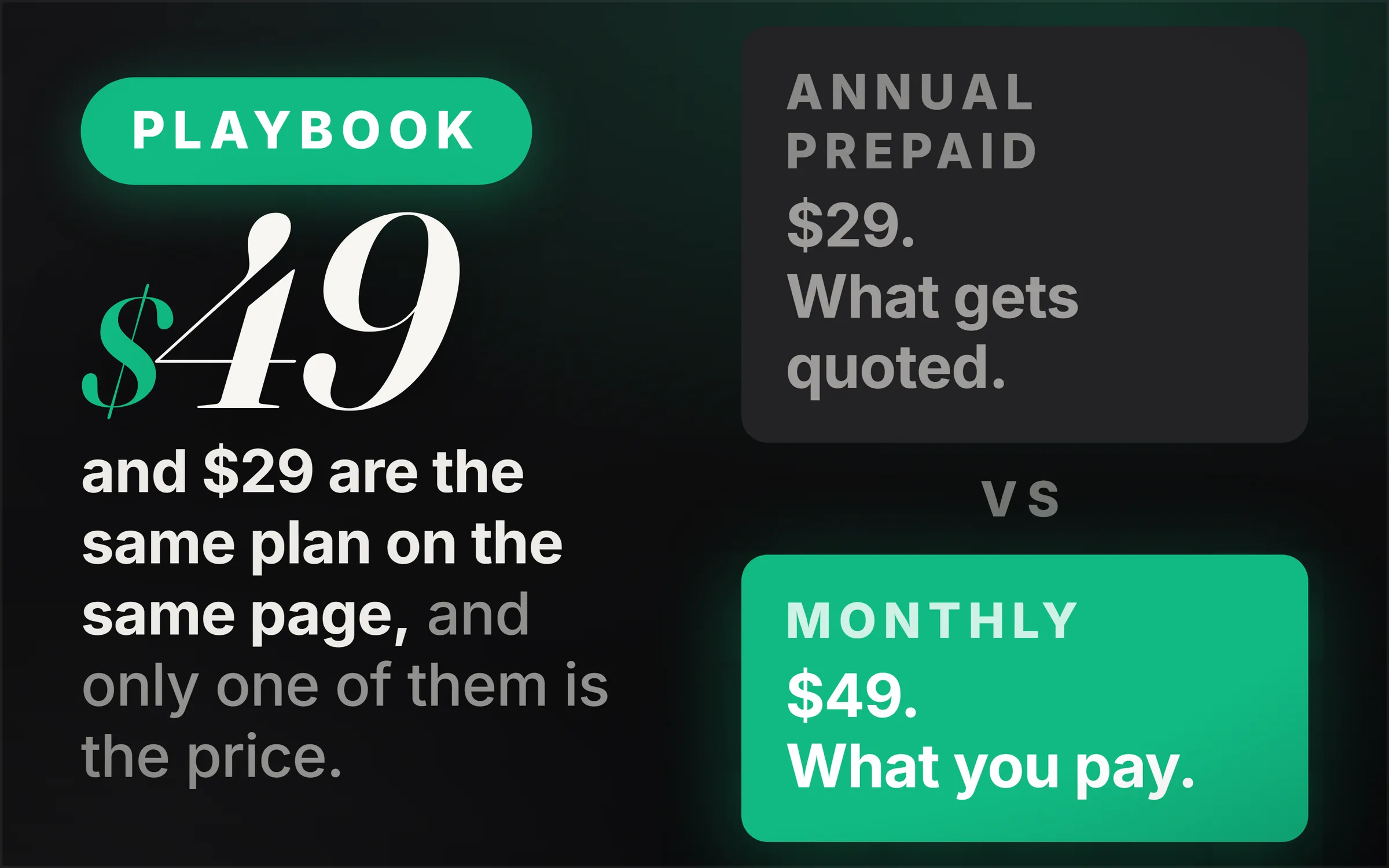
Here is a live example worth internalising. Jobber, the field service software, publishes its Core plan at $49 a month with no commitment, $39 a month on a one-year commitment, and $29 a month paid annually up front, and the page defaults to the annual view. Housecall Pro publishes its Basic plan at $79 a month billed monthly and $59 a month billed annually, again defaulting to annual. In both cases the smaller number is what circulates as "the price," and in both cases the number a customer paying month to month actually pays is roughly forty percent higher.
That pattern is everywhere, and it matters for two reasons. If you are buying, your real cost is the monthly figure, not the advertised one, and a stack costed from advertised prices will be wrong. If you are researching what a market pays, you need to compare like with like, and half the published numbers you find are discounted for a twelve-month prepayment while the other half are not.
The wider point is that published, checkable prices are the only reliable input here. Retainer figures quoted in blog posts about this industry very often trace back to an agency's own marketing, citing itself. A vendor's live pricing page is a commitment. A number in an article is a claim. Creator marketplaces work the same way: in how to start a UGC creator business we use the per-video floor a marketplace publishes, not a survey average nobody can check.
Should you charge hourly or by the project?
By the project, in almost every case, and the reason is that hourly pricing punishes the exact improvement you are trying to make.
The mechanics are unforgiving. You get better, the work takes six hours instead of ten, and your income falls. Every efficiency you gain is transferred to the client automatically, and the only way to earn more is to work more hours, which is the constraint you presumably started a business to escape. Hourly also invites scrutiny of the wrong thing: the client ends up auditing your speed rather than assessing the result, and you end up defending a timesheet.
Project pricing inverts all of it. The client buys a defined outcome for a defined price, your improvements accrue to you, and the conversation is about whether the outcome is worth the money, which is the conversation you want. It requires you to scope properly, and scoping badly is the real risk, which is why the deposit and the staged payment structure in how to invoice clients and actually get paid matter as much as the number itself.
Hourly has two legitimate uses: genuinely open-ended advisory work, and a fixed-price retainer that has a stated hour ceiling to stop it becoming unlimited. Both are deliberate choices. Neither is a default.
Should the first job be free?
No. Charge something, even if it is well below where you intend to end up, because free work costs you the two assets the job was supposed to produce.
The first is the reference. A client who paid nothing is a client whose endorsement carries the qualifier that they paid nothing, and everyone hearing it applies the discount. The second is the result. Free engagements are deprioritised by the client, not out of malice but because nothing was at stake, so materials arrive late, feedback never comes, and the project drifts to a halt without the clean outcome you needed to point at.
There is also a rate problem you create for yourself. The first number sets an anchor, and zero is a very difficult anchor to move away from with the same client. Going from free to paid is a renegotiation of the entire relationship. Going from a modest paid figure to a higher one is an ordinary price increase.
A discounted first engagement, framed explicitly as introductory and tied to getting a testimonial and permission to write up the result, is a different thing entirely. That is a trade, both sides know what it is, and it converts cleanly. We wrote about the version of this that wins work without giving it away in how to get your first client without asking for one.
How do you say the number without flinching?
State it as a fact, in one sentence, and then stop talking. "It's two thousand four hundred dollars." Full stop, no upward inflection, no immediate justification.
The reflex is to keep going: to explain the breakdown, to pre-empt an objection nobody raised, or to soften it into a question. Every one of those signals that you expect resistance, and a price delivered with visible doubt invites the negotiation it was trying to avoid. The silence afterwards feels much longer to you than it does to the other person, who is simply thinking.
There is a preparation step that makes this far easier and it happens before the call. Decide your floor in advance and decide what you will do if they push below it, and make that decision when you are calm rather than while somebody is looking at you. Most people cave not because the argument was persuasive but because they never decided beforehand what they would say.
If they do push, the useful move is to reduce the scope rather than the price. "I can do it for that, and here is what comes out" keeps the rate intact and hands them a real choice. Cutting the number while keeping the work teaches the client that your prices are opening positions, and that lesson never gets unlearned.
The honest hard part
The difficulty here is not analytical, it is that pricing feels like a statement about your worth, and it is not. It is a statement about the value of an outcome to a specific buyer, and your feelings about your own experience are simply not an input.
That confusion produces the whole pattern this article exists to interrupt. Somebody with genuinely useful skills prices from their insecurity, wins clients who are buying on price, delivers well, and concludes from a full calendar and an empty bank account that the business does not work. The business worked. The number was wrong, and it was wrong for reasons that had nothing to do with the market.
The second hard part is that you will get it wrong for a while regardless, and that is survivable in one direction and much less so in the other. Priced slightly high, you lose some deals and learn quickly, and the clients you win fund the learning. Priced too low, you win everything, fill your capacity, and remove the time you needed to fix it. Given a genuine choice between the two errors early, the recoverable one is up.
If you have already priced too low and need to move, that is a different and more delicate problem, and we set it out in how to raise your rates without losing clients.
If the number holds but the work keeps growing after the quote, that is a different failure and it has its own mechanics, in how to handle scope creep. And if the price is right but the document is not getting a decision, see how to write a proposal that closes.