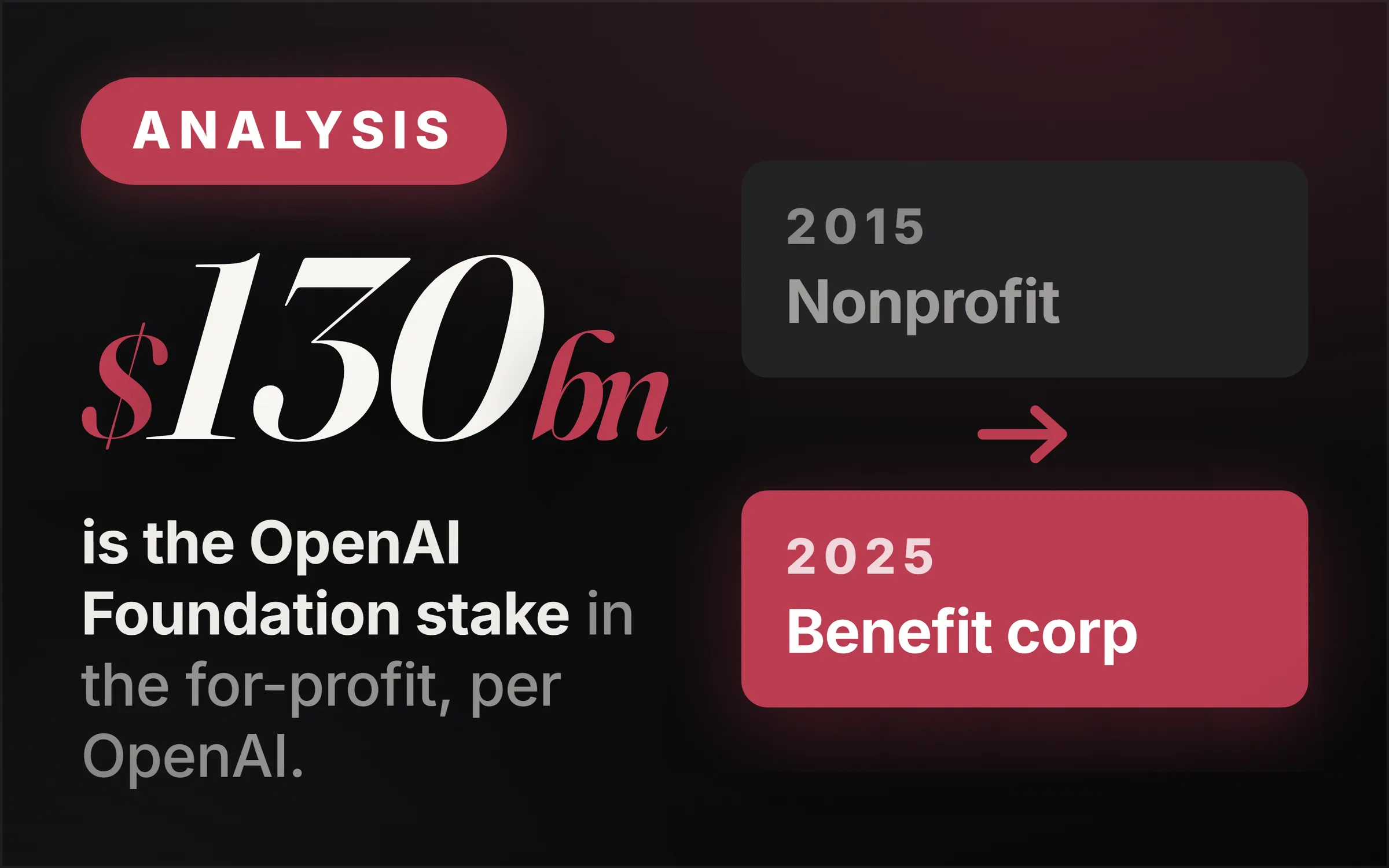
No, not in the way it started, but a nonprofit still controls it. Since October 2025, the business that makes ChatGPT is OpenAI Group PBC, a public benefit corporation. Its nonprofit parent, renamed the OpenAI Foundation, controls it and, according to OpenAI, "holds equity in the for-profit currently valued at approximately $130 billion". Microsoft holds roughly 27%.
That is a long way from OpenAI's founding announcement in December 2015, which described "a non-profit artificial intelligence research company" working "unconstrained by a need to generate financial return." The film above follows the board fight in which that structure was tested. This page sets out what the structure is now and how it got here, from OpenAI's own documents.
Is OpenAI a nonprofit?
OpenAI is controlled by a nonprofit but operated by a for-profit company. The nonprofit, now the OpenAI Foundation, sits at the top. The business, OpenAI Group PBC, is a public benefit corporation. OpenAI's October 2025 announcement says "The OpenAI Foundation controls the for-profit business" and values its equity stake at about $130 billion.
So the honest answer to the search question is "both". Revenue, investors and products sit in the for-profit. The final say over that company, on paper, sits with the nonprofit, whose stated job is the mission rather than investor returns.
That makes the Foundation, in OpenAI's words, "one of the best resourced philanthropic organizations ever", and it says the Foundation will "initially focus on a $25B commitment" to health and AI resilience.
How did OpenAI's structure change?
In three steps: nonprofit, capped-profit, then public benefit corporation. The founding post of December 2015 described a nonprofit. In 2019 OpenAI added what it called a "capped profit" arm so it could raise outside money. In 2025 the for-profit became a public benefit corporation, with the nonprofit keeping control.
OpenAI's own explanation of the 2019 step, on its 2023 structure page, was that the partnership between "our original Nonprofit and a new capped profit arm" served as "a chassis for OpenAI's mission". The same page stated that "The Nonprofit's principal beneficiary is humanity, not OpenAI investors."
The reason was money. OpenAI later wrote that the nonprofit had raised less than $45 million from Elon Musk and more than $90 million from other donors, against a need it put in the billions of dollars a year.
Why did the nonprofit keep control?
Because state attorneys general and others pushed back on handing it over. In May 2025 OpenAI's chair Bret Taylor wrote: "OpenAI was founded as a nonprofit, and is today overseen and controlled by that nonprofit. Going forward, it will continue to be overseen and controlled by that nonprofit."
He said the decision followed conversations with civic leaders and "the offices of the Attorney General of Delaware and the Attorney General of California." Earlier plans, reported at the end of 2024, had pointed toward a structure with less nonprofit control, and former employees objected publicly.
The new for-profit was described as a public benefit corporation, "a purpose-driven company structure that has to consider the interests of both shareholders and the mission." That is a legal duty to weigh the mission, not a duty to put it first.
What happened in Musk v. Altman?
The jury did not decide whether OpenAI broke its charitable promise. It decided Musk sued too late. On 18 May 2026 the court recorded that "The jury reached a unanimous verdict that plaintiff's claims for Breach of Charitable Trust and Restitution based on Unjust Enrichment are barred by the Statute of Limitations." The judge adopted the advisory verdict two days later.
The Guardian reported that the verdict came "after less than two hours of deliberation". OpenAI had argued Musk "was well aware of the company's plans to pursue a for-profit structure as early as 2017" and so had filed "outside the three-year limit."
That outcome is easy to misread in both directions. It was a clear win for OpenAI. It was not a finding that the move from nonprofit to profit was proper, because the jury never reached that question.
Who owns OpenAI now?
The OpenAI Foundation, Microsoft, employees and investors. Microsoft says that after the recapitalisation it "holds an investment in OpenAI Group PBC valued at approximately $135 billion, representing roughly 27 percent on an as-converted diluted basis, inclusive of all owners – employees, investors, and the OpenAI Foundation."
The Foundation's stake is the other large block, valued by OpenAI at about $130 billion. Control and ownership are not the same thing here: the Foundation controls the company through its governance rights, while Microsoft and other investors hold economic stakes.
Sam Altman's position has been unusual throughout. OpenAI's 2023 structure page said he "does not hold equity directly" and that his only interest was indirect, through a Y Combinator fund. The nonprofit board that had that independence removed him as chief executive in November 2023; within days he was back and the board was replaced, which is the episode the film examines.
Why does OpenAI's structure matter?
Because it decides who can say no. The nonprofit board was designed to be able to stop the company in the name of the mission. In November 2023 it tried, and the decision was reversed within days. The former board member Helen Toner later testified that "it turned out that, in practice, those decisions could be reversed."
For anyone thinking about how AI is governed, OpenAI is the clearest test case of whether a mission-first structure can hold when billions of dollars depend on the answer. For the wider question of who regulates AI and why it is so hard, see who regulates AI, and for how much risk the people building it think is involved, what is p(doom).
The honest hard part
The hard part is that most of what matters happens inside boardrooms, and the public record is partial. Much of what we know about the 2023 board fight comes from sworn testimony released in the Musk case, which captures what people said under oath, not necessarily everything that happened.
The second hard part is valuation. The $130 billion and $135 billion figures are the companies' own statements of value at a moment in time, not market prices, and they will move with OpenAI's fortunes.
The third is that "controlled by a nonprofit" is only as strong as the nonprofit's willingness to use its control. The structure has been tested once, in 2023, and the company that came out the other side is the one that exists today.