AI washing is claiming that a product uses artificial intelligence when it does not, or that its AI does more than it really does. The term was put on the record by the US Securities and Exchange Commission in March 2024, when it fined two investment advisers a combined $400,000 for AI claims they could not back up. Since then regulators and prosecutors have brought cases against a drive-thru, a shopping app and a "robot lawyer".
Read the records side by side and one pattern repeats. Using people behind the AI was never the offence. The offence was a number, usually an automation rate, that the company knew and the customer or investor did not. The film above traces that trick back to a chess machine in 1770. This page sets out the cases, the numbers, and the questions that expose it.
What is AI washing?
AI washing means overstating or inventing the AI in a product to win customers or investors. The SEC used the term in a March 2024 enforcement action, where Delphia agreed to pay $225,000 and Global Predictions $175,000 for false statements about their use of AI. Gensler said: "Such AI washing hurts investors."
The name borrows from greenwashing, where a company exaggerates how environmentally friendly it is. The mechanism is the same: a claim that is cheap to make, expensive to check, and valuable because buyers and investors reward it.
It comes in two strengths. The mild form is calling ordinary software "AI" because the label sells. The serious form is a product presented as automated when people are doing most of the work, which is where every case below ends up.
What are real examples of AI washing?
Four cases are now on the public record with official documents behind them: two investment advisers fined by the SEC in 2024, a drive-thru company found by the SEC in 2025 to have overstated its automation, a shopping-app founder charged by federal prosecutors in 2025, and a "robot lawyer" fined $193,000 by the FTC.
Each case is stated below as the regulator or prosecutor stated it, including what was alleged rather than proven.
Case 1: Delphia and Global Predictions, investment advisers
Fined a combined $400,000 by the SEC in March 2024. According to the SEC, the two firms made false and misleading statements about how they used artificial intelligence. Delphia agreed to a $225,000 civil penalty and Global Predictions to $175,000. The SEC's enforcement director said the agency was "committed to protecting them against those engaged in 'AI washing.'"
Case 2: Presto Automation, drive-thru ordering
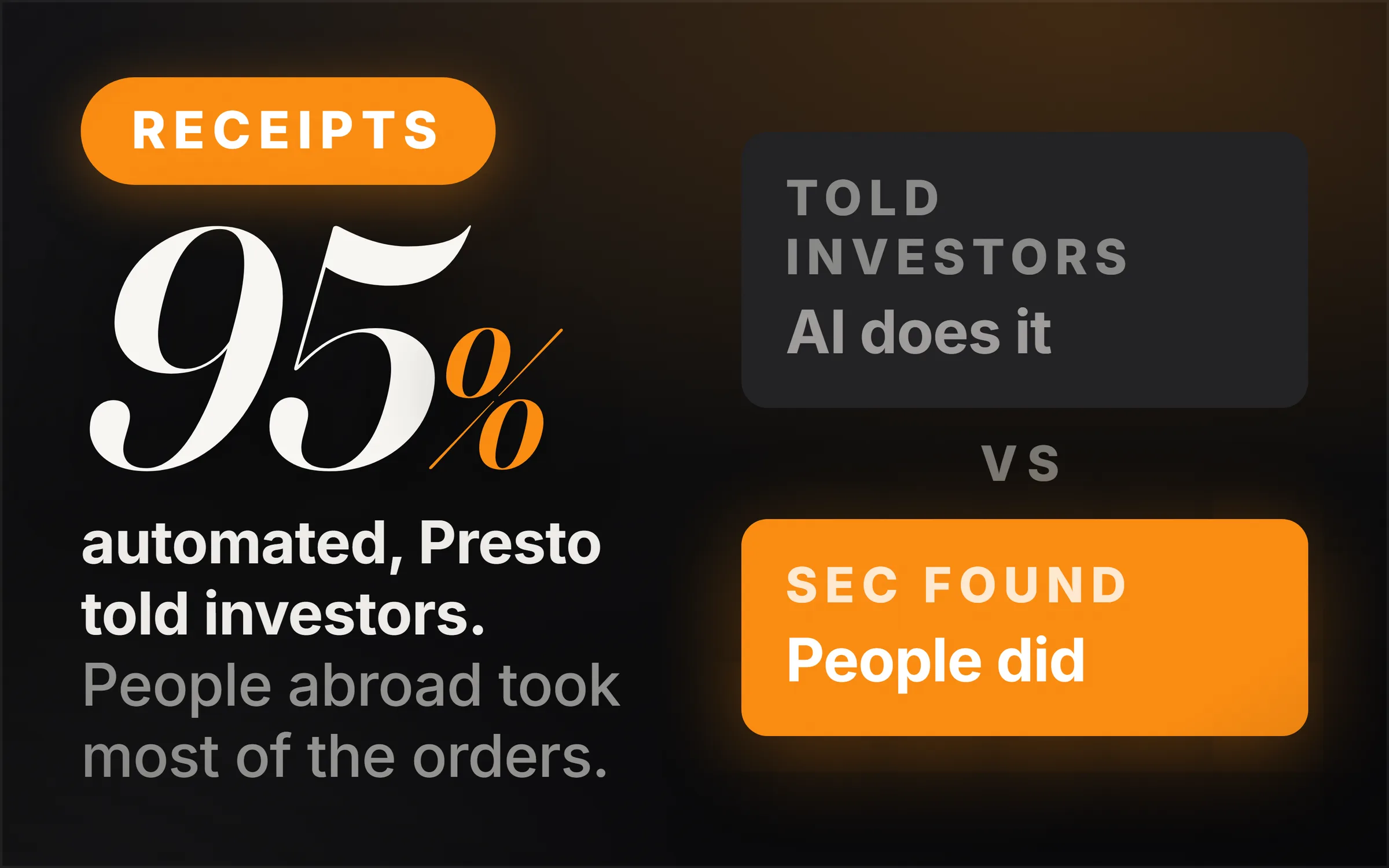
Claimed 95% to 99% automated order completion; the SEC found people abroad doing most of the work. The SEC's January 2025 order says Presto told investors its voice product had achieved "automated order completion" rates of "95% to 99%" at one customer's restaurants. The order also says Presto "hired, trained, and supervised human order takers located abroad (primarily in the Philippines and India), who processed the vast majority of drive-thru orders placed through Presto Voice."
A newer version "required a human agent to enter the orders approximately 70% of the time" from June to at least December 2023. The order quotes one executive messaging another in January 2022 that "with HITL [humans in the loop], accuracy is not a major concern". Per the SEC's summary, no civil penalty was imposed, citing Presto's cooperation.
The 95% figure counted orders completed without help from restaurant staff. The people typing the orders were not in the restaurant, so they were not counted.
Case 3: Nate, a shopping app
Raised more than $40 million on an AI checkout; prosecutors say the automation rate was effectively zero. The US Attorney's Office for the Southern District of New York charged founder Albert Saniger in April 2025, alleging that "the app's actual automation rate was effectively zero percent" and that he "used hundreds of contractors, or "purchasing assistants," in a call center located in the Philippines to manually complete purchases".
Prosecutors also allege he "restricted access to nate's "automation rate dashboard,"" and told staff to keep the rate secret. He is charged with one count of securities fraud and one of wire fraud. The office's own release notes that the charges "are merely accusations and the defendant is presumed innocent unless and until proven guilty."
Case 4: DoNotPay, the "robot lawyer"
Fined $193,000 by the FTC in 2024. The Federal Trade Commission's Operation AI Comply sweep, announced in September 2024, included DoNotPay, which claimed to offer "the world's first robot lawyer". The FTC said the product failed to live up to claims that it could substitute for a human lawyer, and the settlement "would require it to pay $193,000" and notify subscribers from 2021 to 2023 about its limits.
The FTC's own site could not be fetched for this page, so the wording here is from a capture of the FTC press release made for the film's research. The figure is the FTC's.
Is it AI washing to use humans in the loop?
No. Using people inside an AI system is legitimate when it is disclosed. In November 2023 Cruise's chief executive publicly said its driverless cars were "remotely assisted (RA) 2-4% of the time on average, in complex urban environments," as CNBC reported. That is a human in the loop with a number attached.
Designers have faked machines on purpose for decades. The Wizard of Oz method, where a researcher secretly plays the computer so a team can learn whether anyone wants the product before building it, is a standard prototyping technique. The person behind the curtain is a tool.
What turns it into AI washing is concealment that matters to the buyer: an investor valuing the company as software, or a customer paying for automation and getting a call centre. Presto's "95% to 99%" and Nate's locked dashboard are both cases where the number existed and was kept from the people relying on it.
How can you tell if an AI product is really AI?
Ask 3 questions and judge the answers by how specific they are. What share of tasks does the system complete with no person involved? Who handles the rest, and where are they? Can you see the figure measured over a real period? A vendor with genuine automation usually has the number ready, because it is the number it is proudest of.
The questions work for a business buying an AI receptionist, an investor reading a pitch deck, or a customer wondering who is really answering the chat. Vague answers are not proof of anything, but in every case on this page the precise number existed inside the company and the outside world was given a different one or none.
The film ends with the oldest version of this test. Edgar Allan Poe, watching the chess-playing Turk in 1836, did not try to see inside the machine. He noticed which member of the touring crew was never visible during the show and always visible just before and after it. Look at who disappears when the demo starts.
Why do companies hide the humans in AI?
Because a software company is valued very differently from a services company. Nate raised more than $40 million on the promise of automation, according to prosecutors. A business that is mostly software can add customers for little extra cost; a business that is mostly people has to hire for every new customer, and investors price those two very differently.
There is no reliable published figure for that valuation gap across companies, so we have not invented one. The mechanism is enough to explain the incentive: the same product, with the people visible, is worth less to an investor, and that is exactly the gap AI washing exploits.
For anyone building an AI service business, the lesson cuts the other way. Clients increasingly know that most AI products still need a person somewhere. Saying where that person is, and what the AI genuinely handles, is a selling point, not a confession. The same thinking runs through every AI agent failure explained, where the fixes almost always involve a human checkpoint.
What are the penalties for AI washing?
AI washing penalties range from no fine to criminal charges. The two investment advisers paid $225,000 and $175,000 to the SEC. Presto faced an SEC order with no civil penalty because it cooperated. DoNotPay's FTC settlement was $193,000. Nate's founder faces securities and wire fraud charges that each carry a maximum of 20 years, which a judge would decide on conviction.
The spread reflects who was misled and how. Misleading investors falls to the SEC, misleading consumers to the FTC, and deliberate deception to raise money can become a criminal case. The common thread across all four is a specific, checkable claim that turned out to be false.
The honest hard part
The hard part is that the line between a prototype and a deception is disclosure, and disclosure is a matter of degree. Almost every AI product has people somewhere: labelling data, reviewing edge cases, answering when the machine is unsure. Expecting zero humans is unrealistic, and calling every human in the loop "fraud" would be wrong.
The second hard part is that these are the cases that were caught. Records exist because a regulator or prosecutor acted, and most of the outcomes are settlements or charges, not verdicts. Nate's founder in particular has not been convicted of anything.
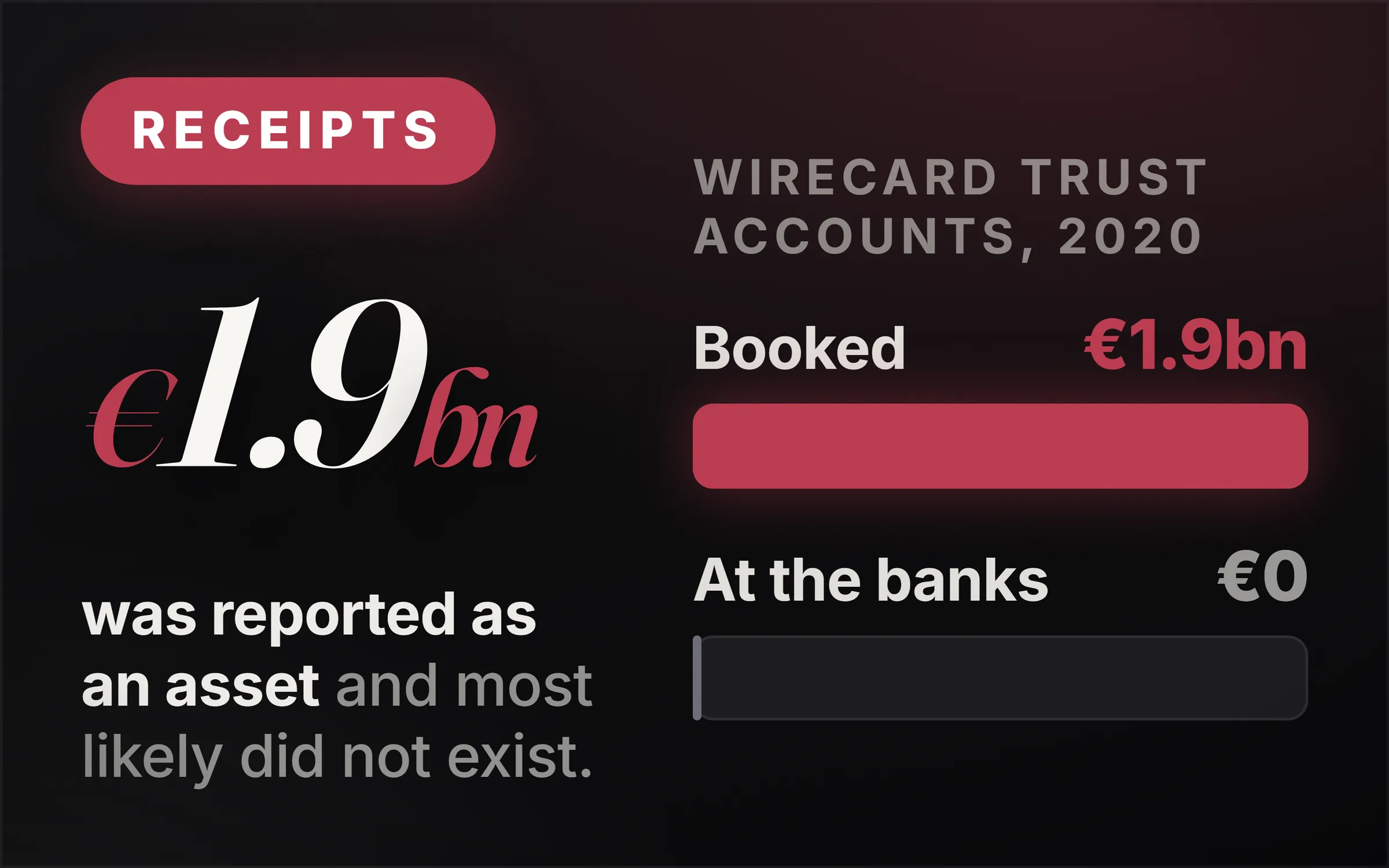
The third is that the incentive has not gone away. As long as automation is valued more highly than people, there will be pressure to describe one as the other. The same pattern, a number that only insiders could see, sits at the centre of the Wirecard case and the accounting fraud red flags it left behind.