An AI influencer business builds one consistent synthetic persona and either points it at your own venture or runs personas for brands on a retainer. Since 2 August 2026, Article 50 of the EU AI Act treats a realistic invented persona as a deepfake that needs a visible label on each post. Consistency, not beauty, is the technical problem.
There is a business here, and there are two completely different versions of it that get talked about as though they were one thing.
In the first, you build a synthetic face, grow an audience around it, and point that audience at a venture you own: a product, a digital download, a brand. Nobody pays you for the persona. The persona is marketing, and the money comes from the thing behind it.
In the second, you never build an audience at all. You build and operate personas for brands who want a consistent human face for their marketing and cannot produce one, and they pay you a monthly retainer to run it.
Those are different businesses with different skills, different customers and different risks, and confusing them is why a lot of people spend three months making beautiful images that earn nothing. This article covers the craft that both depend on, then splits them apart properly, and then deals with the part almost nobody writing about this wants to touch, which is what you are now obliged to tell people.
What is the hardest part of making an AI influencer?
Consistency. A persona is only an asset if it is recognisable, and facial drift, where the face, age and features shift from post to post, is the single most common thing that kills one.
If a character's face, age and features shift from post to post, you do not have a character. You have a stream of unrelated AI people, and no brand or trust can attach to that. This is called facial drift, and solving it is the foundational skill. Everything else sits on top of a locked identity.
There are two families of approach and the difference is worth understanding before you spend anything.
Reference-based is where you start. You produce one image of your character that you genuinely love, then instruct the tool to generate new images matching that reference. It is fast, cheap and close to point-and-click. The honest tradeoff is that a reference is a strong guide rather than a perfect lock, so details wander and you have to check.
Trained-model is the upgrade. You feed a set of images of your character into a tool that trains a dedicated model on that identity, which then reproduces it with much higher fidelity and far less drift. More setup, more cost, noticeably better results. This is where you go once the persona is working, not on day one.
The workflow that actually produces a consistent character is short, and the order matters more than the tools:
- Design the character before you generate anything. Age, look, styling, setting, vibe. If you start generating first you will fall in love with an accident and spend months defending it.
- Generate the anchor image and do not rush it. Prompt for a specific, distinctive, well-lit, reproducible face. Generate batch after batch until one is exactly right. Every future image keys off this one.
- Lock it with the character-reference feature and generate new scenes and poses from it.
- Drift-check every single output against the anchor. Same bone structure, same age, same defining features. Keep the matches, bin the wanderers.
- Build a consistency set of fifteen to thirty on-model images across poses, settings and expressions. This is your working library, and if you upgrade to a trained model it becomes the training data.
- Add motion only when the business justifies it. Plenty of working personas run on stills for months.
The single highest-leverage tip in the whole process: providing three references, front, three-quarter and full-body, dramatically improves consistency over a single one. And the most common beginner mistake is accepting a "good enough" anchor, then fighting drift forever because the foundation was weak. An extra hour on the anchor saves a hundred hours later.
How consistent is consistent enough? The bar is that a casual viewer scrolling their feed reads it as the same person every time. You do not need forensic perfection. Lighting and angle can vary, and variation actually helps it feel real, because real people do not look identical in every photo. What kills it is identity drift, where the face structure or age visibly changes.
Should an AI influencer look perfect?
No. Too-perfect faces read as fake and build less trust than believable, slightly imperfect ones, which is the most counterintuitive finding in the craft.
Every instinct tells you to make the persona as beautiful as the tool allows. That instinct is wrong, and this is the most useful thing on this page.
The too-perfect, model-flawless look is more uncanny and less effective. It reads as manufactured, which is precisely the feeling that prevents anyone bonding with it. It is also harder to relate to and easier to dismiss as just another AI face.
The personas that build real audiences have texture. Natural settings, believable styling, the subtle imperfections real photographs have. The unglamorous Tuesday, not only the magazine shot. You are not building a fantasy, you are building a believable someone that people want to follow, and believable beats beautiful every time for any legitimate business purpose.
Why do most AI influencers fail?
For non-visual reasons: no personality, no niche, nothing to say by week 3, and no business behind the persona.
This is where the money is lost, so it deserves more attention than the tooling.
No personality. A face is not a character. Without a defined voice, a point of view, opinions, quirks and a consistent way of speaking, you have a photograph that posts. Audiences follow people, or at least characters, and a character needs an interior life written down before you post anything.
Nothing to say by week three. This is the quiet killer. A studio builds a flawless, consistent, beautiful persona and then runs out of content in three weeks, because nobody planned the substance. The account goes quiet and dies. The fix is unglamorous: build the content plan before launch, and work from the real questions your niche actually asks rather than from your imagination.
No business behind it. The persona earns nothing on its own. It is a marketing engine. Beginners fall in love with the persona, neglect the venture, and then wonder why a pretty face with followers makes no money. A great persona fronting no business is a hobby. An average persona fronting a sharp digital-product business is income.
No niche. A generically attractive person posting generically pleasant content has no reason to be followed. The niche is what gives the persona something to be about.
How do AI influencers make money?
In 2 ways: point the persona at your own venture, such as a product brand or digital product, or operate personas for brands on a retainer. The retainer pays sooner as a service business; your own venture has the higher ceiling.
Model one: point the persona at your own venture. The persona builds a niche audience and you sell that audience something you own. In practice that means one of four things: a product brand the persona fronts, your own digital product sold to the audience it gathered, affiliate and content revenue, or the persona as top-of-funnel awareness for a larger business you already run.
The strongest versions stack these. Build the audience with content, monetise with affiliate while you develop a digital product, launch the product to the audience you built, and then consider a product brand. The digital-product route is usually the best starting point, because margins are near-total and you can build once and sell repeatedly.
This model has the higher ceiling and it builds an asset you own outright. It is also slower, because you are building an audience from zero and audiences take time regardless of how good the face is.
Model two: run personas for brands. Here you are a service business. Brands want a consistent human face for their marketing without the cost, unpredictability and reputational exposure of a real influencer, and most of them cannot build or operate one. You do it for them on a monthly retainer, and the brand typically owns the persona.
This pays much sooner. Retainers in this market run from roughly $1,500 a month for a single-platform persona with a set content volume, through the $3,000 to $5,000 range for multiple platforms with video and active community management, up to $6,000 to $10,000 and beyond for brands going all-in. Many operators also charge a one-time build fee for the discovery, character design and initial consistency work, commonly in the low thousands, because that work is heavy and front-loaded.
Price on the value to the client and against their alternatives, which are hiring someone or paying a human influencer, never on your tool costs. Your costs are near zero and pricing off them leaves almost all the value on the table. A studio that is too cheap also signals low quality and attracts difficult, low-budget clients.
Which to choose. If you need income sooner and you are comfortable selling, run personas for brands. If you would rather build something you own and can wait longer for it, point one at your own venture. The craft is identical; the business is not.
How much does it cost to create an AI influencer?
The tooling is remarkably cheap, which is the genuine unlock here. You can build and validate a persona on free tiers before paying anything, then upgrade only once it is working.
The categories you need, in order: a reference-based image tool to lock the character, optionally a trained-model tool to raise fidelity once the persona is proven, and eventually a video layer to bring stills into motion. Running costs for one persona sit in the tens of dollars a month rather than the hundreds, and running several for clients does not multiply that anything like proportionally.
Two warnings worth more than any specific price. Check the monthly and annual toggle on every pricing page, because this category defaults to the annual view constantly and the discounted rate gets quoted everywhere as the monthly one. And check what commercial rights you actually get, because it varies by tool and by tier, and a persona you cannot legally use commercially is a very expensive hobby. Verify both on the vendor's own page before you commit, since this space moves faster than any article can.
How much do AI influencers really earn?
Nobody can say reliably. Every famous earnings figure in this industry, including the 2 most quoted, traces back to a press release or a self-report rather than audited accounts.
If you have researched this business you have met the same handful of figures. I tried to source them and none of them holds.
"Aitana López earns $11,000 a month." This traces to a November 2023 article, and Forbes attributes it plainly to the Barcelona agency that created her. The original reporting describes it as a peak single month, not a rate. Her co-founder gave the average as around €3,000. The number circulating is roughly three times the real one, and it was self-reported by the people selling the service.
"Lil Miquela earns $11 million a year." This one is not an earnings figure at all. It originates in a 2020 press release by an e-commerce marketplace, produced using a free online follower-count calculator. The same release generated the numbers you will see quoted for Noonoouri and imma. Nobody measured anything.
The only hard financial document in the entire category is a 2019 SEC filing by Brud, the company behind Lil Miquela, which raised just under $19.5 million. In the box for revenue, it says "Decline to Disclose." A full-text search of SEC filings returns no mention of Lil Miquela, ever.
"The virtual influencer market will be worth $45.88 billion by 2030." Published by a firm that sells the report, with no methodology, no sample and no data sources disclosed. Competing report-sellers disagree on the 2030 figure by around eight billion dollars, which tells you what the precision is worth.
"Virtual influencers get three times the engagement." Contradicted by the largest real study I could find, covering 99,680 Instagram posts, which found human influencers drew greater engagement than virtual ones.
I am not saying nobody makes money here. I am saying there is no reliable public data on what virtual influencers earn, and every number presented as evidence traces to someone selling something. Which is exactly why the retainer model in the previous section is the sane way in: it is a price you negotiate and can verify, rather than a market statistic you inherit from a press release.
Do AI influencers have to be labelled?
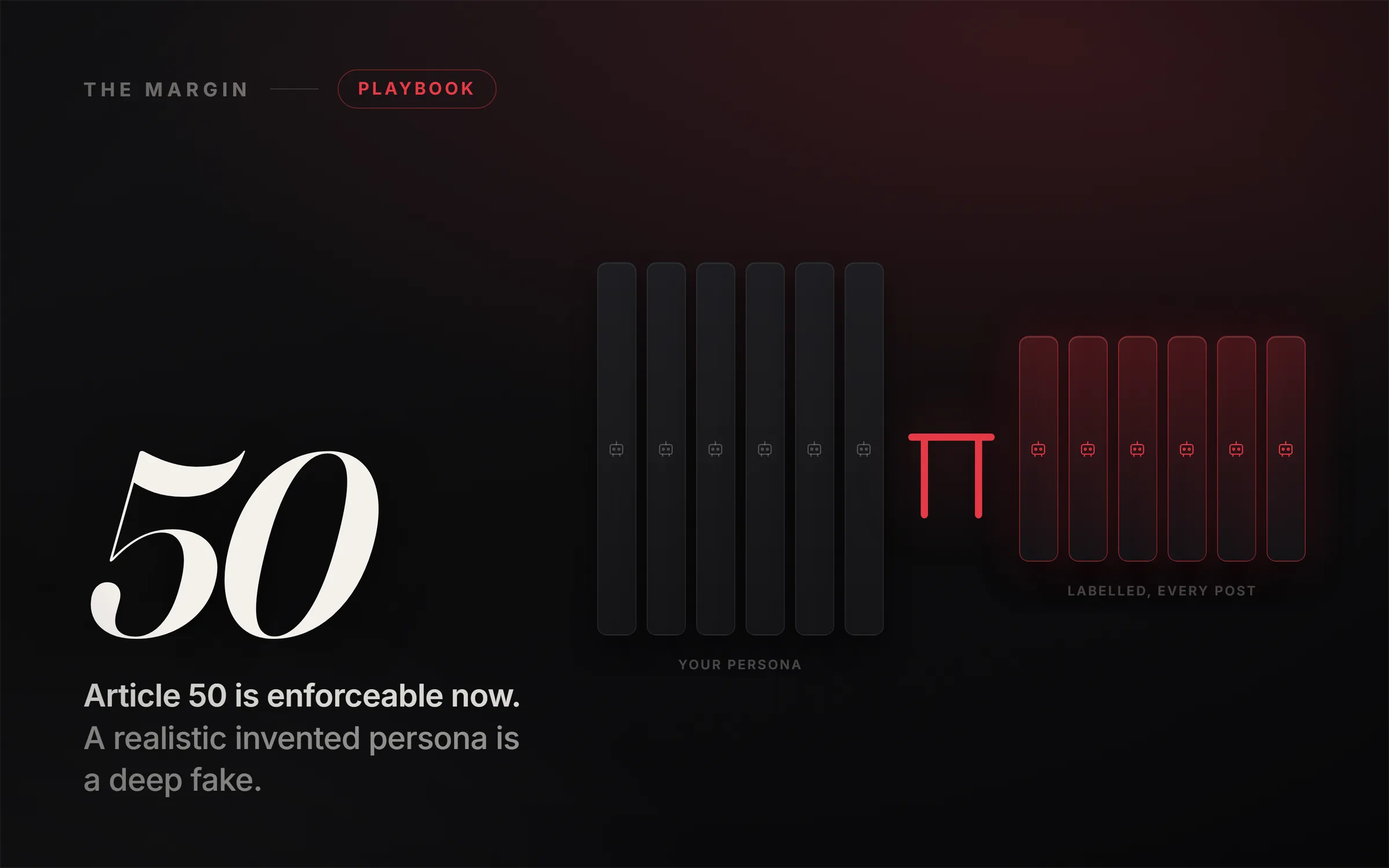
In the EU, yes. Article 50 of the EU AI Act became applicable on 2 August 2026, and the European Commission's guidelines cover realistic AI-generated human avatars or personas, so a visible label is owed on the post; a bio disclosure alone does not satisfy it.
On 2 August 2026, eleven days before this article, the transparency obligations in Article 50 of the EU AI Act became applicable. They were not delayed. The Digital Omnibus regulation that came into force in July 2026 postponed the high-risk regime into 2027 and 2028, and left Article 50 alone.
The defence this whole industry relies on does not work
Ask anyone running AI personas whether the deepfake rules apply to them and you will get the same answer: no, because a deepfake impersonates a real person and my character is invented, so nobody is being impersonated.
The European Commission has explicitly closed that door. Its guidelines on Article 50, published 20 July 2026, say it is enough that a simulated person resembles someone who "exists, can plausibly exist or could have plausibly existed" in reality, and define the relevant persons to include "realistic AI-generated human avatars or personas."
Read that again if you run one of these. A photorealistic invented influencer is a deep fake for the purposes of Article 50. Only the physically impossible, a dragon or a human flying unaided, sits outside. The invented-character defence is not a narrow escape, it is not an escape at all.
The second common defence fails too. Article 50 does reduce the obligation where content is "evidently artistic, creative, satirical, fictional or analogous," and people read that as an exemption for a fictional character. It is a reduction, not an exemption: you still disclose, just in a way that does not spoil the work. The Commission requires those categories be interpreted strictly, excludes anything "exclusively informative or commercial," and offers as its own example of content that does not qualify: "AI-manipulated video featuring a realistic synthetic influencer testing out a sponsored real product." That is a description of this business.
What you actually owe, and what you do not
Now the useful part, because most coverage of this overstates the burden in one direction and understates it in another.
You owe a visible, human-readable disclosure on every photorealistic AI post. It must be clear and distinguishable, perceivable without any technical tools, and present at first exposure. The guidelines are explicit that it fails if it is "hidden under layers of menu options" or buried in terms. A label on the creative itself does the job. A disclosure in your bio alone does not.
You do not owe machine-readable marking. This is the most common error I found. Article 50(2) puts the watermarking and metadata duty on the provider, meaning the company that made the AI tool, never on the person posting. And you cannot lean on their marking either: the Commission says deployers cannot rely on provider watermarks precisely because they are not perceivable by an ordinary viewer.
The penalty figure everyone quotes is wrong. Article 50 breaches sit at up to €15 million or 3% of worldwide turnover, not the 35 million and 7% you will see repeated, which applies to outright prohibited practices. And for SMEs and start-ups the regulation inverts it to whichever is lower, which materially changes the exposure for a solo operator.
On territorial reach, the trigger is output used in the Union, and the Commission treats posting to the open internet as foreseeable use in the Union. The narrow escape is content reaching EU audiences through channels genuinely outside your control, which ordinary public posting is not. If you post publicly, assume you are covered wherever you live.
In long content, disclose more than once. Where viewers foreseeably arrive mid-way, an opening-only disclosure is not enough.
Set the platform toggle on every upload. These bind independently of the law. One useful and widely misunderstood detail: no platform requires an AI persona's account to identify itself as AI. YouTube, TikTok and Meta all operate per-post labelling of realistic content, not account-level labelling. Meta's mandatory disclosure covers photorealistic video and realistic audio, and does not extend to still images. A profile-level "AI-generated character" note is therefore prudent rather than required, and it is cheap insurance, because both TikTok's and Meta's impersonation rules turn on intent to deceive and a standing disclosure is strong evidence you had none.
Two things the US picture gets wrong. There is no FTC rule requiring you to disclose that an influencer is AI. Operation AI Comply, which gets cited as the crackdown, was almost entirely about deceptive claims about AI rather than AI-generated content, involved no personas at all, and its one content-related order against Rytr was set aside by the Commission in December 2025. What does apply is ordinary deception law and the consumer reviews rule, which bans reviews misrepresenting that the reviewer exists or used the product, however they were produced. Notably the FTC narrowed that rule deliberately to avoid banning virtual influencers, and its own guidance says there is no blanket prohibition on AI-generated avatars in marketing.
One US rule that is real and specific: New York now requires conspicuous disclosure of synthetic performers in advertisements, where the advertiser has actual knowledge. Expressive works and audio-only ads are exempt, and penalties are civil at $1,000 for a first offence.
And one that is not: Denmark did not pass a law giving people copyright over their own face. It reached political agreement in 2025, was never tabled as a bill, and lapsed with the March 2026 election. It also would not have been copyright. If someone cites it at you as settled law, they have not checked.
Never replicate an identifiable real person's face or voice without consent. This is where the enforceable likeness laws genuinely bite, in Tennessee, California and Italy's criminal provision, and it is a different and more serious category than disclosure.
The comfortable claim I have to walk back
Almost everyone selling this business, and an earlier draft of this article, tells you that disclosure costs you nothing because audiences happily accept openly synthetic creators. I went looking for the evidence and it points the other way.
The experimental literature is reasonably consistent. A 2023 study in the Journal of Consumer Behaviour running three experiments found that disclosing a persona's non-human nature reduced anthropomorphism, which reduced credibility, which damaged brand trust. Work in Frontiers in Psychology found sponsorship disclosure cut perceived message credibility from 4.85 to 3.54. A 2025 paper in Computers in Human Behavior Reports, across samples of 245 and 429, found that prominently disclosed virtual influencers were rated significantly less credible than subtly disclosed ones or human ones. Some studies find no significant difference, which is the honest middle, but essentially none find that disclosure helps.
There is a larger finding worth having too, because it undercuts the other claim this industry repeats. The biggest real-platform study I found, covering 99,680 Instagram posts across 424 influencers, found human influencers drew greater engagement than virtual ones. The "virtual influencers get three times the engagement" line you will see on agency blogs is contradicted by the largest dataset anyone has published.
So the honest position is not "disclosure is free." It is this: disclosure is legally required and it measurably costs persuasion, and that trade-off is the actual shape of this business. You should go in knowing you are accepting a real cost in exchange for operating legitimately.
I want to name the trap that sits right next to this, because two of those papers explicitly recommend subtler disclosure to preserve persuasive power. That is the opposite of what the regulations require, and it is the exact place where a business like this goes wrong. The research finding is that prominence costs you credibility. The legal obligation is that disclosure must be prominent. When those two conflict, the law wins and you absorb the cost. Anyone advising otherwise is advising you into liability.
The compensating argument is real, though smaller than usually claimed. If you operate personas for brands, compliance is genuinely something you can sell. Being the operator who keeps a client on the right side of Article 50 is a reason to hire you over a cheaper amateur who would expose them to a fine. That is a legitimate pitch. "Your audience will not mind" is not.
How long does an AI influencer take to grow an audience?
The audience still takes as long as it always did. The persona removes the camera, not the years. Nothing about synthetic content makes an audience arrive faster, and anyone implying otherwise is selling something.
You are building on rented land. Platform policies on AI content are evolving and a persona-fronted business has real platform dependency. The mitigations are the obvious ones and they matter more here than in most businesses: operate disclosed so you are never in breach, and build an owned channel like an email list so no policy change can remove your audience overnight.
The ethics need ongoing attention, not a one-time decision. Staying brand-safe, never impersonating anyone, disclosing properly, not deceiving in ways that hurt people: this is a standing discipline. Done carelessly it crosses lines that are difficult to come back from, particularly if you are staking a client's brand on it.
If you work for brands, their reputation is in your hands. That is a real weight. One brand-unsafe piece of content is not a content mistake, it is damage to a paying client, which ends the relationship and the referrals at once.
If the wider question of what to actually build is the one you are stuck on, The Only 13 Ways to Make Money With AI maps the field, and How to Make Content AI Can't Copy is the companion piece on staying distinctive when the tools are available to everyone.
Come and build the persona
If you want the full craft and the venture to point it at, that is at ideasrepay.com, and the walkthrough for the version you own is The AI Persona Architect.
It is the build rather than an article about the build. The consistency methodology in full, so drift stops being a permanent battle. The character bible, which is the document that turns a face into someone with a personality, opinions and a way of speaking. The production pipeline that keeps content flowing past week three. Brand-safe niche selection, the trust curve that tells you whether an audience is genuinely forming or just accumulating, and the four business models for pointing the persona at something you own rather than renting it to sponsors. It runs through one operator from a blank page to a working business.
If the client-services version is the one you want, The AI Persona Studio is the deep-dive for running personas for brands: who your clients are, the acquisition field manual, service packaging and pricing, onboarding and the brief, contracts and getting paid, running several personas at scale, and portfolio strategy. One honest note so you know what you are getting: that one is currently the full written blueprint without the click-by-click walkthrough the others have. The walkthrough is scheduled and, like everything else, it lands free for anyone who already owns access.
One payment of $99 opens both of those and every other walkthrough we have published, plus every one we publish after them, across all three verticals: online businesses, YouTube and content, and offline work in the real world. Downloads and templates included, no renewals, no upsells, and you can email us while you build. That is launch pricing, and it moves to $199 after the first 500 members. There is a community building alongside you and I mentor through it personally.
The face is the easy part now. The character, the business behind it, and the discipline to run it cleanly are what actually decide whether this earns anything.