Not on its own, but it can quietly stop you learning. The research shows people mistake feeling they understand for understanding (Rozenblit and Keil, 2002), remember less when they expect to look things up (Sparrow, Liu and Wegner, 2011), and, in one small MIT preprint of 54 people, showed weaker brain connectivity when writing with ChatGPT. The fix is how you ask, not whether you use it.
The mechanism matters more than the headline. Confusion was the one signal that told you where your knowledge stopped. A tool that answers in two seconds removes the signal before it fires, and being told something feels exactly like understanding it. Below is the evidence, then a method you can use on the next thing AI explains to you.
The film is 18 minutes, with the method worked through on a real pricing page and the arithmetic done on screen so you can check it. It also has a section on who this does not work for, which most advice on the subject leaves out.
Is AI making us dumber?
AI does not make people less intelligent, but it can remove the discomfort that tells you what you do not understand. Forty years of learning research shows that feeling you understand and actually understanding are different, and confusion is how you tell them apart. An instant, fluent AI answer fills the gap before the confusion forms, so the learning that confusion would have prompted never happens.
There is no separate sensation for having been told something and having grasped it. Both arrive as the same smoothness. For most of history the only reliable way to tell them apart was the itch of not quite being able to place what you had just read. When you paste the confusing paragraph into a chat window and a clean, confident explanation arrives in two seconds, that itch has nothing to fire about.
The same tool can do the opposite if you ask it to. Which of the two happens depends on what you type, and almost nobody has been taught the difference.
What is the illusion of explanatory depth?
It is the gap between how well people think they understand something and how well they can explain it. Leonid Rozenblit and Frank Keil at Yale showed in 2002 that people rate their understanding of everyday objects such as zips, door locks and flush toilets highly, then rate it much lower after trying to explain how they work step by step.
Try it now with a zip: what the slider does to the teeth to lock them, and why pulling it back separates them. Most people put themselves at seven or eight out of ten before trying and far lower after. The feeling of understanding and the fact of it are two different things, and from the inside they are indistinguishable until something makes you say it out loud.
What is the Google effect on memory?
The Google effect is the finding that people remember information less well when they expect to be able to find it again. Betsy Sparrow, Jenny Liu and Daniel Wegner reported in Science in 2011 that the expectation of future access alone lowered recall of the fact and raised recall of where to find it.
Memory reassigns the job because storing a pointer is cheaper than storing the thing. A pointer works perfectly until you need to think with what it points to. That was the effect of a search box and a list of links you still had to read. An AI model hands you the finished thought, already assembled, which is the same curve fifteen years further along.
What did MIT's "Your Brain on ChatGPT" study find?
MIT Media Lab researchers put 54 people in 32-electrode EEG caps while they wrote essays using an AI model, a search engine, or nothing. The AI group showed the weakest connectivity in networks tied to memory and attention, wrote the most generic prose and had the most trouble recalling what they had written minutes earlier. The authors called it cognitive debt.
The paper (arXiv 2506.08872) is a preprint with 54 participants, so on its own it deserves caution. Its weight comes from where it sits: on top of a Science finding that has been replicated and argued over for fifteen years. As a confirmation of an established direction it is useful. As a standalone shock it is not.
Why does struggling help you learn?
Because the conditions that make learning feel easy often leave you holding the least. Robert Bjork at UCLA called these desirable difficulties: spacing practice out, testing yourself instead of rereading, and mixing topics. Each makes you slower and more error-prone in the moment and better at recalling and using the material later.
Rereading is the clearest trap. Familiar words feel like knowledge the second time, but familiarity is recognition, not understanding. Sidney D'Mello and Art Graesser went further and induced confusion deliberately with contradictory information on hard material. Learners who became confused and worked their way out learned more and transferred it to new problems better than those who sailed through. Their conclusion was precise: confusion pays when it is about the actual content, when the learner tries to resolve it, and when there is help available to resolve it.
They also tracked what happens when confusion is left alone. Learners cycling between concentration and confusion stay productive. Unresolved confusion slides into frustration and then boredom, which is where people quietly stop. Feeling overwhelmed is usually several days of unresolved confusion stacked up, none of it ever written down as a question.
How do you learn with AI without outsourcing your thinking?
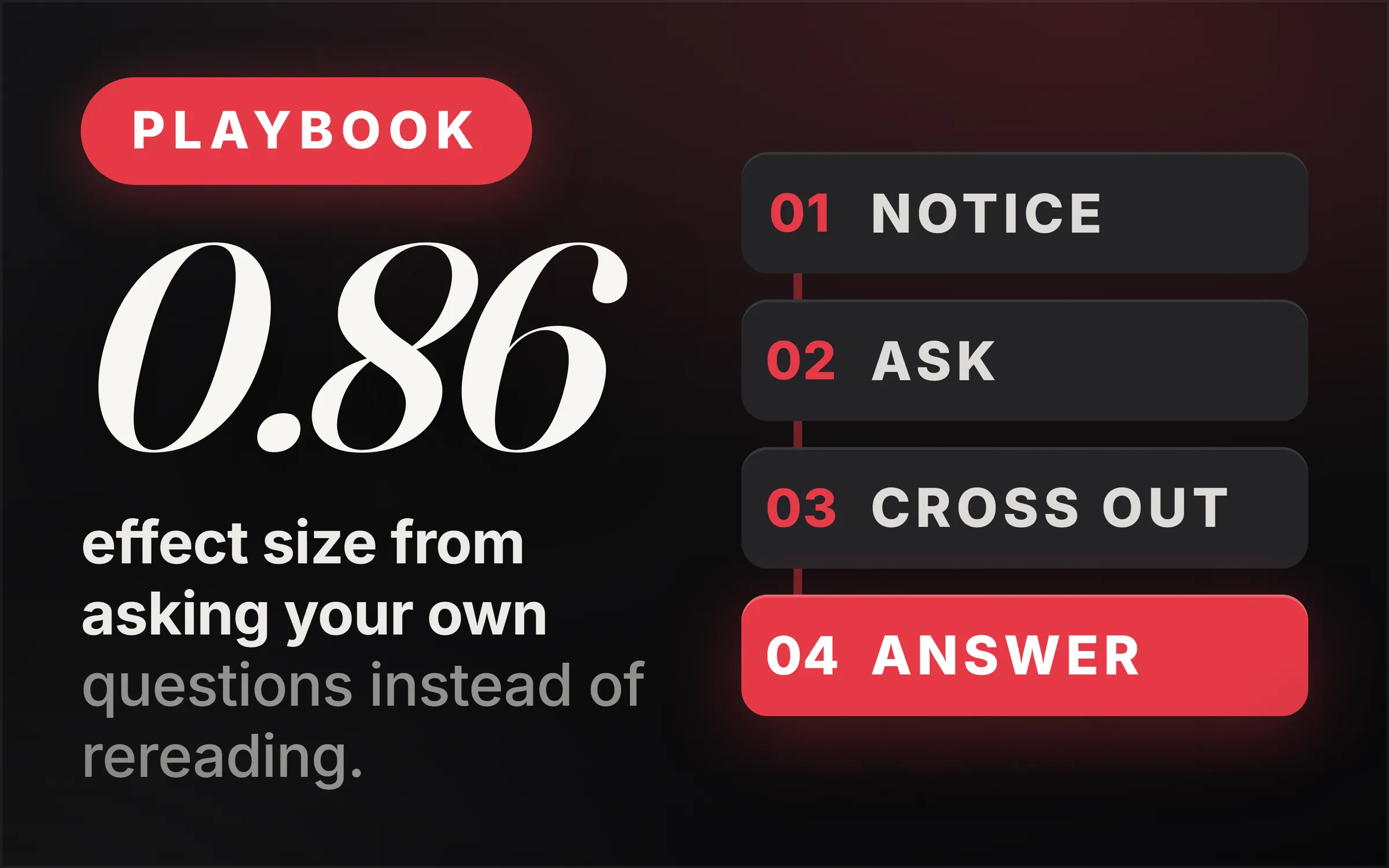
Turn the confusion into written questions before you ask anything. When a page stops making sense, stop reading and write the questions that would make the feeling go away, then answer those, with AI if you like. Barak Rosenshine's 1996 review of studies that taught students to generate their own questions found a median effect size of 0.86 on comprehension tests built for those studies.
That is one of the larger effects in the reading comprehension literature (on standardised tests the median was 0.36), from a technique that costs nothing. Reading pours a hundred pages into a small bucket. Five questions go out and bring back the five pieces that were missing.
The film works this on a real AI pricing page: $3 per million input tokens, $15 per million output tokens, a 200,000-token context window and cached input at a tenth of the price. You understand every word and still cannot say whether it will cost $9 a month or $900. That is the feeling. Pasting the page into a chat gets a fluent explanation of tokens and caching and leaves you exactly where you were.
The questions instead: how many tokens is one of my real requests; how many do I make a day; which part repeats every time, since that is what caching covers; what does my worst day look like; and where does the bill stop being trivial. Answer them. A real request of 800 tokens in and 400 out, 300 times a day, with 600 of the input tokens an identical system prompt, comes to about $61 a month at Claude Sonnet 4.6's published rates, and about $244 at four times the volume. Five questions and ten minutes of arithmetic, and the AI could have done every calculation in a second once you knew what to ask.
What makes a good question?
A good question is one the material in front of you cannot answer. If the answer is on the page, reading would always have got you there, so it was never what was confusing you. The test is one sentence: could this page answer this question? If it could, cross it out, however sensible it looks.
Run it over what people usually write. What is a token: gone, the page defines it. How does caching work: gone, there is a section on it. How much of my request repeats: the page has never met you. What does my worst day look like: the page cannot know. Every surviving question has you inside it. Confusion does not happen in the material. It happens at the join between the material and your situation, which is why you can read the same page four times and be just as lost.
When does this method not work?
It does not work for complete beginners. With no structure at all, confusion is noise, not a signal. John Sweller's cognitive load research finds novices learn more from studying worked examples than from wrestling with problems, and that advantage reverses as they gain ground, which is known as the expertise reversal effect.
D'Mello's team found the same shape: inducing confusion works best on people with some footing, who can be stuck without spiralling. So the honest rule is to get a rough map first, from a worked example, a decent overview or someone showing you, and then use the confusion, because now it has somewhere to point.
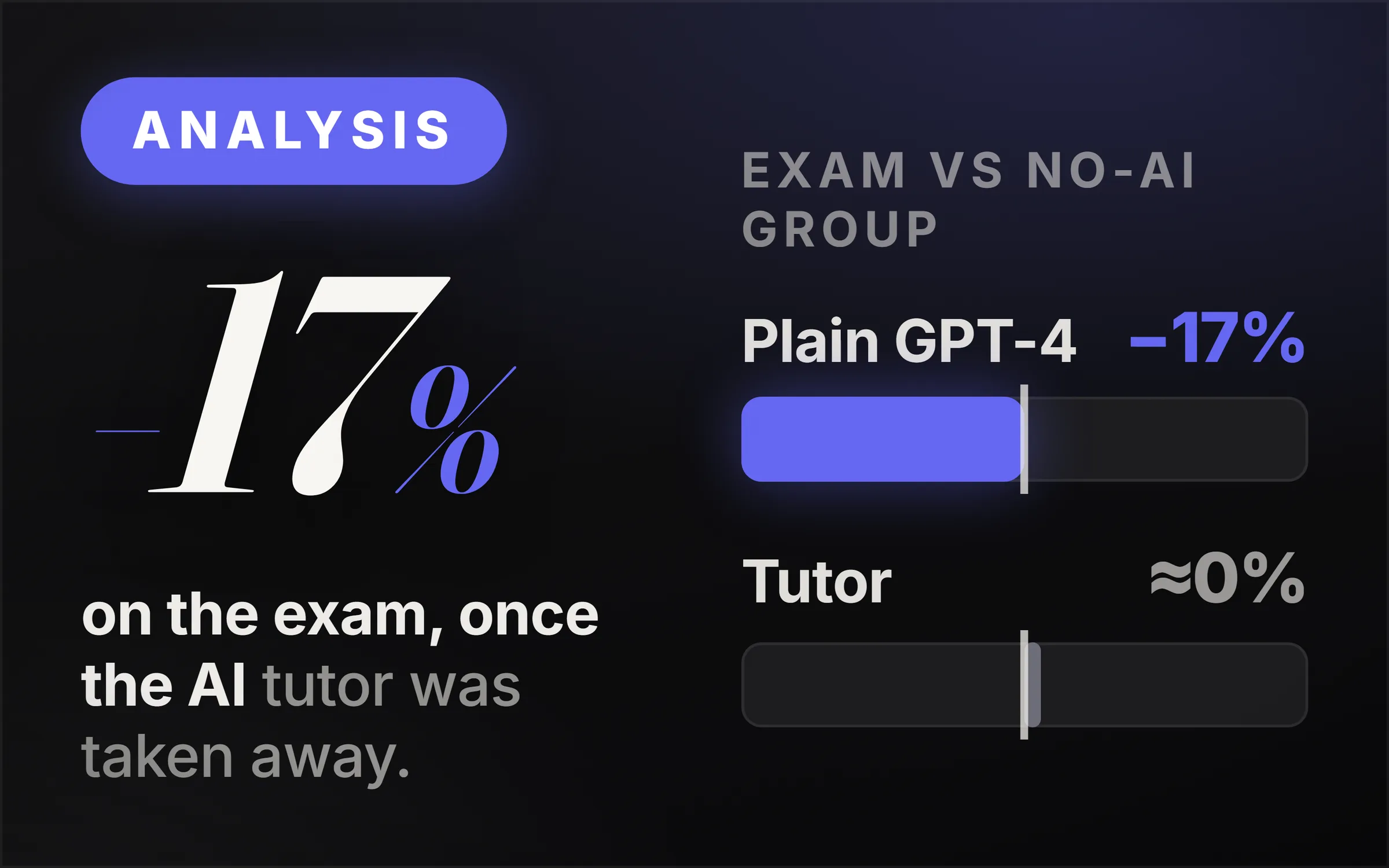
That applies at work as much as in study. A trial in Turkish high schools found students who practised with plain GPT-4 did 17% worse on the exam once it was removed, while those using a version that gave hints and withheld answers held level. The full story is in is AI taking entry-level jobs?, and the related trap of feeling faster while getting less done is in why AI isn't saving you time.
Next time an AI explains something to you, try explaining it to someone else straight afterwards. If you cannot, you were holding the feeling, not the thing.