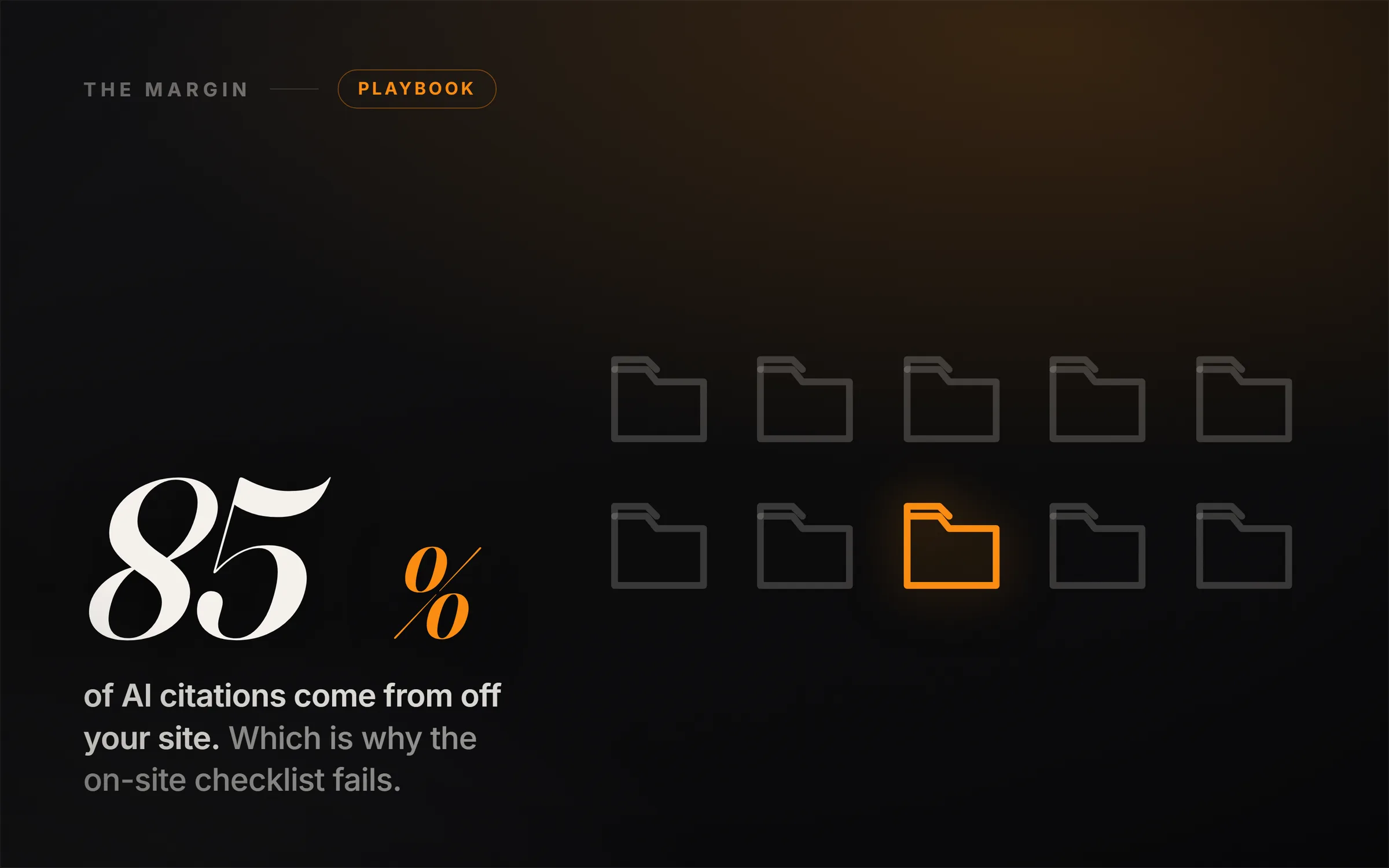
You get a local business recommended by ChatGPT by changing what other websites say about it, not by rewriting its own website. Muck Rack's May 2026 analysis of more than 25 million AI-cited links found 84% came from earned media, pages the business does not own, so the work is off-site first: listings, reviews and third-party mentions.
Muck Rack's Generative Pulse team analysed more than 25 million links from ChatGPT, Claude and Gemini responses across 17 industries and found that earned media accounts for 84% of all AI citations. Paid and advertorial content accounts for 0.3%. That is the May 2026 edition of the study, and across every edition since July 2025 the earned media share has held between 82% and 89%.
Read that as an instruction rather than a statistic. The pages an engine leans on when it recommends a business are overwhelmingly pages that business does not own and cannot edit. Which means the checklist most of this industry sells, schema markup and an llms.txt file and a tidier FAQ, is hygiene sitting on the small side of that split. It is worth doing. It is not the lever, and it is never what you sell as the lever.
What follows is the method we teach in full in the masterclass below: how to measure where a business actually stands across the four engines, what to fix and in what order, what the work sells for, and what to say in month four when the owner asks how many jobs came from it.
The film is the whole thing done on camera, 1 hour 22 minutes, thirteen parts with a checklist at the end of every one: the audit run live across four engines, the report written, the price set, the outreach sent, both layers of the fix delivered, and the first monthly report produced. Every template used in it is free at ideasrepay.com/academy/ai-visibility, with no email required. This article stands on its own.
How do you get a local business recommended by ChatGPT?
Work off-site first. 84% of AI citations are earned media, pages the business does not own, according to Muck Rack's May 2026 analysis of 25 million links. So the order is: claim and correct the listings machines read, then earn genuine third-party mentions, then tidy the website. Three words hold the whole job.
Clear. Can a machine reading this business work out what it does, where, and for whom. A home page that opens on craftsmanship and passion, with no address anywhere on it and nothing answering what a job costs or how long it takes, is not clear. It is decorative.
Consistent. Do the name, address, phone number and opening hours match everywhere the machine looks. When they do not match, the engine has no way to decide which version is true, so it either states something wrong or quietly names somebody else.
Cited. Does anywhere on the web mention this business other than the business itself. If every page about a company is a page that company owns, that is the low score, and given where citations come from it is also the expensive one.
Clear, consistent, cited. You measure those three in the audit, you improve those three in the fix, and you report those three every month. The value of the framing is that an owner understands it in one pass and can repeat it to a spouse or a business partner afterwards, which is usually who the actual decision goes through.
Why do ChatGPT, Perplexity, Gemini and Google give different answers?
Because two separate things happen when you ask, and almost every guide collapses them into one. First the engine retrieves: a crawler has read the web and built an index, and if a business is not in that store nothing else matters. Second it reranks, choosing 3 or 4 things to actually name out of everything it found. Being findable and being chosen are different jobs, and the money is in the second.
Different engines index different things and rerank differently, so they return different lists. Ask the same question in ChatGPT, Perplexity, Gemini and Google's AI answer and you get four overlapping but distinct sets of names. There is almost always one company that appears in all four, and that company is not usually the biggest or the best reviewed. It is the one the machines have the most consistent evidence about.
Then there is the part that unsettles people the first time they see it: ask the same question in the same engine three times within a few minutes and you can get three different answers, with one run naming a business the other two never mention. Answers also change by town, by account and by whether you are logged in.
That instability is not a fault in your method. It is the single most important fact about this field, it is why most people selling this service are doing it badly, and there is a professional way to handle it, which is to stop recording whether a business appeared and start recording how often.
What is an AI visibility audit and how do you run one?
A real audit is 12 customer questions, asked in 4 engines, 3 times each, spread across at least 2 days. That is 144 logged results and roughly a couple of hours the first time you do it. The output is not a screenshot, it is a presence rate: this business was named in 2 of 3 runs on this question, in this engine, under these conditions.
The conditions are half the work, because a comparison between two different setups is worth nothing next month.
CONDITIONS BLOCK, filled in before a single question is asked

- Every engine opened in an incognito window (no history, no cookies,
  no logins carried in)
- Logged out of every engine that allows it
- ChatGPT: personalisation and memory turned OFF in settings
- The location the engine believes you are in, written down
  (ask it directly if you are not sure)
- The date, the exact question wording, and the engine version

Diagnostic: if all three runs come back identical every single time,
you are still logged in somewhere. Real conditions produce variation.
Go back and check before you log a number.
Then you log every run, and you do not read the log by hand. You hand it to an assistant and have it do the counting.
Act as an AI-visibility auditor. Below are the answers ChatGPT,
Perplexity, Google's AI answer and Gemini gave for 12 customer
questions about [category] in [town]. Each question was run three
times per engine.

For each question tell me: which businesses were named, how many of
the three runs named [business], and which competitor appeared most
often. Then give [business] an overall presence rate as a percentage
of all runs, and the same for the top three competitors.

[paste your logged answers here]
What comes back is a scoreboard, and one competitor is usually well ahead of the rest. That is the company the machines trust, and whatever it is doing is what your client has to match.
Then pull the one line that sells. Ask the same assistant for the single most valuable question where the business never appeared and a competitor appeared in every run. That sentence, one specific question a customer with money and intent is typing, the client absent from it, a named rival always in it, is the most commercially valuable object in the entire audit. It is what goes in the first message to the owner, and it is why they reply.
Recording a rate is also what protects you in the room. When an owner pulls out a phone, runs your question and gets something different, you are not caught out, because your report already said 2 of 3. You knew.
Does schema markup or llms.txt get you recommended by AI?
No, and this is where most of an industry is spending client money. Ahrefs tested schema markup across nearly 2,000 pages and found no meaningful increase in citations on any engine. Google's own guidance states that llms.txt is not needed for any of its AI features. Both jobs together are an afternoon of work.
Do them anyway. Schema earns a business other things on Google, llms.txt costs 45 minutes, and neither one hurts. What changes is where they sit on the list and what you promise for them. They are hygiene, they are not the lever, and an owner who was sold them as the lever is an owner who has already paid somebody for a flat result.
There is a clean test for any tactic in this field: does it change what other people's pages say about this business. Schema does not. A first-party text file does not. Claiming a listing that feeds the engines does. Getting into the local roundup that Perplexity cites underneath its answer does. Eleven new reviews on a profile whose last one was eleven months old does.
We wrote up the three ways this goes wrong for people trying to sell the service in the three biggest problems in the AI visibility business, and the wrong-lever problem is the first of them for a reason.
Where does ChatGPT actually get local business information?
From business listings rather than web pages, which is what makes local work its own game. There are 4 platforms to check before anything else, and Local Falcon's study of where the local businesses in ChatGPT's answers come from found the first of them, Foursquare, to be the largest single source. Foursquare is a places database, OpenAI has a partnership to use it, and almost no owner has heard of it. Claiming a listing there is free.
Go to foursquare.com/venue/claim and search the business. One of two things happens. Either a listing already exists, because these databases were built years ago out of other sources and most businesses are in there without knowing, or there is nothing and you create one. Verification happens by a call to the business phone number, so the owner needs to be expecting it, and there is a paid option at about $20 that hands you management access immediately.
Then the rest of the places the machines read: Google Business Profile, claimed with the hours actually correct. Bing Places. Apple Business Connect, which matters because it feeds maps on every iPhone. The review platform for that trade, where recency does real work, because a profile whose newest review is eleven months old reads as a business that may not be operating. Reddit and the community threads where people ask for recommendations by name.
Check each one for three things: does a listing exist, has anyone claimed it, and are the facts on it right. Every empty row in that table is a piece of paid work, and this is where the 84% lives.
What can you charge for AI visibility work?
Three things sold to the same client in order: $500 to $2,000 for the audit, $1,500 to $6,000 for the 60 to 90 day fix project, and $800 to $3,000 a month for the local retainer. Your first audit or two can be free to win the client. Below $800 a month you are doing skilled ongoing work at a loss, and the clients who buy at that price are the ones who churn.
The retainer is the whole point, because it is the income that arrives whether or not you found anybody new this month. It is also honest: the off-site half of this work never finishes. There is always another listing, another month of reviews, another roundup.
Making the price land is arithmetic done out loud rather than persuasion. One kitchen remodel is worth several times a year of your retainer to a renovation company. One roof. One personal injury case. You are not promising a flood of work, you are asking the owner to picture a single job, and the comparison ends the price conversation before it starts. Learn that number for your category before you take a call.
For context on where you sit, agency programmes for small businesses in this field start around $1,500 a month and mid-market sits well above that. The line the industry keeps repeating is that under roughly $1,500 a month you are usually buying old search work with a new name on it. A single location renovation company is not a mid-market client, so a local retainer below that line is correct. Knowing where the line is matters for one moment: when an owner tells you somebody offered to do their AI for $200 a month, you know exactly what they were offered.
How do you prove it worked when there is no tracking?
You report movement as a rate, question by question. The line does not read that they now appear in ChatGPT. It reads that on this question they went from 0 of 12 runs to 5 of 12, under identical conditions, with the month zero screenshot beside this month's. That statement survives the owner running the query themselves and getting a miss.
Be straight about the timeline before any money changes hands: first movement shows up somewhere between 2 and 8 weeks, meaningful change takes 3 to 6 months, and the biggest lever is the slowest one. The same sentence said for the first time in month three is an excuse and sounds like one. Said in week one it is a professional being clear.
Then the question that arrives in month three or four, and it ends most agencies in this field: how many of those jobs came from this. The honest answer is that when somebody asks ChatGPT for a recommendation and then phones the business, nothing about that call says where it came from. There is no tracking inside a chat. Nobody has solved that, and anyone attributing revenue to AI answers is selling a number they invented.
So you do not fight the question. You say you cannot tell them which specific jobs came from it and neither can anybody else, then you move them onto the measure you can defend, which is that on the questions their customers ask they have gone from never being mentioned to being mentioned about half the time, and the company that used to win all of them now shares them. Then you give the owner a job: add one line to the phone script asking new callers how they found you. In six months that will tell you more than any tool.
One more monthly task, and it is the quietest reason people keep paying. Check what the engines say about the business, not just whether they name it. A wrong closing time in an AI answer usually traces back to one directory with old hours, and it spreads. Fix it at the source rather than arguing with the engine. Finding a wrong fact about a client before the client finds it is worth more than any report.
What is in the free kit?
10 working files, all free, no email required, at ideasrepay.com/academy/ai-visibility. Every one of them is used on camera in the film, in order, and they are .docx rather than PDF because these are documents you fill in.
The prompt pack, written so answers stay comparable between engines and between months. The audit template, and a repeat-sample edition of it built for the three-runs rule. A worked example with every field filled in for one business. The on-site and off-site fix checklist, in the order it pays to do things. The schema and llms.txt guide, written for somebody who has never opened a code editor. The outreach and demo scripts. The monthly client report. A plain-English service agreement. And a first five clients tracker, because five filled rows is the difference between a service and an idea about a service.
The engines are not going to stop recommending businesses, and they are not going to start explaining themselves. What they will keep doing is reading other people's pages about a company and repeating what they find. That is the whole opening. Almost every local business in every town is invisible in that process, most of the people selling to them are working the wrong end of that 84%, and the fix is slow, unglamorous and entirely learnable in an afternoon. Start with one question in one town and run it three times. The gap will be on your screen inside ten minutes.
If you want the case for the business itself before the method, that is the AI is recommending your competitor.