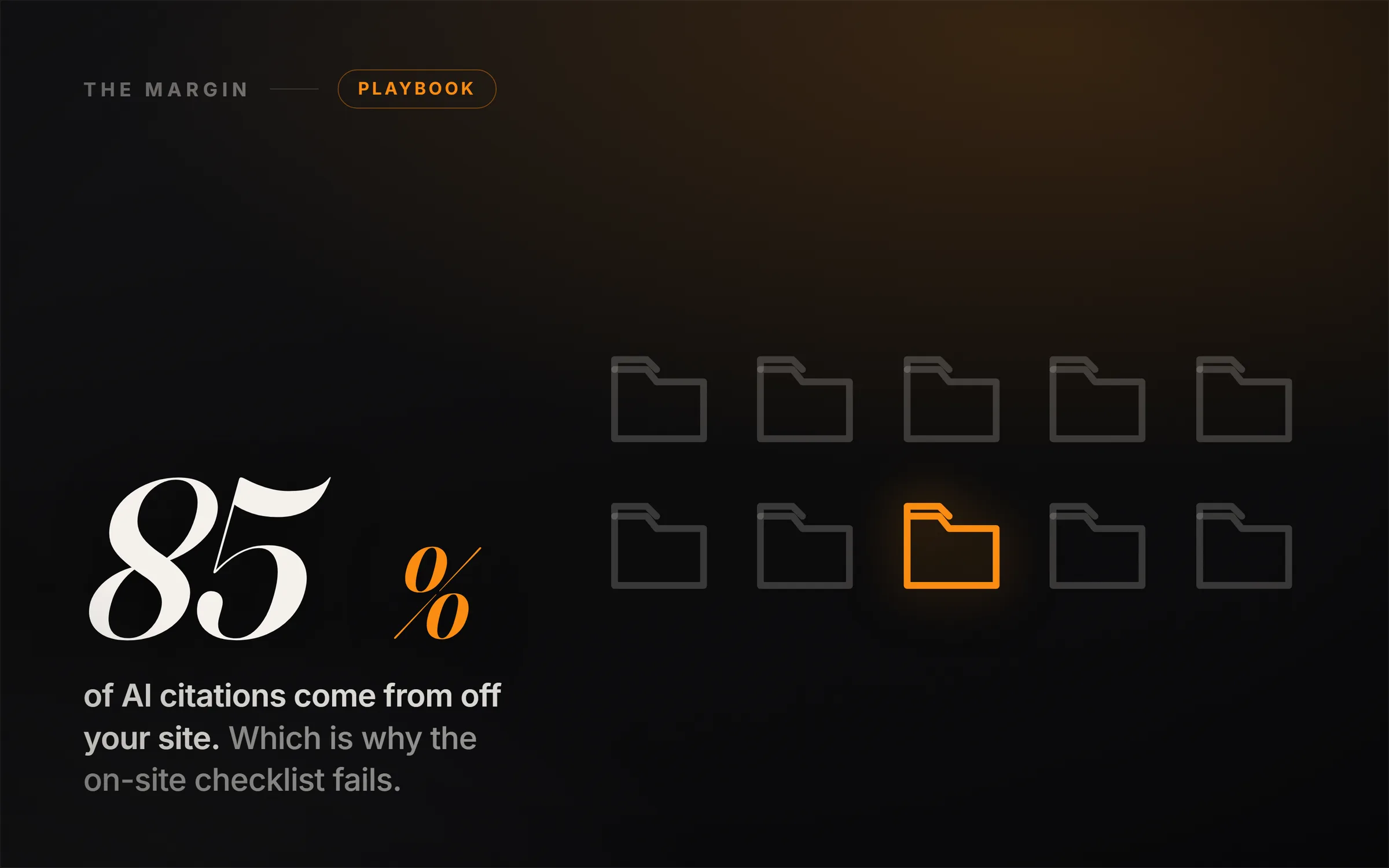
AI visibility is the work of making a local business the one ChatGPT, Perplexity or Google's AI names when a customer asks for a recommendation. Most of it happens off the business's own website: Muck Rack found 84% of AI citations come from earned media. It sells as an audit, a fix and a retainer of $800 to $3,000 a month.
Right now, somewhere in your town, a customer is opening ChatGPT and asking it to name the best dentist near them. And the AI is answering. Not with a page of ten blue links to sort through. With one name. For almost every local business, that name is their competitor, and the owner has no idea it is happening. They are still paying for Google ads and a website while the machine quietly routes their future customers somewhere else.
That gap is a brand new business, and almost nobody is filling it yet. It is called AI visibility, and it is the closest thing to being early to SEO in 2005 that you will see this decade. We research and document opportunities like this at IdeasRepay, so every number below is written from inside the work, and every dollar figure is a range of what operators typically charge in 2026, not a promise of what you will make.
The video walks the whole opportunity out loud, with the real reports and the real AI answers on screen. The written version below stands on its own and carries the exact mechanism, the pricing, and the first move. Read it, watch it, or both.
What is AI visibility?
AI visibility is making a business the one ChatGPT, Perplexity or Google's AI names when a customer asks for a recommendation. Marketers also call it generative engine optimization (GEO), a term Princeton researchers coined in 2023, or answer engine optimization (AEO).
Marketers gave this an ugly name: generative engine optimization, or GEO. Some call it answer engine optimization, AEO. The plainest way to say it is AI visibility, and the job is simple to state: you make a business the answer the AI recommends when a customer asks ChatGPT, Perplexity, Gemini, or Google's AI Overviews for the best option in their category and town.
It is the SEO of the AI era, but it is not old SEO with a new label. Traditional SEO is about ranking a link on Google's results page. AI visibility is about being the name the AI says out loud when it answers. They share some foundations, but the work that actually moves the AI is different enough that most old agencies are behind on it. That gap is your opening.
Why is AI visibility a business opportunity now?
Timing is the entire point, and the numbers are not subtle.
- ChatGPT just crossed 900 million weekly users, up from 800 million a year earlier. That figure comes from OpenAI itself.
- The old winners are not the new winners. Many of the pages AI engines cite do not rank in Google's top ten at all. The company that spent ten years and a fortune climbing Google is not automatically the answer the AI gives.
- The big players validate it, which de-risks your pitch. Adobe paid nearly two billion dollars to acquire Semrush, a brand-visibility platform, and launched Adobe Brand Visibility. Ahrefs shipped Brand Radar, whose tagline is literally "make AI recommend your brand." When you tell a client this is real, you are backed by the whole industry.
- The field is about two years old. The term GEO was coined by Princeton researchers in 2023. The tracking tools were founded in the last two years. There is no ten-year veteran to out-credential, because ten years ago this did not exist.
Being an ordinary person who moves early beats being an expert who moves late here, because AI trust compounds over time.
How does AI decide which business to recommend?
It favours businesses that are clear, consistent and cited: easy to understand, with the same facts everywhere, and referenced by trusted third parties, which is where most of the weight sits.
To make a business the answer, you have to understand how the machine chooses. It is less mysterious than it looks. Boil it down to three words.
Clear. Can the AI easily read and extract what the business is and does? That means answer-first content, question-shaped headings, and structured data (schema) so the AI can label the facts. A page that buries its answer under three paragraphs of fluff is hard to cite.
Consistent. Do the name, address, phone, hours, and description match everywhere the AI looks? If the facts differ across the web, the AI loses confidence. One canonical set of facts, repeated verbatim everywhere, makes a business a trustworthy entity.
Cited. Do trusted third-party sources reference the business? This is the one people underestimate and where most of the power lives. Muck Rack's Generative Pulse study of more than 25 million AI-cited links, May 2026 edition, found 84 percent were earned media, pages the business does not own. Review platforms, local "best of" roundups, reputable directories, and community discussions. A business that only talks about itself is far weaker than one the whole web talks about.
Almost every task you will ever do for a client serves one of those three. When you audit, you measure them. When you fix, you improve them. And the AI tools do most of the production for you: drafting answer-first content, generating the schema, finding the roundups to target, and writing the outreach.
How does an AI visibility business make money?
With 3 sales to the same client: an audit for a few hundred to a couple of thousand dollars, a fix project, and a local monthly retainer of $800 to $3,000.
You sell three things in sequence to the same client, which is both your delivery process and your sales ladder.
| Offer | What it is | What operators charge (2026) |
|---|---|---|
| AI Visibility Audit | A report showing exactly where the business stands in the AI answers and where competitors beat them | 500 to 2,000 dollars (first ones free to win the client) |
| Fix Project | The 60 to 90 day on-site and off-site work that gets them appearing and recommended | 1,500 to 6,000 dollars |
| Monthly Retainer | Ongoing monitoring, off-site building, fresh content, and plain-language reporting | 800 to 3,000 dollars a month |
The math is friendly to an ordinary person: ten to fifteen local retainers at an average of 1,500 dollars a month is 15,000 to 25,000 dollars a month, run part time from a laptop. You are not chasing volume, you are stacking a modest number of recurring relationships.
How do you sell an AI visibility service?
This business has the strongest free sales demo of any service we document, and it is what makes it almost unfair to sell. You do not walk in and pitch. You pull out your phone, ask ChatGPT to name the best in the owner's category in their town, and let them watch it recommend their rival, live. No owner forgets that moment.
Then you hand them a simple audit that shows exactly where they stand and why, you do the work to fix it, and you charge a monthly retainer to keep them there. The AI's own answer does the persuading. You just frame it.
Why do AI visibility clients keep paying monthly?
Here is the objection every beginner worries about: once it is fixed, why would anyone keep paying? The answer is the best part of the business. The sources these AI engines cite shift from month to month. The answer that names your client today can name their competitor next month. Somebody has to watch it, maintain the off-site citations, catch misinformation, and keep them visible as the engines shift.
That is not a flaw in the business. It is the engine of it. The instability that scares people is exactly why this is a durable monthly service and not a one-time trick.
Is it too late to start an AI visibility business?
No, it is not too late, and this is one of the rare businesses where that is genuinely true. The whole field is a couple of years old, the tools were founded in the last two years, and most agencies and nearly all local businesses have not touched it. You can close the small gap to the "experts" in weeks of focused learning.
It rewards clarity, diligence, and being early, not pedigree. If you can follow a checklist, write clearly with an AI's help, and talk to a local business owner like a helpful human, you have the raw material. No coding. The one honest requirement is that you actually learn how AI search works before you sell it, because you cannot fake understanding to a worried owner.
How do you start an AI visibility business this week?
- Run the free test today. Open ChatGPT and Perplexity and ask, as a customer would, "who is the best [a common local service] in [your town]?" Screenshot who gets named and who is invisible. That gap is the whole business.
- Pick one niche. Dentists, law firms, med spas, home services, restaurants. Focus so you learn the category's exact customer questions and become "the AI visibility person for [category] in [region]."
- Do three free audits. They make you genuinely competent and become your proof and your door-openers.
- Run the demo-driven outreach, close the audit into a project and a retainer, deliver, and let results refer you onward.
We wrote up the entire thing, the exact audit template, the on-site and off-site fix checklist, the outreach and demo scripts, the client report, and a fully worked example, as a step-by-step blueprint. If you want the execution and not just the idea, it lives here: The AI Visibility Service blueprint.
The idea is yours now. Go ask the AI who it recommends in your town. We think the gap you see is going to bother you, in the best way.