Handle scope creep by pricing every request instead of refusing it. The sentence that does the work is some version of "yes, I can add that, here is what it costs and what it does to the timeline," and it resolves the great majority of cases without a single difficult conversation.
That works because scope creep is not usually a client trying to extract free labour. It is a client having ideas, in an environment where nobody has told them ideas have prices. Refusing makes you the obstacle. Quoting makes the request a decision they get to make, and about half the time they decline it themselves, which is the outcome you wanted and it did not cost you the relationship.
What is scope creep, and why is it so hard to stop?
Scope creep is the gradual expansion of agreed work through a series of small additions, none of which is worth a confrontation on its own. Its power comes entirely from the sequence, not the size.
Consider how it presents. "Could you just also do the mobile version." "While you're in there, could you fix the contact form." "Can we try a second option for the header." Each one is a few hours. Each one arrives in a friendly message from someone you are enjoying working with. Refusing any single one of them would make you look rigid over something trivial, and that calculation is correct every individual time. It is only wrong in aggregate, and by the time the aggregate is visible you have already established six weeks of precedent that these things are free.
The second reason it is hard is that agreeing feels like good service, especially early in a business when you are trying to be the kind of supplier people recommend. The instinct is sound and the execution is backwards. Clients do not refer suppliers because they got extra work for nothing. They refer suppliers who delivered what they promised, on time, without drama, and a project drowning in unpaid additions delivers late and resentfully.
What do you say when a client asks for something extra?
Say yes, then state the price and the effect on the date. One short message: this is a good addition, it is an extra amount, and it moves delivery by a period. Would you like me to add it.
This is effective for a reason worth understanding. It never puts you in opposition to the client. You are not judging the request or defending your contract, you are doing your job, which is telling them what things cost. The client is then making a normal purchasing decision with real information, and they are entirely capable of that.
What happens next splits three ways, and all three are good outcomes. They approve it, and you are paid for the extra work. They withdraw it, which tells you it was an idea rather than a need. Or they ask to swap it for something already in scope, which is a genuine trade and often the right answer for both of you. Compare that to absorbing it silently, where you get more work, no money, a later delivery, and a client who now expects the next one to be free too.
Two details matter. Confirm in writing, however briefly, because verbal approvals of scope changes are how disputes start. And quote it properly rather than symbolically, because a nominal price signals that the boundary is theatre.
When should you say it, and how do you avoid seeming difficult?
On the first request, before any precedent exists, and in a tone that treats it as ordinary rather than as a correction.
The first request is the cheapest one to price, and every one after it is more expensive to push back on, because by then the client has formed a reasonable expectation from your own behaviour. Somebody who absorbs four additions and then objects to the fifth appears to have changed the rules mid-project, and from the client's side that is exactly what happened.
Framing carries the rest. "Happy to add that, it is a bit outside what we scoped, so here is what it comes to" is not a confrontation, it is an ordinary supplier answer, and it is how every other vendor the client deals with behaves. Nobody is surprised when their accountant charges for work outside the engagement letter.
The pattern to avoid is the silent-then-explosive one: absorb everything without comment while resentment accumulates, then deliver a long message about how much extra work has gone in unpaid. That reads as a grievance, it surprises a client who thought everything was fine, and it damages the relationship far more than pricing the first request ever would have.
How do you prevent it before the project starts?
With a written exclusion list and a stated revision count, agreed before work begins. That document is the only defence that functions, because without it every disagreement becomes a contest of recollection, and you will lose that contest even when you are right.
The exclusions to write down are the ones you can already predict, and after two or three projects in the same trade you can predict nearly all of them. Ongoing maintenance after handover. Content the client is supplying. Anything on a different platform. Additional rounds beyond the agreed number. Training. Rush turnaround. None of this is contentious at the start, because at that point the client is forming an understanding of what they are buying rather than trying to get more of it.
The revision count is the single most valuable line in the document. "Until you are happy" is not a scope, and it is usually offered by the supplier rather than demanded by the client. Two rounds, with the point of each named, gives feedback a shape and gives the project an end. We set out where all of this belongs in the sequence in how to onboard a new client.
What if the project has already drifted?
Stop, take stock, and reset once, in writing, without relitigating the history. The reset works. The argument about how you got here does not.
Write down what was originally agreed, what has been added since, and where that leaves the delivery date and the budget. Then present the position and the options: proceed with the expanded scope at an adjusted price and date, or return to the original scope and park the additions. Neutral, factual, no accounting of who was unreasonable.
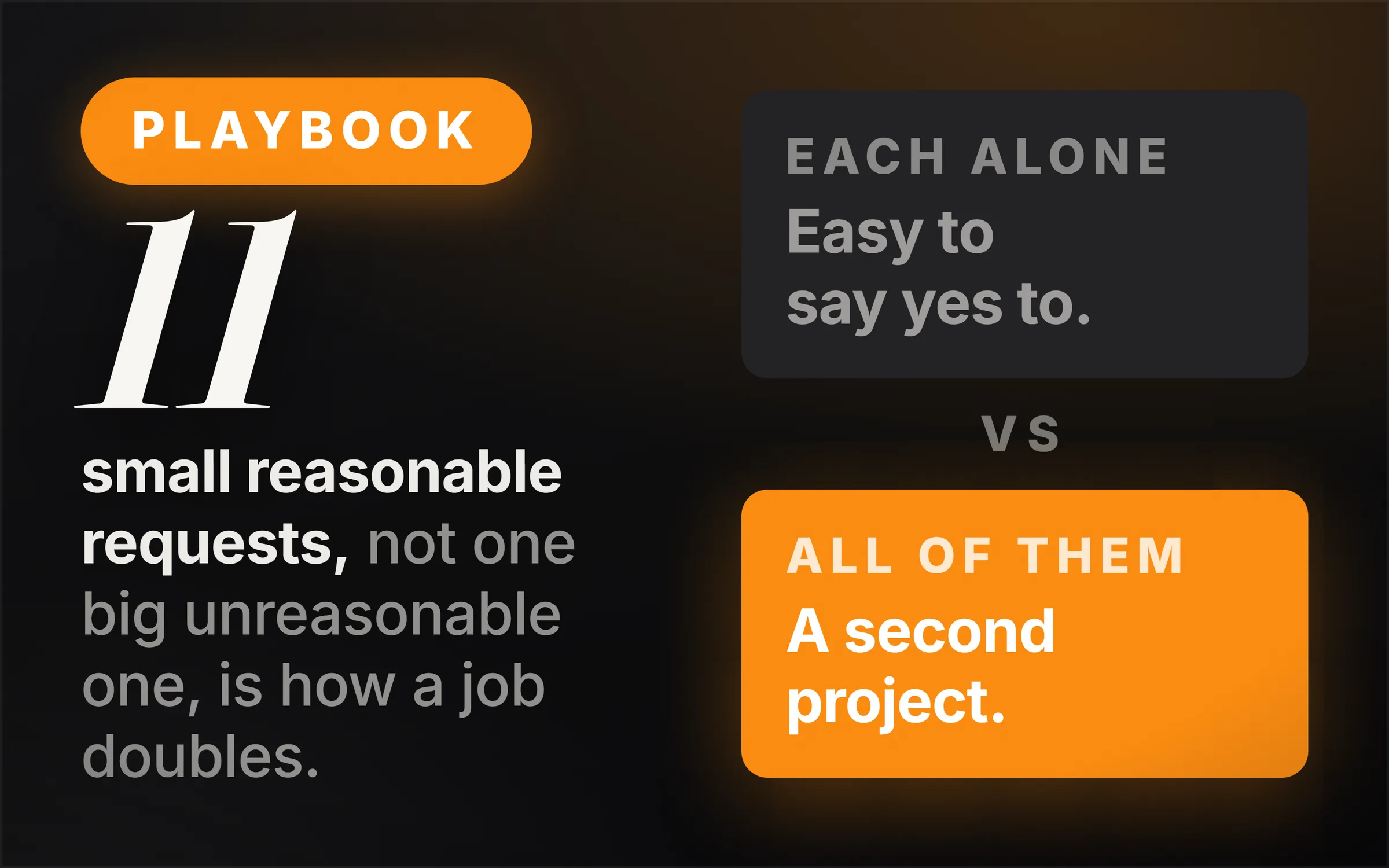
Most clients accept a reset like this with less friction than expected, for a simple reason. Clients frequently have no idea how much has been added. Each request was a passing thought to them, sent and forgotten, and seeing eleven of them listed together is genuinely new information. The list does the persuading, which is another reason to have been keeping a record of the approvals as you went.
Do it once. A project that gets reset twice has a structural problem: either the original scope was never definable, or there is no real decision-maker, or the relationship is not one worth continuing on these terms.
Are small favours ever worth doing for free?
Yes, and this is where a purely mechanical policy gets it wrong. A genuinely small thing, done once, at a good moment, buys real goodwill, and goodwill is worth something.
The distinction is whether it is named. A favour that is done and mentioned as a favour is a deposit into the relationship: "I have added that in, it was quick, no charge this time." A favour absorbed silently is invisible, and invisible work does not generate goodwill because the client never knew it happened. Worse, it resets the baseline, so the same request next month is not a favour any more, it is the standard.
Keep them genuinely small, keep them rare, and never let them touch the delivery date. The version that reliably goes wrong is the free addition that pushes the project late, because you then absorb both the cost and the blame, and you are apologising for a delay caused by work you were never paid for. That combination is where quiet resentment in service businesses mostly comes from.
The honest hard part
The hard part is that scope creep is usually a symptom rather than a disease, and the disease is upstream. Projects that drift badly almost always had a vague scope, an absent decision-maker, or a price so low that the client was never treating the boundary as real.
The vagueness is the most common. A deliverable described in adjectives rather than in countable things cannot be exceeded, because there is no edge to exceed, and every request is arguably inside it. That is not the client being difficult. It is the scope being unwritable, and the fix is at the quoting stage, not the delivery stage.
The underpricing is the most painful. A job priced too low makes every additional request feel like an injustice, because the margin was never there to absorb anything, and the supplier's tolerance is exhausted before the project starts. The same requests on a properly priced job register as ordinary. If additions consistently feel like a violation rather than an inconvenience, the number was probably wrong, and that is a pricing problem wearing a boundaries costume. We wrote about deriving one properly in how to price a service with no track record.
The last thing worth saying is that the discomfort never entirely goes. Pricing a request from someone you like will always feel slightly awkward. What changes is the recognition that the awkward thirty seconds is very cheap compared with six weeks of unpaid work and a delivery you have come to dread.
Most of this is won before delivery starts, in the document that set the boundary in the first place. That is covered in how to write a proposal that closes.