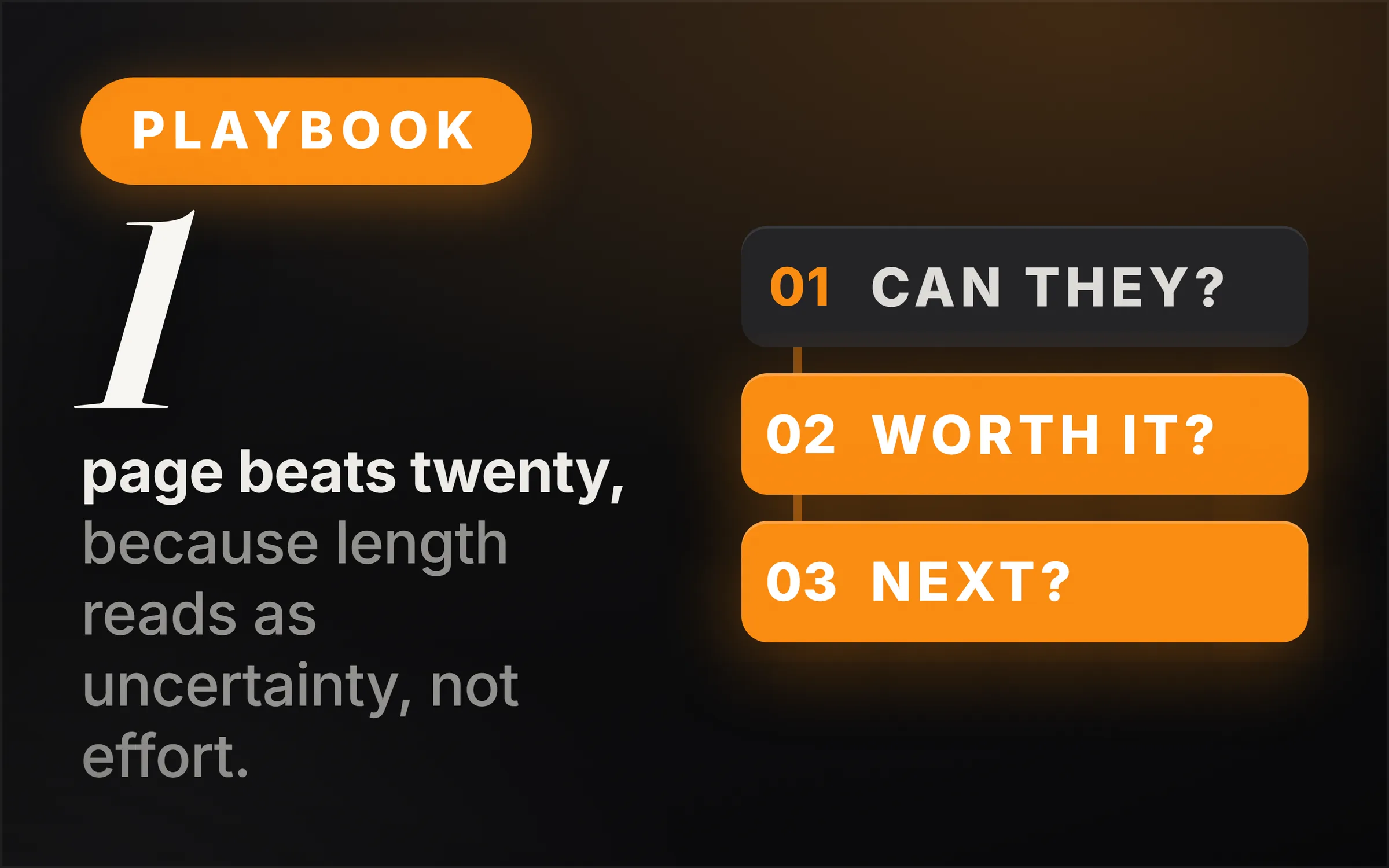
A proposal closes when it restates the client's problem in their own words, names one recommended option with a price, and ends with a single clear action to take. Length works against you. A one-page document that a decision-maker reads in ninety seconds converts better than a twenty-page deck that gets forwarded, skimmed, and parked.
The reason is that most proposals answer the wrong question. They are built to prove capability, which the client usually settled during the conversation that produced the request. What is unresolved is commitment: whether this is worth the money, whether the risk is manageable, and what happens on Monday. A document aimed at the first question is a brochure. A document aimed at the second is a proposal.
What should a proposal actually contain?
Six sections, in this order: the problem as they described it, the outcome you are proposing, what is included, what is excluded, the price and terms, and the next step with a date. Nothing else earns its place.
The order is doing real work. Starting with their problem proves you listened and buys the attention for everything after it. Starting with your company history, as most templates do, spends the reader's best thirty seconds on the least relevant content in the document.
Exclusions deserve their own line rather than being implied, and new operators leave them out because they feel negative. They are the opposite. Explicit exclusions make the included scope credible, they prevent the drift that turns a profitable job into an unprofitable one, and they let you say yes to extra work later at a price rather than having to refuse it. We set out how that plays through delivery in how to handle scope creep.
What does not belong: a company overview, a methodology section describing your process in abstract terms, stock photography, a mission statement, and testimonials from clients in unrelated industries. Every one of those is included to look substantial, and every one of them dilutes the two paragraphs that decide the outcome.
How long should a proposal be?
One page for most service work. Two or three if the engagement is genuinely complex or the buyer's process requires more. Beyond that you are writing for your own comfort rather than for the reader.
There is a belief that length demonstrates effort and therefore justifies price. It demonstrates the opposite. A long proposal reads as hedging, and it reliably delays the decision, because a document that requires twenty minutes gets scheduled rather than read, and anything scheduled competes with everything else in the week. The proposal that gets a decision is the one that can be read on a phone between meetings.
Length also increases the number of things that can be objected to. Every additional paragraph is another surface where the reader can find a reason to pause, ask a question, or route it to someone else for an opinion. Brevity is not laziness here. It is removing the places where a yes can get stuck.
If the buyer's organisation genuinely requires a formal document, the fix is a short proposal with an appendix, not a long proposal. The decision content stays on page one and the supporting detail sits behind it for whoever needs it.
Should you offer multiple pricing options?
Usually not, and this is where common advice is wrong for small service businesses. Offering three tiers is standard guidance, and what it mostly produces is comparison instead of commitment.
The mechanism is straightforward. A single recommendation asks one question: yes or no. Three options ask the client to become an expert in your service, evaluate trade-offs they have no basis for judging, and construct a rationale for a middle choice. That is work, and work gets deferred. The most common outcome of a three-option proposal is not a smaller sale, it is a delayed one.
The version worth keeping is one recommendation plus one clearly labelled optional add-on. That preserves a sense of choice without requiring analysis, and it gives the client something to say yes to beyond the base if they are enthusiastic. What it never does is force them to decide what kind of buyer they are.
There is a legitimate exception. Where the client has genuinely different budget realities that you cannot read, a smaller scoped alternative can rescue a deal that would otherwise be a flat no. Present it as a fallback rather than as a parallel option: this is what I recommend, and if the budget is not there, here is the reduced version and what comes out of it.
How do you present the price?
Once, plainly, as a statement, in its own line, with no preamble and no justification underneath it. "The fee for this is four thousand two hundred dollars." Then the terms, then move on.
The instinct is to build up to it, to itemise it into components so it looks smaller, or to follow it immediately with an explanation of the value. All three make the number feel negotiable. Itemising is the most damaging, because a line-by-line breakdown invites the client to remove lines, and you have handed them a menu you did not intend to offer.
Terms belong next to the price because they are part of it: the deposit, the schedule, and what triggers each payment. A price without terms is incomplete and it forces a second conversation, which is another opportunity for the process to stall. The mechanics of those terms are in how to invoice clients and actually get paid.
And the number itself should be one you decided before writing, from your own floor and your research, rather than one you arrive at while typing the document. Prices set during composition drift downward, because writing the proposal is the moment the doubt arrives. We set out how to derive one properly in how to price a service with no track record.
How do you end a proposal?
With one specific action, attached to a date, that requires no thinking. "If this looks right, reply with the word yes and I will send the agreement today, with a start on the ninth."
The default ending is "let me know your thoughts," and it is where proposals go to die. It requests reflection rather than a decision, it names no action, and it sets no time. The client is not refusing when they fail to respond to it. They simply were not asked to do anything, and the document quietly moves down the inbox.
An expiry can help and it has to be real. A start date that genuinely depends on your availability is honest and creates a natural deadline. A fabricated scarcity is transparent to anyone who has been sold to before, and it costs more credibility than it buys urgency.
The other half of the ending is what you do afterwards. Agree the follow-up at the moment you send it, ideally on the call: I will send it today, I will follow up Thursday if I have not heard. Then follow up on Thursday. Silence after a proposal is almost never a rejection, and the single most common reason a deal dies is that the sender interpreted a busy week as a no and never asked again.
Should you send a proposal at all?
Often not, and this is the most useful question in the article. For small, well-understood work, a short email confirming what you discussed, the price and the start date closes faster than a formal document and feels lighter to say yes to.
Proposals carry a cost that is easy to miss. They introduce a delay between enthusiasm and commitment, and enthusiasm decays. A client who was ready to proceed at the end of a call is meaningfully less ready three days later when a PDF arrives, because the conversation has faded and other priorities have arrived. Formalising the moment can cool it.
The test is whether anyone other than the person you spoke to needs to be persuaded, or whether the engagement is large or complex enough that a shared written scope genuinely protects both sides. If neither is true, send the email version: here is what we agreed, here is the price, here is when I can start, reply yes and I will send the agreement.
What you should never do is send a proposal to somebody you have not spoken to. A proposal is a written confirmation of a conversation, and without the conversation it is a guess about a problem you have not diagnosed. Those are the ones that get no reply, and the failure happened before the document was written.
The honest hard part
The difficult part of proposals is that the document gets blamed for outcomes it never controlled. People rewrite, redesign and lengthen them looking for the version that converts, when the conversion was almost entirely determined by the conversation beforehand.
If the discovery call established the problem clearly, confirmed the budget was real, and identified who decides, the proposal is a formality and its design barely matters. If it did not, no document rescues it: you are writing to somebody who has not agreed there is a problem, or who cannot authorise spending, and a better layout does not fix either. The proposal is where the weakness of the conversation becomes visible, which is why it feels like the proposal failed.
The second hard part is the waiting, and it makes people behave badly in a specific way. Silence gets read as rejection, and the response is either to disappear out of pride or to send an anxious follow-up that discounts the price unprompted. Both are unforced errors. A follow-up that adds nothing but a date, sent when you said you would send it, is the correct move, and it recovers a surprising share of deals that appeared dead.
If the gap you are trying to close is earlier than this, and the real problem is getting into the conversation at all, that sequence is in how to get your first client without asking for one and, once you have one, how to get your second client.