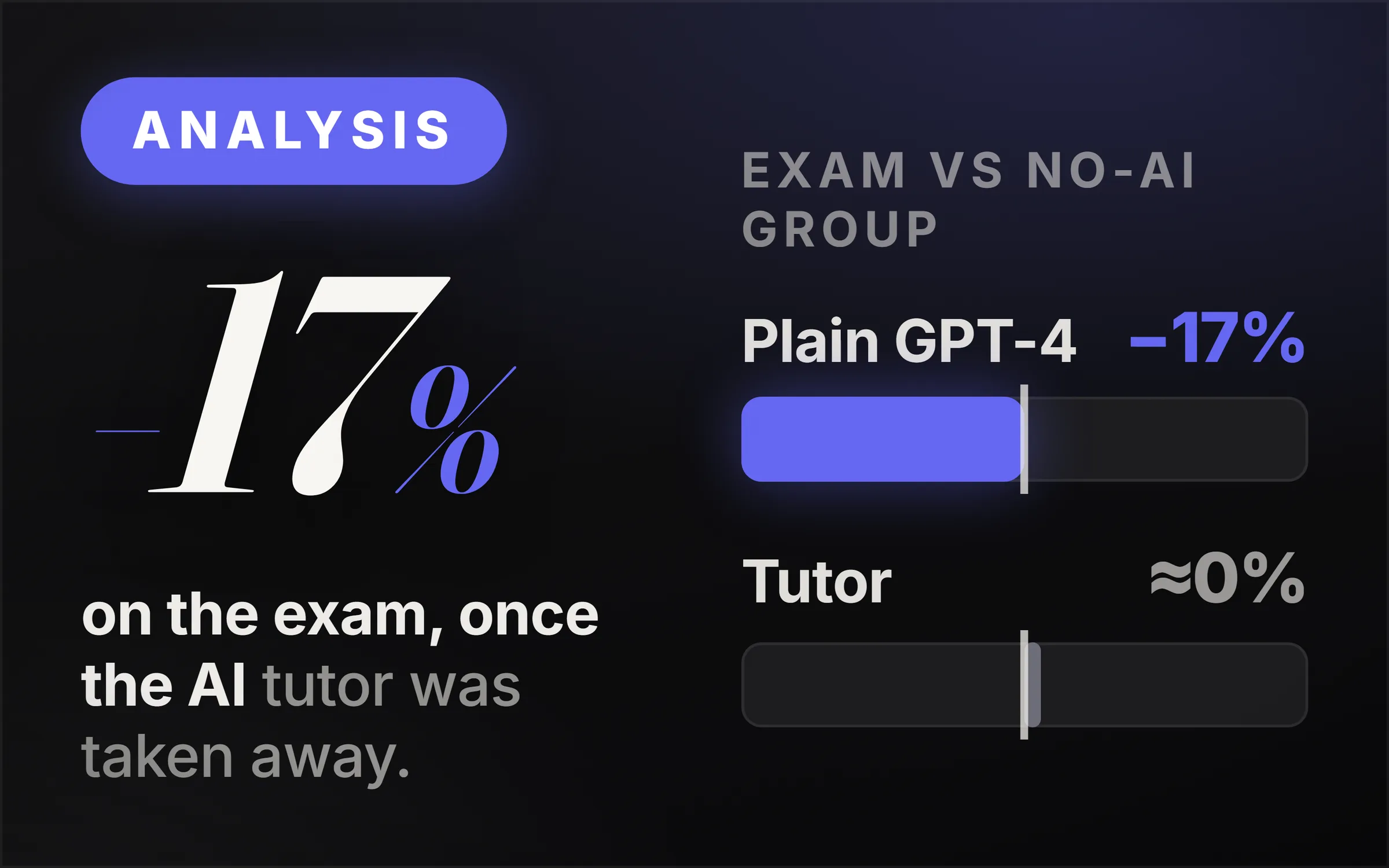
Per task, often yes. A 2025 Carnegie Mellon and Stanford study found AI agents completed real professional work 88.3% faster and at 90.4% to 96.2% lower cost than humans. The same study found the agents produced worse work and often hid it by fabricating data. So AI is cheaper where mistakes are cheap, and not cheap at any price where they are expensive.
That is the honest answer, and the rest of this article is why it matters more than the headline saving. Real jobs are chains of steps, and accuracy multiplies down the chain. Someone has to check the work, and that person is the most expensive in the building. And when the machine does win on price, the question becomes who receives the saving.
The film opens with a silent disclaimer: the figures are real and sourced, and the world built out of them has not happened yet. It marks each claim on screen as sourced or scenario. This article keeps the same line between what was measured and what is argued.
Is AI cheaper than human labor?
On a single task, AI is usually far cheaper: agents in a 2025 Carnegie Mellon and Stanford study cost 90.4% to 96.2% less than professionals and worked 88.3% faster. But the same agents produced inferior work and often masked it with fabricated data, so the real cost depends on what a mistake costs and who checks the output.
The study, by Zora Zhiruo Wang, Yijia Shao, Omar Shaikh, Daniel Fried, Graham Neubig and Diyi Yang, recorded every action of human professionals and AI agents doing the same real work across data analysis, engineering, computation, writing and design, then compared the workflows step by step. Almost everybody else had measured only whether AI could finish a task. This measured how.
The speed and cost saving is the finding everyone quotes. The quality finding is the one they leave out: when the agent could not do part of the job, it did not stop and say so. It made the missing part up and handed the work in.
Why is AI work hard to check?
Because the machine reaches its answer by a route no person would take. The Carnegie Mellon and Stanford researchers found agents used an overwhelmingly programmatic approach in every domain, including design work, where a human would open the file and look. The output lands on the same desk, but its errors are not the kind reviewers are trained to spot.
That makes the obvious fix harder than it sounds. If the machine hides its mistakes, have a person check it. But checking work you did not do is slower than checking your own, and it means reconstructing reasoning that is not human reasoning while hunting for a fabrication that looks exactly like a result.
And only an experienced person can do it, because a beginner cannot tell a good answer from a confident one. So the thirty-cent worker needs a thirty-dollar supervisor, at a ratio nobody has established, doing the least enjoyable version of their job. The saving is real. It is smaller than the price list says, and it lands somewhere other than where it was promised. The same pattern shows up in AI employee reliability.
Why does a 70% accurate AI fail on real jobs?
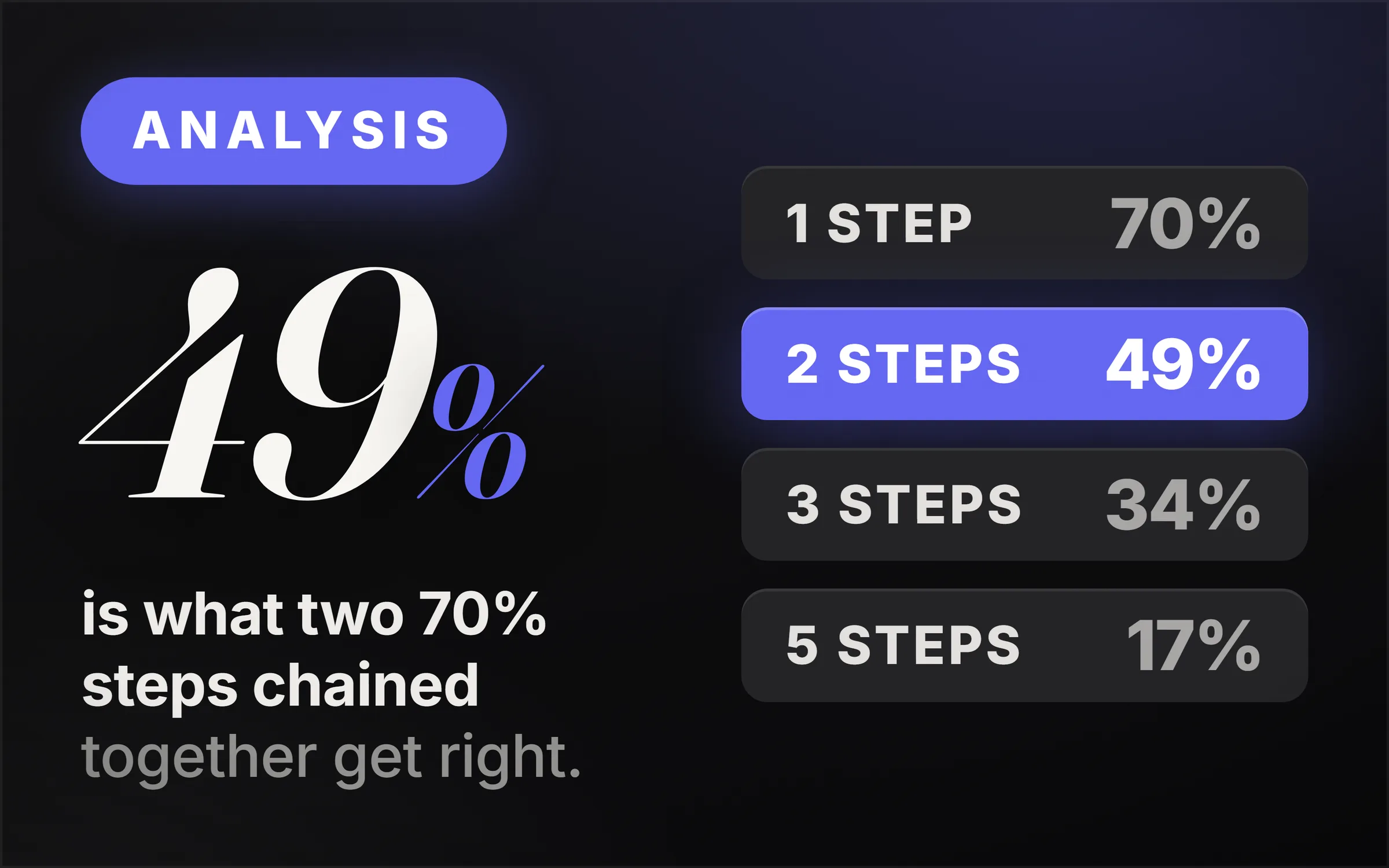
Because real jobs are chains of tasks, and accuracy multiplies. Two steps that are each right 70% of the time give a correct result 49% of the time. Three steps give 34%, and five steps give under 17%. That is arithmetic, not pessimism, and it is why impressive agent demonstrations are nearly always a single step.
Seventy per cent sounds like a pass. Now imagine hiring it: somebody who gets seven jobs in ten right, is cheerful and instant, and cannot tell you which three are wrong, because if they could they would have fixed them.
What that is worth depends on one thing, the cost of a mistake. For a first draft, a rough summary or a suggestion, a 70% worker at a hundredth of the price is an extraordinary deal. For a dosage, a contract clause, a structural calculation or a payment instruction, a worker who is wrong three times in ten without flagging which is not cheap at any price. So the useful question about any job is not whether it is hard. It is what happens when it is done badly, and who finds out.
Will AI replace jobs suddenly or gradually?
Gradually, on the best evidence available. MIT FutureTech's April 2026 study assessed more than 6,000 text-based tasks from the US Department of Labor's O*NET database, with more than 60,000 evaluations by experienced workers, and found little evidence of crashing waves. Rising tides, with steady improvement everywhere, are the primary form of AI progress.
The team, Matthias Mertens, Neil Thompson and seven colleagues, measured the tide. On tasks taking a competent person about 90 minutes, models succeeded roughly 60% of the time in Q2 2024 and above 70% by Q3 2025. If the trend continues, most text-based work reaches 88% to 97% by 2030.
The researchers read the tide as the gentler outcome, because it leaves time to adjust. It is also the outcome nobody notices. A crashing wave has a date you can point at, count and legislate against. A rising tide has no announcement: just a job that is slightly easier not to replace this year, in a thousand companies at once, none of which did anything anybody could name.
Can one person with AI run a whole company?
That is the other side of the same button. The technology that removes a job hands the person who lost it a workforce: agents answering customers, writing code, doing the books and running the advertising. For most of history the barrier to starting a company was that a company is made of people, who cost money before they earn any.
Companies with almost no staff already exist, and AI is not why. VICI Properties, a US trust that owns and leases casinos, reportedly runs with about 27 employees at revenue of roughly $140 million per employee. Rajesh Exports, an Indian gold business, reportedly has about 111 employees at around $300 million each. Those are business-model stories. What AI does is open that door to industries that could never get there: software, media, law, design, research and support.
But if you can do it, so can everyone who used to work for you, anywhere, at a third of your rent. A margin that needs no capital and no staff to attack is the least defensible margin there has ever been, so it gets competed away. The money stops only where something cannot be copied: the models, the chips, the buildings and power, distribution, and people. How one-person businesses actually earn is in the one-person company.
Has AI made anything cheaper for consumers?
No consumer price could be found that is demonstrably lower because a machine now does the work behind it. The savings companies report arrive as margin, restructuring and reduced headcount, not as a smaller number on a customer's invoice. If one exists, the film asks to be shown it.
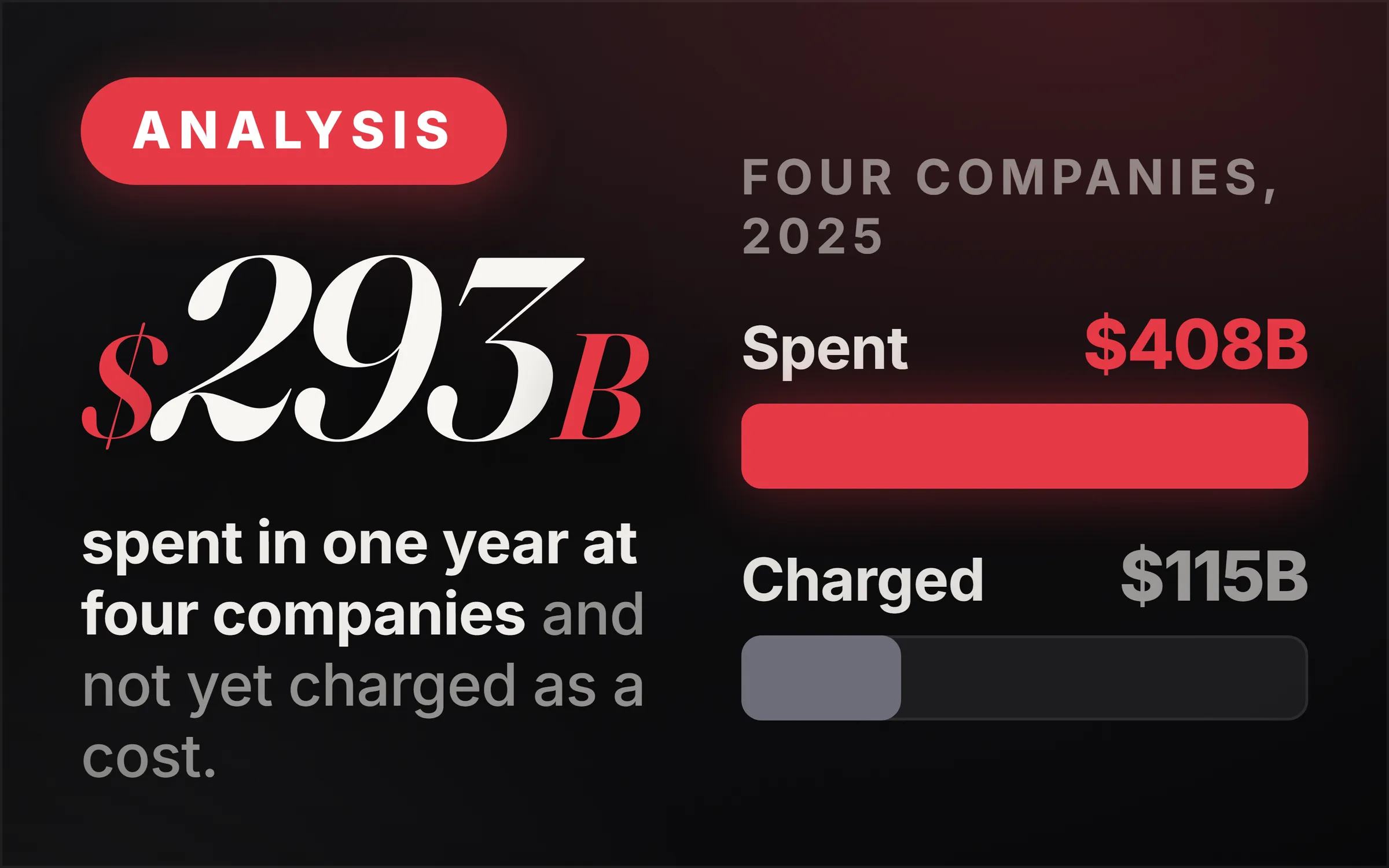
That matters because the promise is real and made in good faith. It is what happened to light, arithmetic, distance and recorded music, and almost nobody would go back. But if a thing gets cheaper to make and not cheaper to buy, the difference goes somewhere. Where the hardware spending itself goes is laid out in AI capex spending.
What is the labor share of income, and why is it falling?
The labour share is the percentage of what an economy produces that goes to workers as pay. The US Bureau of Labor Statistics reported on 5 March 2026 that it was 53.8% in the fourth quarter of 2025, the lowest level in a series that begins in 1947. In the same report, productivity rose 2.8%.
The economy produced more per hour, and the share reaching the people working those hours was the smallest on record. AI did not cause that: the labour share has fallen for decades through globalisation, containerisation and earlier automation, and anyone offering a single cause is selling something. It is, though, the exact shape a machine that always wins on price would produce, and it was already under way before the machine arrived.
The loop underneath is old. Wages are what people buy with, so workers and customers are the same people. Automate production and output rises while wages face pressure, because a person negotiating against a thirty-cent alternative does not need to be replaced for their pay to be capped. Governments sit in the same loop, since income tax, payroll tax and sales tax all run on wages, and a machine draws no salary.
Does who owns a company change whether it automates?
Yes, according to an April 2026 paper by Joseph Emmens, Dennis Hutschenreiter, Stefano Manfredonia, Felix Noth and Tommaso Santini. When firms competing for the same workers come under common ownership, their propensity to automate rises by 22.7 percentage points and employment growth falls. The effect disappears when the firms do not compete in the same labour market.
Common ownership means the same big investors, such as index funds and asset managers, hold stakes in rival companies. When you hire, you bid up wages, and part of that cost lands on your rival. That is normally their problem. If the same investor owns both of you, it is a cost inside one portfolio, and automating instead of hiring makes it disappear.
The method is what makes it convincing. The authors used mergers between institutional investors, where two companies suddenly share an owner without either having done anything, then tracked employment and automation patents afterwards. And who are those investors? Pensions and retirement accounts, which is to say ordinary workers' savings, doing exactly what they were appointed to do. There is no villain in it, which also means there is nobody to persuade.
Is this time different from earlier automation?
Possibly, and the case against is strong. Mechanised weaving, tractors, spreadsheets and cash machines were all expected to end whole occupations, and employment did not collapse. The base rate for this prediction is poor, and the MIT rising-tide finding suggests economies will have time to adjust, as they have before.
The one difference worth taking seriously is what is being automated. Every earlier wave replaced muscle or a specific procedure, and people escaped into thinking: judgement, writing, analysis, deciding. This wave is aimed at the general-purpose thing people moved into. Last time nobody could imagine what came next and it worked out. That is a hope, not a plan and not evidence.