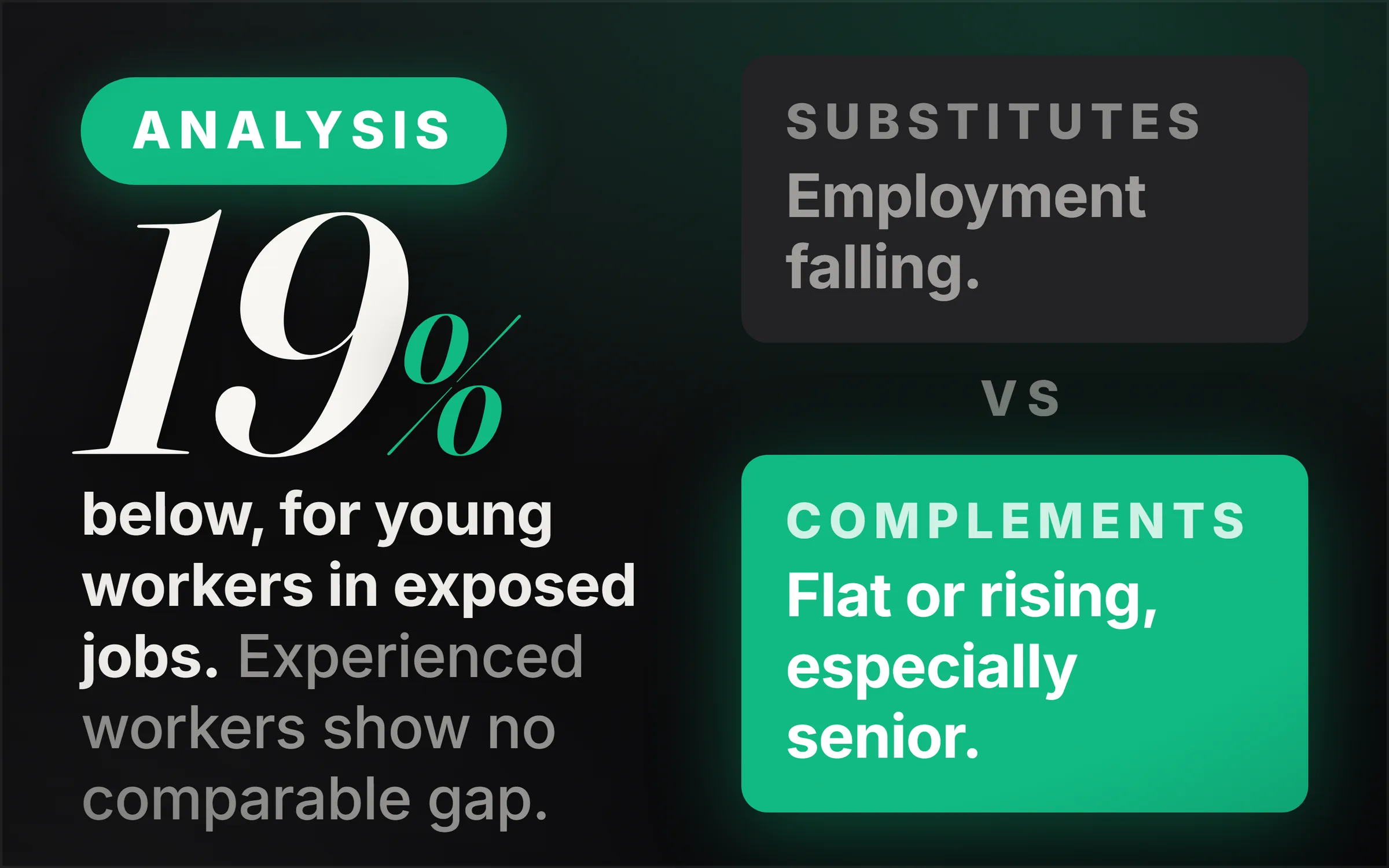
Partly, and through hiring rather than firing. Stanford's analysis of ADP payroll records found employment for 22 to 25 year olds in the most AI-exposed occupations fell about 11% between November 2022 and June 2026, while the same age group in the least exposed occupations grew about 10%. The authors see no economy-wide job displacement from AI.
Both halves of that answer matter. The labour market as a whole is stable, and good economists argue the youth gap has other causes. But what is changing sits at the entrance, where it cannot show up as a job loss because the people affected were never hired. This article sets out the evidence on both sides, then the one experiment that tested a fix.
The film is 54 minutes and does not claim AI is causing mass unemployment: where a claim is contested, the disagreement is on screen, and where a picture is an illustration rather than evidence, it says so. This article follows the same rules.
Is AI taking entry-level jobs?
The evidence points to fewer entry-level hires in AI-exposed work, not mass job losses. In Stanford's "Canaries in the Coal Mine" study of about 4.6 million workers across more than 730 occupations, 22 to 25 year olds in the most exposed occupations saw employment fall about 11% from November 2022 to June 2026, while the least exposed grew about 10%.
The study is by Erik Brynjolfsson, Bharat Chandar and Ruyu Chen at Stanford's Digital Economy Lab, using ADP payroll records, which are the actual monthly record of who is paid in what role, not a survey. Their first finding is the one to lead with: no widespread, economy-wide displacement associated with AI.
What they found instead is a split by age. Same economy, same years, same age group, opposite directions depending on exposure. By their August 2026 update the gap between young workers in exposed occupations and their peers had reached 19%, from 15% a year before. Two further details matter. The adjustment is happening through reduced hiring, not increased separations. And the declines concentrate where AI substitutes for a person, not where it assists one.
Why do some economists say AI is not the cause?
Because the overall labour market has barely moved. Yale's Budget Lab measured how fast the mix of occupations is changing and found about a 1% shift over the 33 months since ChatGPT launched, less than the equivalent early years of the personal computer or the internet. Brookings published its own analysis under the verdict of no AI jobs apocalypse, for now.
The objections to the Stanford paper are serious. Economists at Google argued interest rates explain it, since the industries that cut young hiring hardest are sensitive to borrowing costs. Torsten Slok at Apollo argued that a low-hiring, low-firing market always hits the young first because they are the only ones being hired. Others point to tech firms correcting pandemic over-hiring.
The authors answered part of this: exposure to AI and exposure to interest rates are negatively correlated across occupations, since construction is highly rate-sensitive and barely touched by AI. They also say plainly that their findings are descriptive, not causal. So two findings that sound contradictory are not. A change at the entry point is invisible in the aggregate for years, because the people it affects are not in the aggregate yet.
Did Klarna replace 700 workers with AI?
No. Klarna said in February 2024 that its OpenAI-built assistant was doing the equivalent work of 700 full-time agents, a productivity comparison about its own software. It did not dismiss 700 people for AI. Its headcount fell from about 5,500 in 2022 to under 3,000 by 2025 through a hiring freeze and ordinary staff turnover.
In its first month the assistant handled 2.3 million conversations, about two thirds of the volume, resolving issues in under two minutes against 11 for a person, and Klarna projected a $40 million profit improvement that year. The 700 redundancies people remember happened in May 2022, blamed on the war in Ukraine, inflation and an expected recession.
The part that got less coverage came in May 2025, when chief executive Sebastian Siemiatkowski told Bloomberg the company had cut too far, quality had dropped, and Klarna was hiring human agents again. A company that makes people redundant leaves a record. A company that stops hiring leaves nothing, which is why this is so hard to see.
Which tasks does AI take first?
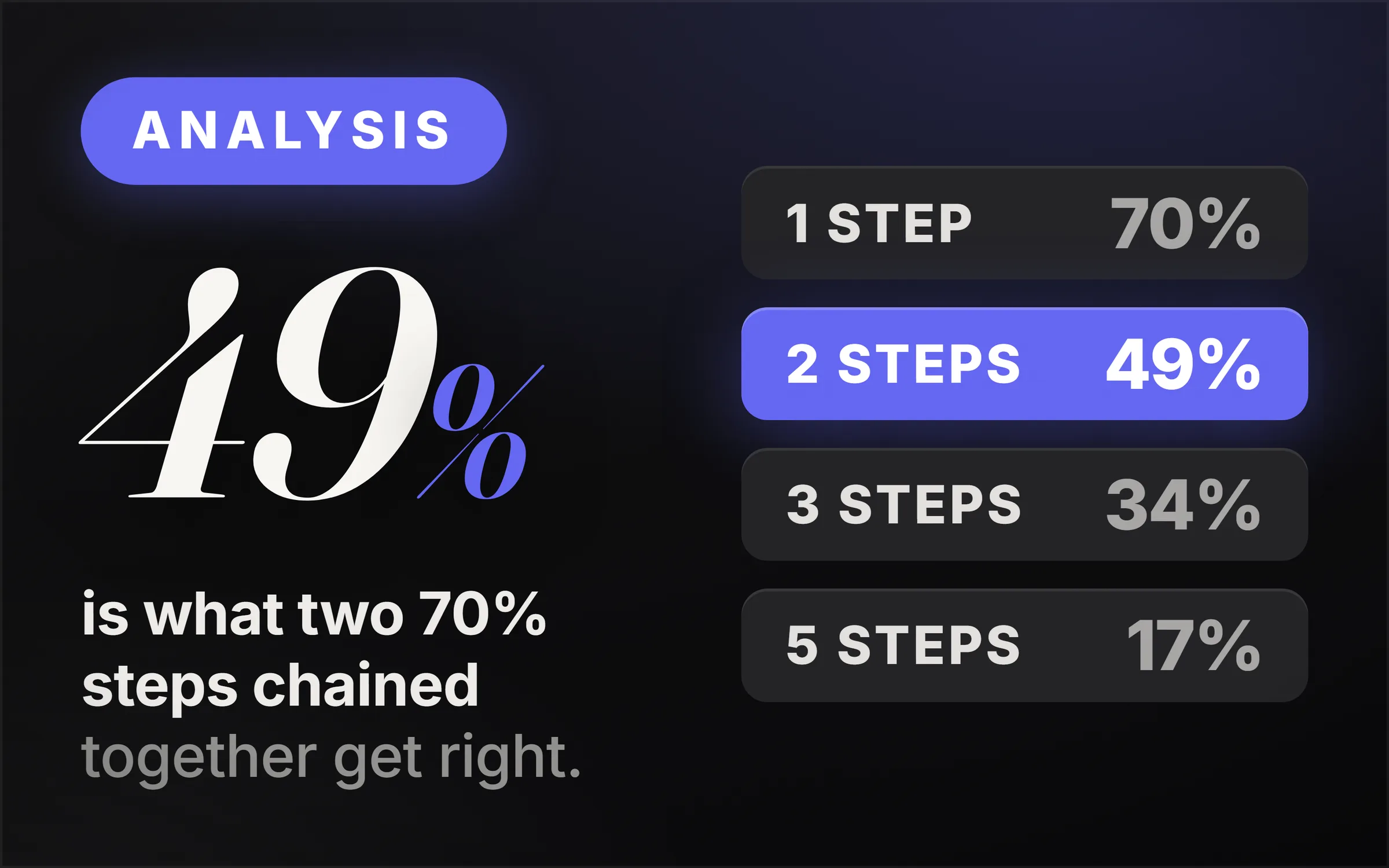
The easy-to-specify, repetitive, self-contained, easy-to-check ones: summarise this, format that, draft the first version, pull the numbers together. Anthropic's Economic Index, mapping 1 million real conversations in its February 2026 edition, found about 49% of occupations now have at least a quarter of their tasks done with its model some of the time.
Very few occupations have most of their work going that way. Jobs are being hollowed, unevenly, from inside rather than deleted. The index sees only one company's traffic, so treat it as the closest live measurement available rather than a census.
Now list the work handed to the newest person in any office for the last hundred years. Not because it is important but because it is safe: a first-year cannot do much damage with it, someone can check it quickly, and doing it teaches them where everything is. It is the same list. What makes a task automatable is the same thing that makes it safe to give to someone who does not yet know anything.
Is Amazon planning to hire fewer people because of automation?
According to internal documents reported by the New York Times in October 2025, yes. The documents described automating up to 75% of Amazon's operations, framed as hires avoided rather than jobs cut: more than 160,000 US workers not hired by 2027 and more than 600,000 by 2033, while sales are expected to double.
Amazon disputed that the documents represent its overall hiring strategy, and that should be weighed. Its facility in Shreveport, Louisiana, runs around 1,000 robots with about a quarter fewer people than an equivalent site, with roughly 40 more planned on that design. Amazon is one of the largest employers of people with no prior experience, so its warehouse floor is a first job for a great many people. The mechanism is the same one again: not firing, just not opening.
Does AI help beginners at work?
Yes, measurably. In a study of 5,179 customer support agents by Erik Brynjolfsson, Danielle Li and Lindsey Raymond, published in the Quarterly Journal of Economics, an AI assistant raised issues resolved per hour by 14% on average and by 34% for the least experienced and least skilled agents, with almost no gain for the best.
The rollout was staggered, so agents not yet given the tool served as a comparison group. Customer sentiment improved, staff were less likely to quit, and the researchers found suggestive evidence the system spread the best agents' practices to everyone else. That is the strongest argument against the worry in this article: a machine carrying the best worker's judgement to the newest worker's screen could be the apprenticeship rather than its replacement.
The Turkish result below is what decides which way it goes.
What is workslop, and what does it cost?
Workslop is AI-generated work that looks finished but lacks the substance to move the task forward. BetterUp Labs and Stanford's Social Media Lab, writing in Harvard Business Review in September 2025, surveyed 1,150 full-time US workers: 41% had received workslop in the previous month, and each instance cost the receiver an average of 1 hour 56 minutes.
That is a transfer, not a saving. The sender saved twenty minutes and the receiver lost two hours. Bad human work used to announce itself on the surface. Fluent AI output hides the wrong assumption inside correct formatting, so catching it takes someone who knows the subject well enough to sense something is off. Every profession has a name for that ability, and it is built only by having been wrong yourself, repeatedly, in that domain.
What happens to training when experts no longer need juniors?
The training gets squeezed out. Matt Beane of UC Santa Barbara found that in a four-and-a-half-hour robotic operation a surgical resident might get 15 minutes at the console, generally a 10 to 20-fold cut in hands-on time. On the robot, the surgeon can do the whole operation alone.
A minority of residents got good anyway through what Beane calls shadow learning: watching hundreds of hours of recordings on their own time and specialising absurdly early. That selects for people with the time and nerve to break the rules. In his 2024 book "The Skill Code" he argues expertise needs challenge, complexity and connection together, and a smooth AI workflow removes all three.
Office life shows the same mechanism. Natalia Emanuel, Emma Harrington and Amanda Pallais found software engineers sitting with their teams got 18.3% more feedback on their code, concentrated among newer and younger staff, and experienced engineers wrote more code when not sitting near juniors. Training was never free; it was paid for out of a senior person's afternoon. Nobody has measured AI doing the same to offices, and the film says so, but a model answers the question you asked, while a colleague often answers the one you should have asked.
Are entry-level job postings falling?
Yes, in many fields. Indeed's Hiring Lab reported US entry-level postings down 7.5% year on year as of May 2026, trending down since a 2022 peak, while senior postings rose almost 15%. UK graduate postings in July 2026 were down about 7%, the lowest for that point in the year since 2020.
It is not everywhere. Handshake's early-career data has entry-level healthcare postings up 13 percentage points against the trend, with cybersecurity and skilled trades also holding. If you are choosing a direction, that distinction is worth more than the headline.
Can AI be used without making beginners worse?
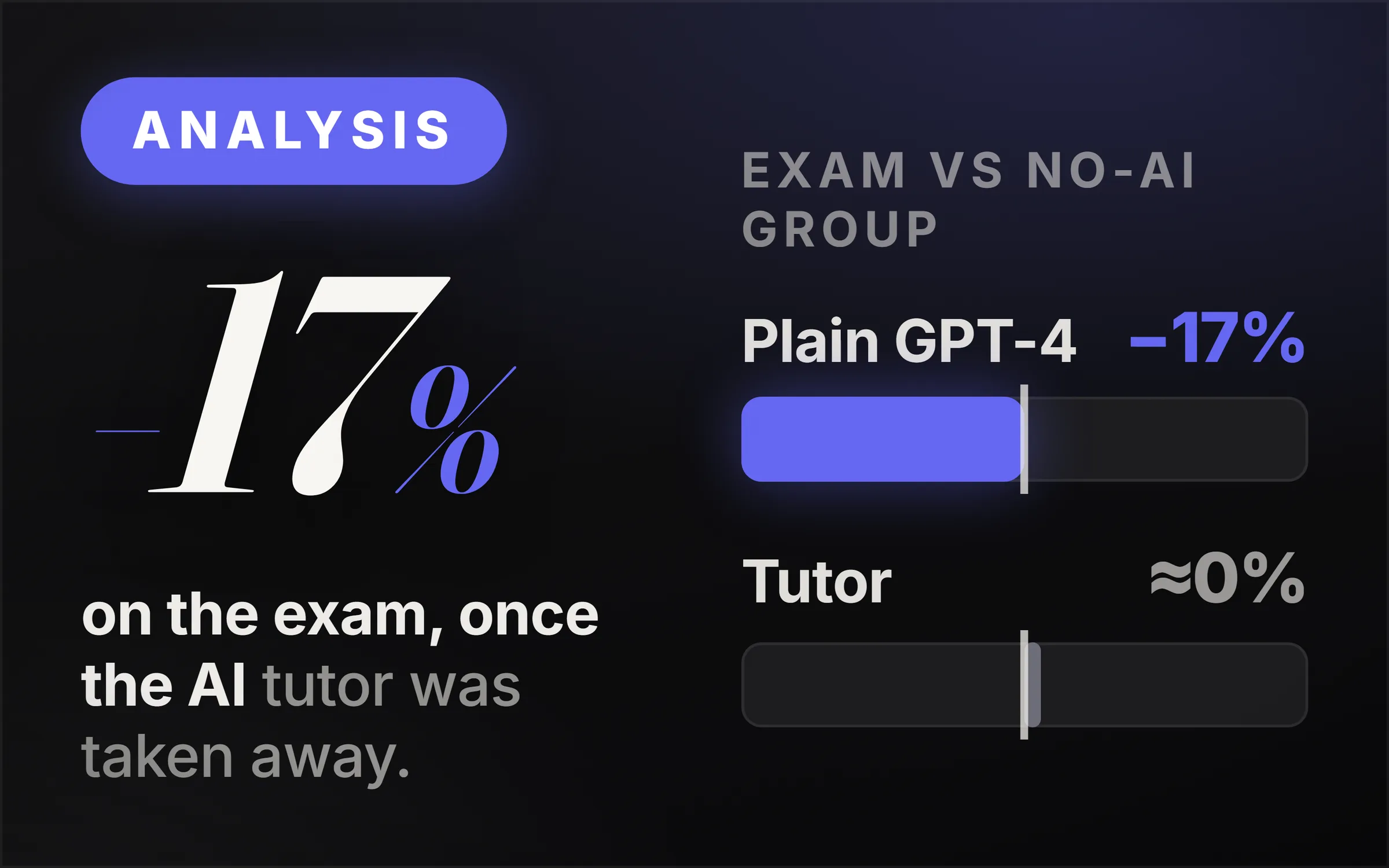
Yes, and the evidence is one design decision. In the Turkish trial by Hamsa Bastani, Osbert Bastani, Alp Sungu and colleagues, published in PNAS as "Generative AI without guardrails can harm learning", nearly 1,000 high school students were split three ways: no AI, plain GPT-4, and a GPT-4 tutor that gave teacher-written hints and would not hand over answers.
During practice, plain GPT-4 lifted performance 48% over the control group and the tutor version lifted it 127%. Then the AI was taken away for the exam. The plain GPT-4 group scored 17% worse than students who never had AI. The tutor group scored about the same as the control.
Same model, same capability, opposite outcomes, and both groups experienced it as help. Nobody in the plain group knew they were being deskilled; their practice scores were up almost half. The difference was a change to the instructions, which is to say it was cheap. The same holds in a company. One that uses AI to strip out drudgery and then deliberately gives young staff real, hard problems, with a senior person arguing through what the machine assumed and missed, will look slightly less efficient than one that simply stops hiring at the bottom. On a quarterly report the second looks better. In ten years they are different organisations, and nobody can yet prove which way it goes, because the experiment is still running.
For what the same Turkish finding means for your own thinking, not just your career, read is AI making us dumber? For the roles where the evidence says human work holds up best, see jobs safe from AI.