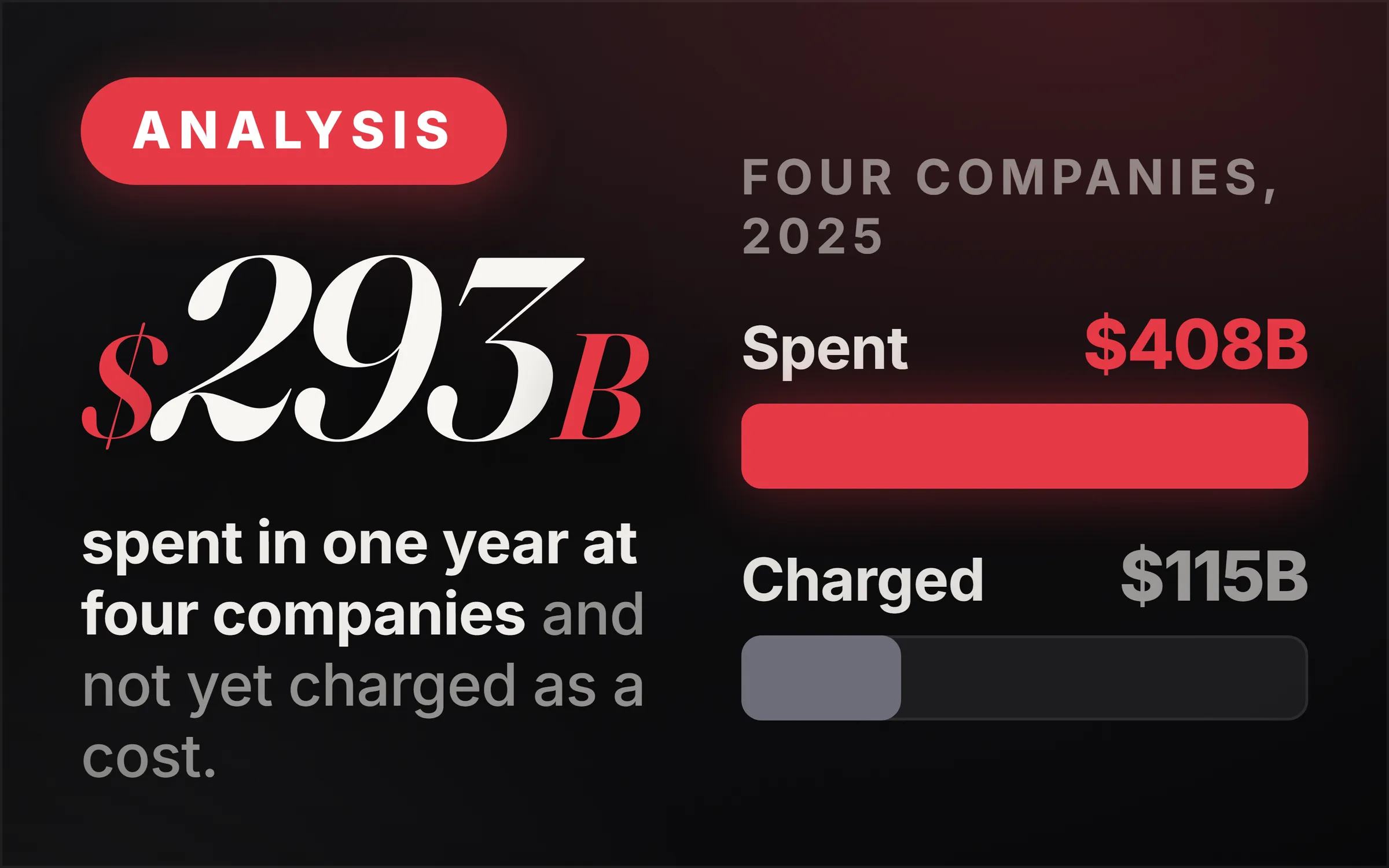
In their most recent filed years, Amazon, Microsoft, Alphabet, Meta and Oracle spent $464.5 billion on capital equipment, most of it for AI. Very little of it has been charged as a cost yet. In 2025 four of them spent $408 billion and recorded $115 billion of depreciation, leaving about $293 billion to be recognised over the next six years.
That is not hidden and it is not a trick. It is how capital spending is supposed to be accounted for, applied at a scale nothing has been applied at before. What makes it worth understanding is that the timetable for when the cost arrives is an estimate made by the companies themselves, and in January 2025 two of them moved it in opposite directions.
Every figure in the 26-minute film is marked on screen for what it is: filed (read out of a 10-K), reported (journalism with outlet and date), projection (a forecast, said out loud as one) or disputed (both sides shown). This article uses the same labels in words.
How much are big tech companies spending on AI?
Filed capital expenditure in each company's latest year came to $464.5 billion across five companies: Amazon $131.8 billion, Microsoft $115.9 billion, Alphabet $91.4 billion, Meta $69.7 billion and Oracle $55.7 billion. Two years earlier Amazon spent $52.7 billion, Alphabet $32.3 billion and Oracle $6.9 billion.
Capex is money spent on things a company will own and use for years: buildings, machines, servers. These figures come from 10-K annual reports, which are audited legal documents the companies can be sued over, not press releases. Microsoft's year ends in June, so its figures run on a different calendar.
The full two-year run in the filings: Amazon $52.7 billion, $83 billion, $131.8 billion. Microsoft $44.5 billion, $64.6 billion, $115.9 billion. Alphabet $32.3 billion, $52.5 billion, $91.4 billion. Meta $27 billion, $37.3 billion, $69.7 billion. Oracle's eightfold rise in two years stands out for a company that has sold databases since the 1970s.
On the buyer side, Gartner projects worldwide AI spending at $2.5 trillion in 2026, up 47%. That is a projection, not a filing. What is telling is that Gartner revised its forecast upward four times in ten months, so even professional forecasters kept underestimating in the same direction.
If AI got so much cheaper, why is spending going up?
Because cheaper units create far more demand, so total spending rises even as the price per unit falls. It is the oldest pattern in economics, seen with coal, electricity and bandwidth. The price collapse in AI is real, measured independently by Epoch AI and Stanford, and the spending surge is in the filings.
On price: in March 2023, getting a machine to answer a set of PhD-level science questions cost $37.50. Twenty-one months later the same benchmark at the same score cost $0.12. Epoch AI found falls of 9 to 900 times per year depending on the milestone. Stanford's AI Index found GPT-3.5-level output went from $20 per million tokens in November 2022 to $0.07 by October 2024, a 280-fold drop, with hardware costs falling about 30% a year and energy efficiency improving about 40% a year.
Epoch attaches its own caution: the fastest falls came in the most recent year measured, so it is unclear those rates will persist. Nobody is promising the curve continues.
Who receives the money big tech spends on AI?
Mostly Nvidia. In its financial year to January 2026, Nvidia filed revenue of $215.9 billion, up 65% from $130.5 billion, and net income of $120.1 billion, so more than 55 cents of every dollar of revenue was left after all costs and tax. Its gross margin was 71.1%.
The compute and networking segment selling into data centres grew from $47.3 billion to $82.9 billion to $130.1 billion over three years.
Nvidia must disclose customer concentration. In the year to January 2024 one direct customer was 13% of revenue. In the year to January 2025 one was 12% and two were 11% each. In the year to January 2026 one was 22% and another 14%: two accounts, 36% of revenue, roughly $78 billion. Nvidia does not name them, and its direct customers include the manufacturers and integrators who build machines for cloud companies, so nobody reading the documents can say who they are. What the filings do establish is that concentration nearly doubled in two years.
Why doesn't AI capex show up as a cost?
Because under standard accounting, buying equipment is not a cost in the year of purchase. The company swaps cash for an asset and spreads the cost over the asset's expected useful life as depreciation. Alphabet spent $91.4 billion in 2025 and charged $21.1 billion to its accounts that year.
The same pattern at the other three: Microsoft spent $115.9 billion and charged $34.3 billion; Amazon spent $131.8 billion and charged $41.9 billion; Meta spent $69.7 billion and charged $18.0 billion. Four companies, $408 billion spent, $115 billion charged, so roughly $293 billion was spent in one year without yet appearing as a cost to anyone.
A simple version: a business that buys a $30,000 van does not show a $30,000 cost that year. It shows $6,000 a year for five years. This is why these companies can keep spending at record levels and still report record margins. Nothing is concealed. It is ordinary, audited treatment.
The two sides of the same sale are also asymmetric. Nvidia records the sale and its profit in the year it happens. The buyer records almost nothing that year and recognises the cost over about six. In any given year, most of the money leaving the buyer's account arrives in full as somebody else's profit while barely appearing as anybody's cost.
One part does arrive immediately: electricity. Power is an operating cost that hits the accounts the month it is used. How big that part is cannot be measured from outside, because neither Alphabet's nor Meta's annual report breaks out an energy line.
How long do tech companies depreciate AI servers?
Alphabet says in its 2025 annual report that it generally depreciates servers and network equipment over six years. Across these companies, the assumed useful life of a server lengthened from three years to four and then to six between 2020 and 2024, which halves the annual charge for the same machine.
The arithmetic is simple. A $600 machine over three years costs $200 a year against profit. Over six years it costs $100. Every change was disclosed, but lengthening an asset's life makes this year cheaper and a later year more expensive, and the extensions happened in exactly the years spending climbed fastest.
Who sets the number? The company does. Alphabet says it bases useful lives on historical asset performance, expected technology advancements and its future deployment plans. Expected technology advancements is the hard part: how long today's machine stays useful depends on how fast the next one arrives, and the companies predicting that are the ones building the next one.
Alphabet's policy also says changes in estimated useful lives are recognised prospectively, meaning forwards only. Past years are not restated. Whatever the right answer turns out to be, profits already reported stay reported, and any correction is paid by future years.
What happened to server depreciation in January 2025?
Amazon and Meta moved in opposite directions in the same month. Effective 1 January 2025, Amazon shortened the useful life of a subset of servers and networking equipment from six years to five, citing the faster pace of technology development, especially in AI. Meta lengthened most servers and network assets to 5.5 years.
Amazon's filing puts a price on its change: $1.4 billion more depreciation and amortisation, $1.0 billion less net income, or $0.10 per basic share, mainly in AWS. That is cost pulled forward into one year by moving one number from six to five. Meta's filing lists slower depreciation growth from the longer lives among the factors shaping its cost of revenue.
Same month, same kind of equipment, same technology. One company decided its servers would last less time, the other longer. Both were disclosed and audited, and both are defensible from outside.
There is a public argument about the size of the gap. One estimate says these companies will understate depreciation by around $176 billion between 2026 and 2028. The companies' answer is that every change was disclosed, reviewed by auditors each quarter and justified to the regulator with data on how the equipment actually performs. That dispute is open, and the film does not settle it.
Are companies saving money by using AI?
Few can point to it cleanly. Searches for companies reporting AI savings mostly return restructuring, such as headcount cut by a third, which saves money whether or not a company owns a single chip. The best-known clean case, Klarna's assistant doing the work of 700 agents, ended with Klarna hiring humans again because the cheaper system was also worse.
There is also a cost on nobody's price card. BetterUp Labs and Stanford's Social Media Lab reported in Harvard Business Review that 41% of full-time US workers had received work in the previous month that looked finished and was not, costing nearly two hours each to fix. Twelve cents for the output, two hours for the person who checks it. Neither number is wrong. They are just on different invoices. The question of whether AI is actually cheaper than a person, task by task, is taken apart in is AI cheaper than human labor?
When will the AI capex bill land?
Nobody outside these companies can say, and anyone naming a year is guessing. The date roughly $293 billion of one year's spending reaches the income statements depends on useful-life estimates, which are judgements about how fast technology moves. The first early instalment has already arrived: Amazon's $1.4 billion in 2025.
The line worth watching is not the price of a prompt, which will keep falling and keep being reported as the whole story. It is the useful life, one sentence in the accounting policies near the back of each 10-K. It has moved twice in five years, and both times the companies said so in advance. For the bigger picture of who is steering all this spending, see who regulates AI?