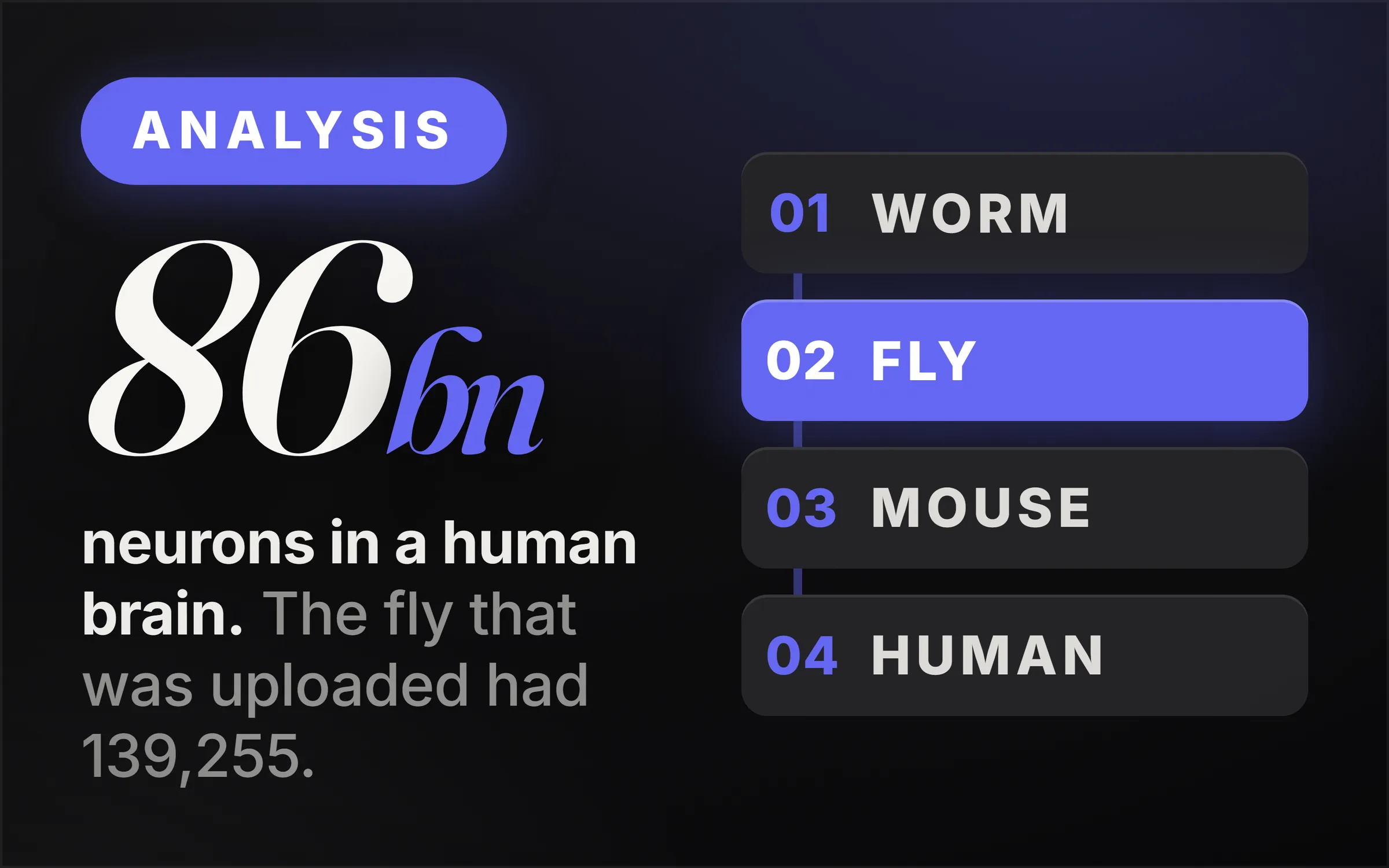
Mind uploading is not possible for a human today, and nobody building the tools has put a credible date on it. What exists is the full wiring of one fruit fly brain, 139,255 neurons, driving a simulated body. A human brain holds about 86 billion neurons. That is a gap of roughly 600,000 times in neuron count alone, before anything a wiring map cannot capture.
The fly is still a genuine milestone, and it changes the question from philosophy to engineering. The film above follows that fly from the laboratory to the edge of what science can do. This page sets out the numbers on each rung of the ladder, what the map leaves out, and what it costs, in published prices, to keep a brain preserved while you wait.
Is mind uploading possible?
Not for a person, and not soon. The largest brain ever mapped and run is a fruit fly's: 139,255 neurons, published in Nature in October 2024. A human brain averages about 86 billion neurons, and every method that maps a brain at this detail works by slicing it, which means the brain being copied has to be dead first.
What has become possible is narrower and still remarkable: taking a dead animal's wiring diagram, giving each neuron one simple rule, and getting recognisable behaviour out of it. That is a proof that wiring carries a lot of information. It is not a proof that wiring is a mind, and the people who built the fly say as much in their own write-up.
So the honest answer is: possible in principle for small brains, partly demonstrated for one insect, and unmeasured for anything the size of yours.
What did Eon Systems actually upload?
A wiring map of one fly brain connected to a simulated fly body. Eon Systems' announcement of 8 March 2026 took the FlyWire map, applied the neuron model from a 2024 Nature paper, and used it to control a physics-simulated body. The company claims "91% behavior accuracy" for the result.
The company's technical write-up is unusually candid about the limits. It says that "Fly walking was implemented using slight modifications to existing NeuroMechFly controllers", meaning the body already knew how to walk and the copied brain steered it. The announcement adds, of its neuron model: "This fly cannot form long-term memories atm."
The brain model underneath is from Shiu and colleagues in Nature, who showed that activating sugar-sensing neurons in the model "accurately predicts neurons that respond to tastes and are required for feeding initiation". Feeding and grooming came out of the wiring without anyone programming them in. That is the real result, and it is a big one.
What does a brain map leave out?
Most of what makes a brain an individual. A connectome records which neurons connect to which. Eon's own write-up says that in its model "internal state, plasticity, learning, hormonal changes are largely missing." Those four things are where memory, mood and experience live, so a map of 50 million connections is a template, not a person.
The biggest missing piece is connection strength. Learning works by making particular synapses stronger or weaker, and an electron microscope image shows that a synapse exists far more reliably than it shows how strong it was in life. Brain chemistry is the second: the same wiring behaves differently depending on which chemicals are washing over it.
So what runs inside the computer is closer to the general shape of a fly, built on one fly's wiring, than to that particular fly. That distinction matters enormously when the question becomes a person.
How far is a fly from a human brain?
About 600,000 times more neurons, and a data problem to match. The one cubic millimetre of human cortex mapped by Harvard and Google in 2024 holds about 57,000 cells and 150 million synapses, and took 1.4 petabytes of storage. A whole human brain is more than a million cubic millimetres, and the full map would still be wiring only.
The clearest way to see the distance is as a ladder, where every rung has been reached or at least attempted.
Rung 1: The worm, 302 neurons
Fully mapped in 1986. John White, Sydney Brenner and colleagues published the complete nervous system of the worm C. elegans, with "a total complement of 302 neurons", traced by hand from electron micrographs. Forty years later, researchers are still working out how its behaviour comes out of that map, which says a lot about how much a map explains on its own.
Rung 2: The fly, 139,255 neurons
Fully mapped in 2024, and now driving a body. The FlyWire paper in Nature presents the wiring of a whole brain from one adult female fruit fly: 139,255 neurons joined by about 50 million chemical synapses. Google's AI traced the neurons and hundreds of researchers and volunteers corrected the result by hand.
Rung 3: The mouse, one grain-sized piece
Mapped with its living activity in 2025. The MICrONS Consortium recorded around 75,000 neurons in an awake mouse watching visual stimuli, then mapped the same tissue: "more than 200,000 cells and 0.5 billion synapses". It is the first serious attempt to capture what neurons were doing in life, not only how they were wired. No whole mouse brain has been mapped.
Rung 4: The human, about 86 billion neurons
One cubic millimetre mapped, from surgery. The Harvard and Google sample in Science was tissue "surgically removed to gain access to an underlying epileptic focus", and it "comprises 1.4 petabytes". The whole-brain neuron count comes from a 2009 study that counted an average of 86.1 billion neurons, give or take 8.1 billion, in the adult male human brain.
How much does it cost to preserve a brain today?
From about $28,000 to $220,000, before extras. Alcor lists neuropreservation at $80,000 and whole-body preservation at $220,000 out of pocket, plus age-based annual dues. The Cryonics Institute lists $28,000 for a lifetime member who paid a $1,250 one-time fee, or $35,000 for an annual member paying $120 a year.
Those are the published list prices on each organisation's own pages, read on 18 October 2026:
| Provider and option | Preservation price | Membership cost | What is not included |
|---|---|---|---|
| Alcor, neuropreservation | $80,000 | Age at joining × $15 a year (2025 schedule) | Surcharges, e.g. $20,000 within the first 180 days of membership |
| Alcor, whole body | $220,000 | Same age-based dues | Same surcharges |
| Cryonics Institute, lifetime member | $28,000 | $1,250 once | Local funeral director, shipping, standby |
| Cryonics Institute, annual member | $35,000 | $200 to join, then $120 a year | Local funeral director, shipping, standby |
Sources: Alcor pricing and dues, Cryonics Institute membership.
The whole-life number is the one the pricing pages do not add up for you. A 40-year-old joining Alcor for neuropreservation locks in dues of 40 × $15 = $600 a year. Over 40 years that is $24,000 in dues on top of the $80,000, so roughly $104,000 if the dues multiplier never rises, and Alcor's own FAQ says dues can increase. At the Cryonics Institute, a lifetime member's fixed cost is $29,250 ($1,250 plus $28,000), but CI's page says the price excludes local help, which it puts at nothing in Michigan to $3,000 on the US west coast, and it lists standby and transport by a separate company with a $30,000 completion fee.
Most members do not pay cash. Both organisations point to life insurance naming them as beneficiary, which is why the monthly figures quoted in this industry look small.
Can a preserved brain be brought back?
No preserved brain has ever been revived, and the best wiring-preservation method rules revival out. The Brain Preservation Foundation's prize was won in 2018 by aldehyde-stabilised cryopreservation, scaled to a whole pig brain. Its first step fixes tissue with glutaraldehyde, an embalming chemical, so the only future it leaves open is a copy.
The Brain Preservation Foundation records the small-mammal stage won in 2016 with a rabbit brain and the large-mammal stage in 2018. The method answers the question the prize asked, whether every connection can still be seen under an electron microscope. It does not answer whether those connections are a person.
When a start-up called Nectome set out to offer the procedure to people, MIT Technology Review's headline in March 2018 was "A startup is pitching a mind-uploading service that is "100 percent fatal"". The magazine reported that 25 people had already paid a $10,000 deposit, "fully refundable if you change your mind."
Conventional cryonics, which Alcor and the Cryonics Institute offer, aims at future repair rather than copying, but it faces ice damage and has no demonstrated revival either. Anyone paying today is buying a chance whose size nobody can measure.
Would an uploaded copy be you?
Philosophers have argued about this since at least 1984, and there is no settled answer. Derek Parfit's book Reasons and Persons, published in 1984, used a teleporter that copies you and destroys the original to argue that what matters is continuity of memory and character, not some deeper fact about identity. Many philosophers disagree with him.
The practical point is sharper than the philosophy. Every mapping method on this page reads a brain by ending it. If a copy of a person is ever made this way, it will be made from someone who did not walk out of the booth, and the copy will be certain that it is them either way.
There is also a cheaper, cruder version already here: chatbots built from a dead person's messages, which the film covers in its final act. They copy what someone said rather than how they were wired, they run on a company's servers, and they can be switched off by whoever pays for those servers.
The honest hard part
The hard part is that the most important number does not exist. Nobody knows how much of a person is held in the wiring a microscope can see, and how much lives in connection strengths, chemistry and ongoing activity that no current method can capture across a whole brain. Every timeline for human uploading is filling that gap with a guess.
The second hard part is that the people closest to the work have an interest in it. Eon is a company raising support for brain emulation, and its "91%" figure is its own claim. It is also, to its credit, the most candid source on the limits.
The third is about the money. Cryonics prices are real, published and easy to compare. What they buy is not. If you are weighing it, read the provider's contract, its surcharges and its dues policy as closely as the science, and treat any monthly figure quoted through life insurance as a premium on a policy, not as the price.
For what the research says AI is already doing to the brains we have, see is AI making us dumber, and for which brain technologies are actually working now, from a retinal chip to a gene therapy for deafness, the world they are building for 2028.