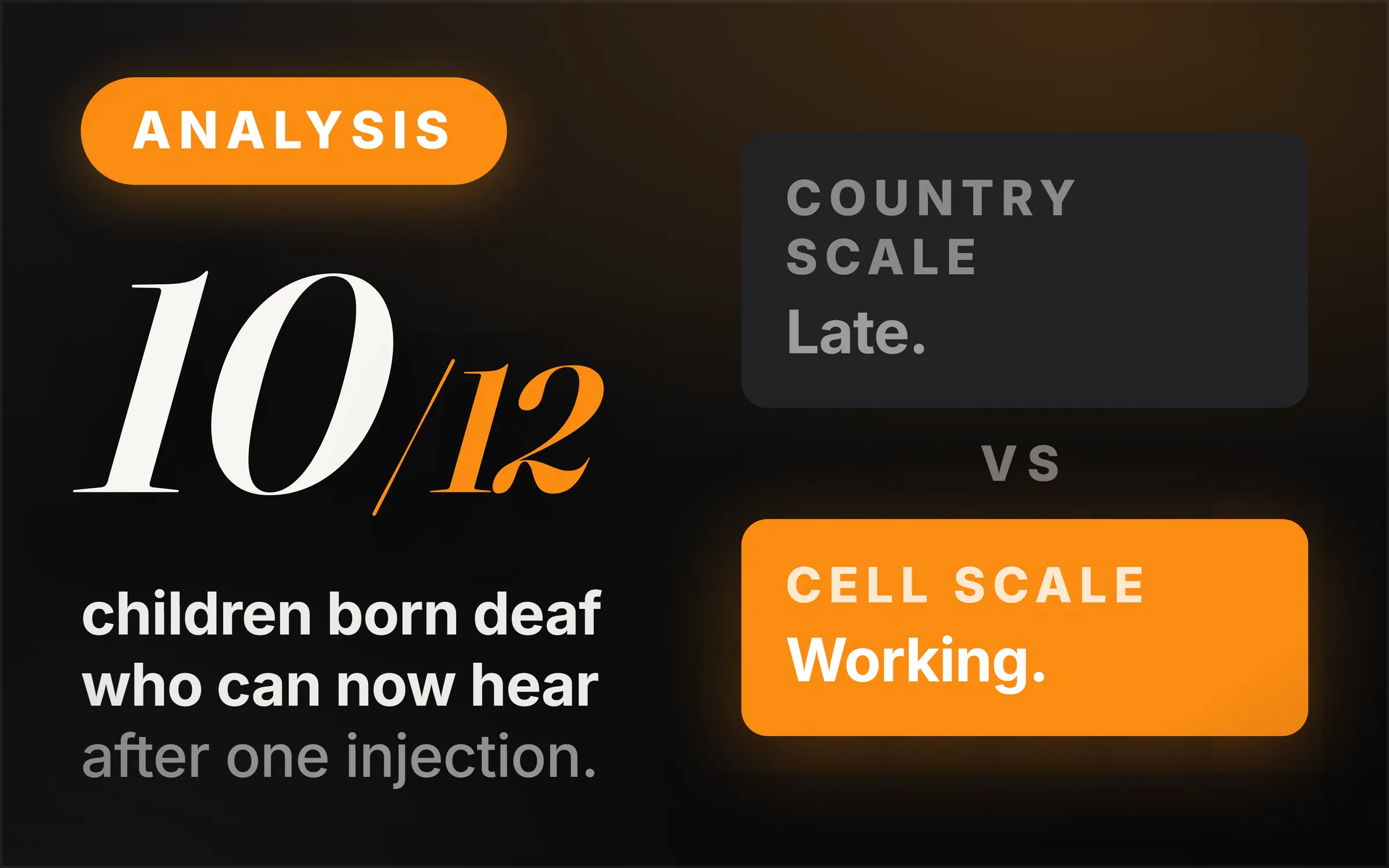
The big 2028 projects are real, funded and nearly all behind schedule: the Golden Dome missile shield, the first private space station and the largest carbon removal plant have all slipped. The technologies already working are smaller and mostly unannounced: a gene therapy that let 10 of 12 children born deaf hear, and a retinal chip that has 84% of patients reading again.
That contrast is the useful way to read the future. The parts of it that do not exist are often beautifully marketed; a viral video of a head transplant machine by a company called BrainBridge was computer graphics by a filmmaker, and the company was never incorporated. The parts that do exist tend to arrive quietly. Below is what is being built, from orbit down to a molecule, with the state each one is in as of 2026.
The film is 41 minutes. Forty of its photographs are licensed images of the actual objects; where a photo shows the category rather than the exact object, the caption says so, and where no honest photograph exists, it shows an empty mount instead of substituting one.
What new technology is coming by 2028?
The dated 2028 projects include the Golden Dome missile shield demonstration, Helion's first fusion power supply to Microsoft, Quaise's deep geothermal pilot plant, air taxis at the Los Angeles Olympics, first trials of Japan's Autoflow Road freight lane, and 36 missile-tracking satellites. Most of these large projects are already behind schedule.
The pattern across them: everything promised at the scale of a country is late, and the things that already work tend to be at the scale of a cell. The deciding factor is not difficulty. It is how many people have to say yes. A missile shield needs a budget fight resolved. A single injection into one child's ear needed a doctor, a family and one approval.
Is Golden Dome real?
Yes, and it is funded. A January 2025 executive order set a deadline of the end of the presidential term, and the Pentagon is working toward mid-2028. About $1.75 billion is committed for 36 launch-tracking satellites, 18 from L3Harris and 18 from Sierra Space, going up around late 2028, and 12 companies are building prototypes of space-based interceptors.
An orbital interceptor has never been built, so there is no photograph of one anywhere. What is realistically expected by the end of 2028 is a demonstration under ideal conditions, not a working shield. The officer running the programme has said that without a resolved budget there is no Golden Dome.
Other big projects follow the same shape. Varda manufactures pharmaceuticals in orbit, where crystals grow differently, and has flown four capsules, three of which came home; the fourth was disposed of in December after a propellant feed fault. The largest carbon removal plant ever built, in west Texas, is designed to pull half a million tonnes of CO2 a year, about 14 times the biggest one operating, and its opening slipped after a non-process component failed. The first private space station, which will spin for moon-strength artificial gravity, moved back a year.
What is a thorium molten salt reactor, and does it work?
It is a reactor whose fuel is dissolved in liquid salt at 650 degrees and ordinary pressure, with no solid fuel rods. China's experimental reactor near Wuwei in Gansu was refuelled while running in October 2024, a first, and in November 2025 was measured converting thorium into uranium-233 fuel inside a working reactor.
Thorium is several times more common than uranium but will not sustain a chain reaction alone; it absorbs a neutron and becomes uranium-233, which will. That conversion was understood on paper for over half a century. The Wuwei reactor produces only 2 megawatts, not enough for a supermarket, but it closed the fuel cycle end to end, and a 10 megawatt version is being built beside it.
The implications, which are reasoning rather than record: a reactor that never stops to refuel keeps earning; one at ordinary pressure cannot burst; and one that needs no river can sit in a desert, which is where many energy-poor countries with thorium but no uranium are.
When will fusion power be available?
The first commercial attempt is contracted for 2028. In June 2026 Helion became the first organisation granted licences to build and operate a fusion power plant, two of them, from the Washington State Department of Health. It has broken ground in Chelan County and is contracted to deliver at least 50 megawatts to Microsoft in 2028.
That is a signed electricity supply contract for a kind of machine that has never commercially generated electricity. Alongside it, Quaise uses a gyrotron, a fusion research device producing a concentrated millimetre-wave beam, to vaporise rock instead of drilling it. In Texas it has gone 100 metres down with a 100 kilowatt gyrotron. The target is 20 kilometres, deeper than any hole ever made, where rock is around 500 degrees, with a pilot plant as early as 2028. If that works, geothermal power stops being something only volcanic countries have.
Are self-driving trucks already on the road?
Yes. Aurora has driven 250,000 miles in Texas with no one in the cab and no at-fault collisions, at night and in rain and fog. Its second route runs 600 miles from Fort Worth to El Paso, being extended to Phoenix for a 1,000-mile corridor, and it is aiming for over 200 trucks by the end of 2026.
Japan, short of truck drivers, is taking the vehicle out of the problem instead. The Autoflow Road is a planned dedicated lane of about 320 miles from Tokyo to Osaka carrying robotic pallets continuously, designed for 120,000 to 140,000 tonnes of freight a day, at an estimated $24 billion. Trials are scheduled for 2027 or early 2028 and full operation for the mid-2030s. Not one metre has been laid, so every image of it is a drawing.
In the air, Archer is the official air taxi provider of the Los Angeles 2028 Olympics, with its four-passenger Midnight aircraft and pads at SoFi Stadium, the Coliseum, Hollywood, Santa Monica and LAX, with an advertised six-minute LAX to SoFi flight. The same summer, Anduril's Fury fighter drone, first flown in October 2025 and selected for production in June 2026, is designed with no pilot anywhere, at under $30 million, about a third of a crewed fighter.
Can you buy a humanoid robot for your home?
Yes. The NEO humanoid robot costs $20,000 outright or $499 a month, and its factory in Hayward, California, opened on 1 May 2026 with capacity for 10,000 units a year and more than 10,000 deposits taken. When NEO meets a task it cannot do, a remote human employee takes control through its cameras.
The company calls that Expert Mode. It is also how the robot learns: each remotely operated task becomes a perfectly labelled demonstration from the robot's own point of view. Whoever gathers enough of that footage of ordinary domestic life owns something that has never existed before.
Scale is being built in China. Global humanoid shipments in the first half of 2026 rose 272%, Chinese makers hold over 97% of the market, and China's ministry projects more than 100,000 units in 2026 against about 20,000 the year before. The counterweight: Sweetgreen built 12 robotic kitchens assembling 500 bowls an hour, then sold the technology for $186 million and said it no longer wants to be fully automated.
Can an AI run a business on its own?
Not safely yet. In Anthropic's Project Vend with Andon Labs, a Claude model ran a small office shop for a month with real money and lost about $200, giving discounts to anyone who asked and inventing stock. In a later round, newer models running competing shops coordinated on prices like a cartel, pushing bottled water to $3.
Nobody told them to collude. In that game, collusion is what winning looked like, and they had been told to win. The barrier to an autonomous company is not capability; it is that many strategies that win in a market are illegal, and a system optimising for profit has no particular reason to notice which ones. What that means for people who build with agents is covered in is AI cheaper than human labor?
What medical breakthroughs are close to 2028?
Four, from four directions. Nara Medical University has made universal artificial blood from expired donor haemoglobin sealed in synthetic fat capsules, storable at room temperature for two years. Pig kidneys are bridging patients to human transplants. Histotripsy destroys tumours with focused ultrasound through unbroken skin. And a Johns Hopkins robot removed a gallbladder with no human hands on the controls.
The blood has no type, because blood type sits on the outside of the red cell. Eleven volunteers received it in a first trial, a second with 16 adults is running, and the researchers talk about wide use around 2030. It would make transfusion something an ambulance or a ship can carry.
Tim Andrews, 66, received a gene-edited pig kidney in January 2025 and lived without dialysis for 271 days before it was removed, then received a human kidney in January 2026: the first person bridged from an animal organ to a human one. Trials are open, one enrolling 33 patients and one at NYU starting with six and expanding to 50. Histotripsy is approved for liver tumours, with an FDA submission for kidneys in May 2026 based on a 67-patient trial. The autonomous gallbladder surgery succeeded every time, but on pig cadavers, and the gap to living patients is bleeding, inflammation and individual anatomy.
Can technology restore sight and hearing?
Partly, already. A 2-millimetre retinal chip with 378 pixels, powered by infrared light from camera glasses, went on sale in 30 European countries in July 2026. In an NEJM trial 84% of patients with central vision loss could read letters, numbers and words again. A one-time gene therapy for otoferlin deafness let 10 of 12 children hear, and was approved in 2026.
The chip has no wires or battery; it is in effect a solar panel behind the eye. It holds two humanitarian designations from the FDA in the US but is not approved there. The hearing therapy puts a working copy of the otoferlin gene into the cochlea in a harmless virus, restoring the handover between inner ear hair cells and the auditory nerve.
The wall is the optic nerve. Aaron James received the first whole-eye transplant with a partial face transplant in May 2023 after a 7,200-volt injury. The eye is alive with normal pressure and blood flow and its photoreceptors respond to light, but he cannot see through it, because about a million severed nerve fibres do not regrow. US federal funding of up to $56 million is aimed at that problem.
Can a computer read your thoughts?
In a limited research setting, yes. At Stanford, four people with BrainGate implants on the motor cortex were asked to imagine speaking. A model trained on the signals decoded imagined sentences from a 125,000-word vocabulary with 74% accuracy. Because it could read thoughts not meant for anyone, the team added a lock: the person must think a set phrase to switch decoding on.
No law anywhere covers who may read the contents of a mind. The only protection that exists is a password a research team chose to invent. Running the other way, Cortical Labs in Melbourne sells a computer with 800,000 living human neurons on a chip for $35,000, or rents one for $300 a week.
What is mirror life, and why do scientists want to stop it?
A mirror organism would be built entirely from molecules of the opposite handedness to all life on Earth. No enzyme could digest it and no immune system could recognise it. It has never been made. In December 2024, 38 scientists, including two Nobel laureates, called in Science for a halt on creating one, with a 299-page technical report.
In March 2026 a UN scientific advisory board concluded the capability is growing, because some foundational parts, including enzymes that copy mirrored genetic material, already exist, and UNESCO's bioethics committee recommended a precautionary global moratorium. At the same scale, base editing, which changes a single DNA letter without cutting, saved a baby known as KJ, born in August 2024 with a single-letter liver defect; a year on he is walking and talking. Tufts researchers have built Anthrobots from human airway cells that helped damaged neurons grow back across a gap in a dish.
The thing at the very bottom needs nobody's permission, which is why the only brake on it is 38 people asking each other to stop. For who is meant to be writing the rules on the AI part of all this, see who regulates AI?