AI is not about to replace actors wholesale, but the actors' contract already allows it to happen role by role. The SAG-AFTRA 2023 TV and theatrical agreement defines a "synthetic performer" and, when one replaces a human role, requires notice to the union and good-faith bargaining over appropriate consideration, "if any". It does not ban AI performers. It prices them, possibly at zero.
That is the part of the Tilly Norwood argument that almost nobody quotes. Tilly, a character generated by AI whose makers call her an actor, drew condemnation from the union in September 2025 and was announced in July 2026 as the lead of a feature film, Misaligned. The film above follows who is really talking when she talks. This page reads the documents that will decide what happens to human actors.
Will AI replace actors?
Not all at once, and not without a paper trail. The SAG-AFTRA 2023 contract lets a producer use a synthetic performer in place of a human role if it gives the union notice and bargains in good faith over payment, "if any". The union's own September 2025 statement warned producers that they "may not use synthetic performers without complying with our contractual obligations, which generally require notice and bargaining whenever a synthetic performer is going to be used."
So the realistic path is not a single day when actors disappear. It is a series of individual decisions, role by role, where a producer weighs the cost of a human performer against the cost of a synthetic one plus whatever the union negotiates. The contract makes that decision visible. It does not forbid it.
The first real test is commercial, not legal. Tilly Norwood's studio, Particle6, announced her first feature in July 2026. Whether audiences pay to watch it will say more about the threat to actors than any statement.
Who is Tilly Norwood?
A character generated by AI, presented by her makers as an actor. Tilly was created by Particle6, the studio founded by Eline van der Velden, and drew a storm of criticism in September 2025. In July 2026 Variety reported that she would front her first feature, a comedy-drama called Misaligned.
Van der Velden's own framing of the film is notable. She told Variety that "AI can support premium narrative filmmaking, but only with substantial amounts of human craft, skill, judgement and time." In other words, the company behind the most famous AI performer says the production still needs directors, writers and editors.
The union's view was blunter. SAG-AFTRA said Tilly "is not an actor, it's a character generated by a computer program that was trained on the work of countless professional performers," as NBC News reported on 30 September 2025.
What does the SAG-AFTRA contract say about AI actors?
The SAG-AFTRA contract defines a synthetic performer with 4 conditions and requires notice and bargaining, not consent. Under the 2023 TV/Theatrical summary agreement, the asset must create "the clear impression that the asset is a natural performer", must not be recognisable as any identifiable performer, must not be voiced by a person, and must have no human employed in the role.
When a synthetic performer is used "in place of a performer who would have been engaged under this Agreement in a human role", the producer owes the union "Notice to Union and an opportunity to bargain in good faith over appropriate consideration, if any". Two limits follow immediately in the text: the rule "Does not apply to non-human characters", and "Claims are arbitrable and limited to monetary damages".
Consent appears in one specific case. A producer must bargain with and obtain a performer's consent before using generative AI to create a synthetic performer with a recognisable facial feature of that performer, where the performer's name and feature are used in the prompt. Prompting for "someone who looks like" a named actor needs that actor's agreement. Building a face that resembles nobody in particular does not.
Read together, the clauses say something more precise than either side's headlines. Human performers are protected against being copied. They are not protected against being replaced by someone who never existed, beyond a negotiation whose outcome can be nothing.
Can audiences tell an AI actor from a real one?
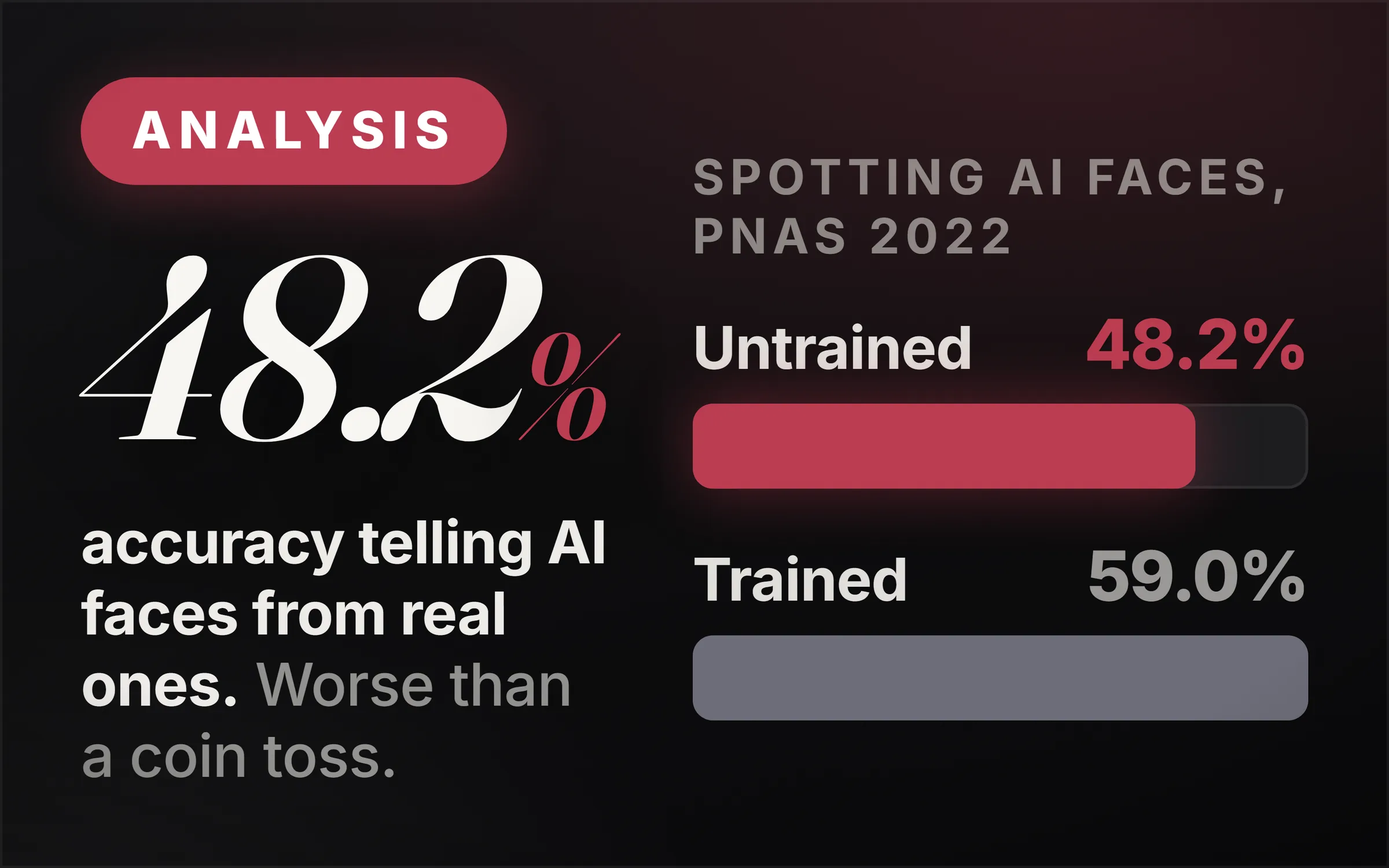
Not reliably, at least for faces. In a 2022 study in PNAS, Sophie Nightingale and Hany Farid found that people sorting real faces from AI-generated ones scored an average accuracy of 48.2%, slightly worse than a coin toss. After training, accuracy rose only to 59.0%.
The same study asked people to rate trustworthiness, and AI-generated faces came out 7.7% more trustworthy than real ones, a small but statistically significant difference. The paper's title states the finding plainly: AI-synthesized faces are indistinguishable from real faces and more trustworthy.
Still faces are not performances. Holding a scene, timing a line and reacting to another actor are far harder to synthesise convincingly, which is part of why the film tests whether Tilly can act at all. But the research means the old safeguard, that audiences would simply notice, cannot be relied on.
Do AI actors have to be labelled?
In New York adverts, yes; in films, there is no equivalent rule. On 11 December 2025 Governor Kathy Hochul signed legislation that, per the governor's office, "requires persons who produce or create an advertisement to identify if it includes AI generated synthetic performers" (bill S.8420-A/A.8887-B).
The law defines those performers as "digitally-created media that appear as a real person". A soft-drink advert using one has to say so. The law is written around advertisements, and the governor's announcement sets no labelling rule for films themselves, so a viewer can be told about an AI performer in an advert and not in the cinema.
A second bill signed the same day (S.8391/A.8882) deals with consent for using a deceased performer's name, image and likeness, which is a different problem from performers who never lived.
Which acting work is most exposed to AI?
Roles the 2023 contract does not cover, and roles where the face matters more than the performance. The synthetic-performer rule excludes non-human characters entirely, so animated creatures and fantasy figures can be built without notice to the union. Non-union productions, which sit outside SAG-AFTRA's agreements, have no such clause at all.
Inside the contract, the most exposed roles are the ones where a convincing face is most of the job and the role has no lines that demand sustained performance. The PNAS finding matters most here: if 48.2% accuracy is the audience's best guess, a background or brief on-screen role is where synthetic substitution is cheapest and least noticed.
The least exposed work is the opposite: leading roles where audiences come for a specific, known person. A synthetic performer cannot be anyone recognisable without that person's consent under the contract, so star power stays human by definition. For the wider picture of which jobs AI threatens and which it does not, see which jobs are safe from AI and whether AI is taking entry-level jobs.
The honest hard part
The hard part is that the contract was written in 2023, before any AI performer had starred in anything, and the next negotiation will rewrite it. What reads as a gap today may be closed, or widened, by the time Misaligned is released. Anyone predicting the outcome is guessing.
The second hard part is that "if any" cuts both ways. It means a union could negotiate real money for every synthetic role, or nothing. The text does not decide which. Bargaining power does.
The third is that the strongest protection human actors have is not legal at all. It is whether audiences want to watch something with nobody behind it. The union says they do not. The studio says the film is mostly human craft anyway. That claim, like every claim about how much of a product is really AI, deserves the same scrutiny as AI washing.