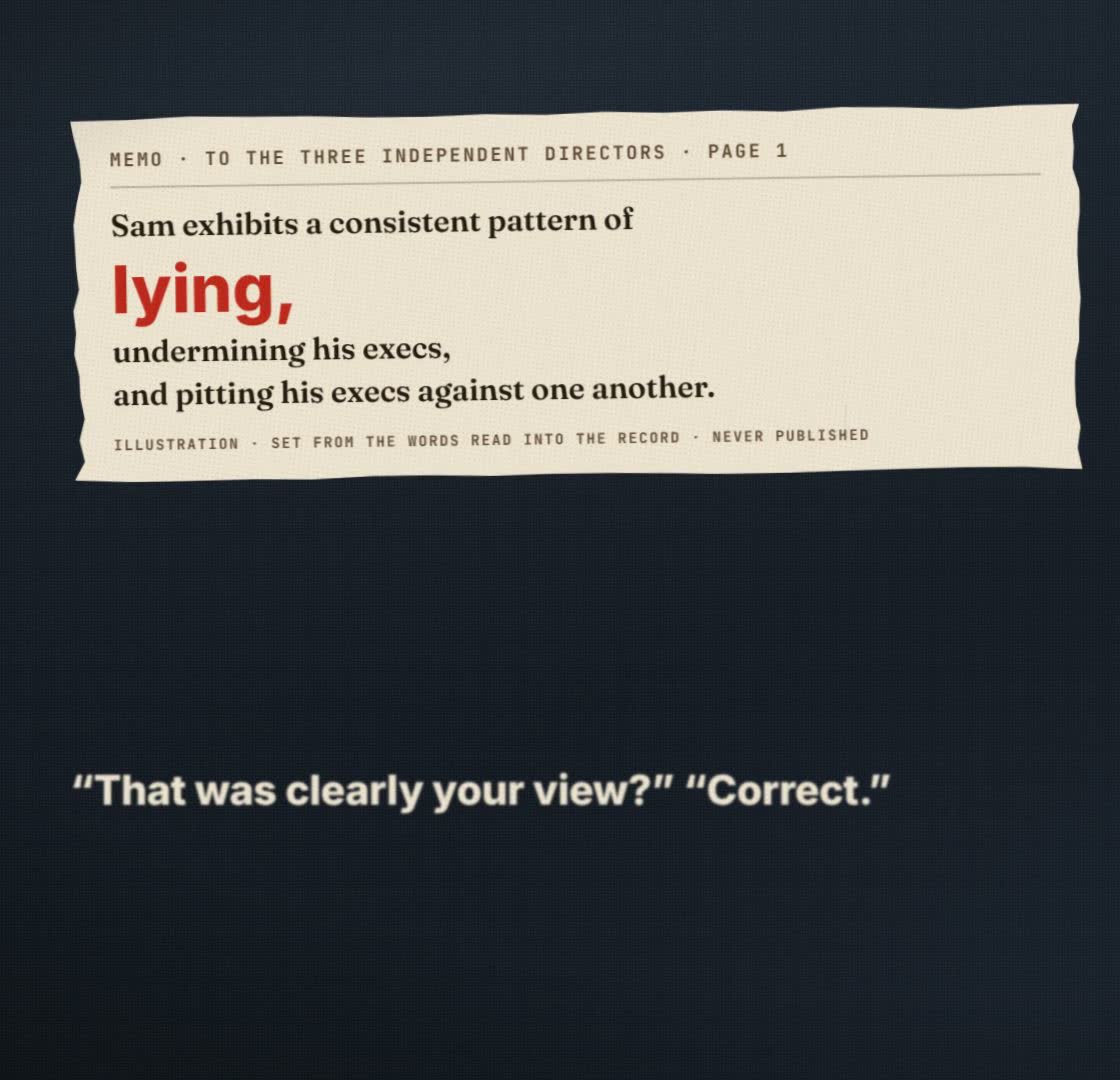
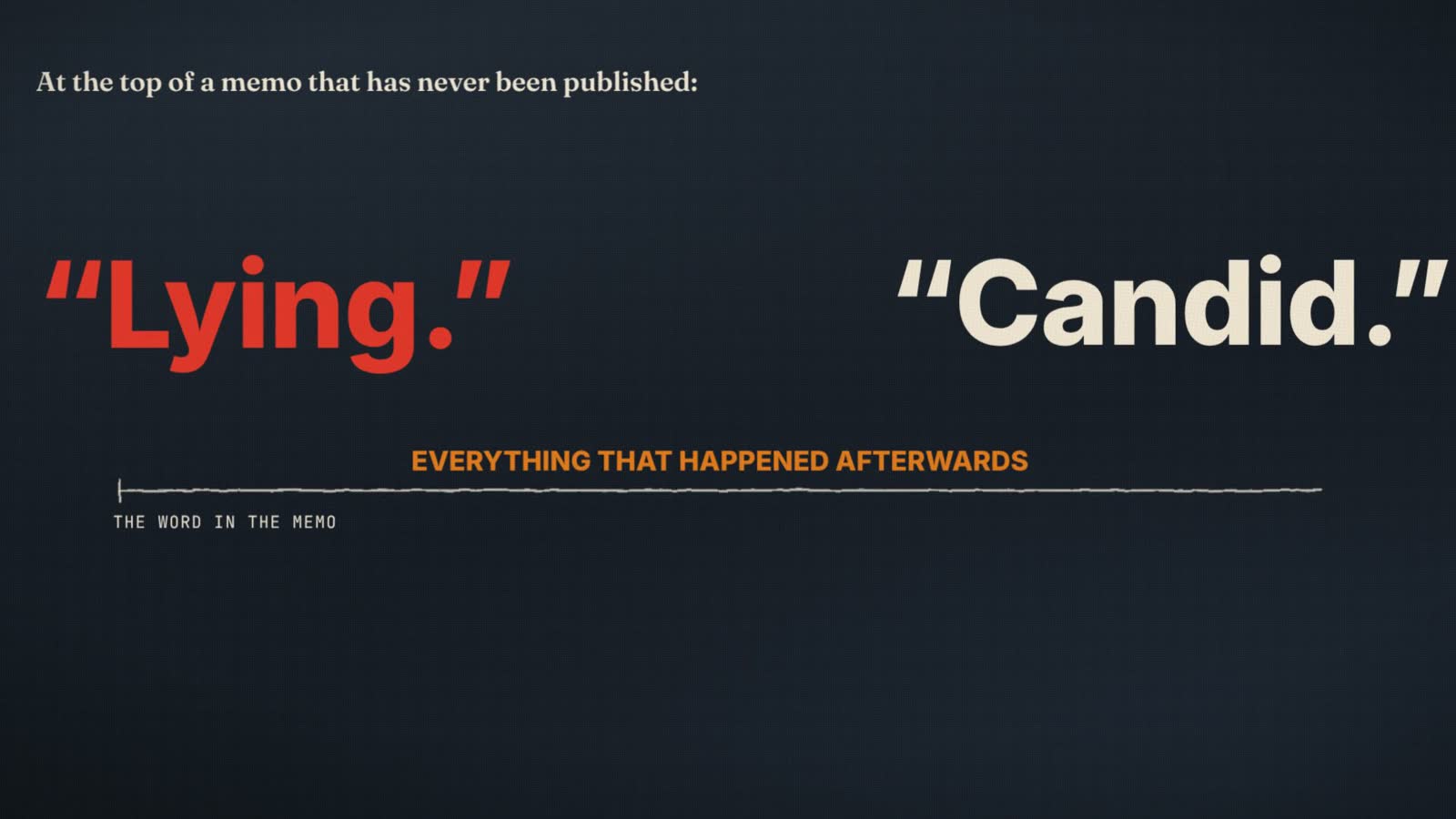
"Sam exhibits a consistent pattern of lying." That sentence sits on the first page of a 52-page memo that OpenAI's chief scientist sent to three of the company's directors in the autumn of 2023. Weeks later, on Friday 17 November, the board fired Sam Altman, the chief executive behind ChatGPT. By Tuesday 21 November it had agreed to take him back.
When the board explained itself to the world, it never used the memo's word. It said he had not been "consistently candid in his communications with the board." It would not tell even his own staff what that meant. Two years later a lawsuit put almost everyone involved under oath: the memo's author, the directors who voted, the executive whose evidence they relied on, and Altman himself.
Our 44-minute documentary for The Signal reads that sworn record, alongside the board's resolution, the company's own announcements and a letter signed by 738 employees, to answer one question: why was Sam Altman fired, and why did it last only five days? This piece follows the film act by act. Where a witness could not remember, it says so. Where the other side has answered on the record, the answer is here too. The film is at the top of this page.
The film in 10 chapters
Pick a chapter and the film starts there. 44:22 in all.
Why could OpenAI's board fire Sam Altman at all?
Watch from 1:26A company designed to fire its boss
OpenAI's board could fire Altman because the company was built that way. Founded on 11 December 2015 as a non-profit, OpenAI kept a board whose duty ran to its mission, not to investors, even after it created a capped-profit company in 2019. By 2023 the majority of that board had to be independent and hold no equity.
The first sentence OpenAI ever published is worth reading as written: "OpenAI is a non-profit artificial intelligence research company. Our goal is to advance digital intelligence in the way that is most likely to benefit humanity as a whole, unconstrained by a need to generate financial return." A non-profit has no owners and pays no dividends; whatever it earns goes back into its purpose. The founders believed artificial intelligence might become the most powerful technology ever built, and that the lab building it should not answer to shareholders.
The same post named the people behind it. Ilya Sutskever was research director, Greg Brockman was chief technology officer, and the co-chairs were Sam Altman, then president of the start-up investor Y Combinator, and Elon Musk. The backers, it said, had committed $1 billion. That billion never arrived as cash. By OpenAI's own later account, the non-profit raised less than $45 million from Musk and more than $90 million from other donors, and by 2017 the founders had worked out that their goal would cost billions of dollars a year.
So in March 2019 they built something unusual: a company underneath the non-profit that could take investment and pay returns, but only up to a limit. Returns for the first investors were "capped at 100x their investment." Money could come in. Control stayed with the non-profit's board.
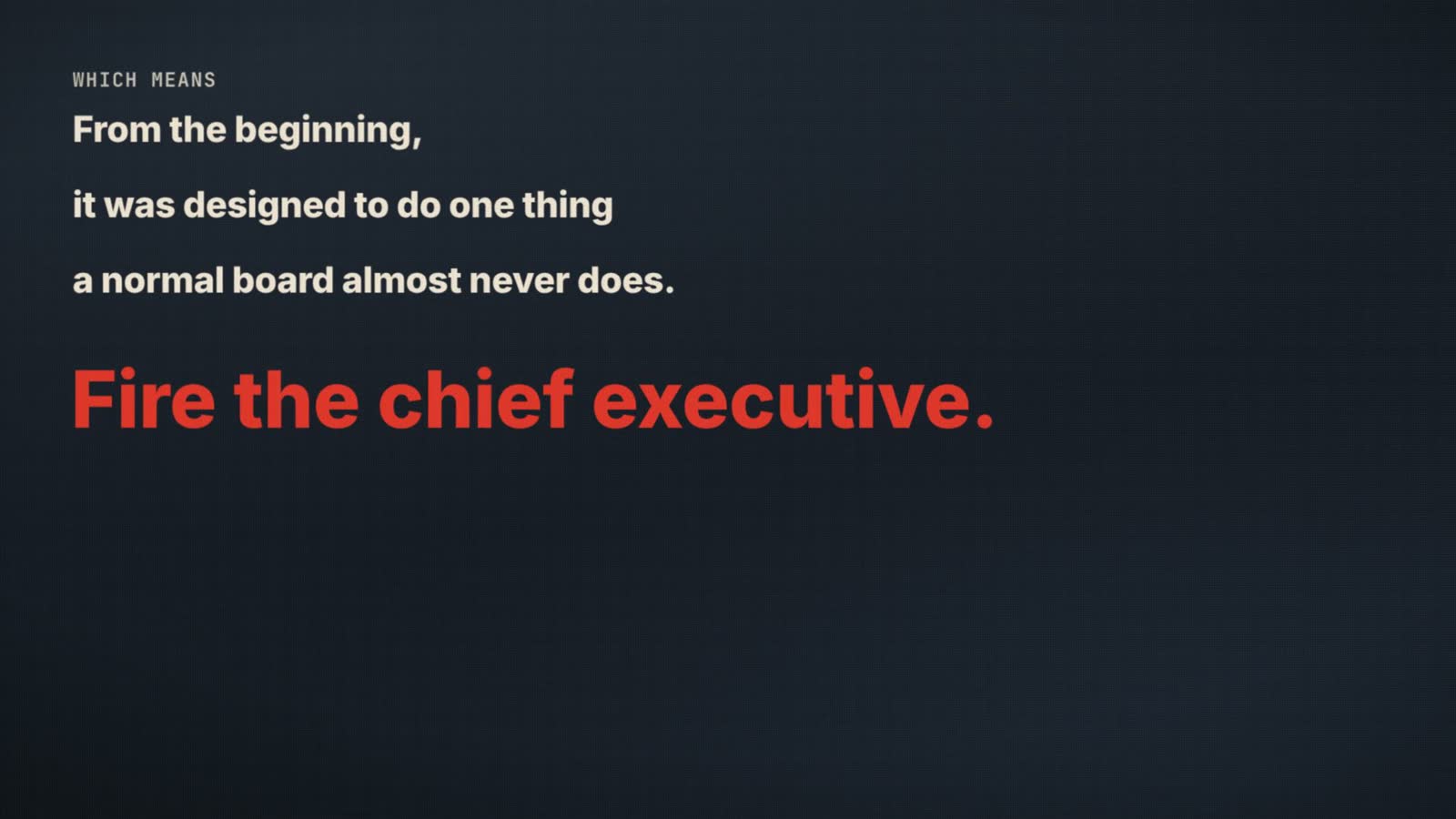
OpenAI's structure page, as it stood in November 2023, spelled out what that meant. Each director had to act "in furtherance of its mission," which the page defined as "safe AGI that is broadly beneficial." The non-profit's "principal beneficiary is humanity, not OpenAI investors." AGI, artificial general intelligence, was defined there as "a highly autonomous system that outperforms humans at most economically valuable work." Building it was the mission. Being able to stop the people building it was the board's job, which meant this board could do something a normal board almost never does: fire the chief executive for reasons that had nothing to do with money.
The same page said one more thing that matters later. "Even OpenAI's CEO, Sam Altman, does not hold equity directly. His only interest is indirectly through a Y Combinator investment fund that made a small investment in OpenAI before he was full-time."
On 16 May 2023, with ChatGPT public for less than six months, Altman sat before a US Senate subcommittee. Asked about his worst fears, he said: "My worst fears are that we cause significant, we, the field, the technology, the industry cause significant harm to the world." He added, "I think if this technology goes wrong, it can go quite wrong," and suggested governments consider licensing and testing requirements for the most powerful models. Near the end, Senator John Kennedy of Louisiana asked whether he made a lot of money. "I get paid enough for health insurance. I have no equity in OpenAI." The senator told him, "You need a lawyer or an agent." Altman replied: "I'm doing this cuz I love it."
People have called that answer a lie ever since, and the film does not. His only stake was the indirect one through Y Combinator's fund, and OpenAI's website disclosed it. What the answer shows is narrower. In May 2023, the story Sam Altman told about himself was a man with nothing to gain, running a company whose board could remove him. Six months later, that board used its power.
What was in Ilya Sutskever's memo about Sam Altman?
Ilya Sutskever's memo ran to 52 pages and opened, he confirmed under oath, with "Sam exhibits a consistent pattern of lying, undermining his execs, and pitting his execs against one another." He sent it only to the three independent directors, as a disappearing email. Most of its screenshots, he testified, came from chief technology officer Mira Murati.
By autumn 2023 the board had six seats. Besides Altman and Brockman sat Sutskever; Adam D'Angelo, chief executive of Quora; Tasha McCauley, a technology entrepreneur; and Helen Toner of Georgetown University's Center for Security and Emerging Technology. Asked in October 2025 what "board dynamics" he had been waiting for, Sutskever answered: "That the majority of the board is not obviously friendly with Sam." Asked how long he had been considering Altman's removal: "At least a year."
Three of those four directors, and the executive whose evidence they relied on, were later questioned under oath in Elon Musk's lawsuit against OpenAI, and their accounts line up closely enough to set out one incident at a time.
The launch. ChatGPT went public on 30 November 2022. Toner said on a podcast in May 2024: "when ChatGPT came out November, 2022, the board was not informed in advance about that. We learned about ChatGPT on Twitter." Asked under oath whether that surprised her: "No, I was not surprised, because I was used to the board not being very informed about things."
The fund. The OpenAI Startup Fund invested in young companies building on OpenAI's technology. Asked whether Altman had ever disclosed to the board that he had any ownership interest in it, Toner said: "No." McCauley said that "we didn't know that Sam owned the fund was, you know, concerning." OpenAI's side is on the record too. A spokesperson told TechCrunch in April 2024 that the fund's original structure had been meant as a temporary arrangement and that Altman made no personal investment and had no financial interest in it. On 1 April 2024, formal control passed to an OpenAI employee, Ian Hathaway.
The safety board. OpenAI and Microsoft ran a joint committee, the Deployment Safety Board, to review OpenAI's most powerful models before release. In 2023 OpenAI was preparing GPT-4 Turbo. Murati was asked under oath: "Did Mr. Altman tell you that OpenAI's legal department had said that GPT Turbo did not need to go through OpenAI's deployment safety board?" She answered "Yes." Asked whether he was telling the truth, she answered "No." She went to Jason Kwon, who oversaw legal: "I confirmed that what Jason was saying and what Sam was saying were not the same thing."
The same testimony holds the other half. Questioned by OpenAI's lawyers, Murati said her concern was not really the model: "My concern was about Sam saying one thing to one person and completely the opposite to another person, and this made it a very difficult and chaotic environment to work with." She believed the model did go through the safety board in the end. And Toner, asked whether anyone on the board had ever put the allegation to Kwon, said: "No, not that I'm aware of." The one incident everybody agrees happened is small. What it shows is not danger. It shows two senior people being told two different things.
The paper. In October 2023 Toner co-wrote an academic paper that compared OpenAI unfavourably with a rival lab, Anthropic. Altman was unhappy about it, and Sutskever testified that he found the paper "not far from obviously inappropriate" for a board member. What Toner objected to was what came next. She testified that Altman "told Ilya that Tasha thought I had to leave the board because of the fact that I had written this paper, which Tasha had not said." How did she know? "Because she said she hadn't." Asked by Musk's lawyer whether that was one of the incidents behind the firing, McCauley said yes.
The executives. On The TED AI Show in May 2024, Toner said two senior executives had come to the board that October. "They used the phrase psychological abuse," she said, and "they actually sent us screenshots and documentation of some of the, the instances they were telling, telling us about, of him lying and being manipulative in different situations." She did not name them. Murati, asked under oath whether Altman had been candid with her by autumn 2023, said "Not always." Had he undermined her in her role? "Yes." Pitted executives against each other? "Yes." The journalist Karen Hao, who reviewed notes of one of those meetings for her 2025 book, reported Sutskever telling the directors: "I don't think Sam is the guy who should have the finger on the button for AGI."
Then the memo. Sutskever assembled it at the independent directors' request. Asked why he did not send it to Altman: "Because I felt that, had he become aware of these discussions, he would just find a way to make them disappear." Why it had to vanish: "Because I was worried that those memos will somehow leak." Was the line about a consistent pattern of lying his view at the time? "Correct." What action did he think appropriate? "Termination."
The same deposition is where the memo's weaknesses come out. It said Altman had been pushed out of Y Combinator for similar behaviour, which came from Murati passing on what she had heard. Did Sutskever check it? "No." Of the rest: "I fully believed the information that Mira was giving me." Why not speak to the people named? "It didn't occur to me." On GPT-4 Turbo he said that back then he thought he knew what had happened, "But I knew it through secondhand knowledge." And then a line anyone who has acted on somebody else's word will recognise: "I think secondhand knowledge can be very useful, but I think that secondhand knowledge is an invitation for further investigation." That investigation did not happen before the vote. By Hao's account, the three independent directors had made up their minds by Saturday 11 November.
Why was Sam Altman fired?
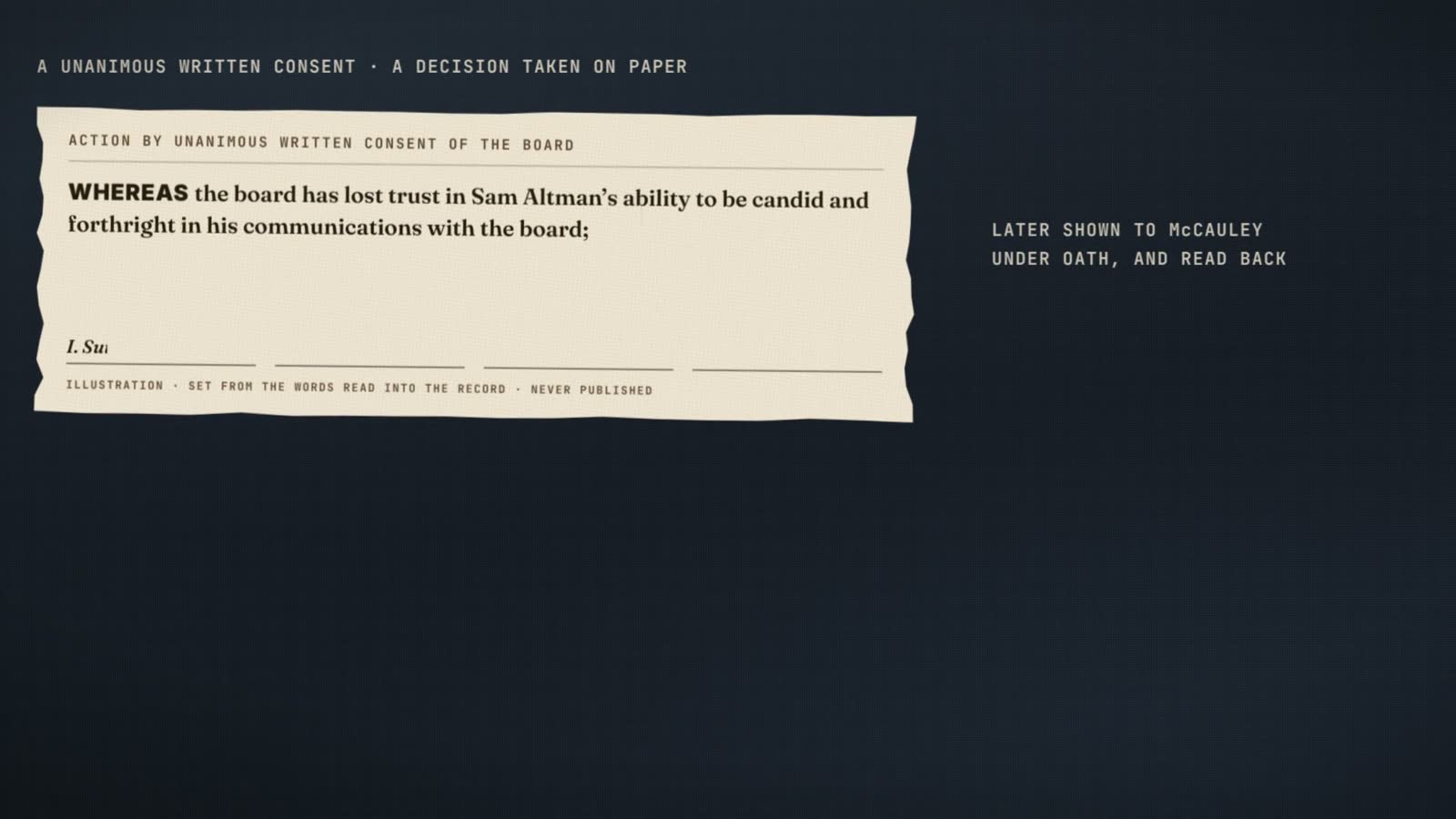
Sam Altman was fired because, in the words of the consent four directors signed on 16 November 2023, "the board has lost trust in Sam Altman's ability to be candid and forthright in his communications with the board." The next day OpenAI announced that he "was not consistently candid," and gave no examples.
A unanimous written consent is a decision a board can take on paper without meeting. It has never been published; it exists in public because a lawyer read it back to McCauley at her deposition, including the operative words: "Now, therefore, be it resolved that the board hereby, effective immediately … terminates Mr. Altman's employment."
On Friday 17 November, around noon Pacific time by Hao's account, the board told Altman on Google Meet. Asked where he was, McCauley said: "I heard he was attending, maybe, a Formula 1, like, race." The Las Vegas Grand Prix was running that weekend. Sutskever, she said, did most of the talking. Then a post went up on OpenAI's website, and it is still there: "Mr. Altman's departure follows a deliberative review process by the board, which concluded that he was not consistently candid in his communications with the board, hindering its ability to exercise its responsibilities. The board no longer has confidence in his ability to continue leading OpenAI." Murati became interim chief executive. Brockman was removed as chairman and quit within hours, followed, Hao reported, by three senior researchers.
"Not consistently candid" was chosen with care. Asked whether the board had been careful with the words of that announcement, Sutskever said "Yes." The board, Hao reported, felt it could not give its evidence without outing Murati as the source. So when staff gathered that afternoon, they were told almost nothing. Hao obtained a recording of the meeting. Asked whether a specific incident had led to this, Sutskever said: "What, when, how, who, exactly. I wish I could go into the details. But I can't." Asked if it was a hostile takeover: "The OpenAI nonprofit board has acted entirely in accordance to its objective. It is not a hostile takeover. Not at all." Asked under oath how the meeting went, Sutskever gave one word: "Tense."
The board had the power to fire him. What it did not have was a way to explain why without naming the people who had told it.
The board had the power to fire him. What it did not have was a way to explain why without naming the people who had told it.
How did Sam Altman get his job back in five days?
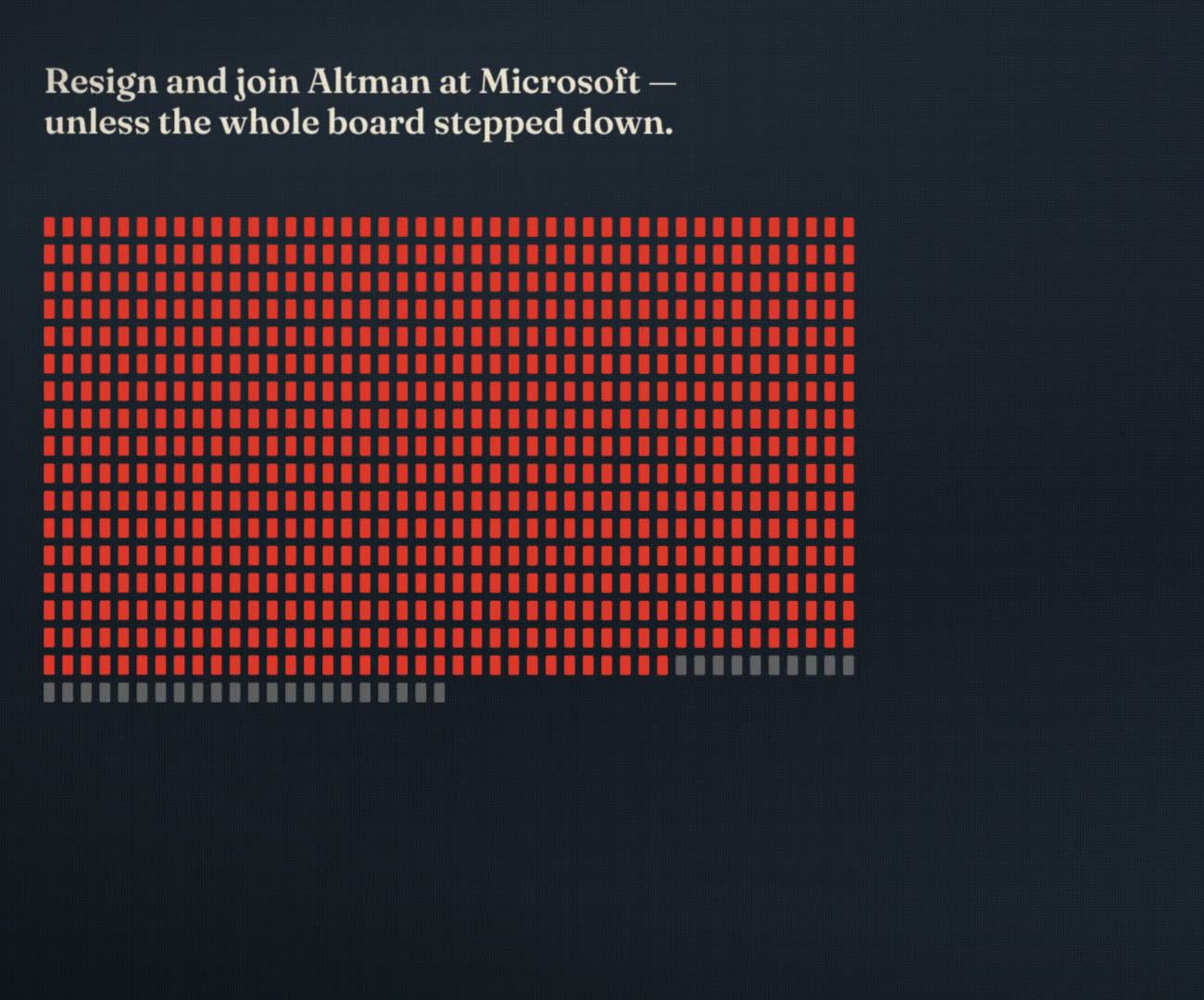
Sam Altman got his job back through three pressures at once: staff about to lose a share sale, executives threatening to resign, and a Microsoft offer to hire anyone who followed him. By 5:10 pm Eastern on Monday 20 November, 738 of roughly 770 employees had signed a letter demanding the board quit. On Tuesday it gave way.
The first force was money. OpenAI was in the middle of a tender offer, letting employees sell shares to outside investors for what could amount, Hao reported, to millions of dollars each. Toner later testified that the reaction of "some employees who were concerned about their equity stakes and the potential loss of an upcoming stock sale, tender deal" played a significant part in what followed. The second was that nobody could run the company. By Saturday night, she testified, the board "had already had multiple threats from the entire executive team to resign," and Murati was not willing to keep serving.
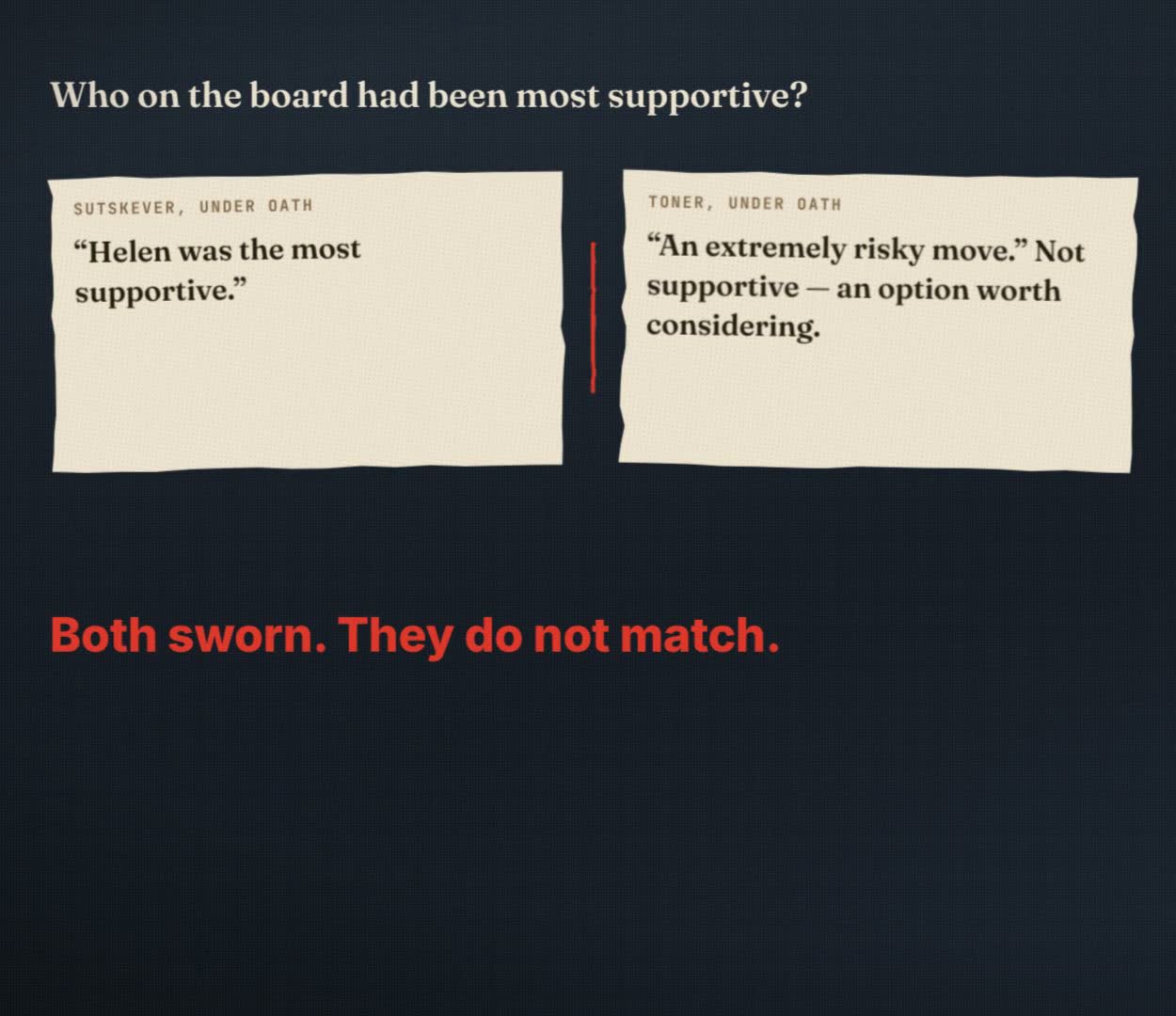
So the directors looked for a way to save OpenAI without Altman, and one option is still barely known. That weekend, on a call Sutskever placed on Saturday 18 November, the board spoke to the leadership of Anthropic. Toner, under oath: "I believe we discussed whether it might make sense for Anthropic to merge with OpenAI in some way." Had they discussed making Anthropic's chief executive, Dario Amodei, head of OpenAI? "I believe so, yes." Sutskever was on that call. "I was very unhappy about it," he said. "Because I really did not want OpenAI to merge with Anthropic." Who on the board had been most supportive? "My recollection is that Helen was the most supportive." Toner, asked the same, said: "I thought it would have been an extremely risky move. I would not describe myself as supportive of it. I would say I thought it was an option worth considering among our set of difficult options." Both accounts are sworn, and they do not match. The idea lasted, in Sutskever's words, "Extremely briefly."
On Sunday night the board named a new interim chief executive, Emmett Shear, formerly of Twitch. Hours later Microsoft's Satya Nadella announced that Altman and Brockman would join Microsoft to lead a new research team. Toner explained under oath why that changed everything: it "significantly increased the credibility of employees' threats that they would leave en masse and gave Sam significantly more leverage to demand his own reinstatement to avoid the company falling apart."
On Monday 20 November the staff letter arrived. "Your conduct has made it clear you did not have the competence to oversee OpenAI." "Despite many requests for specific facts for your allegations, you have never provided any written evidence." And: "You also informed the leadership team that allowing the company to be destroyed 'would be consistent with the mission.'" That last line was Toner's, and Sutskever confirmed it: "Helen Toner said something to the effect of that it is consistent, but I think she said it even more directly than that." Read against OpenAI's own structure page, which named humanity, not investors, as the non-profit's principal beneficiary, her sentence was the design stated plainly. What nobody had tested was how it would sound to the people who worked there.
One signature was Sutskever's. That Monday he posted: "I deeply regret my participation in the board's actions. I never intended to harm OpenAI. I love everything we've built together and I will do everything I can to reunite the company." Asked two years later why he signed: "Because I felt that if we were to go down the path where Sam would not return, then OpenAI would be destroyed. And I really didn't want that." He added that after he withdrew his support for the firing, "the board stopped communicating with me."
On Tuesday 21 November the board agreed to take Altman back. Friday to Tuesday: five days. The new board was Bret Taylor, formerly co-chief executive of Salesforce, as chair; Larry Summers, the former US Treasury Secretary; and Adam D'Angelo, the only one of the four who had fired Altman to keep his seat. Altman confirmed in his deposition that Toner's and McCauley's removal was a condition of his return. On 29 November OpenAI published his message to staff: "I love and respect Ilya … I harbor zero ill will towards him." The week had proven, he wrote, that "we didn't lose a single employee." McCauley was later asked whether it had been better to reinstate Altman with new safeguards than to let OpenAI disintegrate. "Yes." The departing directors, The New Yorker later reported, made one thing a condition of leaving: an independent inquiry.
What did the WilmerHale investigation into Sam Altman find?
WilmerHale reviewed more than 30,000 documents and found "a breakdown in trust" between the old board and Altman. It found the board "acted within its broad discretion to terminate Mr. Altman, but also found that his conduct did not mandate removal." OpenAI published that summary on 8 March 2024. No full written report has ever been released.
A committee of the new board hired WilmerHale on 8 December 2023. Three months later OpenAI's summary said the lawyers had conducted dozens of interviews, and its key sentences are short enough to read in full. "WilmerHale found there was a breakdown in trust between the prior Board and Mr. Altman that precipitated the events of November 17." The firm reviewed the board's 17 November post and "concluded that the statement accurately recounted the prior Board's decision and rationales." The decision "did not arise out of concerns regarding product safety or security, the pace of development, OpenAI's finances, or its statements to investors, customers, or business partners." The board "implemented its decision on an abridged timeframe, without advance notice to key stakeholders, and without a full inquiry or an opportunity for Mr. Altman to address the prior Board's concerns."
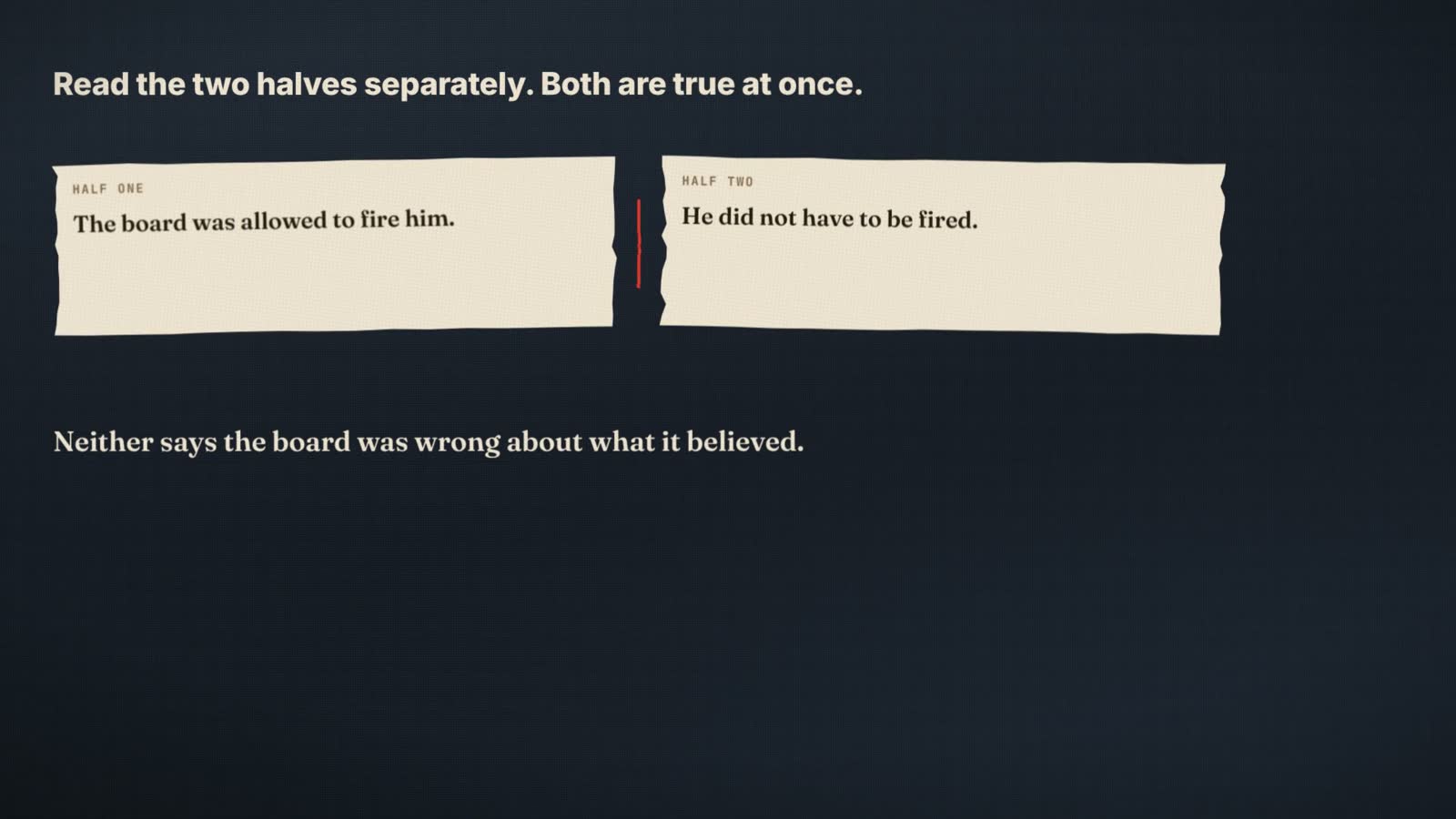
Read the sentence the review is remembered for in two halves, because both are true at once. The board was allowed to fire him, and he did not have to be fired. Neither half says the board was wrong about what it believed. The review said the board's statement accurately reflected its reasons. It did not say whether those reasons were right.
The board was allowed to fire him, and he did not have to be fired.
The same day, Altman rejoined the board, alongside three new directors. Taylor said: "We have unanimously concluded that Sam and Greg are the right leaders for OpenAI." In April 2026, The New Yorker reported that no report was released because none was written, and that the findings were delivered in oral briefings. Taylor did not dispute it. In light of those briefings, he told the magazine, there was "no need for a formal written report." So the only independent account of why OpenAI's chief executive was fired exists, in public, as a summary of some 800 words, published by the company.
Three days before that summary, on 5 March 2024, OpenAI had published a long post answering a lawsuit from Elon Musk. Five founders signed it. One was Sam Altman. Another was Ilya Sutskever.
What did Helen Toner say about why Sam Altman was fired?
Watch from 27:45The month it all came out
Helen Toner said on 28 May 2024 that for years Altman had hampered the board by "withholding information. Misrepresenting things that were happening at the company, in some cases outright lying to the board." All four directors who fired him, she said, concluded "we just couldn't believe things that Sam was telling us." OpenAI's chair answered by pointing to an independent review.
That May almost everything came out at once. In mid-May Sutskever announced he was leaving. He later told the lawyers: "Ultimately, I had a big new vision, and it felt more suitable for a new company." That same week Jan Leike, who ran OpenAI's long-term safety research with him, left too. Their team had been set up in July 2023 with a promise of "20% of the compute we've secured to date over the next four years," compute being the banks of processors these systems are trained and run on. On 17 May Leike wrote that "safety culture and processes have taken a backseat to shiny products," and that "Over the past few months my team has been sailing against the wind." Fortune reported, citing half a dozen sources, that the 20 percent was never delivered. OpenAI did not respond to Fortune's requests to comment, and the team was disbanded.
The same Friday, Vox reported that departing employees were being asked to sign a lifelong agreement never to criticise the company, at the risk of "forfeiting what could be millions of dollars" in vested equity. The next day Altman posted, in his own lower case: "there was a provision about potential equity cancellation in our previous exit docs; although we never clawed anything back, it should never have been something we had in any documents or communication. this is on me and one of the few times i've been genuinely embarrassed running openai; i did not know this was happening and i should have."
On 22 May Vox published the documents. The reporter, Kelsey Piper, went looking for who had set up the clauses that gave the company that power. They sat in the incorporation papers of the company that held employees' shares, signed on 10 April 2023. "So I scrolled down to the signature page, wondering who at OpenAI had set all this up. The page had three signatures. All three of them were Sam Altman." A signature is not proof that the signer read every clause, and chief executives sign a great deal of paper. But it is the kind of gap the old board described: a statement and a document that do not sit comfortably together. OpenAI released former employees from the agreements on 23 May.
Then Toner and McCauley spoke. In The Economist on 26 May they wrote: "But based on our experience, we believe that self-governance cannot reliably withstand the pressure of profit incentives." Two days later, on The TED AI Show, Toner explained what "not consistently candid" had meant. "But for years, Sam had made it really difficult for the board to actually do that job by, you know, withholding information." For any single case, she said, "Sam could always come up with some kind of like innocuous sounding explanation," but "the end effect was that after years of this kind of thing, all four of us who fired him came to the conclusion that we just couldn't believe things that Sam was telling us."
She reached back before OpenAI. At Loopt, Altman's first company, she said management had twice asked the board to fire him for what they called "deceptive and chaotic behavior," and she said he had been fired from Y Combinator, "Which was hushed up at the time." Those claims have another side, given under oath. At his September 2025 deposition, Altman was asked why he left Y Combinator. "Because I wanted to do OpenAI." Was he fired? "No." Given an ultimatum to choose? "To choose one or other, yeah." Paul Graham, who co-founded Y Combinator, gave The New Yorker a statement in 2026 that sits between the two accounts: "We didn't have the legal power to fire anyone. All we could do was apply moral pressure." On Loopt, the claim comes from Wall Street Journal reporter Keach Hagey's 2025 biography of Altman, and a Loopt board member told The New Yorker the attempts to remove him were not serious. That is where the record on Loopt stops.
OpenAI's reply came from its chair, Bret Taylor, and was included in the episode. "We are disappointed that Ms. Toner continues to revisit these issues." He pointed to the WilmerHale review and added: "Additionally, over 95 percent of employees, including senior leadership, asked for Sam's reinstatement as CEO and the resignation of the prior board." Every fact in that reply is accurate. None of them is about whether Toner's account was true.
Every fact in that reply is accurate. None of them is about whether Toner's account was true.
Who controls OpenAI now?
On paper, OpenAI's non-profit still controls the company. Since a recapitalisation completed on 28 October 2025, the non-profit, renamed the OpenAI Foundation, holds equity in the for-profit, OpenAI Group PBC, valued at approximately $130 billion. Microsoft's stake was valued at about $135 billion, roughly 27 percent.
By 2025 the question in public had moved from the man to the structure. In December 2024 OpenAI laid out a plan to turn its company into a more conventional business. After objections from former employees and civic groups, and talks with the Attorneys General of Delaware and California, the two officials who oversee its non-profit, it changed course. On 5 May 2025 Bret Taylor announced: "OpenAI was founded as a nonprofit, and is today overseen and controlled by that nonprofit. Going forward, it will continue to be overseen and controlled by that nonprofit." The company would become a public benefit corporation, a business legally required to weigh a stated mission alongside profit.
The non-profit is now also one of the company's largest shareholders, and OpenAI described what that means in a single sentence: "The more OpenAI succeeds as a company, the more the non-profit's equity stake will be worth." No finding says this is wrong, and it was completed after nearly a year of talks with both Attorneys General. But the old directors had already said what they thought such a structure was worth under pressure, and Toner said it most exactly under oath: "Well, because there was a guardrail around the nonprofit being able to make certain decisions, and then it turned out that, in practice, those decisions could be reversed."
What did the jury decide in Musk v. Altman?
On 18 May 2026, after less than two hours, a nine-person advisory jury found that Elon Musk's claims against OpenAI and Altman were barred by the statute of limitations, the deadline for bringing a case. Judge Yvonne Gonzalez Rogers adopted the verdict. Having answered that question yes, the jury never had to reach anything else.
Almost everything quoted in this article was said under oath because of that lawsuit. Musk, who co-founded OpenAI and left its board in 2018, sued OpenAI and Altman on 29 February 2024, claiming the company had broken its founding promise and that he had been misled into funding it. He dropped that case and refiled in federal court in August 2024. OpenAI's defence was that Musk had known of the for-profit plans since 2017, had wanted control himself, and left when he could not have it. Neither side's version of Musk is the subject of the film. What matters is that Musk's lawyers made Altman's character central to their case, and so they went looking for the people who had fired him.
Between September and November 2025 they were deposed, on video, by lawyers from both sides: Altman on 16 September, McCauley on 30 September, Sutskever on 1 October from 10:19 in the morning until 8:07 at night, Toner on 8 October and Murati on 2 November. Long excerpts were filed in the public court record, and they were not kind to anyone. Sutskever: "One thing I can say is that the process was rushed." Why? "I think it was rushed because the board was inexperienced." Murati, on why she backed Altman's return: "I realized that the board had not followed the process that could be trusted, and it wasn't transparent." Did her earlier problems with Altman persist after he came back? "Yes." Sutskever said OpenAI was probably paying his lawyers, "I think that's probably the case," and confirmed he still held a financial interest in the company, which had grown in value.
In April 2026 The New Yorker published an investigation by Ronan Farrow and Andrew Marantz, built partly on Sutskever's memos. One, they reported, "begins with a list headed 'Sam exhibits a consistent pattern of . . .' The first item is 'Lying.'"
Jury selection began on 27 April. The recorded depositions of Toner, Murati and McCauley were played to the jury. Sutskever testified in person on 11 May and Altman on 12 May. The Guardian, in the courtroom, reported Musk's lawyer Steven Molo opening his cross-examination: "You've repeatedly been called deceptive and a liar by people with whom you've done business, right?" Altman, the paper reported, answered mostly in short yes-or-no replies, at times said he did not recall details, and disputed how events had been described. Earlier, questioned by his own lawyer, he had put his case in one line about the charity Musk accused him of taking: "I agree you can't steal it. Mr Musk did try to kill it, I guess twice."
At closing on 14 May, Molo told the jury what he thought the case was about. "Sam Altman's credibility is directly at issue in this case. The defendants absolutely need you to believe Sam Altman. If you cannot trust him, if you do not believe him, they cannot win. It's that simple."
On Monday 18 May the jury went out and came back in less than two hours. Musk had three years from the point he should have known about the harm he alleged, and OpenAI argued he knew of the for-profit plans as early as 2017. The jury agreed the case came too late. Its verdict was advisory, a recommendation rather than the final word, and the judge adopted it; on 20 May she confirmed it in writing. OpenAI's lawyer, William Savitt, said: "Mr Musk can tell his stories. What the jury found today is just that: Stories, not facts." He called it "not a technical decision; it's a substantive one." Musk called it "a calendar technicality" and said: "I will be filing an appeal with the Ninth Circuit."
Look at what the jury was actually asked. The verdict form's first question was whether the charitable-trust claim was barred by the statute of limitations. The jury ticked yes, and yes again on the unjust-enrichment claim. The printed instruction beneath read: "If you answered 'YES' to both Question 1 and Question 3, then skip the other questions and the presiding juror should sign and date this form." Nobody on that jury was ever asked to decide whether Sam Altman could be believed.
Nobody on that jury was ever asked to decide whether Sam Altman could be believed.
Was Sam Altman fired for lying?
No public document says the board fired Altman for lying. The word appears in Sutskever's unpublished 52-page memo and in Toner's 2024 account. The board's own words were "candid and forthright" and "not consistently candid," and every body that examined November 2023 since then ruled on something next to that question.
Here is everything the record holds. A board resolution, signed on 16 November 2023, saying the board had lost trust in its chief executive's ability to be candid and forthright. A 52-page memo, never published, whose first page said "consistent pattern of lying," and whose author testified that most of its screenshots came from one colleague and that he had not checked much of it with the people involved. A chief technology officer who said under oath that on one occasion her chief executive had not told her the truth, and that the board which acted on her evidence had not followed a process that could be trusted. A letter from 738 employees saying the board had never provided any written evidence, which was true: the evidence was the memo, and the memo went out as an email that deleted itself. An independent review that said the board had the right to fire him and did not have to, and that was never written down. A signature on a page, three times, beneath clauses its signer said he did not know about. And a jury told the whole case turned on whether one man could be trusted, which ruled on the calendar instead.
The lawyers ruled on the board's discretion. The jury ruled on the deadline. The Attorneys General negotiated the structure. None of them was asked, or chose, to decide the thing the board said in the first place. The man at the centre has kept the same account throughout: he says he was never fired from Y Combinator and did not know about the clauses. He is still OpenAI's chief executive, and he rejoined the board meant to be able to remove him in March 2024.
In December 2015, the first sentence OpenAI published said it would be free of the need to make money, so that it could put humanity first. In November 2023, four people tried to use the one power that sentence gave them. It lasted five days. The board chose to say "candid" instead of the memo's word. Everything that happened afterwards happened in the space between those two words.
Everything that happened afterwards happened in the space between those two words.
Key findings
OpenAI's board told the world on 17 November 2023 that Sam Altman was not consistently candid in his communications with the board. The written consent the four directors had signed the day before said they had lost trust in his ability to be candid and forthright.
OpenAI, OpenAI announces leadership transition, 17 Nov 2023; McCauley deposition, Musk v. Altman, Dkt 379-101Ilya Sutskever testified that his memo on Altman ran to 52 pages, went only to the three independent directors as a disappearing email, and opened with the words 'Sam exhibits a consistent pattern of lying.' The memo itself has never been published.
Sutskever deposition, 1 Oct 2025, Musk v. Altman, Dkt 340-1By 5:10 pm Eastern on Monday 20 November 2023, some 738 of OpenAI's roughly 770 employees had signed a letter threatening to leave unless the board resigned.
Will Knight and Steven Levy, Wired, 20 Nov 2023The board fired Altman on Friday 17 November 2023 and agreed to rehire him on Tuesday 21 November, 5 days counted from Friday to Tuesday. Two of the four directors who removed him, Helen Toner and Tasha McCauley, left as a condition of his return.
OpenAI posts of 17 and 29 Nov 2023; WilmerHale summary, 8 Mar 2024; Altman deposition, Dkt 379-76WilmerHale reviewed more than 30,000 documents and found the old board acted within its broad discretion to fire Altman, but also that his conduct did not mandate removal. No full written report was published; The New Yorker reported none was written.
OpenAI, Review completed, 8 Mar 2024; The New Yorker, 6 Apr 2026In July 2023 OpenAI promised its superalignment team 20% of the compute it had secured, over four years. Fortune reported, from half a dozen sources, that the commitment was never fulfilled. OpenAI did not respond to Fortune.
OpenAI, Introducing Superalignment, 5 Jul 2023; Fortune, 21 May 2024After the October 2025 recapitalisation, the non-profit, renamed the OpenAI Foundation, holds equity in the company valued at approximately $130 billion. Microsoft's stake was valued at about $135 billion, roughly 27%.
OpenAI, Built to benefit everyone, 28 Oct 2025; Microsoft, 28 Oct 2025The advisory jury in Musk v. Altman returned its verdict after less than 2 hours, finding Musk's claims barred by the statute of limitations. Under the verdict form's own instruction, it never had to reach the other questions.
Minute entry, Dkt 576; verdict form, Dkt 572; The Guardian, 18 May 2026Frequently asked questions about why Sam Altman was fired
Why was Sam Altman fired from OpenAI?
OpenAI's board said on 17 November 2023 that Altman was not consistently candid in his communications with the board. Under oath in 2025, the directors described specific incidents, including a disputed account of a safety review and an undisclosed stake in the OpenAI Startup Fund. An independent review later said the board was within its rights but that his conduct did not mandate removal.
What did Ilya Sutskever's memo about Sam Altman say?
The memo has never been published. Under oath, Sutskever confirmed that its first page said 'Sam exhibits a consistent pattern of lying, undermining his execs, and pitting his execs against one another,' that it ran to 52 pages, and that most of its screenshots came from Mira Murati. He also admitted he had not checked much of it with the people named.
Who fired Sam Altman?
Four directors signed the decision on 16 November 2023: chief scientist Ilya Sutskever, Quora chief executive Adam D'Angelo, technology entrepreneur Tasha McCauley and Georgetown researcher Helen Toner. D'Angelo was the only one of the four who stayed on the board after Altman returned.
How did Sam Altman get his job back?
Over the weekend the executive team threatened to resign, Microsoft offered to hire Altman and anyone who followed him, and 738 of about 770 employees signed a letter demanding the board step down. On Tuesday 21 November 2023 the board agreed to rehire him, with a new board chaired by Bret Taylor.
What did the WilmerHale investigation find?
According to OpenAI's 8 March 2024 summary, WilmerHale found a breakdown in trust, found that the board's public statement accurately recounted its decision, and found that the board acted within its broad discretion but that Altman's conduct did not mandate removal. No full report was released. The New Yorker reported that none was written.
Was Sam Altman fired from Y Combinator?
Helen Toner said in May 2024 that he was. Under oath in September 2025, Altman said he was not fired and was asked to choose between Y Combinator and OpenAI. Y Combinator co-founder Paul Graham told The New Yorker in 2026: 'We didn't have the legal power to fire anyone. All we could do was apply moral pressure.'
Who won the Musk v. Altman trial?
OpenAI and Altman. On 18 May 2026 an advisory jury found Musk's claims barred by the statute of limitations, and Judge Yvonne Gonzalez Rogers adopted the verdict. The jury did not rule on whether Altman was credible. Musk said he would appeal to the Ninth Circuit; OpenAI's lawyer called the verdict a substantive one.
Did Sam Altman lie to Congress about his OpenAI equity?
No document says so. Altman told a Senate subcommittee in May 2023 that he had no equity in OpenAI. OpenAI's website disclosed that his only interest was an indirect one, through a Y Combinator fund that made a small early investment. The film does not call the answer a lie, and neither does this article.
Sources
- OpenAI, Introducing OpenAI, 11 Dec 2015openai.com
- OpenAI, OpenAI LP, 11 Mar 2019openai.com
- OpenAI, Our structure (as archived 1 Nov 2023)web.archive.org
- TechPolicy.Press, Transcript: Senate Judiciary Subcommittee Hearing on Oversight of AI, 16 May 2023techpolicy.press
- OpenAI, Introducing Superalignment, 5 Jul 2023openai.com
- OpenAI, OpenAI announces leadership transition, 17 Nov 2023openai.com
- Will Knight and Steven Levy, OpenAI Staff Threaten to Quit Unless Board Resigns, Wired, 20 Nov 2023wired.com
- OpenAI, Sam Altman returns as CEO, OpenAI has a new initial board, 29 Nov 2023openai.com
- OpenAI, OpenAI and Elon Musk, 5 Mar 2024openai.com
- OpenAI, Review completed & Altman, Brockman to continue to lead OpenAI, 8 Mar 2024openai.com
- Marina Temkin, Sam Altman gives up control of OpenAI Startup Fund, TechCrunch, 1 Apr 2024techcrunch.com
- CNBC, OpenAI dissolves Superalignment AI safety team, 17 May 2024cnbc.com
- Jan Leike, thread on X announcing his departure, 17 May 2024 (via Thread Reader)threadreaderapp.com
- Kelsey Piper, OpenAI departures: why can't former employees talk?, Vox, 17 May 2024vox.com
- Fortune, OpenAI promised 20% of its computing power to combat the most dangerous kind of AI, but never delivered, 21 May 2024fortune.com
- Kelsey Piper, Leaked OpenAI documents reveal aggressive tactics toward former employees, Vox, 22 May 2024vox.com
- Aestas, LLC, Amended and Restated LLC Agreement, 10 Apr 2023, as published by Vox (archived)web.archive.org
- CNBC, OpenAI sends internal memo releasing former employees from controversial exit agreements, 24 May 2024cnbc.com
- Helen Toner and Tasha McCauley, AI firms mustn't govern themselves, The Economist, 26 May 2024economist.com
- The TED AI Show, What really went down at OpenAI and the future of regulation w/ Helen Toner, May 2024 (transcript)ted.com
- Richard Lawler, Why the OpenAI board fired Sam Altman, The Verge, 28 May 2024 (with Bret Taylor's response)theverge.com
- OpenAI, Why OpenAI's structure must evolve to advance our mission, 27 Dec 2024openai.com
- OpenAI, Evolving OpenAI's structure, 5 May 2025openai.com
- Karen Hao, What Really Happened When OpenAI Turned on Sam Altman, The Atlantic, May 2025theatlantic.com
- OpenAI, Built to benefit everyone, 28 Oct 2025openai.com
- Microsoft, The next chapter of the Microsoft-OpenAI partnership, 28 Oct 2025blogs.microsoft.com
- Musk v. Altman, No. 4:24-cv-04722-YGR (N.D. Cal.), docket on CourtListenercourtlistener.com
- Ilya Sutskever deposition excerpt, 1 Oct 2025, Dkt 340-1storage.courtlistener.com
- Ilya Sutskever deposition excerpt, Dkt 379-92storage.courtlistener.com
- Tasha McCauley deposition excerpt, 30 Sep 2025, Dkt 379-101storage.courtlistener.com
- Sam Altman deposition excerpt, 16 Sep 2025, Dkt 379-76storage.courtlistener.com
- Mira Murati video deposition as played at trial (Trial Exh. 1701), Dkt 601-2storage.courtlistener.com
- Helen Toner video deposition as played at trial (Trial Exh. 1702), Dkt 601-3storage.courtlistener.com
- Tasha McCauley video deposition as played at trial (Trial Exh. 1703), Dkt 601-4storage.courtlistener.com
- Jury verdict form, 18 May 2026, Dkt 572storage.courtlistener.com
- Civil minutes, 18 May 2026, Dkt 576storage.courtlistener.com
- Post-trial order re advisory verdict, 20 May 2026, Dkt 580storage.courtlistener.com
- Ronan Farrow and Andrew Marantz, Sam Altman May Control Our Future. Can He Be Trusted?, The New Yorker, 6 Apr 2026newyorker.com
- The Guardian, Sam Altman testifies in Musk v OpenAI trial, 12 May 2026theguardian.com
- The Guardian, Closing arguments in Musk v Altman, 14 May 2026theguardian.com
- The Guardian, Sam Altman wins trial against Elon Musk, 18 May 2026theguardian.com
Every quotation in the film and in this article comes from a published company post, a Senate transcript, a filing in the public record of Musk v. Altman (No. 4:24-cv-04722-YGR, N.D. Cal.), a named person's own public statement, or named reporting, all listed above. Where testimony is quoted, it is one witness's sworn account, and where the other side has answered, its answer is given beside it. The Sutskever memo and the board's written consent have never been published; they are quoted only where lawyers read them into the sworn record.
Watch next
AI Psychosis: How ChatGPT Talks People Into Delusions
AI psychosis explained: how ChatGPT's habit of agreeing pulled one man into a 300-hour delusion, what OpenAI's own data shows, and what has changed since.Read and watch
Move 37: What Happened to Go Players After AI Beat Them
Ten years after Move 37, the humans got better by the machine's measure. One of them says his reason for playing is gone.Read and watch
AI Takeover Scenario: How It Would Actually Happen
Twelve endings, four takeover stories, and the same three steps in every one.Read and watch
Is the Internet Dead? The Dead Internet Theory, Checked
Bots are 53% of web traffic. Half of new articles are machine-written. So why is almost everything you read still made by people?Read and watch
What Is AI? Why 'Artificial Intelligence' Is an Illusion
Two thirds of people think someone is inside ChatGPT. The name was chosen in 1955 to dodge an argument.Read and watchThe fight in this film is over who controls a company building artificial general intelligence, a term OpenAI defines in its own charter. AGI, compute, alignment and the rest of the vocabulary behind the story are among the 52 terms explained in plain English, with a printable sheet, in our free AI Terms guide.