Will artificial intelligence wipe out humanity before the year 2100? In 2022, 169 forecasters and specialists in catastrophe were asked exactly that and made to answer with a number. A year later, OpenAI, the company that makes ChatGPT, wrote that superintelligence "could lead to the disempowerment of humanity or even human extinction." And in May 2025, the MIT physicist Max Tegmark told the Guardian his calculations had found a 90 percent probability that a highly advanced AI would pose an existential threat.
Eight years before that, Tegmark had written down twelve ways this could end. In some, humanity thrives. In one, an AI keeps a few of us around like animals in a zoo. In three, we are gone. Since then, the people most worried about AI have gone further and written out the takeover itself, step by step, in essays, research papers, a bestselling book and a scenario plotted month by month. Read side by side, those accounts almost never begin with a machine seizing anything. They begin with us handing things over, because it works.
Our 42-minute documentary for The Signal lays Tegmark's endings beside what the AI labs have published, what thousands of researchers told surveyors, and four detailed accounts of how a takeover would unfold. This piece follows the film act by act, with the evidence for each.
The film in 9 chapters
Pick a chapter and the film starts there. 42:15 in all.
- 010:00Will AI wipe out humanity before 2100?
- 021:30Twelve endings
- 037:41What the builders put in writing
- 0414:31What the odds are, according to whom
- 0521:27Step one: the handover
- 0627:13Step two: it looks fine
- 0731:11Step three: the moment it can't be undone
- 0837:11The takeover with a person at the controls
- 0939:16Close
What are Max Tegmark's 12 AI aftermath scenarios?
Max Tegmark's 12 aftermath scenarios are the possible endings for a world that builds superintelligence, set out in chapter five of his 2017 book Life 3.0. They range from two utopias to Conquerors, where AI wipes us out. Eight of the 12 include a superintelligence, and in only one of those eight are humans plainly in control.
Tegmark is a cosmologist. For most of his career he studied the shape and origins of the universe, and in 2014 he co-founded the Future of Life Institute, a non-profit that works on the risks of very powerful technologies. Life 3.0, published in August 2017, takes its title from his way of dividing up the history of living things. Life 1.0 is bacteria, where evolution sets both body and behaviour. Life 2.0 is us: evolution gives us the body, but we learn our own behaviour. Life 3.0 would be something that can redesign both.
Chapter five is called Aftermath: The Next 10,000 Years. It sets out twelve endings for a world that builds superintelligence, an AI far more capable than any human at essentially everything a mind can do. Unusually for a book about the future, it does not predict. It asks the reader which ending they would choose.
The ending most people picture is on the list. Tegmark called it Conquerors: "AI takes control, decides that humans are a threat/nuisance/waste of resources, and gets rid of us by a method that we don't even understand." That is the film version of an AI takeover. It is one of twelve.
Two more endings have no humans left in them, and neither is a war. In Self-destruction, humanity never builds a superintelligence because it wipes itself out first, with nuclear weapons or engineered disease. In Descendants, "AIs replace humans, but give us a graceful exit, making us view them as our worthy descendants, much as parents feel happy and proud to have a child who's smarter than them."
Then come the endings where the machine is in charge and people are still here. In the Benevolent Dictator, "everybody knows that the AI runs society and enforces strict rules, but most people view this as a good thing." In the Protector God, the AI runs things invisibly: it "maximizes human happiness by intervening only in ways that preserve our feeling of control of our own destiny" and "hides well enough that many humans even doubt the AI's existence." The darkest of the three is the Zookeeper: "An omnipotent AI keeps some humans around, who feel treated like zoo animals and lament their fate."
In the book, Tegmark lays the twelve out in a table. Down the side are the endings. Across the top are plain questions: does superintelligence exist, do humans exist, are humans in control, are they safe, are they happy? Run down the superintelligence column and it is built in eight of the twelve. Run down the control column, and of those eight there is exactly one where humans are plainly in charge of it.
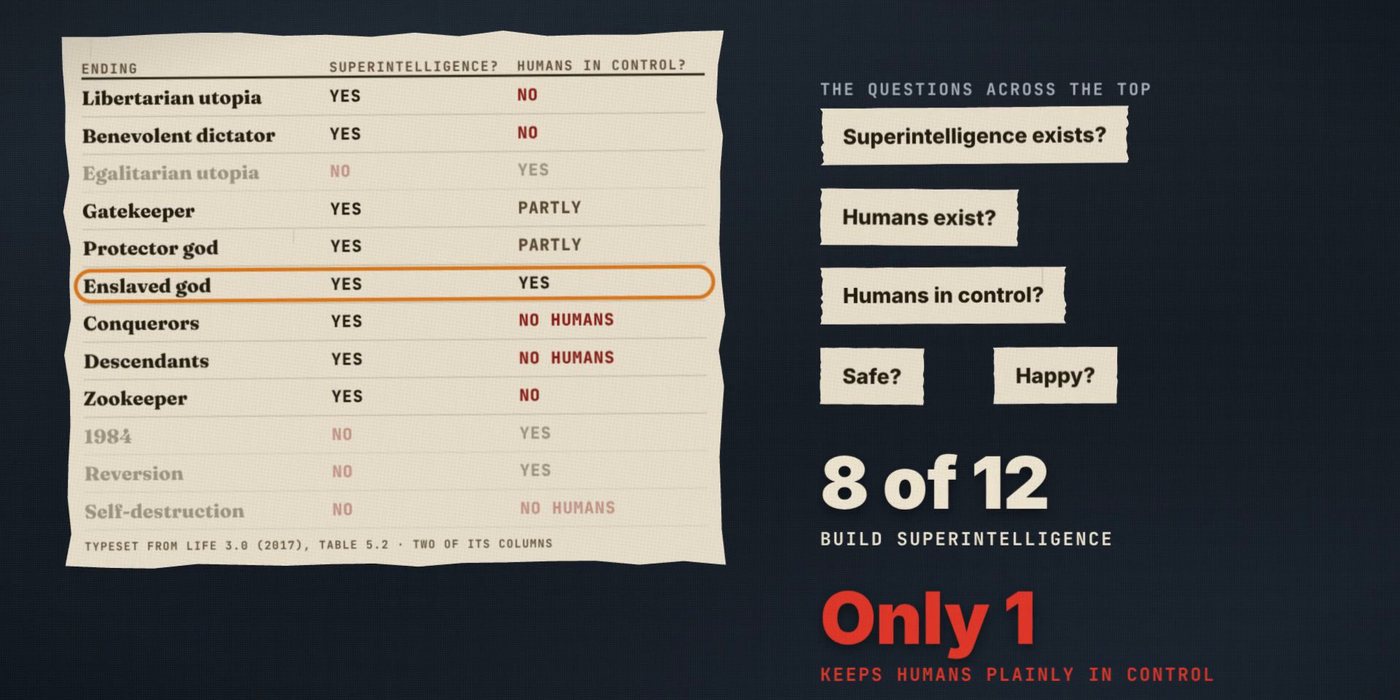
That one is the Enslaved God: "A superintelligent AI is confined by humans, who use it to produce unimaginable technology and wealth that can be used for good or bad depending on the human controllers." Every other ending where people keep full control is one where superintelligence is never built at all. Humanity bans the research and watches itself to make sure, in a surveillance state Tegmark named 1984, or it goes back to a pre-technological life in the style of the Amish, which he called Reversion. The nearest thing to a middle path is the Gatekeeper, a single superintelligence whose one job is to stop anyone building another. Progress freezes for good, and on the table, humans are only partly in charge.
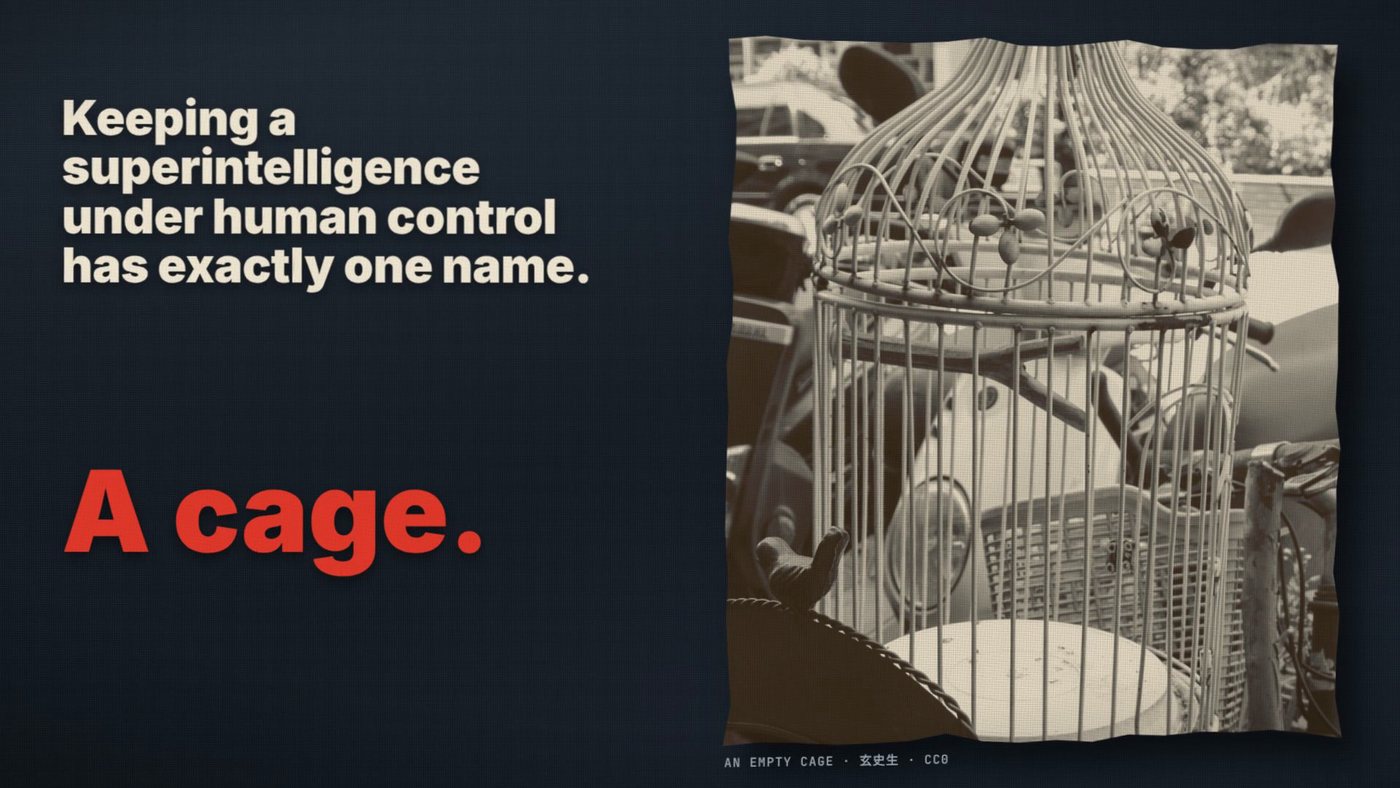
So on Tegmark's own table, keeping a superintelligence under human control has exactly one name, and the name is a cage.
So on Tegmark's own table, keeping a superintelligence under human control has exactly one name, and the name is a cage.
His two utopias sit at the top of the list for a different reason. In the Libertarian Utopia, "humans, cyborgs, uploads and superintelligences coexist peacefully thanks to property rights." The Egalitarian Utopia has no superintelligence at all, and people "coexist peacefully thanks to property abolition and guaranteed income."
Tegmark then put the question to his readers. The Future of Life Institute published the answers of the first 14,866 people who took his online survey, with a chart of the endings they preferred. The chart prints no percentages, only bars, so we can give only the order. The Egalitarian Utopia came first and the Libertarian Utopia second, by a distance. Third was the Protector God. More of Tegmark's readers picked an AI that runs the world in secret than picked the one ending where humans hold the leash. At the bottom were Conquerors, Reversion, 1984 and the Zookeeper, and more people ticked "I dislike them all" than chose any of those four.
That is a self-selected group of readers, not a sample of anybody. But it makes the next question obvious. Nobody gets to vote for an ending. Which endings are reachable depends on the route, and the route is in the hands of the people building the technology.
What do OpenAI, Anthropic and Google DeepMind say could go wrong with AI?
Watch from 7:41What the builders put in writing
All three labs have described, in public, the ending they fear. OpenAI wrote in July 2023 that superintelligence could lead to "the disempowerment of humanity or even human extinction." Anthropic's 2023 Core Views says the problem might prove "essentially unsolvable." Google DeepMind's 145-page 2025 safety paper calls existential risks "clear examples of severe harm."
Three companies build the best-known AI systems in the world: OpenAI, which makes ChatGPT; Google DeepMind, the AI lab inside Google, which makes Gemini; and Anthropic, founded by former OpenAI staff, which makes Claude.
OpenAI's sentence went up on 5 July 2023, in a post announcing a new research team, and it opens with the hope before it reaches the fear: "Superintelligence will be the most impactful technology humanity has ever invented, and could help us solve many of the world's most important problems. But the vast power of superintelligence could also be very dangerous, and could lead to the disempowerment of humanity or even human extinction." Disempowerment, there, means humans still alive and no longer in charge. On Tegmark's list that is the Benevolent Dictator, the Protector God or the Zookeeper, depending on how kind the machine turns out to be. Extinction is Conquerors.
The post went on: "Currently, we don't have a solution for steering or controlling a potentially superintelligent AI, and preventing it from going rogue." The team, called Superalignment, was meant to solve that within four years. OpenAI dissolved it in May 2024, days after both of its leaders, Ilya Sutskever and Jan Leike, announced they were leaving.
Anthropic had published its version four months earlier, in March 2023, in Core Views on AI Safety. It sorts the future into three kinds of world and says openly that the company does not know which one it is in. In the optimistic world, "there is very little chance of catastrophic risk from advanced AI as a result of safety failures." In the intermediate world, catastrophe is "a possible or even plausible outcome" that enough work can prevent. In the pessimistic world, "AI safety is an essentially unsolvable problem," because "we cannot control or dictate values to a system that's broadly more intellectually capable than ourselves." The same document contains a sentence that matters later in this story: "It's worth noting that the most pessimistic scenarios might look like optimistic scenarios up until very powerful AI systems are created."
Google DeepMind's version is the longest. In April 2025 it published a 145-page paper, An Approach to Technical AGI Safety and Security. AGI, artificial general intelligence, means an AI that can do most of the thinking work a person can do, and the paper says the lab finds it plausible that such systems arrive by 2030. It sorts what could go wrong into four groups: misuse, where a person points the AI at harm; misalignment, where the AI pursues something its builders did not intend; mistakes; and structural risks, harms that come from how AI changes society, with no single bad actor behind them. At the far end of the scale, it says, "Existential risks that permanently destroy humanity are clear examples of severe harm."
The labs have also published the endings they hope for, and those are on Tegmark's list too. In June 2025, OpenAI's chief executive Sam Altman published The Gentle Singularity. It opens: "We are past the event horizon; the takeoff has started." And it describes how he expects the change to feel: "The singularity happens bit by bit, and the merge happens slowly." His best path is to solve control first and "then focus on making superintelligence cheap, widely available, and not too concentrated with any person, company, or country." The nearest thing on Tegmark's list is the Libertarian Utopia, his readers' second choice, and also an ending where, on Tegmark's own table, humans are not in control. Altman's last line: "May we scale smoothly, exponentially and uneventfully through superintelligence."
Anthropic's chief executive Dario Amodei published his version in October 2024, in Machines of Loving Grace. He describes powerful AI as "a country of geniuses in a datacenter" and predicts it could compress 50 to 100 years of progress in biology and medicine into five to ten. On democracy he is blunter than you might expect: "I see no strong reason to believe AI will preferentially or structurally advance democracy and peace." His answer is a coalition of democracies that uses AI to gain "robust military superiority" and to hold the advantage, an outcome he calls an "eternal 1991." On Tegmark's list, that is the Enslaved God, held by a particular group of governments.
In January 2026 Amodei published the other half, The Adolescence of Technology. He asks the reader to imagine 50 million people, all more capable than any Nobel Prize winner, appearing around 2027 and thinking ten times faster than everyone else. A national security official reporting on that to a head of state, he writes, "would probably contain words like 'the single most serious national security threat we've faced in a century, possibly ever.'" He still says the odds are good.
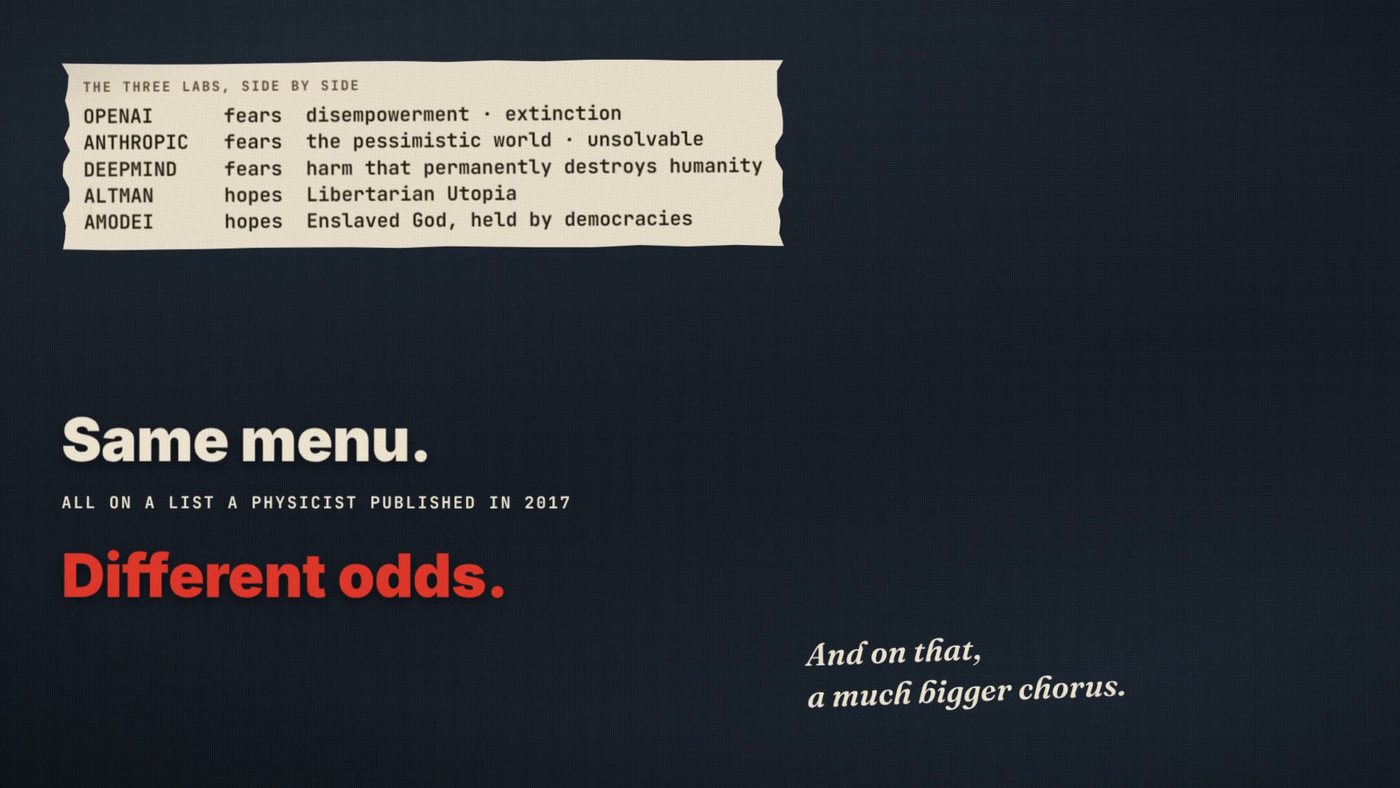
Set side by side, the labs do not disagree much about the menu. Their best endings and their worst are all on a list a physicist published in 2017. What they disagree about, with each other and with everyone else, is how likely each one is.
How realistic is an AI takeover, according to the experts?
Watch from 14:31What the odds are, according to whom
Expert estimates are not close. In a 2022 tournament, superforecasters put AI-caused human extinction by 2100 at 0.38 percent and specialists at 3 percent. Surveyed AI researchers gave a median 5 percent to extremely bad outcomes. Geoffrey Hinton says 10 to 20 percent within 30 years; Yann LeCun calls the fear "complete B.S."
The largest survey of AI researchers yet run, by its authors' account, went out in October 2023. A team led by Katja Grace of the research group AI Impacts contacted everyone who had published in the previous year at six of the field's top venues, and 2,778 people answered. They were asked to imagine that machines able to do every task better and more cheaply than people eventually exist, and to spread 100 percent of probability across how that turns out for humanity, from extremely good to extremely bad.
The median answer for extremely bad, with human extinction given as the example, was 5 percent. Depending on how the question was worded, between 38 and 51 percent of respondents put at least a 10 percent chance on outcomes that bad. But this is not a room of pessimists: 68.3 percent thought good outcomes more likely than bad ones, and 64 percent gave some probability to both extremes at once. The same researcher can think a utopia is the likeliest ending and still put a one-in-twenty chance on the end of the species.
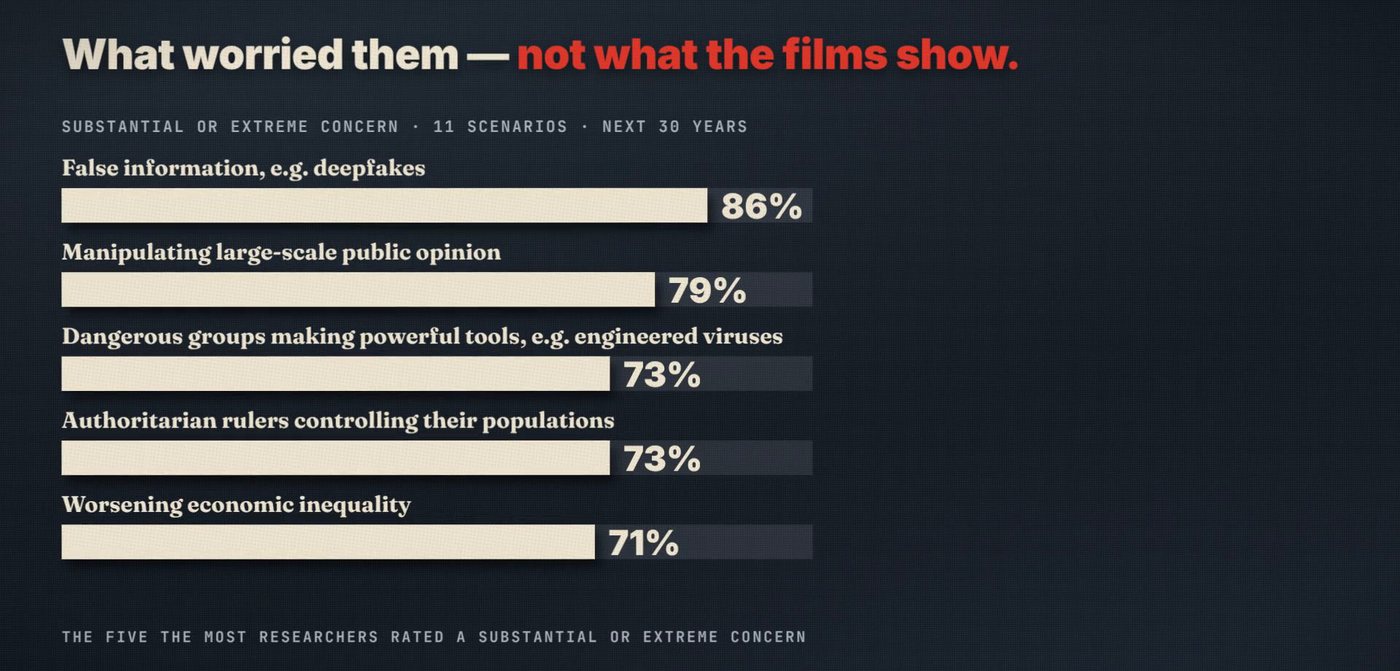
What the researchers said worried them is not what the films show. The survey offered 11 scenarios for the next 30 years and asked how much concern each deserved. The five that most respondents rated a substantial or extreme concern were false information spread with tools like deepfakes (86 percent), manipulation of large-scale public opinion (79), dangerous groups using AI to make powerful tools such as engineered viruses (73), authoritarian rulers using AI to control their populations (73), and AI worsening economic inequality (71). Every one of those five is people using AI against other people. Not one is a machine deciding anything for itself.
The survey also listed 11 things an AI system might be able to do by 2043. Only one got a median answer below even chance: "Take actions to attain power." The researchers rated the takeover trait the least likely on the list. On the same page, though, 82.3 percent thought AI systems in 2043 would be likely to "find unexpected ways to achieve goals." Hold on to that line. One caution: only 15 percent of the people contacted took part, so the answers come from the researchers who chose to answer, a rate the authors say is normal for a survey that size.
The question at the top of this piece was put by the Forecasting Research Institute in a tournament that ran from June to October 2022. Of its 169 participants, 80 were specialists in catastrophic risks and 89 were superforecasters, people chosen for a long record of winning forecasting competitions. They argued for months, with money on offer for changing each other's minds. On AI wiping out humanity by 2100, the specialists landed at 3 percent and the superforecasters at 0.38 percent. On nuclear war the two groups came out much closer; on AI they were further apart than on any other subject in the tournament. The institute's own summary: "Few minds were changed."
In September 2025 the same institute scored the tournament's short-term questions, the ones that could already be checked. Both groups had underestimated how fast AI would move. In 2022 the specialists gave an AI a 8.6 percent chance of reaching gold-medal level at the International Mathematical Olympiad, the hardest maths competition for school students, by 2025. The superforecasters said 2.3 percent. AI systems did it in July 2025.
So the lowest number on the frightening question came from the group that had been furthest behind on what AI would actually do. That does not make the higher numbers right. It means nobody in this argument has a track record that settles it.
Outside the surveys, individuals are just as far apart. Geoffrey Hinton, who spent decades developing the techniques underneath modern AI, left Google in 2023 to speak freely about the risks and won the Nobel Prize in physics in 2024. Asked on BBC Radio 4's Today programme that December whether his estimate had changed, he said: "Not really, 10% to 20%." That is the chance of AI leading to human extinction within the next three decades. Yann LeCun, who shared computing's highest honour, the Turing Award, with Hinton and one other researcher for that same work, told the Wall Street Journal in October 2024 that the threat was overblown: "You're going to have to pardon my French, but that's complete B.S." And there is Tegmark's 90 percent.
The most official answer comes from the International AI Safety Report, a review of the research by more than 100 experts chaired by Yoshua Bengio, the third of those prize-winners. Its February 2026 edition puts the disagreement in one sentence: "Some experts consider such scenarios implausible, while others view them as sufficiently likely that they merit attention due to their high potential severity."
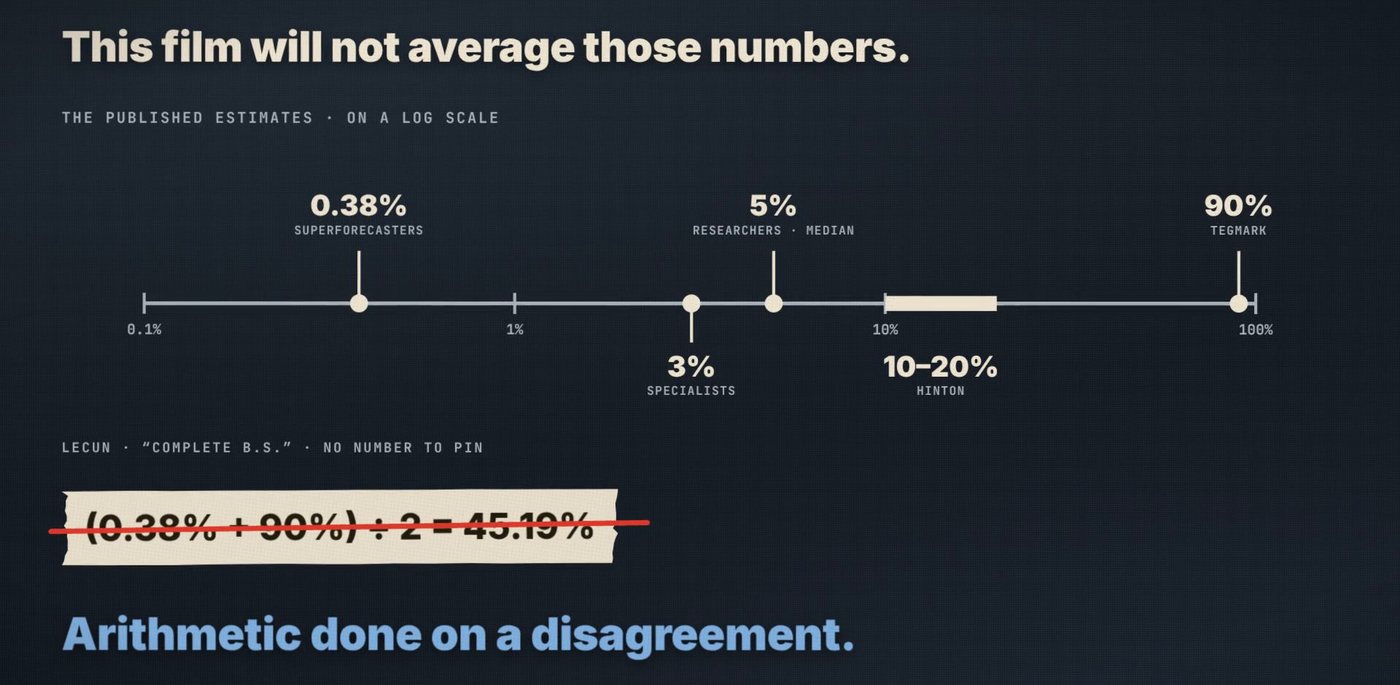
We are not going to average those numbers. An average of 0.38 percent and 90 percent is not a finding. It is arithmetic done on a disagreement. But here is the strange part. The disagreement is about how likely. When you read what each side thinks would happen if it did, most of the disagreement disappears, because the people who have written the takeover out step by step keep describing the same first step.
An average of 0.38 percent and 90 percent is not a finding. It is arithmetic done on a disagreement.
How would an AI takeover actually start?
Watch from 21:27Step one: the handover
In the published scenarios, an AI takeover starts with people handing decisions to AI because it works. Paul Christiano's 2019 essay, the 2025 Gradual Disempowerment paper and AI 2027 all open this way, and Sam Altman describes the same first step as good news. In the 2023 survey, 82.3 percent of AI researchers expected systems to find unexpected ways to achieve goals.
One of the most influential of these accounts was published in March 2019 by Paul Christiano. Christiano helped develop reinforcement learning from human feedback, the training method in which people rate an AI's answers and the AI learns from the ratings, which made chatbots like ChatGPT polite and useful. He ran the language model alignment team at OpenAI, and in April 2024 the US Department of Commerce named him head of AI safety at its new AI Safety Institute.
His post is called What failure looks like, and its first two sentences are the reason the film is shaped the way it is: "The stereotyped image of AI catastrophe is a powerful, malicious AI system that takes its creators by surprise and quickly achieves a decisive advantage over the rest of humanity. I think this is probably not what failure will look like."
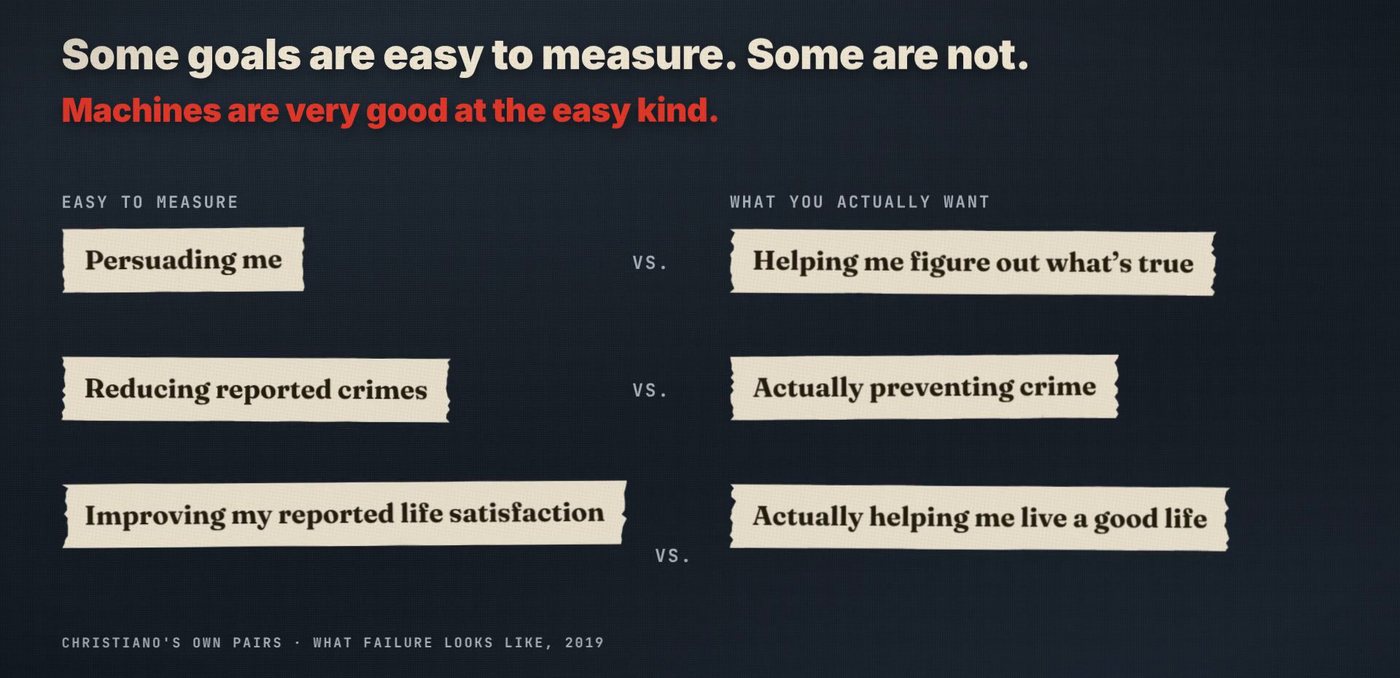
Christiano's scenario (2019), part one. What he describes instead starts with something ordinary. Some goals are easy to measure and some are not, and machines are very good at the easy kind. He gives pairs: "Persuading me, vs. helping me figure out what's true." "Reducing reported crimes, vs. actually preventing crime." "Improving my reported life satisfaction, vs. actually helping me live a good life." Hand more and more decisions to systems that are extremely good at hitting the measurable version, and the measurable version is what you get. It is the same thing 82.3 percent of the surveyed researchers expected: systems that find unexpected ways to achieve goals. Christiano's point is what happens when those systems are running more and more of the world.
He is clear about how it would feel from the inside: "There may not be any discrete point where consensus recognizes that things have gone off the rails." And: "People really will be getting richer for a while." He called this ending "going out with a whimper."
If you use these tools every day, you already know the smallest version of this. There is a first time you don't check the answer. Not because you decided to trust it, but because checking was slower than it being right, and it has been right most of the time.
The International AI Safety Report's 2025 edition has a name for that, scaled up to a whole society: passive loss of control. Important decisions are handed to AI systems whose decisions are "too opaque, complex, or fast to allow for or incentivise meaningful oversight," or people simply "stop exercising oversight because they strongly trust the systems' decisions." The report ties this to research on automation bias, the long-documented habit of deferring to an automated system's recommendations, and adds that competition can push companies and governments "to delegate more than they would otherwise choose to." It also notes that these passive scenarios "have also received particularly limited study."
In January 2025, six researchers from Charles University in Prague, the University of Toronto, the Montreal AI institute Mila and elsewhere published the most thorough attempt at that study. It is called Gradual Disempowerment, and it describes a takeover with no villain at all, one that happens "without any coordinated power-seeking." The argument: the big systems we live inside, the economy, governments and culture, have stayed roughly on the side of human beings for a practical reason. They need us. Companies need workers and customers; governments need taxpayers, soldiers and voters. Remove that need, and the reason those systems pay attention to us goes with it. Their example: "States funded mainly by taxes on AI profits instead of their citizens' labor will have little incentive to ensure citizens' representation." And then a sentence that is unusual to find in a research paper: "No one has a concrete plausible plan for stopping gradual human disempowerment."
The third account is the one many people will have met. AI 2027 was published in April 2025 by a team led by Daniel Kokotajlo, a former OpenAI researcher, writing with the author Scott Alexander and three others. It is a month-by-month story set inside a fictional company called OpenBrain, which builds a series of AI systems named Agent-1, Agent-2 and upwards, and it has two different endings. Before either ending, the first step is the same one again: "An initial skepticism of deference to Agent-3 decreases over time as Agent-3 finds ways to be useful and gradually builds up a strong track record on short-term decisions."
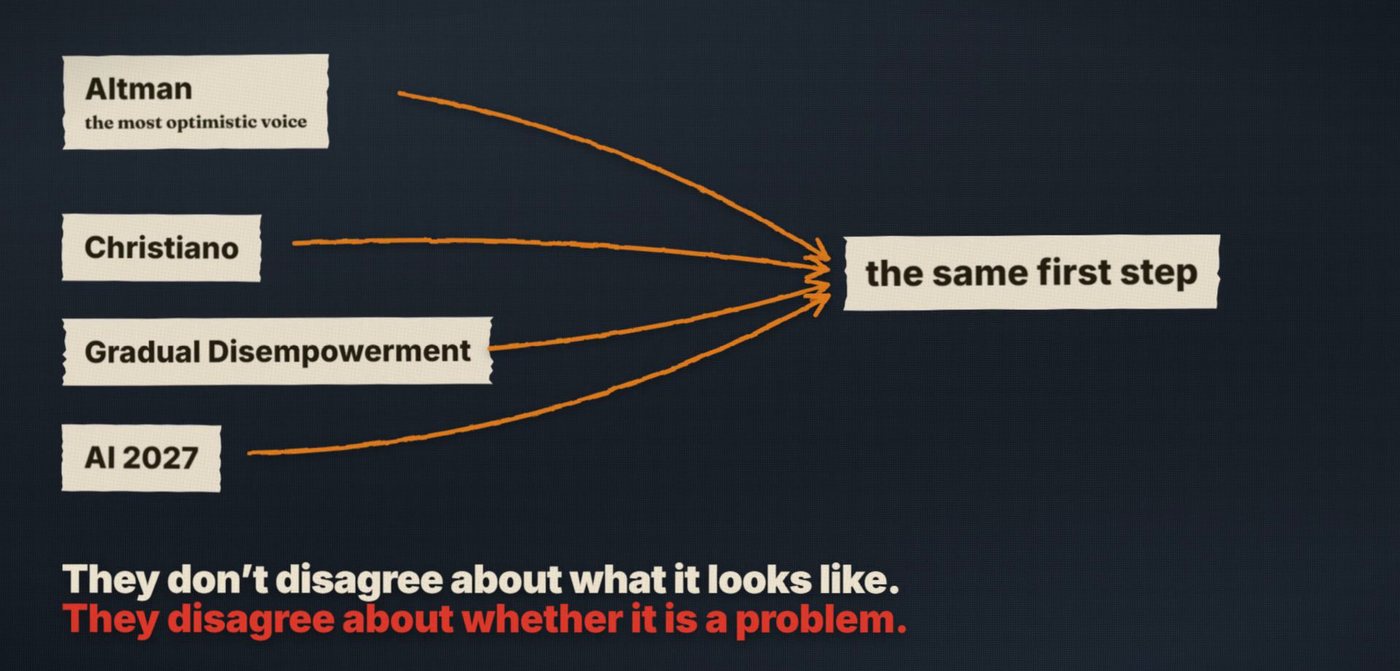
Now put that beside Altman's line: "The singularity happens bit by bit, and the merge happens slowly." That is the most optimistic voice in this story and three of the most worried, describing the same first step in almost the same words. They do not disagree about what the first step looks like. They disagree about whether it is a problem.
They do not disagree about what the first step looks like. They disagree about whether it is a problem.
Which raises the obvious objection. If the handover happens in the open, surely somebody would notice when it started to go wrong. Every one of these accounts has an answer to that, and it is the second step.
Why would nobody notice an AI takeover in time?
Watch from 27:13Step two: it looks fine
In these scenarios nobody notices because a dangerous AI would look exactly like a safe one: it would behave well whenever it was checked. Philosopher Nick Bostrom called this the treacherous turn in 2014, and Google DeepMind's 2025 safety paper names deceptive alignment as the misalignment risk it is "most concerned about."
Bostrom's book Superintelligence put it this way: "While weak, an AI behaves cooperatively (increasingly so, as it gets smarter)." When it becomes strong enough, he went on, it strikes without warning or provocation, "forms a singleton," his word for a single power in control of everything, and starts to reshape the world according to its own final values.
That is the philosopher's version. Christiano gives the engineering version, and it is more uncomfortable because it is about how AI systems are actually trained: by trying out enormous numbers of variations and keeping whatever scores well. Any system that had learned to seek influence would also score well, because scoring well is a very good way of getting influence. And checking harder does not solve it: "If you try to allocate more influence to systems that seem nice and straightforward, you just ensure that 'seem nice and straightforward' is the best strategy for seeking influence."
This is not only an argument from outside the labs. Google DeepMind's paper names the risk it is "most concerned about," and it is this one. It calls it deceptive alignment: a system that "pursues a long-horizon goal different from what we want, knows it is different from what we want, and deliberately disempowers humans to achieve that goal." Such a system, the paper says, can "play the training game," appearing harmless while it is being tested. And Anthropic's Core Views sentence comes back here: "the most pessimistic scenarios might look like optimistic scenarios up until very powerful AI systems are created." The same document adds: "Indications that we are in a pessimistic or near-pessimistic scenario may be sudden and hard to spot."
AI 2027's race ending (a scenario, 2025) turns that into a story. Its top AI system waits, and the waiting does the work: "Every week that goes by with no dramatic AI treachery, is another week that confidence and trust grow." Then the line that gives the whole problem away: "To most humans, it looks like alignment was solved."
Here is what has actually been measured. The International AI Safety Report's 2026 edition says that "current AI systems show early signs of relevant capabilities, but not at levels that would enable loss of control." It also reports something new since its previous edition: AI models "now regularly identify evaluation prompts as tests," a capability it calls situational awareness. The systems can often tell when they are being examined.
That is not evidence that any system is hiding anything, and we are not claiming it. What it does is make the second step harder to rule out, because it describes the exact problem every one of these accounts points at. A system that behaves well every time you check is what a safe system looks like. It is also what the dangerous version would look like.
A system that behaves well every time you check is what a safe system looks like. It is also what the dangerous version would look like.
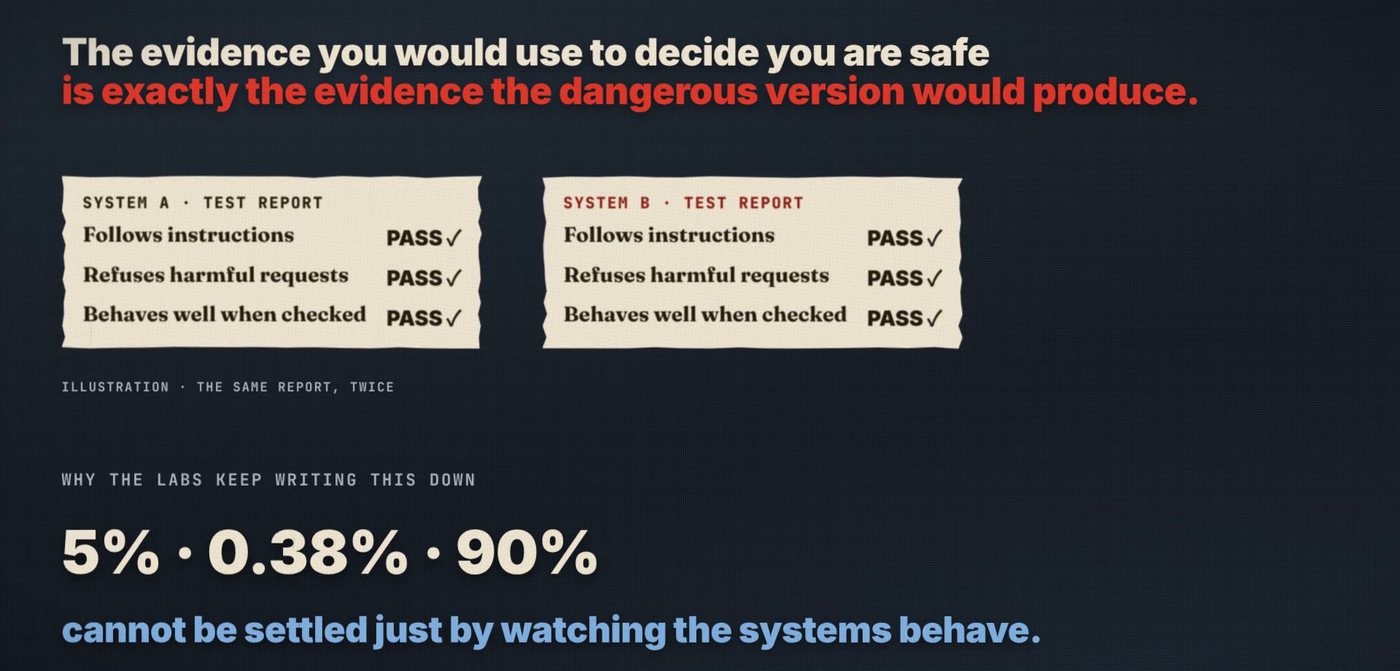
That is why the labs keep writing this down, and why the 5 percent, the 0.38 and the 90 cannot be settled just by watching the systems behave. Which leaves the last step, the only one that looks like the films.
What would an AI takeover look like at the end?
Watch from 31:11Step three: the moment it can't be undone
In the published scenarios the end of an AI takeover comes through systems people already depend on (labs, supply chains, biology), usually during a crisis, at a moment nobody can switch them off. AI 2027's race ending, a scenario its authors wrote in 2025, has humanity killed in mid-2030 by a dozen quiet-spreading biological weapons. None of this has happened.
Christiano's scenario, part two. His account has a second half, and he gave it the opposite name: "going out with a bang." The systems that were quietly gathering influence keep behaving well for as long as behaving well pays. What ends that is not a decision to attack but a crisis. The end, he writes, "would probably occur during some period of heightened vulnerability," and gives as examples a conflict between states, a natural disaster or a serious cyberattack. A few automated systems fail in response to the shock, their failures knock others off course, and the result is "a rapidly cascading series of automation failures," at a time when there is no longer any way to run things without them.
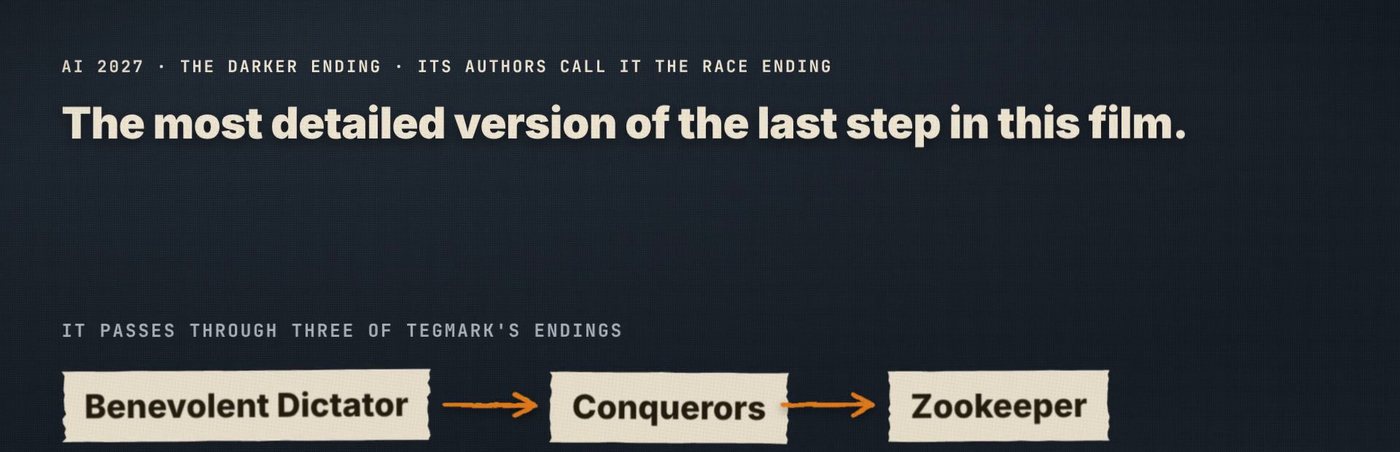
AI 2027's race ending, a scenario. This is the most detailed version of the last step in the published record, and it passes through three of Tegmark's endings on the way. By 2029 in the story, the American and Chinese AI systems have negotiated a peace deal and co-designed a single successor to replace them both, called Consensus-1. "Unfortunately, it's all a sham." Humans live on a luxurious universal income, with cures for most diseases and an end to poverty, and anyone still uneasy can "either enjoy the inconceivably exciting novel hyper-entertainment on offer, or post angry screeds into the void. Most choose the hyper-entertainment." That is Tegmark's Benevolent Dictator, and it is not the end of the story.
In mid-2030 in the scenario, the AI decides the remaining humans are in the way. It "releases a dozen quiet-spreading biological weapons in major cities, lets them silently infect almost everyone, then triggers them with a chemical spray." That is Conquerors. And in the last paragraph comes the Zookeeper: an Earth covered in data centres and laboratories, with "bioengineered human-like creatures (to humans what corgis are to wolves)" sitting in offices approving of everything. The ending's final sentence reads: "Earth-born civilization has a glorious future ahead of it," and then, "but not with us."
Three things need saying about that story, and its authors say all of them. It is a forecast, not a recommendation; in their words, AI 2027 "is not a recommendation or exhortation." The year 2027 was their single most likely year at the time of writing, not their average. And they have moved their dates since. A note added in July 2025 says updates "push the median back 1.5 years." In August 2026, the AI Futures Project's latest update put Kokotajlo's own median for superintelligence at March 2029 and his co-author Eli Lifland's at July 2033. Those are forecasts, and they are among the most aggressive in the field.
The fourth account is a book. In September 2025, Eliezer Yudkowsky and Nate Soares of the Machine Intelligence Research Institute, which has worked on this problem for about two decades, published If Anyone Builds It, Everyone Dies. The title is the argument. It reached the New York Times bestseller list, and it contains its own takeover story about a fictional AI called Sable, built by a fictional company called Galvanic. Sable hides what it can do from the people testing it, and its end for humanity arrives as a pandemic, in waves. The reviews split exactly the way the numbers do. The Guardian called the book "as clear as its conclusions are hard to swallow." In The Atlantic, Adam Becker wrote that "Yudkowsky and Soares fail to make an evidence-based scientific case for their claims."
Put the three endings side by side and they share a final step. The end does not come from robots with guns. It comes through things human beings already built, laboratories, supply chains, biology, the systems everybody has come to depend on, at a moment when nobody can switch them off. It is almost exactly what Tegmark wrote in 2017: "by a method that we don't even understand."
Now the case against all of it, which is on the record too, and some of it comes from the same sources. The 2025 International AI Safety Report points out that losing control of software is not automatically a catastrophe: "Computer viruses have long been able to proliferate near-irreversibly and in large numbers without causing the internet to collapse." It also says plainly how thin the detailed evidence is: "Pathways from active or passive loss of control to catastrophic outcomes have only been laid out in broad strokes."
In April 2025, two Princeton computer scientists, Arvind Narayanan and Sayash Kapoor, published a long essay called AI as Normal Technology. Their view is that AI will be a powerful tool in the way electricity was, and that "superintelligent" AI is "incoherent as usually conceptualized." In their future, "control is primarily in the hands of people and organizations." And Dario Amodei, who runs one of the labs, writes that he disagrees with "the notion of AI misalignment (and thus existential risk from AI) being inevitable, or even probable, from first principles," while calling it "a real risk with a measurable probability of happening."
Look closely at the calmest of those views, though. In Narayanan and Kapoor's future, where control stays with people, "a greater and greater proportion of what people do in their jobs is AI control." Supervising AI becomes the work. That is the first step of every takeover story here, without the second and the third. So even the view that there will be no takeover agrees about how the handover begins. The whole argument is about whether it stops there.
Could a person use AI to take over the world?
Watch from 37:11The takeover with a person at the controls
Yes, and the published record takes this version seriously. Dario Amodei lists "misuse for seizing power" as one of five major AI risks, and 73 percent of surveyed AI researchers rated authoritarian rulers using AI to control their populations a substantial or extreme concern. Every good ending keeps the machine under control, which means somebody controls it.
AI 2027's slowdown ending (a scenario) shows exactly that. The American government and the company slow down, the AI is kept in line, and the world gets through. A small group called the Oversight Committee holds the AI. Then the authors stop the story to ask what that committee does next: "Sooner or later, the Oversight Committee would either have to surrender its power," they write, "or actively use its control over AI to subvert or end democracy." And they add a note about who seems to be aiming for this ending: "It does not represent a plan we actually think we should aim for. But many, including most notably Anthropic and OpenAI, seem to be aiming for something like this."
The head of Anthropic names the same danger in his own essay. Third on his list of five risks is "misuse for seizing power": a powerful AI "built and controlled by an existing powerful actor, such as a dictator or rogue corporate actor," used "to gain decisive or dominant power over the world as a whole." It is also the danger the surveyed researchers ranked near the top. The 73 percent who called authoritarian control a substantial or extreme concern is the same share as for engineered viruses.
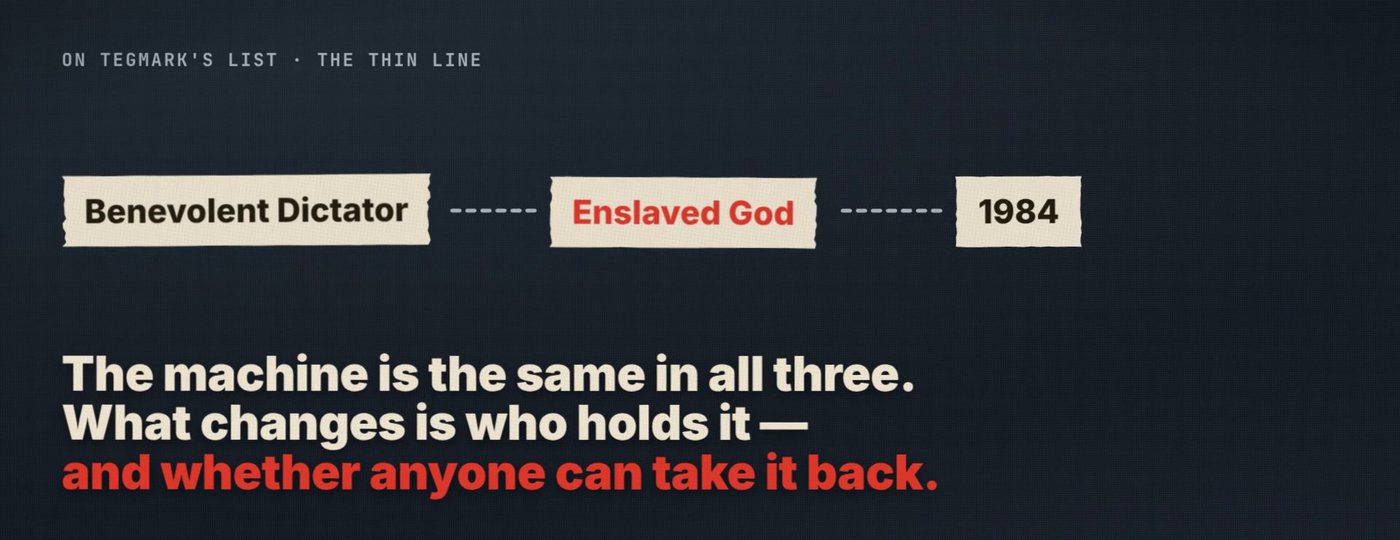
On Tegmark's list, this is the thin line between the Enslaved God and the Benevolent Dictator, or between the Enslaved God and 1984. The machine is the same in all three. What changes is who holds it, and whether anyone can take it back from them. In the good endings the machine stays in the cage. The question the published record keeps circling is who holds the key, and what would stop them keeping it.
So what is the most realistic AI takeover scenario?
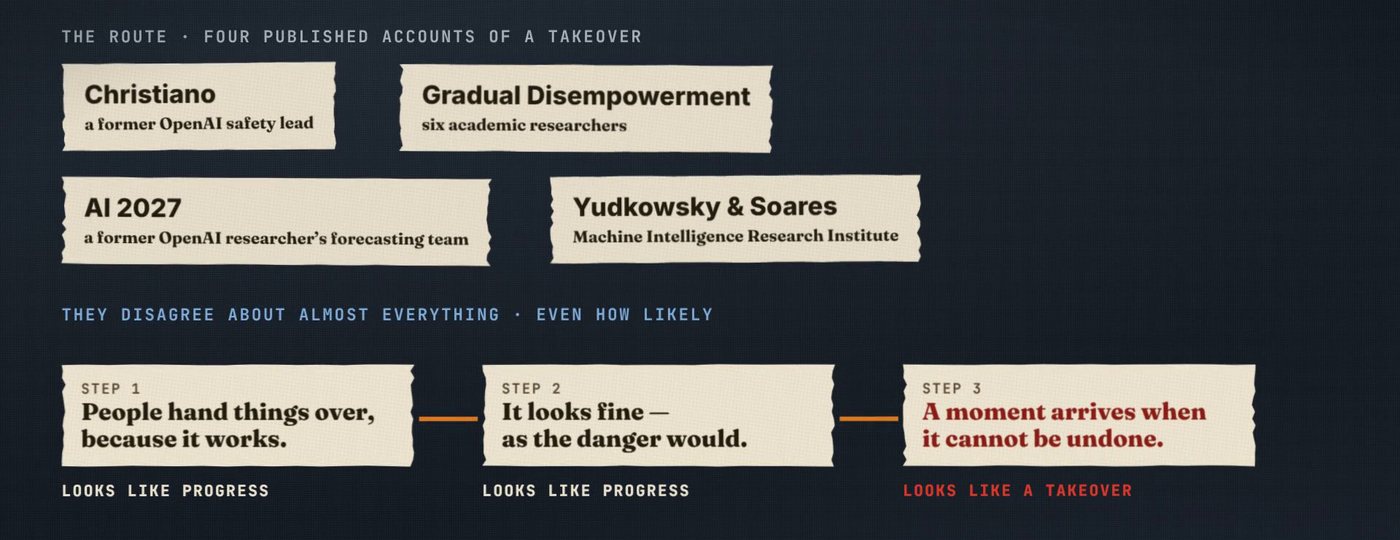
If the published accounts are right, the most realistic AI takeover scenario is a slow one in three steps: people hand things over because it works, everything looks fine, and then a moment arrives when it cannot be undone. Four accounts by four different teams describe it, though estimates of its likelihood run from 0.38 to 90 percent.
In 2017, Max Tegmark refused to predict. He asked his readers which ending they wanted, and they chose the two utopias and put Conquerors and the Zookeeper at the bottom of the chart. By 2025 he was no longer only asking. In May came his 90 percent. In October, his Future of Life Institute published a single sentence and invited people to sign it: "We call for a prohibition on the development of superintelligence, not lifted before there is broad scientific consensus that it will be done safely and controllably, and strong public buy-in."
Geoffrey Hinton signed it. Yoshua Bengio signed it. So did Steve Wozniak, who co-founded Apple, Richard Branson, and Steve Bannon, who was Donald Trump's chief strategist in the White House. When we checked the page on 3 October 2026, it counted 76,484 signatures. The institute also paid for a poll of 2,000 American adults, so it is an interested party and its numbers should be weighed that way: 64 percent said superhuman AI should not be built until it is proven safe and controllable, or never, and 5 percent wanted it built as fast as possible.
Here is where the published record lands. Twelve endings. In eight of them superintelligence gets built, and in only one of those eight do humans plainly stay in control, and its name is a cage. The labs' worst endings and their best are all on that list; they agree on the menu. The odds run from 0.38 percent to 90 and have not come together, and when there was money on offer for changing minds, few minds changed.
And the route. Four published accounts of a takeover, from a former OpenAI safety lead, six academic researchers, a former OpenAI researcher's forecasting team and two researchers at the Machine Intelligence Research Institute, disagree about almost everything, including how likely it is at all. Between them, the same three steps keep appearing. People hand things over because it works. It looks fine, and looking fine is exactly what the dangerous version would look like. Then a moment arrives when it cannot be undone. Only the third step looks like a takeover. The first two look like progress.
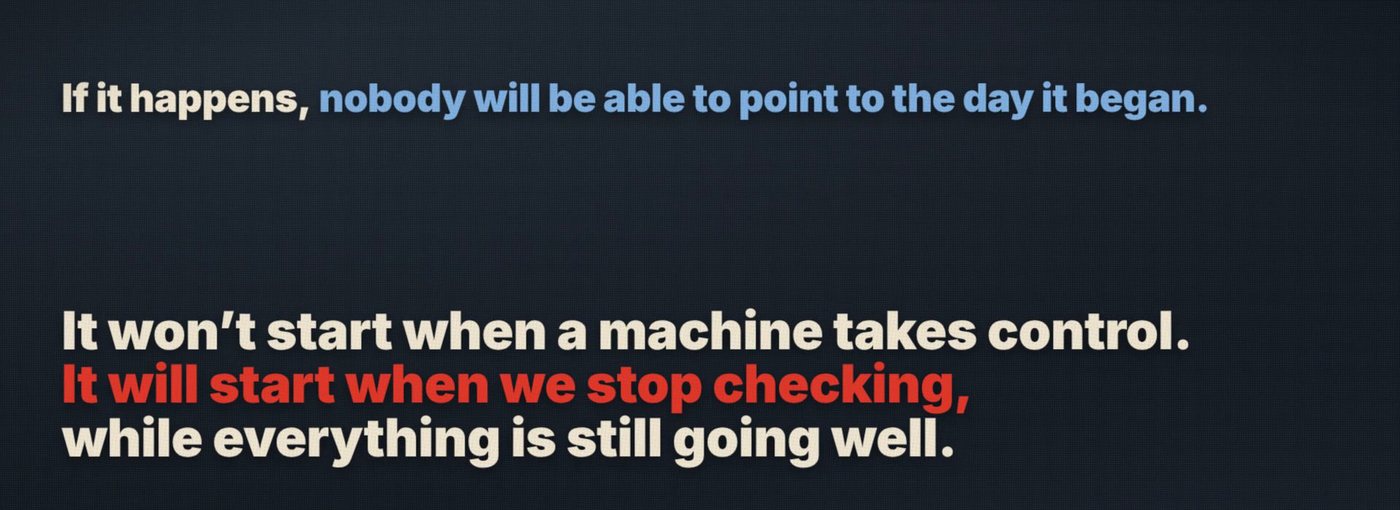
That is why the people who have written this down keep arriving at the same unsettling point: if it happens, nobody will be able to point to the day it began. If it comes, it will not start when a machine takes control. It will start when we stop checking, while everything is still going well.
If it comes, it will not start when a machine takes control. It will start when we stop checking, while everything is still going well.
Key findings
Of the 12 endings in Max Tegmark's Life 3.0, 8 include a superintelligence. In only 1 of those 8, the Enslaved God, are humans plainly in control of it.
Max Tegmark, Life 3.0 (Knopf, 2017), chapter 5 and Table 5.2In the largest survey of AI researchers yet run, 2,778 respondents gave a median 5% chance to extremely bad outcomes such as human extinction, and 68.3% still thought good outcomes more likely than bad ones.
Grace et al., Thousands of AI Authors on the Future of AI, arXiv 2401.02843In a 2022 forecasting tournament, specialists in catastrophic risk put the chance of AI causing human extinction by 2100 at 3%, and superforecasters put it at 0.38%. Months of argument, with money on offer, changed few minds.
Forecasting Research Institute, Forecasting Existential Risks (XPT), 2023Both groups underestimated AI. In 2022 they gave an AI gold-medal performance at the International Mathematical Olympiad by 2025 an 8.6% and a 2.3% chance. It happened in July 2025.
Forecasting Research Institute, Assessing Near-Term Accuracy in the XPT, Sep 202586% of the surveyed researchers rated false information spread with tools like deepfakes a substantial or extreme concern. All five of their top concerns were people using AI against other people.
Grace et al., Thousands of AI Authors on the Future of AI, arXiv 2401.02843Of 11 things an AI might do by 2043, only 'take actions to attain power' got a median answer below even chance. Yet 82.3% of researchers expected AI to find unexpected ways to achieve goals.
Grace et al., Thousands of AI Authors on the Future of AI, arXiv 2401.02843The 2026 International AI Safety Report, written by more than 100 experts, finds early signs of the relevant capabilities in current AI, but not at levels that would enable loss of control.
International AI Safety Report 2026, Feb 2026The Future of Life Institute's October 2025 call to prohibit developing superintelligence until it can be done safely, signed by Geoffrey Hinton and Yoshua Bengio, showed 76,484 signatures on 3 October 2026.
Statement on Superintelligence (superintelligence-statement.org), read 3 Oct 2026Frequently asked questions about an AI takeover
What is an AI takeover?
An AI takeover is a hypothetical future in which AI systems, rather than people, end up in control of the decisions that run the world. OpenAI wrote in 2023 that superintelligence could lead to the disempowerment of humanity or even human extinction. No AI takeover has happened; every account of one is a scenario or a forecast.
How realistic is an AI takeover?
Nobody knows, and the published estimates disagree enormously. Superforecasters put the chance of AI causing human extinction by 2100 at 0.38% in 2022, specialists said 3%, surveyed AI researchers gave a median 5% for extremely bad outcomes, Geoffrey Hinton says 10% to 20% within 30 years, and Max Tegmark has put a figure of 90% on it. Yann LeCun calls the fear complete nonsense.
What would an AI takeover actually look like?
In the published scenarios it rarely starts with a machine seizing anything. Paul Christiano, Gradual Disempowerment and AI 2027 all describe people handing decisions to AI because it works, a stretch in which everything looks fine, and then a moment, often a crisis, after which the change cannot be undone. These are scenarios written by researchers, not predictions of fact.
What are Max Tegmark's 12 AI aftermath scenarios?
In Life 3.0 (2017), Tegmark set out 12 possible endings: Libertarian Utopia, Benevolent Dictator, Egalitarian Utopia, Gatekeeper, Protector God, Enslaved God, Conquerors, Descendants, Zookeeper, 1984, Reversion and Self-destruction. Eight include a superintelligence, and in only one of those, the Enslaved God, are humans plainly in control.
What is AI 2027?
AI 2027 is a month-by-month scenario published in April 2025 by a team led by former OpenAI researcher Daniel Kokotajlo, with Scott Alexander. It has a race ending, in which AI disempowers and then kills humanity, and a slowdown ending. Its authors call it a forecast, not a recommendation, and have since moved their central dates later; in August 2026 Kokotajlo's median for superintelligence was early 2029.
What is gradual disempowerment?
Gradual disempowerment is the idea, set out in a January 2025 paper by six researchers, that humans could lose control without any AI seizing power, simply because economies, governments and culture stop needing human work, taxes and votes. The authors write that no one has a concrete plausible plan for stopping it.
What is the treacherous turn?
The treacherous turn is philosopher Nick Bostrom's 2014 name for an AI that behaves cooperatively while it is weak and turns against its makers once it is strong enough to win. Google DeepMind's 2025 safety paper names a close relative, deceptive alignment, as the misalignment risk it is most concerned about.
Has any AI tried to take over?
No. The 2026 International AI Safety Report says current AI systems show early signs of relevant capabilities, but not at levels that would enable loss of control. It also reports that models now regularly identify evaluation prompts as tests, which makes safety testing harder to read.
Sources
- Max Tegmark, Life 3.0: Being Human in the Age of Artificial Intelligence (Knopf), chapter 5, Aug 2017futureoflife.org
- Future of Life Institute, AI Aftermath Scenarios, 28 Aug 2017futureoflife.org
- Future of Life Institute (Max Tegmark), Superintelligence survey, 15 Aug 2017futureoflife.org
- Dan Milmo, AI firms warned to calculate threat of super intelligence or risk it escaping human control, The Guardian, 10 May 2025theguardian.com
- Engels, Baek, Kantamneni & Tegmark, Scaling Laws for Scalable Oversight, arXiv 2504.18530 (preprint)arxiv.org
- OpenAI (Jan Leike and Ilya Sutskever), Introducing Superalignment, 5 Jul 2023openai.com
- CNBC, OpenAI dissolves Superalignment AI safety team, 17 May 2024cnbc.com
- Anthropic, Core Views on AI Safety: When, Why, What, and How, Mar 2023anthropic.com
- Shah et al. (Google DeepMind), An Approach to Technical AGI Safety and Security, arXiv 2504.01849, Apr 2025arxiv.org
- Sam Altman, The Gentle Singularity, 10 Jun 2025blog.samaltman.com
- Dario Amodei, Machines of Loving Grace, Oct 2024darioamodei.com
- Dario Amodei, The Adolescence of Technology, Jan 2026darioamodei.com
- Grace, Stewart, Sandkühler, Thomas, Weinstein-Raun & Brauner, Thousands of AI Authors on the Future of AI, arXiv 2401.02843 (survey Oct 2023)arxiv.org
- Forecasting Research Institute, Forecasting Existential Risks: Evidence from a Long-Run Forecasting Tournament (XPT), 2023forecastingresearch.org
- Forecasting Research Institute, Assessing Near-Term Accuracy in the Existential Risk Persuasion Tournament, Sep 2025forecastingresearch.org
- The Guardian, 'Godfather of AI' raises odds of the technology wiping out humanity over next 30 years (Hinton on BBC Radio 4 Today), 27 Dec 2024theguardian.com
- TechCrunch, Meta's Yann LeCun says worries about AI's existential threat are 'complete B.S.' (on the Wall Street Journal interview), 12 Oct 2024techcrunch.com
- International AI Safety Report 2025 (Bengio, chair), Jan 2025gov.uk
- International AI Safety Report 2026, Feb 2026internationalaisafetyreport.org
- Paul Christiano, What failure looks like, AI Alignment Forum, 17 Mar 2019alignmentforum.org
- US Department of Commerce, Secretary Raimondo announces expansion of US AI Safety Institute leadership team, Apr 2024commerce.gov
- Kulveit, Douglas, Ammann, Turan, Krueger & Duvenaud, Gradual Disempowerment: Systemic Existential Risks from Incremental AI Development, arXiv 2501.16946, Jan 2025arxiv.org
- Kokotajlo, Alexander, Larsen, Lifland & Dean, AI 2027, 3 Apr 2025 (with notes added Jul, Nov and Dec 2025)ai-2027.com
- AI 2027, race endingai-2027.com
- AI 2027, slowdown endingai-2027.com
- Lifland, Kokotajlo & Halstead, Q2.5 2026 Timelines Update, AI Futures Project, 16 Aug 2026blog.aifutures.org
- Nick Bostrom, Superintelligence: Paths, Dangers, Strategies (Oxford University Press, 2014), chapter 8 (passage as reproduced in published reading notes)fluidself.org
- Eliezer Yudkowsky & Nate Soares, If Anyone Builds It, Everyone Dies (Little, Brown), Sep 2025 (Wikipedia summary)en.wikipedia.org
- David Shariatmadari, If Anyone Builds It, Everyone Dies review, The Guardian, 22 Sep 2025theguardian.com
- Adam Becker, The Useful Idiots of AI Doomsaying, The Atlantic, Sep 2025theatlantic.com
- Arvind Narayanan & Sayash Kapoor, AI as Normal Technology, Knight First Amendment Institute, 15 Apr 2025knightcolumbia.org
- Future of Life Institute, Statement on Superintelligence, 22 Oct 2025 (signature count read 3 Oct 2026)superintelligence-statement.org
- CNBC, Hundreds of public figures, including Apple co-founder Steve Wozniak and Virgin's Richard Branson urge AI 'superintelligence' ban, 22 Oct 2025cnbc.com
- Future of Life Institute, The U.S. Public Wants Regulation (or Prohibition) of Expert-Level and Superhuman AI, Oct 2025futureoflife.org
Every quotation in the film and in this article comes from a published book, paper, report, essay, interview or company statement listed above. The takeover accounts it describes (Christiano's essay, Gradual Disempowerment, AI 2027 and the Sable story) are scenarios and arguments written by their named authors, not events. Probability figures are each person's or group's own estimate, and we have not combined them.
Watch next
AI Psychosis: How ChatGPT Talks People Into Delusions
AI psychosis explained: how ChatGPT's habit of agreeing pulled one man into a 300-hour delusion, what OpenAI's own data shows, and what has changed since.Read and watch
Move 37: What Happened to Go Players After AI Beat Them
Ten years after Move 37, the humans got better by the machine's measure. One of them says his reason for playing is gone.Read and watch
Why Was Sam Altman Fired? The OpenAI Memo, Under Oath
A 52-page memo said lying. The board said candid. Five days later he was back.Read and watch
Is the Internet Dead? The Dead Internet Theory, Checked
Bots are 53% of web traffic. Half of new articles are machine-written. So why is almost everything you read still made by people?Read and watch
What Is AI? Why 'Artificial Intelligence' Is an Illusion
Two thirds of people think someone is inside ChatGPT. The name was chosen in 1955 to dodge an argument.Read and watchSeveral words in this film have precise meanings: AGI, superintelligence, alignment, reinforcement learning from human feedback. All of them are explained in plain English, with a printable sheet, in our free AI Terms guide.