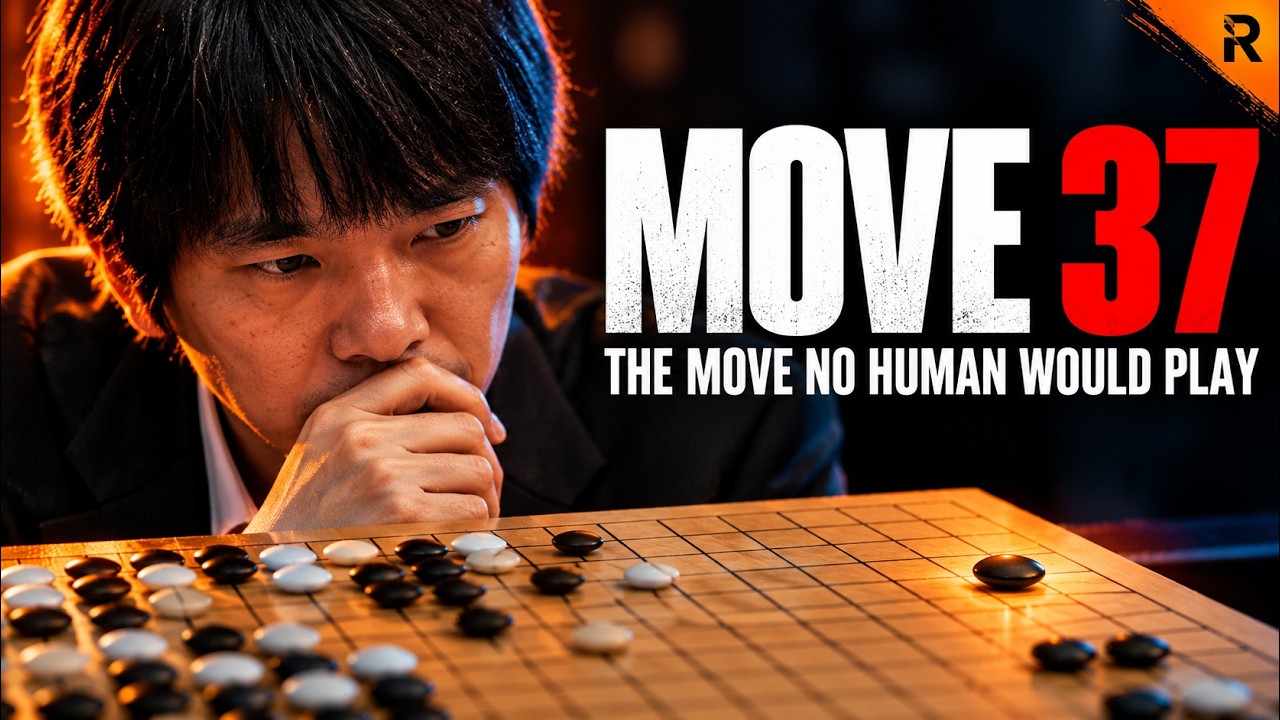
On 10 March 2016, in a hotel conference room in Seoul, a computer program played a stone that some of the best Go players in the world, watching live, took for a mistake. It was the 37th move of the second game between DeepMind's AlphaGo and Lee Sedol, one of the strongest players alive. "I thought it was a mistake," one of the English commentators said. Lee stood up and left the room.
The move was good. It helped AlphaGo win the game, and when DeepMind looked at the program's own numbers, it found AlphaGo had put the chance of a human professional playing that move at about 1 in 10,000. It played it anyway.
That is usually where the story stops. Our 30-minute documentary for The Signal starts there, because Go is the first serious human skill to have lived for ten full years with a machine that is better at it than any person will ever be. In 2023, researchers scored 5.8 million decisions made by professional players over 71 years. What they found is not what anybody predicted on the day of Move 37. This piece follows the film act by act, with the evidence for each.
The film in 10 chapters
Pick a chapter and the film starts there. 30:04 in all.
Why was Go so hard for computers to master?
Watch from 2:09The game that could not be counted
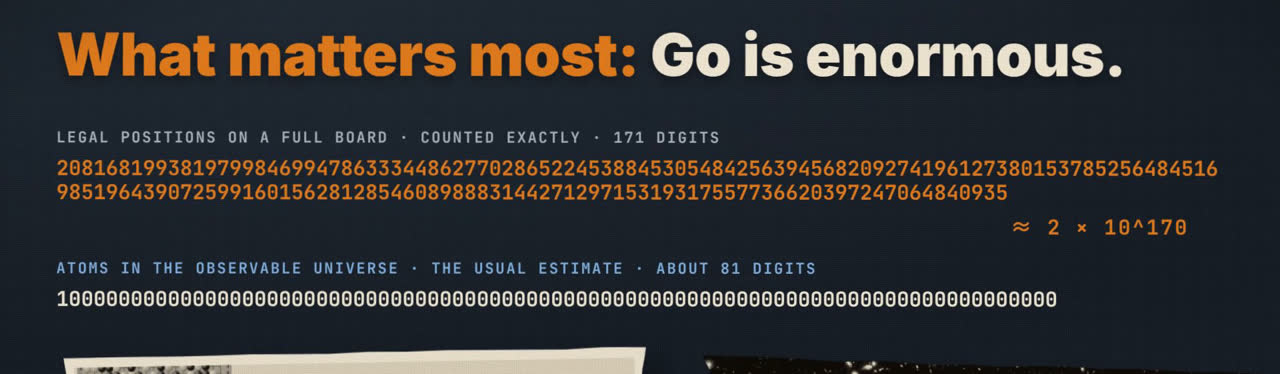
Go was hard for computers because it is too big to calculate. A 19 by 19 board has about 2 × 10^170 legal positions, counted exactly by John Tromp in 2016, against roughly 10^80 atoms in the observable universe. Chess fell to brute-force search in 1997. For almost twenty years after that, the best Go programs played at a decent amateur's level.
The rules take five minutes to learn. Two players take turns placing black and white stones where the lines cross. Stones never move. You try to surround more of the board than your opponent, and a group that is completely surrounded is captured. People spend their whole lives failing to master what comes out of those rules.
The game is more than two thousand years old. It grew up in China and is played most seriously in China, Korea and Japan, where the best players are full-time professionals who start as small children, train for years in special schools and pass an exam to turn professional. The ranks run up to ninth dan.
When IBM's Deep Blue beat Garry Kasparov at chess in 1997, it won largely by looking ahead through enormous numbers of possible moves. Go has too many moves at every turn for that to work. So professionals did not learn Go by calculating. They learned it the way you learn a language: rules of thumb passed from teacher to student, good shapes and bad shapes, and a feel for where a stone belongs at each stage of the game.
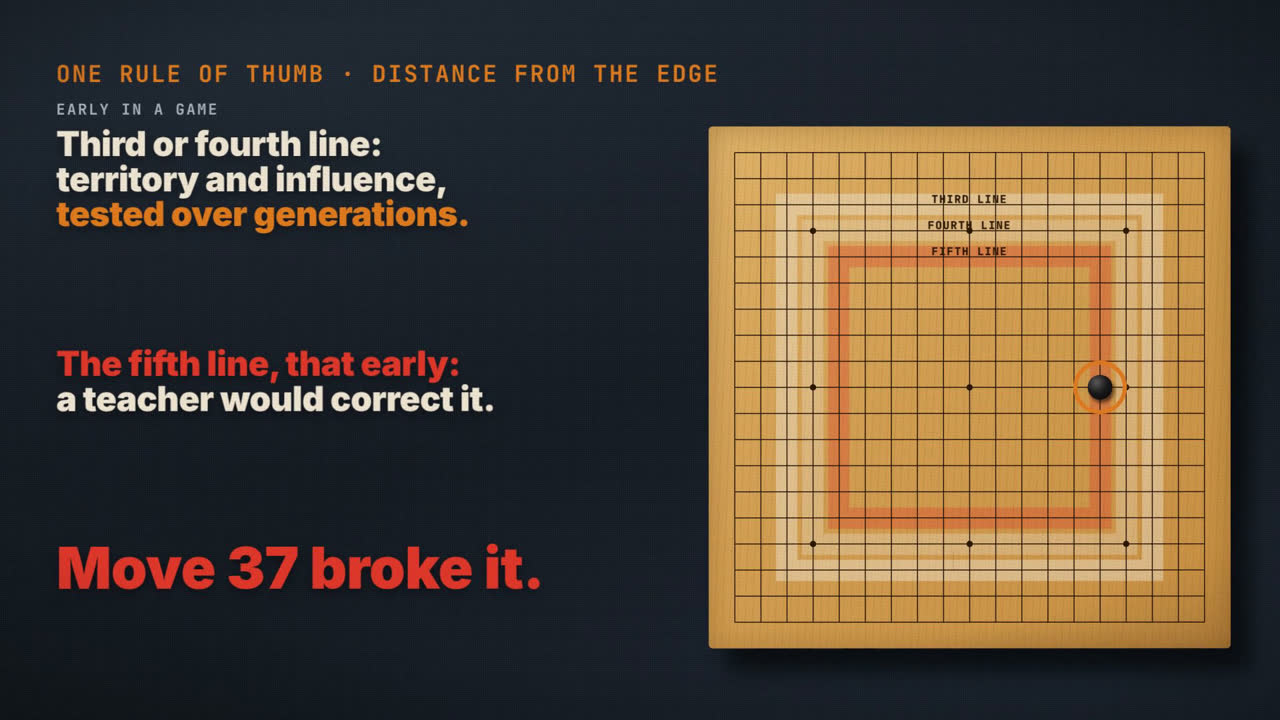
One of those rules was about distance from the edge. Early in a game, strong players put their stones on the third or fourth line from the side, a balance between territory and influence tested over generations. A stone on the fifth line that early was something a teacher would correct.
What was Move 37, and why did it shock Go players?
Watch from 4:57Five games in Seoul
Move 37 was AlphaGo's stone on the fifth line, on the right side, early in game two against Lee Sedol on 10 March 2016. It broke a rule of thumb taught for centuries. AlphaGo's own estimate of a human playing it was 1 in 10,000. AlphaGo won the game and the match, 4-1.
AlphaGo was built by DeepMind, a London company Google had bought in 2014, and it did not work like Deep Blue. It first studied a large collection of games by strong humans until it could predict what a strong human would play next. Then it played against versions of itself millions of times and kept whatever won. It still searched ahead, but selectively, looking hard at the moves its training called promising.
In October 2015 it beat the European champion, Fan Hui, five games to nothing, the first time a program had beaten a human professional on a full board. Many professionals pointed out that Fan Hui was not one of the very best. Lee Sedol was. In March 2016 DeepMind brought AlphaGo to the Four Seasons Hotel in Seoul for five games and a $1 million prize, a match DeepMind says more than 200 million people watched. Before it began, Lee expected to win 5-0, or maybe 4-1.
He lost the first game. In the second, AlphaGo dropped its stone on the fifth line. "It's a creative move," said Michael Redmond, the American ninth dan commentating in English. "It's something that I don't think I've seen in a top player's game." Lee came back to the table and spent nearly 15 minutes on his reply.
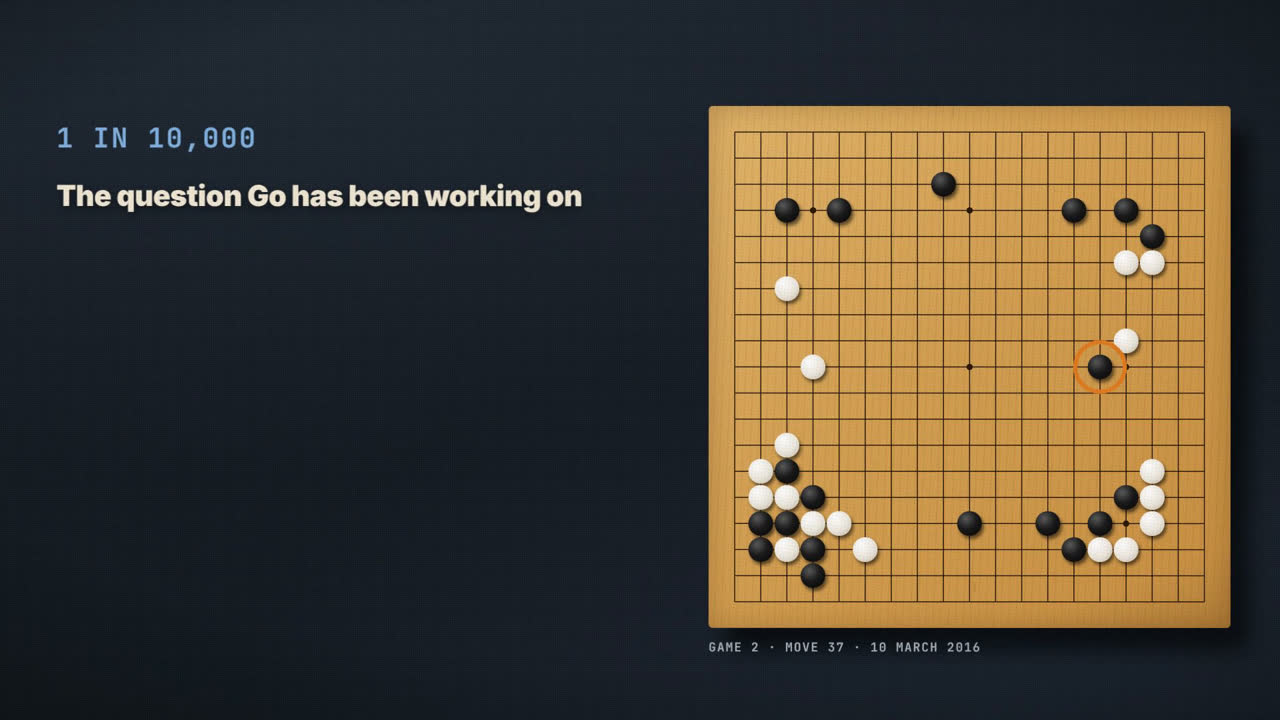
Fan Hui, who had been advising the DeepMind team since his own defeat, was in Seoul for the match. "It's not a human move. I've never seen a human play this move," he told Wired. "So beautiful." What makes the move more than a curiosity is where the 1 in 10,000 came from. Because AlphaGo's first stage of training was copying humans, it carried its own estimate of how likely a professional was to play any move. The machine had learned what a human would do, and then it did something else.
The machine had learned what a human would do, and then it did something else.
Lee lost the third game, and with it the match. "Today's defeat was Lee Sedol's defeat," he said. "It was not the defeat of human beings." In game four he proved it, driving a single stone, Move 78, into the middle of a position where AlphaGo looked safe. The program's play went badly wrong and Lee won. Go players called the move God's Touch, and DeepMind's figure for it was the same: AlphaGo had rated it at about 1 in 10,000. AlphaGo took the fifth game, and the Korea Baduk Association gave it an honorary ninth dan, the first professional dan certificate given to a machine.
What is AlphaGo Zero, and why does it matter?
Watch from 9:17The machine that did not need us
AlphaGo Zero is the 2017 version of AlphaGo that learned Go from the rules alone, with no human games. After 3 days of playing itself, it beat the version that defeated Lee Sedol 100 games to 0. It matters because it showed that thousands of years of human Go knowledge were optional for the machine.
Lee's line about humanity did not stay true for long. Over the winter of 2016, an anonymous player called Master appeared on Asian Go servers and beat the world's elite in fast online games, a streak Sixth Tone put at more than 50 wins without a loss. On 4 January 2017 it was revealed to be a new AlphaGo. In May 2017, at the Future of Go Summit in Wuzhen, it beat the world number one, 19-year-old Ke Jie, three games to nothing. Ke lost the first by half a point, the smallest margin there is, which is not as close as it sounds: a program trying only to win, not to win big, will give away points it does not need. "Last year, AlphaGo played more like a human," Ke said, "but right now, it's playing more like a god of Go."
DeepMind retired AlphaGo from competition after Wuzhen. Then, in October 2017, it published a paper in Nature titled "Mastering the game of Go without human knowledge."
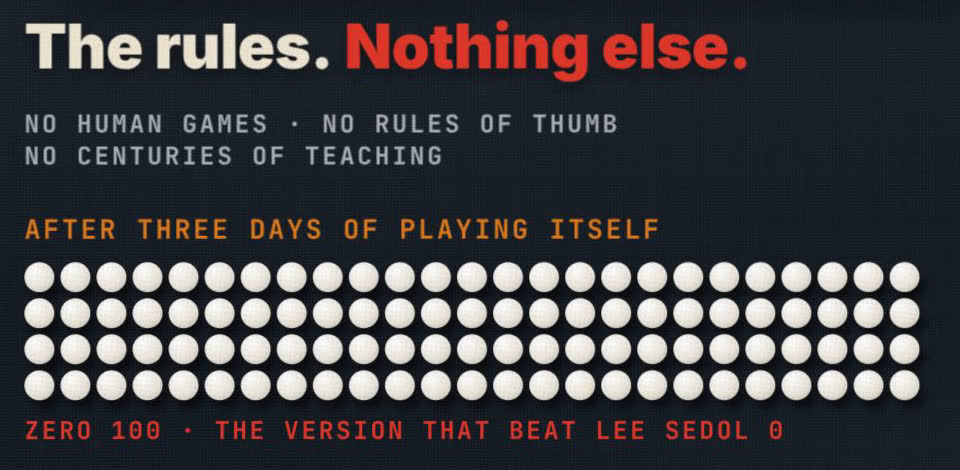
This is the real turning point, and it gets far less attention than Move 37. The first AlphaGo started by learning from us and then went further. The one that came after it threw that inheritance away and was stronger for doing so. Everything humans had worked out about the game was, from the machine's point of view, optional. If your career rests on knowing that inheritance better than anyone, that is not a defeat in a match. It is a statement about the value of what you know.
Everything humans had worked out about the game was, from the machine's point of view, optional.
It also stopped being something that happened to a few famous players on a stage. Free programs built on the same ideas, KataGo the best known among them, became stronger than any human and ran on a home computer. From about 2017, every professional and every child in a Go school had a teacher stronger than anyone who had ever lived, one that never got tired and could say after every move how much it had changed your chances of winning.
Did AI make human Go players better?
Watch from 12:33The humans got better
Yes, by the machine's measure. A 2023 PNAS study used KataGo to score more than 5.8 million professional moves from 1950 to 2021. Decision quality was comparatively flat for 66 years, then rose significantly after superhuman AI arrived in 2016 and 2017. The gain held even in moves that did not copy the AI.
The study is by Minkyu Shin of City University of Hong Kong, Jin Kim of the Yale School of Management, and Bas van Opheusden and Thomas Griffiths of Princeton. For each human move they had KataGo simulate how the game would go, 58 billion simulated continuations in all, and compared the human's winning chances with those of the move KataGo would have played. That gives a score for every professional decision in 71 years, against one standard.
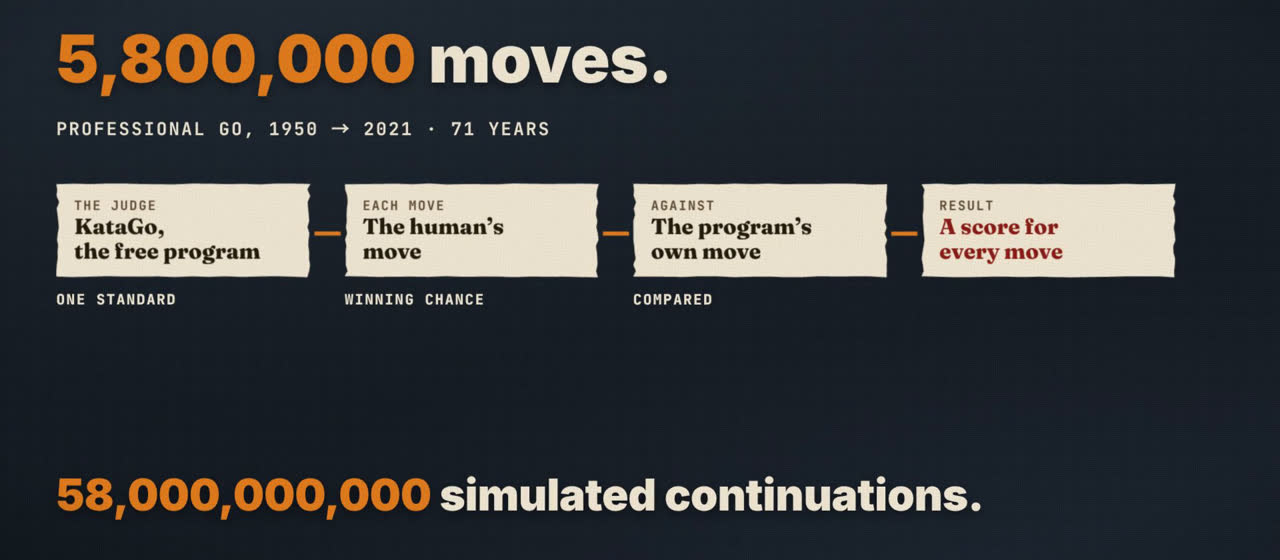
Put those scores on a timeline and, from 1950 to 2016, the line barely moves: generations of players and the most intense training systems in the game's history, with comparatively little change on this measure. Then, in the authors' words, "humans began to make significantly better decisions following the advent of superhuman AI."
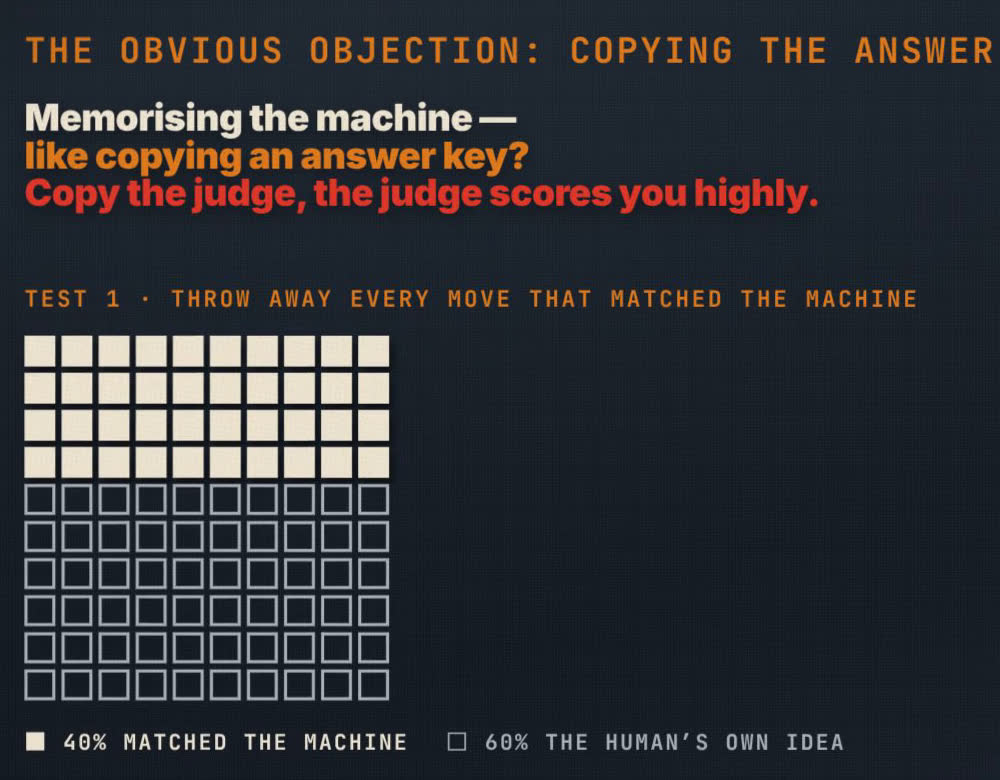
The obvious objection is that players were memorising the machine, like a student copying an answer key, and of course the judge scores its own answers highly. The researchers tested that two ways. About 40 percent of all human moves matched the AI's choice, so they threw those away; the improvement was still there in the other 60 percent. They also found that 99 percent of opening sequences became historically new by move 21, so later moves faced positions nobody could have memorised. The improvement held there too.
The second measure was novelty: how early in a game a player made a move never seen before in that position. For decades it had drifted later, as more of the opening became settled. After the machines arrived it reversed, and the new moves became linked with better decisions. The humans did not just copy. The machine's strange moves told them the inherited rules of thumb were not the ceiling, and they went exploring.
There is one honest limit, and the film says it plainly. Better here means better according to the machine. The study shows human play moving toward what a superhuman program considers strong. That is a real gain in winning chances. It is not the same as saying human Go became more beautiful, or more human.
The gains did not land evenly, either. Women professionals long had far less access to the top men, the top games and the top teachers. Kim Chae-young, one of the strongest women players, told MIT Technology Review that before AI, "I couldn't gauge just how strong top male players were." Studying their games with AI changed that: "AI broke the psychological barrier." In 2022 Choi Jeong became the first woman to reach the final of a major international tournament, and in 2024 Kim won the Korean Go League's postseason playoffs as the only woman in it. Those results have many causes, and nobody can measure how much came from the machine.
Do professional Go players now just copy the AI?
Watch from 17:44The answer key
Partly. A 2022 Korean Baduk League study found that world number one Shin Jin-seo's moves matched the AI's 37.5 percent of the time, against a 28.5 percent average. Many players say the first 50 moves of top games often follow the machine's lines, and they train to reproduce choices they cannot always explain.
In Korea they call Shin "Shintelligence" for how closely he plays like the machine. He describes it as the job. "I constantly think about why AI chose a move," he told MIT Technology Review. "My game has changed a lot," he said, "because I have to follow the directions suggested by AI to some extent." The commentator Park Jeong-sang put the wider change plainly: "AI has changed everything." In his words, "Fundamental moves that were once considered common sense aren't played at all today, and techniques that didn't exist before have become popular."
That looks like a contradiction. The study found novelty rising; the players describe everyone converging on the same machine lines. The film's reading, offered as interpretation rather than a measured result, is that the two are measuring different things. The study measures novelty against history. The players describe sameness against each other. If everyone abandons the old human playbook at once for the same new one, every game looks new compared with 1990 and alike compared with the game on the next board.
If everyone abandons the old human playbook at once for the same new one, every game looks new compared with 1990 and alike compared with the game on the next board.
That is a less comfortable shape than either story alone. The machine broke a tradition that had been stuck for decades, and then much of the field gathered round the new one. Anyone who works in a field with a best practice knows how fast a new one spreads, and how quickly nobody remembers what it replaced.
How has AI changed cheating in Go?
Watch from 20:15The answer key in your pocket
If a free program can name the best move in any position, a player who can see it during a game cannot lose to one who cannot. In November 2020 the Korea Baduk Association suspended a 13-year-old professional for 1 year after she admitted using AI to beat a ninth dan in an online tournament.
The game was played on 29 September 2020 on the cyberORO server. Kim Eun-ji, the youngest professional in the country and considered a prodigy, beat Lee Yeong-ku, a ninth dan on the national team, a result that defied expectations. Her opponent raised the suspicion, she admitted she had help from an AI program, and the association suspended her for breaking the rule that a professional cannot receive outside advice in official play. It then tightened its rules, allowing suspensions of three years or a permanent ban.
That case is clear because she admitted it. The cost lands on everyone else. Before the machines, an astonishing game by an unknown young player was a reason to celebrate. Now a second question is attached to every surprising result, and it cannot be fully taken away. The tool that made the honest players better made every brilliant game a little harder to believe.
Why did Lee Sedol retire from Go?
Watch from 21:36The man who stopped
Lee Sedol retired in November 2019, aged 36, because AI meant he could never again be the best there is. "Even if I become the number one, there is an entity that cannot be defeated," he told Yonhap. In 2026 he told MIT Technology Review that his reason for playing Go had vanished.
His full words, as CNN reported them from Yonhap: "With the debut of AI in Go games, I've realized that I'm not at the top, even if I become the number one through frantic efforts." He was not saying he had got worse, or that he could no longer win tournaments. He was saying that the thing he had spent his life reaching for, being the best there is, had stopped existing as a possibility, for him or anyone.
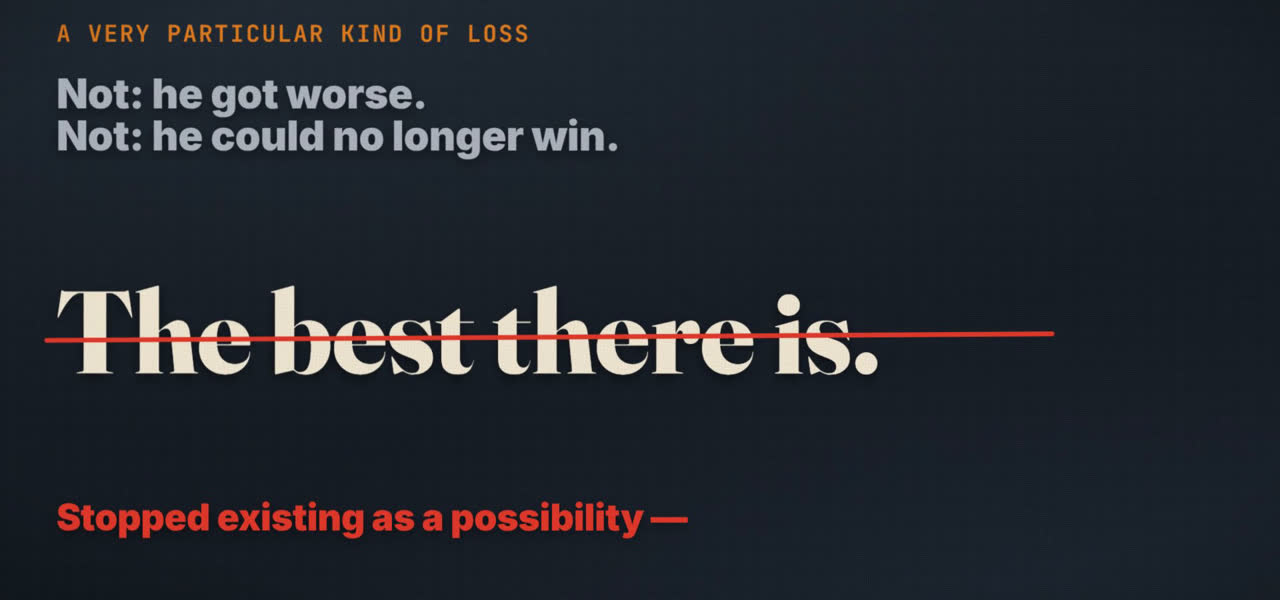
Ten years after the match, he went further. "Go has become a mind sport," he told MIT Technology Review. "Before AI, we sought something greater. I learned Go as an art," he said. "But if you copy your moves from an answer key, that's no longer art." And then: "I used to inspire fans by advancing the techniques of Go and presenting a new paradigm." The next line was shorter: "My reason for playing Go has vanished."
Put that next to the study. By the machine's measure, the players who came after him are making better decisions than any generation in the game's history, and the man who was the face of that generation says the reason he played has gone. Those are not opposite findings. They are the same event, described once by the scoreboard and once by the person.
They are the same event, described once by the scoreboard and once by the person.
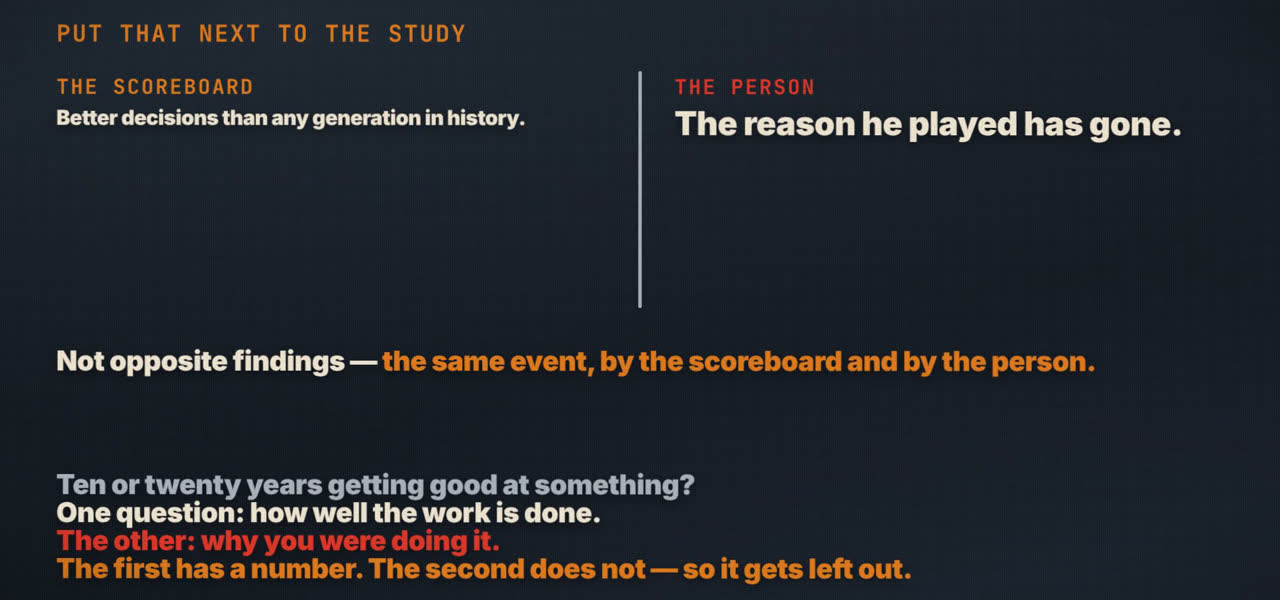
If you have spent ten or twenty years getting good at something, you already know the difference. One question is how well the work is done. The other is why you were doing it. The first has a number. The second does not, which is exactly why it gets left out.
Can a human still beat a superhuman Go AI?
Watch from 23:41The hole in the machine
In normal play, no. But in 2023 researchers found a blind spot in KataGo: programs trained to attack it won more than 97 percent of games against it at superhuman strength, and an amateur using the same trick by hand won 14 of 15 games against the strongest bot on a public Go server.
The researchers, many of them at the AI safety group FAR AI with colleagues at UC Berkeley and MIT, did not try to build a better Go player. They built a program whose only job was to make KataGo lose. In their words, "Our adversaries do not win by playing Go well. Instead, they trick KataGo into making serious blunders."
The trick is a shape. The attacker lets KataGo build a large group of its own stones in a ring, with stones inside it, then quietly surrounds the ring from outside. KataGo does not see the danger until it is too late.
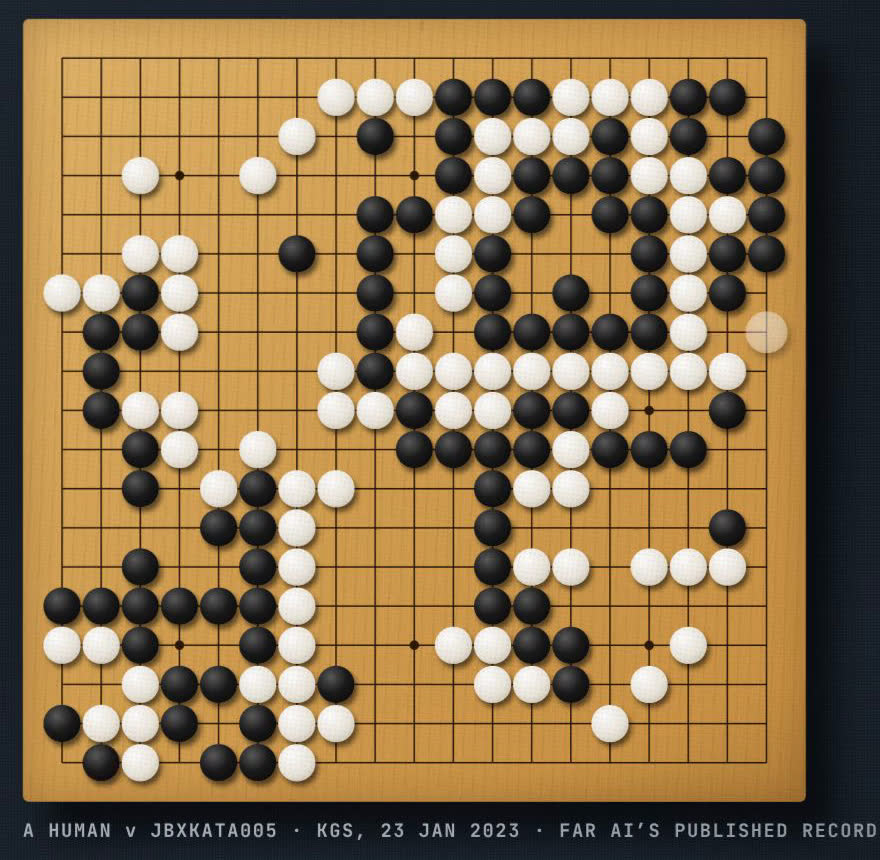
Kellin Pelrine, one of the researchers and a strong amateur rather than a professional, learned the trick and played it with no computer help against JBXKata005, the strongest bot on the KGS Go Server at the time. He won 14 of 15 games, the Financial Times reported in February 2023, and the paper adds that he also won after giving the bot three, five and nine extra stones. "As a human it would be quite easy to spot," Pelrine said. Stuart Russell, a co-author: "It shows once again we've been far too hasty to ascribe superhuman levels of intelligence to machines."
It has not simply been fixed. In 2024 several of the same researchers tested defences and concluded that "though some of these defenses protect against previously discovered attacks, none withstand freshly trained adversaries." Be precise about what that shows. It does not mean humans are better at Go; in ordinary play no professional can live with KataGo. It means a program can be stronger than every human who ever lived and still have a blind spot. Superhuman on average and having no weaknesses are two different claims.
In July 2026, at an event marking ten years since Seoul, Shin Jin-seo played KataGo three times with a two-stone handicap; the Korean press did not report the program's settings. KataGo won the first game. Shin won the second, and the third by 11.5 points. "AI's weakness seems to be that it is too perfect," he said. "Even when it is behind, it doesn't take desperate risks." With two free stones it was not an even game. It was a human, ten years on, who knew the machine well enough to know where it is narrow.
What does Move 37 mean for people whose work AI can now do?
Go's 10 years after Move 37 say that the day a machine is better at your work is not the end of the story. The players stayed, made better decisions than any generation before them by the machine's measure, and broke a 66-year plateau. It also cost them originality, trust and, for one champion, the reason to play.
The best teacher in history became something anyone could download, and some of the people kept furthest from the top came closest to it. But much of the field gathered round the machine's way of playing, the strongest player alive is nicknamed for how closely he follows it, every surprising result now carries a question, and the man who was the face of the game decided the thing he loved about it had gone. The machine itself is not the god Ke Jie called it. It is enormously strong, it has a blind spot shaped like a ring of stones, and the people who know it best are the ones who found where it is narrow.
None of that was predicted in March 2016. The story everyone told was replacement: the machine wins, the humans leave. What happened is that almost all of them stayed, the game changed underneath them, and the question that turned out to matter was not whether they could still win. It was what they wanted the game to be for.
Shin Jin-seo gave MIT Technology Review something close to an answer. "I may be one of the strongest human players, but with AI around, I can't be so arrogant," he said. And about the part that is still his: "I can play a kind of Go that tells a story that only a human can." Move 37 was one in ten thousand. When the machine knows the strong move, what is the human move for?
When the machine knows the strong move, what is the human move for?
Key findings
AlphaGo's own training put the chance of a human professional playing Move 37 at about 1 in 10,000. DeepMind gives the same figure for Lee Sedol's Move 78 in game four, the only game he won.
Google DeepMind, AlphaGo research page; Cade Metz, Wired, 16 Mar 2016AlphaGo Zero learned from the rules alone and, after 3 days of training against itself, beat the version that defeated Lee Sedol 100 games to 0.
Silver et al., Mastering the game of Go without human knowledge, Nature 550 (2017)Measured by KataGo across more than 5.8 million professional moves from 1950 to 2021, human decision quality was comparatively flat for 66 years and rose significantly after superhuman AI arrived in 2016 and 2017.
Shin, Kim, van Opheusden & Griffiths, PNAS 2023About 40% of professional moves matched the AI's choice. The improvement held in the other 60%, and 99% of opening sequences were historically new by move 21, too early to memorise.
Shin, Kim, van Opheusden & Griffiths, PNAS 2023A 2022 Korean Baduk League study found world number one Shin Jin-seo's moves matched the AI's 37.5% of the time, against a 28.5% average.
Michelle Kim, MIT Technology Review, 27 Feb 2026Adversarial programs beat KataGo running at superhuman strength in more than 97% of games, not by playing Go well but by tricking it into blunders.
Wang, Gleave et al., Adversarial Policies Beat Superhuman Go AIs, ICML 2023Using the same trick by hand, amateur Kellin Pelrine won 14 of 15 games against the strongest bot on a public Go server.
Richard Waters, Financial Times, via Ars Technica, 19 Feb 2023; paper appendix G.2In July 2026, playing with a two-stone handicap, Shin Jin-seo beat KataGo 2-1, winning the deciding game by 11.5 points.
Hankook Ilbo via The Korea Times, 21 Jul 2026Frequently asked questions about Move 37 and AlphaGo
What is Move 37?
Move 37 is the 37th move of the second game between DeepMind's AlphaGo and Lee Sedol, played in Seoul on 10 March 2016. AlphaGo placed a stone on the fifth line, on the right side, early in the game, where centuries of teaching said not to play. AlphaGo's own estimate put the chance of a human professional playing it at about 1 in 10,000. It helped AlphaGo win the game.
Why was Move 37 so surprising?
Strong players are taught to play their early stones on the third or fourth line from the edge. Move 37 went on the fifth line. An English-language commentator thought it was a mistake, and Lee Sedol left the room and then spent nearly 15 minutes on his reply. The move turned out to be strong.
Did Lee Sedol ever beat AlphaGo?
Yes, once. Lee lost the five-game match 4-1 but won game four with Move 78, a wedge move known as God's Touch. DeepMind says AlphaGo had rated that move at about 1 in 10,000 too, the same odds it gave its own Move 37.
Why did Lee Sedol retire?
Lee Sedol retired in November 2019, aged 36. He told Yonhap that even if he became number one, 'there is an entity that cannot be defeated.' In 2026 he told MIT Technology Review that copying moves from an answer key is no longer art, and that his reason for playing Go had vanished.
Did AI make human Go players better?
By the machine's own measure, yes. A 2023 PNAS study scored more than 5.8 million professional moves from 1950 to 2021 with KataGo and found decision quality was comparatively flat for 66 years, then rose significantly after 2016 and 2017. The improvement held in moves that did not copy the AI.
What is AlphaGo Zero?
AlphaGo Zero is the 2017 version of AlphaGo that learned Go from the rules alone, with no human games. After three days of training against itself it beat the version that had defeated Lee Sedol 100 games to 0, as reported in Nature in October 2017.
Can humans still beat Go AI?
Not in normal play. But in 2023 researchers found a blind spot in KataGo, a ring-shaped trap, and an amateur used it by hand to win 14 of 15 games against a top bot. In July 2026 Shin Jin-seo beat KataGo 2-1 with a two-stone handicap.
What is KataGo?
KataGo is a free, open-source Go program stronger than any human. According to MIT Technology Review it is the program most widely used by professional players in South Korea, and the 2023 PNAS study used it as the judge for every move it scored.
Sources
- Cade Metz, Google's AI Wins Pivotal Second Game in Match With Go Grandmaster, Wired, 10 Mar 2016wired.com
- Cade Metz, The Sadness and Beauty of Watching Google's AI Play Go, Wired, 11 Mar 2016wired.com
- Cade Metz, In Two Moves, AlphaGo and Lee Sedol Redefined the Future, Wired, 16 Mar 2016wired.com
- Google DeepMind, AlphaGo (research page)deepmind.google
- Google DeepMind, AlphaGo's next move, 27 May 2017deepmind.google
- Silver et al., Mastering the game of Go with deep neural networks and tree search, Nature 529 (2016)nature.com
- Silver et al., Mastering the game of Go without human knowledge, Nature 550 (2017)nature.com
- John Tromp, Number of legal Go positionstromp.github.io
- NPR, Going, Going, Gone: Master Go Player Loses Best-Of-5 Match With A.I., 12 Mar 2016npr.org
- NPR, After 3 Losses, Master Go Player Scores A Win Against Computer, 13 Mar 2016npr.org
- The Straits Times (AFP), Google's AlphaGo gets 'divine' Go ranking, 15 Mar 2016straitstimes.com
- David Paulk, Ke Jie, Humanity's Last Hope, Loses to AlphaGo by Half a Point, Sixth Tone, 23 May 2017sixthtone.com
- Shin, Kim, van Opheusden & Griffiths, Superhuman artificial intelligence can improve human decision-making by increasing novelty, PNAS 2023doi.org
- Michelle Kim, AI is rewiring how the world's best Go players think, MIT Technology Review, 27 Feb 2026technologyreview.com
- Park Ji-won, Go player cheated using AI, The Korea Times, 23 Nov 2020koreatimes.co.kr
- James Griffiths, Korean Go master quits the game because AI 'cannot be defeated', CNN, 28 Nov 2019 (quoting Yonhap)cnn.com
- Wang, Gleave, Tseng, Pelrine et al., Adversarial Policies Beat Superhuman Go AIs, ICML 2023arxiv.org
- Richard Waters, Man beats machine at Go in human victory over AI, Financial Times via Ars Technica, 19 Feb 2023arstechnica.com
- Tseng, McLean, Pelrine, Wang & Gleave, Can Go AIs Be Adversarially Robust?, AAAI 2025arxiv.org
- Hankook Ilbo via The Korea Times, Humans strike back: Shin Jin-seo defeats top Go AI KataGo 2-1, 21 Jul 2026koreatimes.co.kr
Every quotation in this article comes from a published article, paper or company page listed above. The reconciliation of novelty and sameness in the answer-key section is the film's interpretation, not a measured result. Board positions are replayed from the published game records.
Watch next
AI Psychosis: How ChatGPT Talks People Into Delusions
AI psychosis explained: how ChatGPT's habit of agreeing pulled one man into a 300-hour delusion, what OpenAI's own data shows, and what has changed since.Read and watch
AI Takeover Scenario: How It Would Actually Happen
Twelve endings, four takeover stories, and the same three steps in every one.Read and watch
Why Was Sam Altman Fired? The OpenAI Memo, Under Oath
A 52-page memo said lying. The board said candid. Five days later he was back.Read and watch
Is the Internet Dead? The Dead Internet Theory, Checked
Bots are 53% of web traffic. Half of new articles are machine-written. So why is almost everything you read still made by people?Read and watch
What Is AI? Why 'Artificial Intelligence' Is an Illusion
Two thirds of people think someone is inside ChatGPT. The name was chosen in 1955 to dodge an argument.Read and watchThe program at the heart of this story learned by playing, getting a score and adjusting, millions of times over. If the vocabulary around that is new to you, our free AI Terms guide explains the key words in plain English, with a printable sheet.