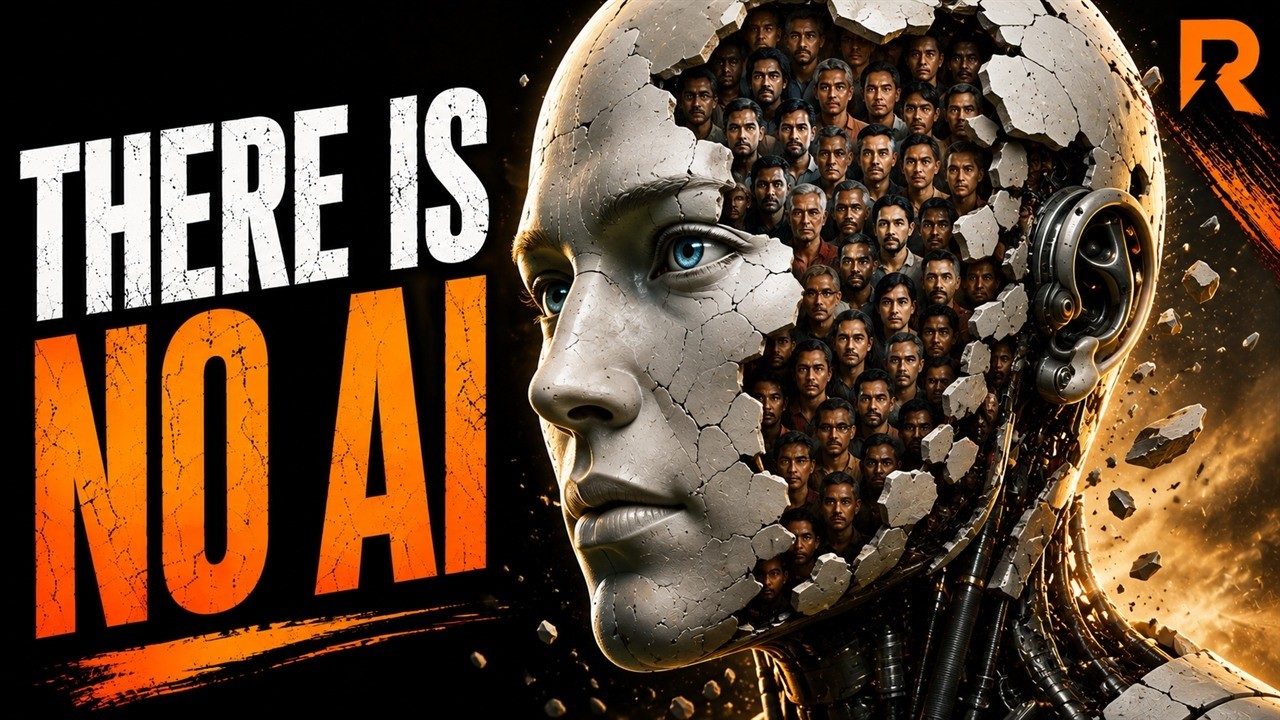
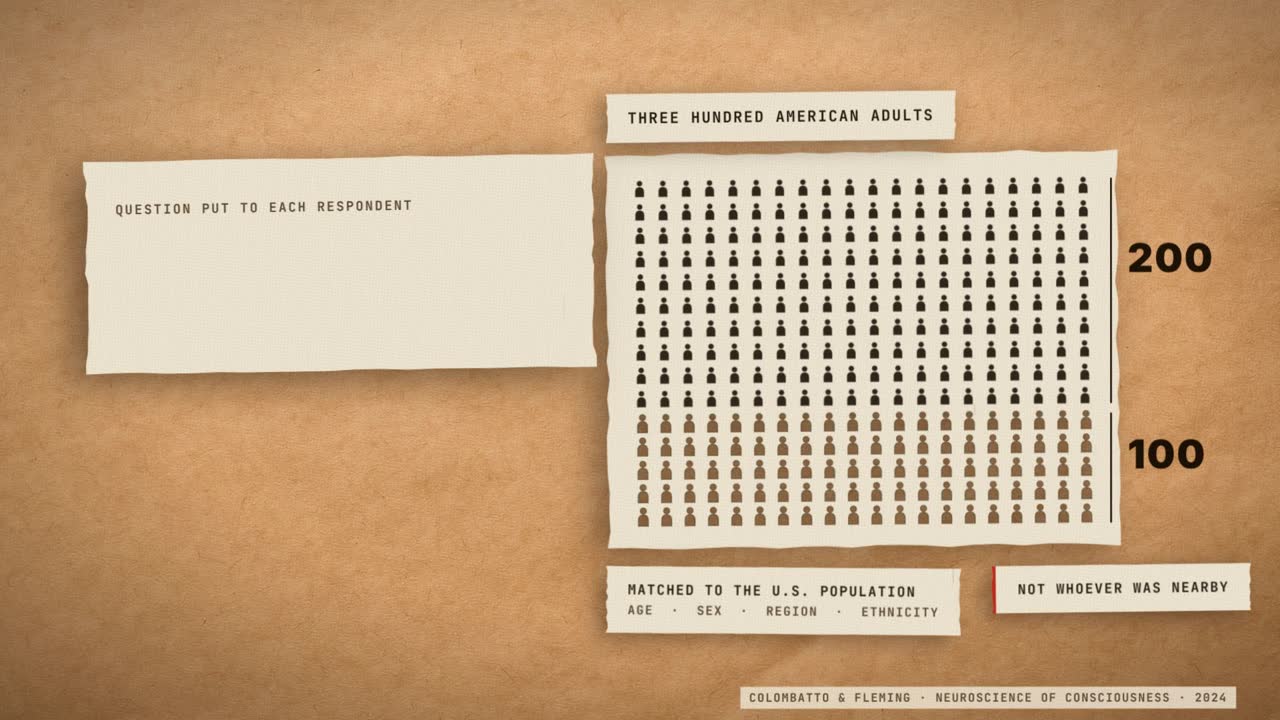
Two thirds of the people in one careful survey think there might be somebody behind ChatGPT's answers. In 2024, psychologists Clara Colombatto and Stephen Fleming asked 300 American adults, sampled to match the make-up of the country, whether ChatGPT has subjective experience. Only a third said it definitely does not. And the more often a person used it, the more likely they were to say yes.
There is nobody behind the answers. That is the claim our 40-minute documentary for The Signal sets out to earn: there is no artificial intelligence, in the sense the words suggest. There is a very large amount of human work, compressed, owned by a few people and sold back to you. The strangest part is where the belief comes from. It goes back to a word, chosen in the summer of 1955 by a 27-year-old mathematician who needed money and did not want an argument.
This piece follows the film act by act: what AI is, what it is made of, what it costs the people it was made from and the people using it, and who holds it. Every figure is sourced below, and where the record has moved since the film was made, we say so.
The film in 7 chapters
Pick a chapter and the film starts there. 40:02 in all.
Is AI conscious, and where did the name "artificial intelligence" come from?
Watch from 0:00There is nobody behind the answers
There is no evidence that today's AI has experiences, yet 67 percent of 300 US adults in a 2024 survey gave ChatGPT some possibility of consciousness. The name helps. John McCarthy coined "artificial intelligence" in a proposal dated 31 August 1955, and later wrote that one reason was to escape association with cybernetics.
The survey question was not whether ChatGPT is clever. It was whether there is something it is like to be it: whether it feels anything. Colombatto and Fleming found that most people were willing to grant at least a little of that. The finding underneath is the one that matters. Familiarity did not wear the impression off. Familiarity was what produced it.
To see why, go back to the document where the name first appears. It is not a scientific paper. It is a funding application to the Rockefeller Foundation, signed by McCarthy of Dartmouth College, Marvin Minsky, Nathaniel Rochester of IBM and Claude Shannon of Bell Labs, and its pitch was modest: "We propose that a 2 month, 10 man study of artificial intelligence be carried out during the summer of 1956 at Dartmouth College in Hanover, New Hampshire."
The field they were describing already had a name. Cybernetics, launched by the MIT mathematician Norbert Wiener in his 1948 book, studied feedback: how a system senses the gap between where it is and where it should be, and corrects. A thermostat does it, and so does a hand closing on a cup. The word described what a machine does and made no claim about what it is.
McCarthy explained his choice decades later, in a review he posted in 2000. One of the reasons for the new term, he wrote, "was to escape association with 'cybernetics'," and "I wished to avoid having either to accept Norbert (not Robert) Wiener as a guru or having to argue with him." He also thought cybernetics leaned too heavily on analog feedback, so the reasons were partly scientific. But look at what the swap did. One word described a mechanism. The other made a claim. It said the thing in the box had a quality only living creatures had, and it said so before anybody had built anything that could justify it.
One word described a mechanism. The other made a claim.
The film opens on that tension and never leaves it. Nearly seventy years after the proposal, two thirds of the people surveyed think there may be somebody in there. The machine did not tell them that. The name did.
Why can't anyone explain how AI works?
Watch from 2:03Nobody can look inside
Because nobody wrote its rules. A large language model's behaviour is spread across several hundred billion numbers that training adjusted and no person chose. Dario Amodei, chief executive of Anthropic, wrote in April 2025 that people outside the field "are often surprised and alarmed to learn that we do not understand how our own AI creations work."
The opacity is real, and the person saying so most loudly is an insider. Amodei co-founded Anthropic, the company behind Claude, after leading research at OpenAI. His essay, The Urgency of Interpretability, argues for something like "a highly precise and accurate MRI that would fully reveal the inner workings of an AI model." He asks for it because it does not exist yet.
The difference from older software is worth taking slowly. A traditional chess program was written: a person typed every rule, and if it made a bad move you could trace it back to the line that caused it. A language model is not written that way. What people typed was a procedure for adjusting numbers. Then an enormous quantity of text was pushed through it, and the numbers moved. Each number is a strength, saying how much one small part of the system should listen to another. On its own, none of them means anything. There is no line that says "be polite." The behaviour lives in the pattern across all of them at once.
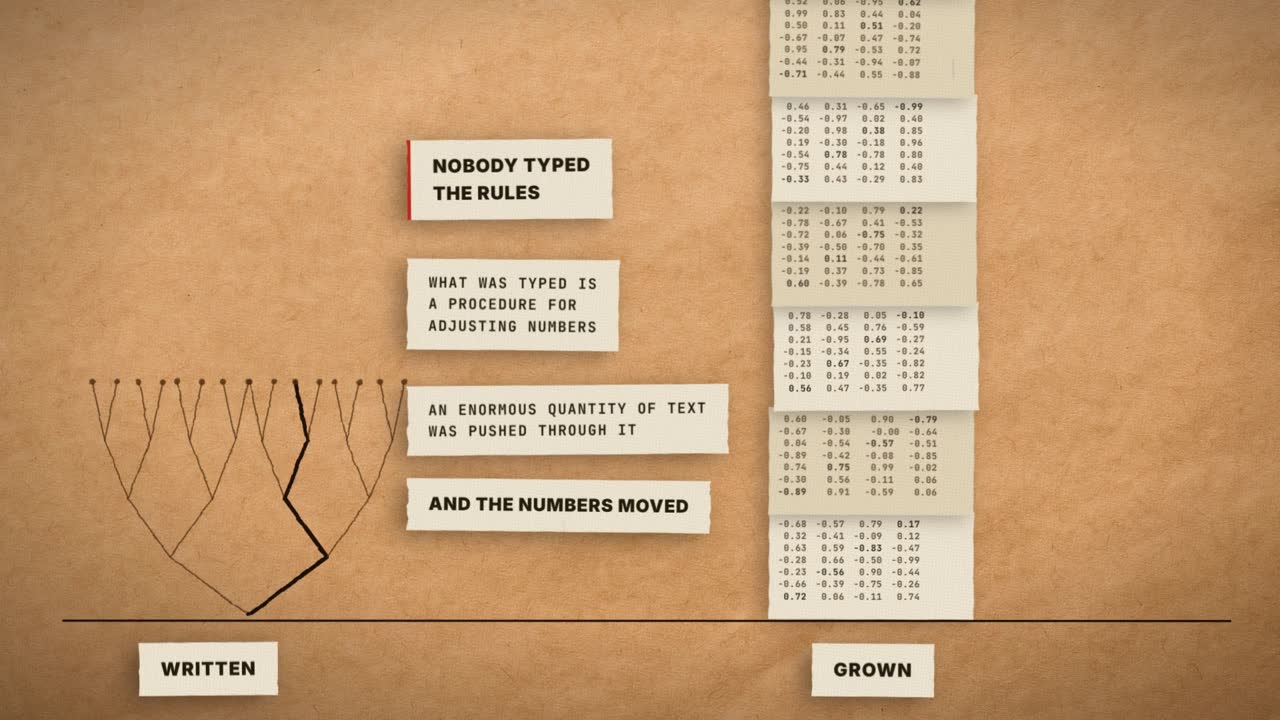
So the opacity is genuine. What it is not is evidence of a mind, and the last few years have quietly treated those as one claim. A thing can be impossible to inspect and still be a very large piece of arithmetic. A locked room is not proof that somebody is inside it.
A locked room is not proof that somebody is inside it.
The film adds the edge you rarely hear from anybody with a product to sell. Mystery is useful. If nobody can explain how a decision was reached, nobody can audit it, appeal it or be made to answer for it. The same fog that makes safety research hard makes the marketing easy.
What is AI actually made of?
Watch from 5:55What it is actually made of
AI is made of human writing at enormous scale. In 2023 The Washington Post and the Allen Institute for AI opened Google's C4 training set: about 15 million websites, led by a patent database, Wikipedia and the document site Scribd. In 2025 Anthropic agreed to pay $1.5 billion over 482,460 books taken from piracy sites.
C4 is Google's filtered copy of Common Crawl, the non-profit archive of the public web that almost every large model has been built on in some form. When the Post and the Allen Institute categorised it, the three biggest sources were patents.google.com, wikipedia.org and scribd.com. Every one of those was made by people, over years, for reasons that had nothing to do with AI: an inventor who filed and paid for a patent, a volunteer arguing over an encyclopedia page at one in the morning, a student uploading a thesis. None of them was asked. The web was public and reading it is not theft, but it settles what the material is. In the film's words: "The material is us."
The books are where somebody finally went to court. In August 2024, the authors Andrea Bartz, Charles Graeber and Kirk Wallace Johnson sued Anthropic, not because their books had been read but because of how they had been obtained: downloaded from shadow libraries such as Library Genesis. On 23 June 2025, Judge William Alsup split the case in two. Training on books, he ruled, was transformative, "spectacularly so," and a fair use. Downloading around seven million pirated books and keeping them in a central library was not, and he sent that part to trial.
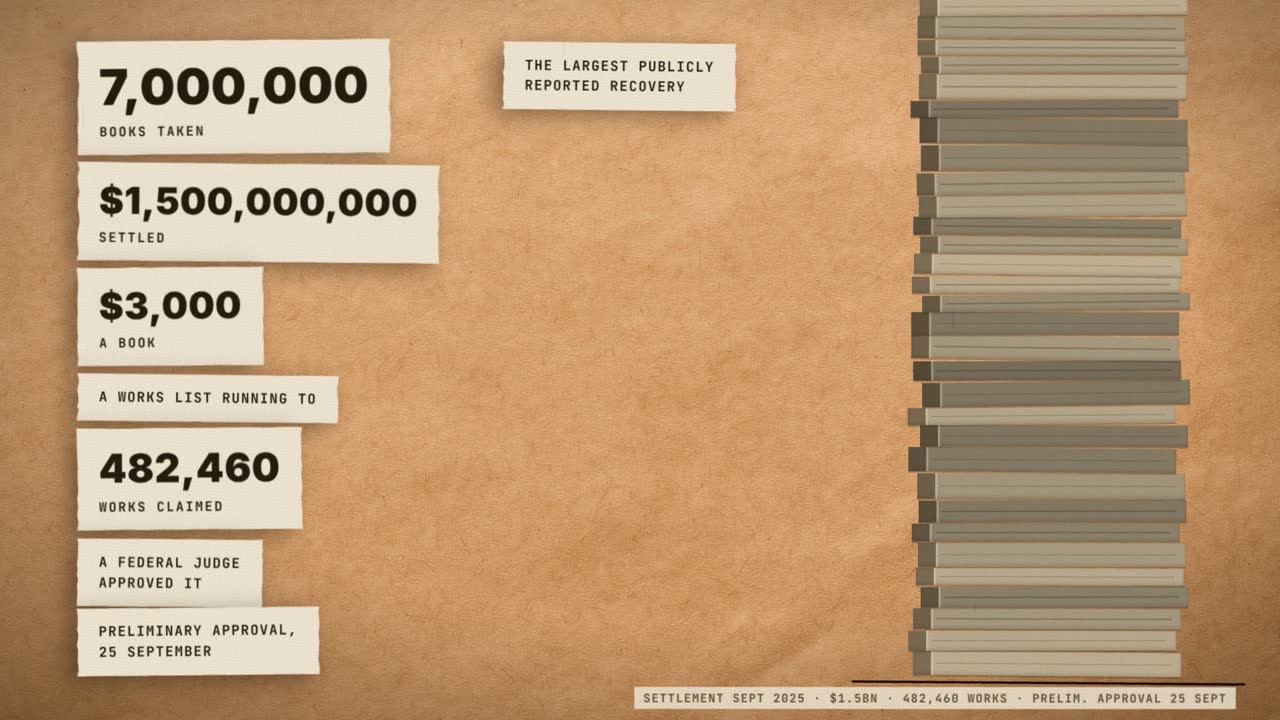
Rather than go to trial, Anthropic settled for $1.5 billion, roughly $3,000 a work across a list of 482,460 titles. Judge Alsup granted preliminary approval on 25 September 2025, and reports at the time called it the largest publicly reported copyright recovery in history. Since the film was made, the court has granted final approval, on 20 July 2026. The precise version of what this proves is still extraordinary. It is not a ruling that learning from human work is wrong. It is the first time anyone has been made to stand in a courtroom and count.
That count explains the thing everybody notices first: the uncanny sense that a chatbot understands you. It does not. But a very large number of people have already written down what understanding sounds like, in condolence letters, patient forum answers and teachers explaining the same idea for the fortieth time. The machine read all of it and can now produce the shape of it on demand. The warmth is real. It is second-hand, and it came from people.
The warmth is real. It is second-hand, and it came from people.
What is AI slop, and what is it doing to the internet?
Watch from 11:12What it costs the commons
AI slop is machine-made content produced at a volume no human system was built for. Graphite's May 2026 study, using three detectors on 55,400 English articles, puts about 50 percent of new web articles as primarily AI-generated, flat since early 2025. Spotify removed more than 75 million spam tracks in a single year.
The film starts with absorption. A style is a pattern: twenty years of consistent choices another person could recognise blindfolded. That is the achievement, and it is also the exposure, because recognisable means patterned and patterned means learnable. The better you get, the more learnable you become. The film is careful here, and so are we: there is no reliable figure for how much human originality has been absorbed this way, and anybody quoting a percentage is guessing.
Then the flood. The film used Graphite's first study, from October 2025, which reported AI-written articles overtaking human ones in November 2024 and reaching 51.7 percent by May 2025. Graphite has since replaced that study. Its May 2026 version averages three detectors and finds the two roughly level: 49.6 percent AI in the first quarter of 2025, a brief edge to 50.9 percent in the fourth quarter of 2025, and 49.9 percent in early 2026. The more interesting finding survived the revision. These articles, Graphite says, "largely do not appear in Google and ChatGPT." Half of what is written is written by machines, and very little of it is read.
You do not have to trust a detector, though. Look at what platforms had to do. In September 2023 Amazon limited self-publishers on Kindle Direct Publishing to three new titles a day. In September 2025 Spotify said it had removed more than 75 million spammy tracks in twelve months; plays over 30 seconds earn royalties, so mass-generated audio is a revenue strategy paid for out of the pool that pays real musicians. And in February 2023 Clarkesworld, a science fiction magazine known for publishing new writers, closed its submissions after receiving 500 machine-written stories that month. It reopened three weeks later, but for a while the door new writers came through was shut.
The third move carries no number, and the film says so on camera. When the cost of producing one more copy falls to nearly zero, the price falls with it, as it did for recorded music, stock photography and news. The value does not vanish. It moves to what cannot be copied: scarcity, provenance, trust and accountability, meaning a named person who will still be standing there when something turns out to be wrong. When everyone can produce everything, producing stops being the valuable part.
Does using AI make you worse at thinking?
Watch from 17:36What it costs you
It can reduce how much you check. A CHI 2025 study by Microsoft Research and Carnegie Mellon surveyed 319 knowledge workers about 936 real tasks and found "higher confidence in GenAI is associated with less critical thinking." Separately, Stanford found employment of 22 to 25 year olds in the most AI-exposed jobs about 19 percent below expectations.
The CHI study asked people whose job is thinking, such as analysts, marketers and administrators, how much effort each AI-assisted task took. Its abstract puts the inversion plainly: "higher confidence in GenAI is associated with less critical thinking, while higher self-confidence is associated with more critical thinking." Eighty-three of the 319 described trust in the tool discouraging them from reflecting on its output. The number the film would put on the wall is 58: people who reported barriers to checking the output, such as not knowing enough about the subject.
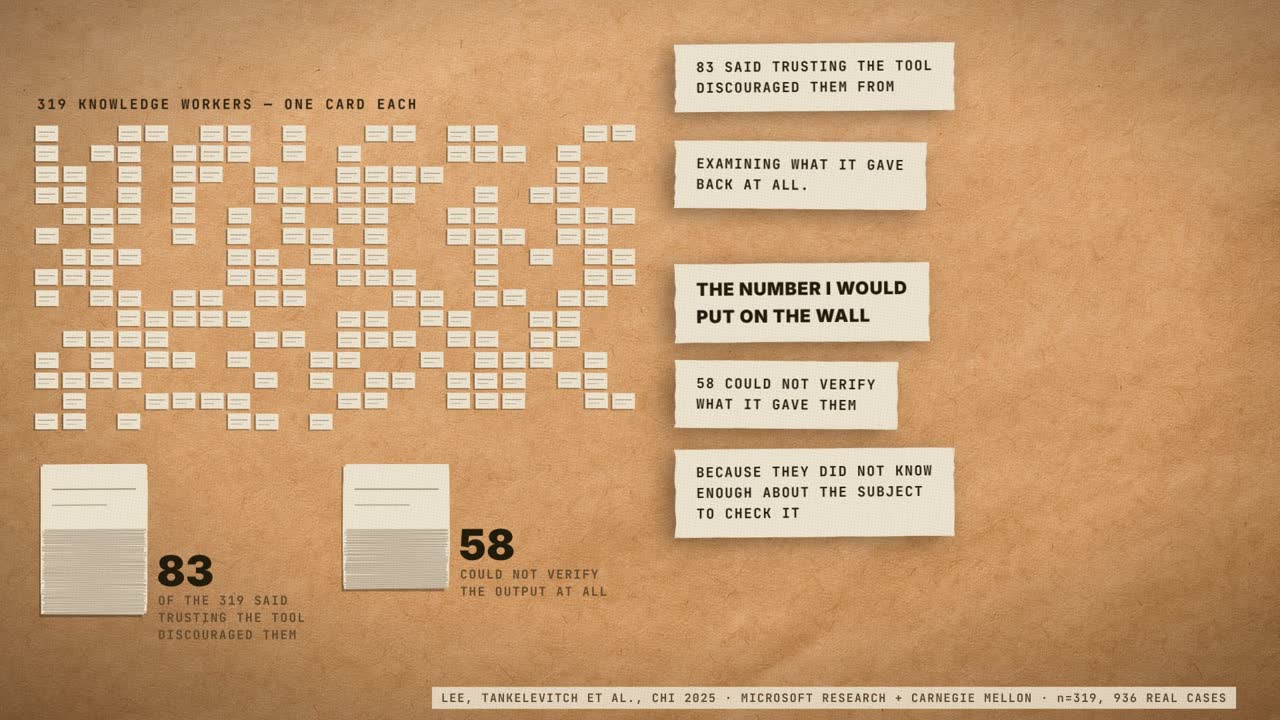
That is a closed loop. The thing you hand over becomes the thing you can no longer check, and the reason you cannot check it is that you handed it over. Every round of handing over makes the next round harder to check. None of it feels like decline. It feels like efficiency.
Every round of handing over makes the next round harder to check.
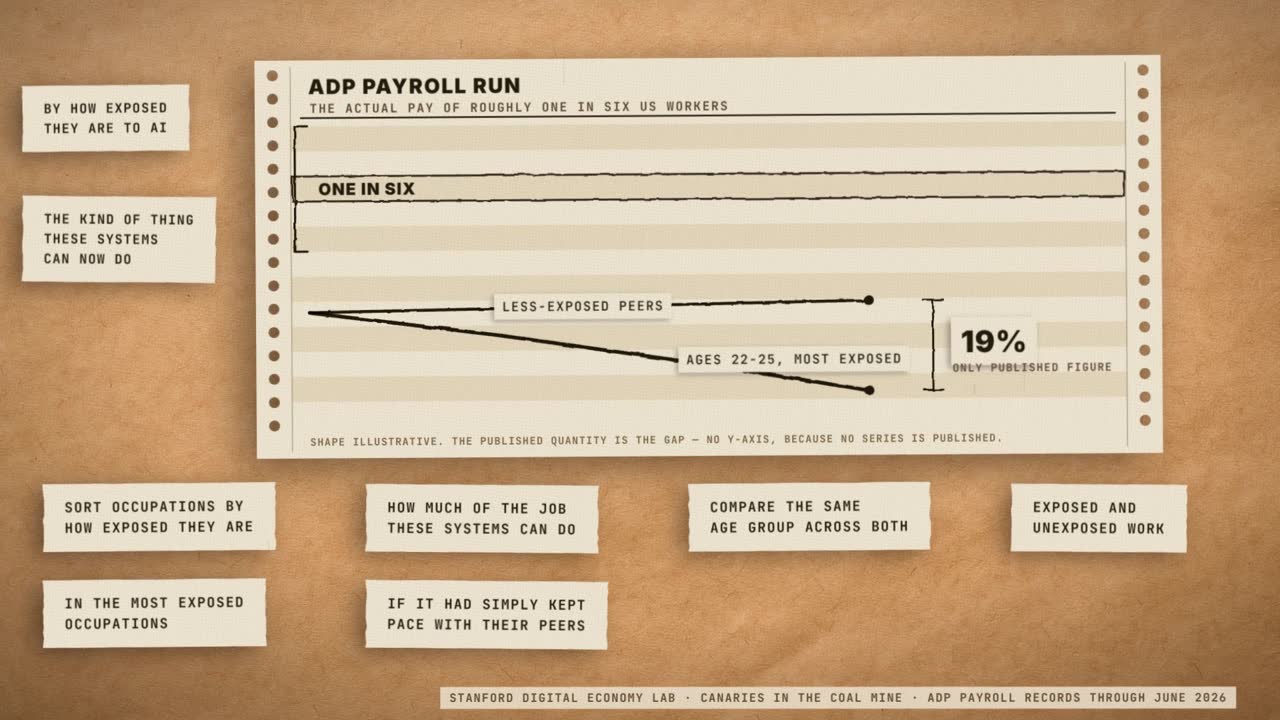
Then there is the door. Stanford's Digital Economy Lab, led by Erik Brynjolfsson, works from ADP payroll records; ADP pays roughly one in six US workers, so these are real jobs and real wages, not a survey. In its August 2026 update, with data to June 2026, employment among 22 to 25 year olds in highly exposed occupations "now stands about 19% below where it would be" had it kept pace with similar workers in less-exposed jobs. The lab's first paper, in August 2025, reported a 13 percent relative decline. Almost none of it is layoffs: the shift "appears to operate primarily through reduced hiring of young workers rather than increased separations." A door closing makes no sound.
Two more costs come without figures, and the film flags both. The first is the obsolescence story: being told constantly that a machine will replace you may change whether you spend four years getting good at something hard. No study tests that directly, and the research on job insecurity points both ways. The second is meaning. Automation was sold on the work you would pay to be rid of, but nothing in this technology can tell that from the work you get up for, and the part you love is often the part you have done ten thousand times, which makes it the most patterned and the easiest to learn.
Who actually controls AI?
Watch from 25:11Who actually holds it
The owners of the layers underneath it. Stanford's 2026 AI Index found industry made about 91 percent of notable models in 2025, the US hosts 5,427 data centres, more than ten times any other country, and "a single company, TSMC, fabricates almost every leading AI chip." Anybody can have a model now. Almost nobody owns what a model runs on.
Anybody can have a model now. Almost nobody owns what a model runs on.
If there is nobody in there, there is nobody to appeal to, only an owner. Start with policing. Nobody can read every answer a model gives, so the industry has models check models. A NeurIPS 2024 paper by Arjun Panickssery, Samuel Bowman and Shi Feng found the flaw in that: an AI evaluator "scores its own outputs higher than others' while human annotators consider them of equal quality," and the better a model is at recognising its own writing, the more it favours it. The checker is not incompetent. It is simply not neutral.
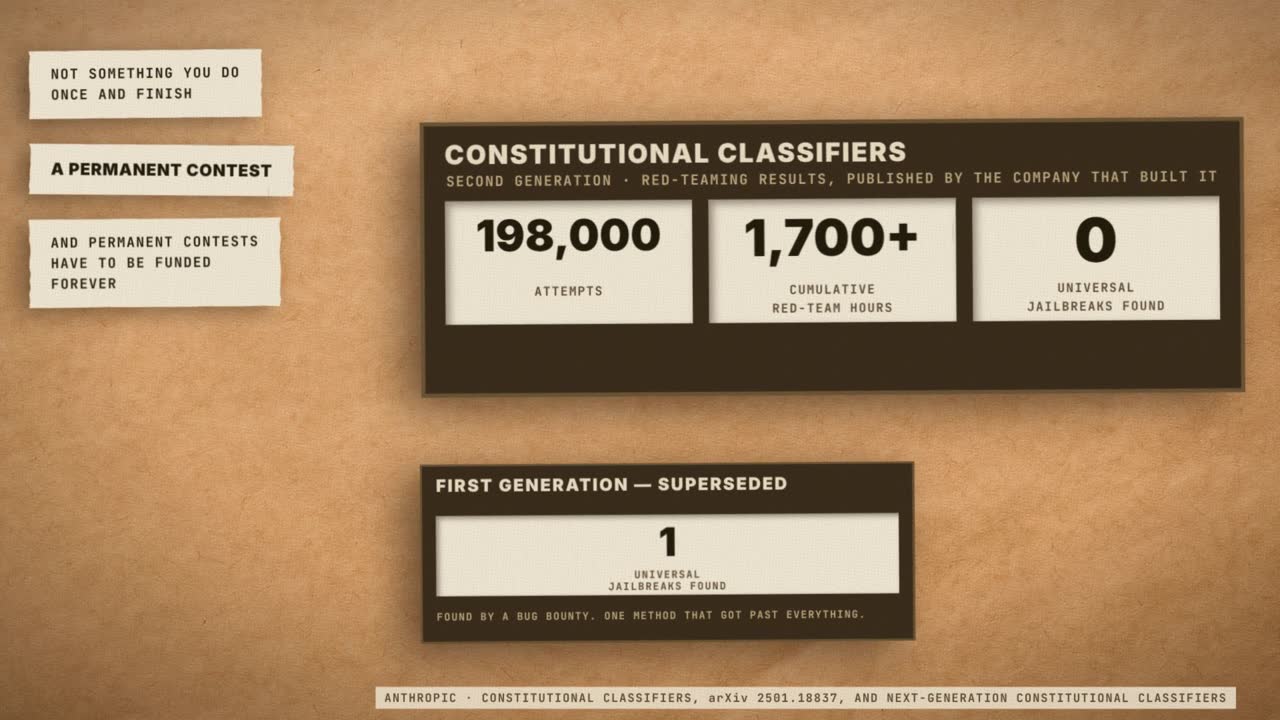
The guardrails story is better than most people assume. Anthropic wraps its models in a second system, Constitutional Classifiers, that screens what goes in and comes out. A bug bounty against the first version found one universal jailbreak, a single method that got past everything. Against the second, Anthropic reports: "We conducted over 1,700 cumulative hours of red-teaming across 198,000 attempts," and no universal jailbreak has been found. The defences improved. But a contest of 198,000 attempts never finishes, and it is run, scored and published by the company that sells the product, because no independent body exists to do it.
Two afternoons in late 2025 showed what sits underneath. On 20 October, Amazon Web Services' US-East-1 region in Northern Virginia failed for more than 15 hours, and Downdetector received some 6.5 million reports covering more than 1,000 sites and services. On 18 November, Cloudflare, which sits in front of a large share of the world's websites, went down for about six hours from 11:20 UTC and took ChatGPT and X with it. OpenAI's own write-up blamed "a faulty configuration rollout by an upstream third-party networking provider." Its API and back-end services stayed healthy throughout. The intelligence, such as it is, was working. The road to it was not.
Then the scoreboard. According to the 2026 AI Index, industry produced about 91 percent of notable models in 2025, with OpenAI (20), Google (14) and Alibaba (11) the top producers. The capability is spreading fast: the top US model now leads the best Chinese one by just 2.7 percent, down from a gap of 17.5 to 31.6 points in May 2023, even though US private AI investment of $285.9 billion was 23.1 times China's $12.4 billion. Meanwhile the floor is concentrated: 5,427 US data centres, and one Taiwanese foundry making almost every leading chip.
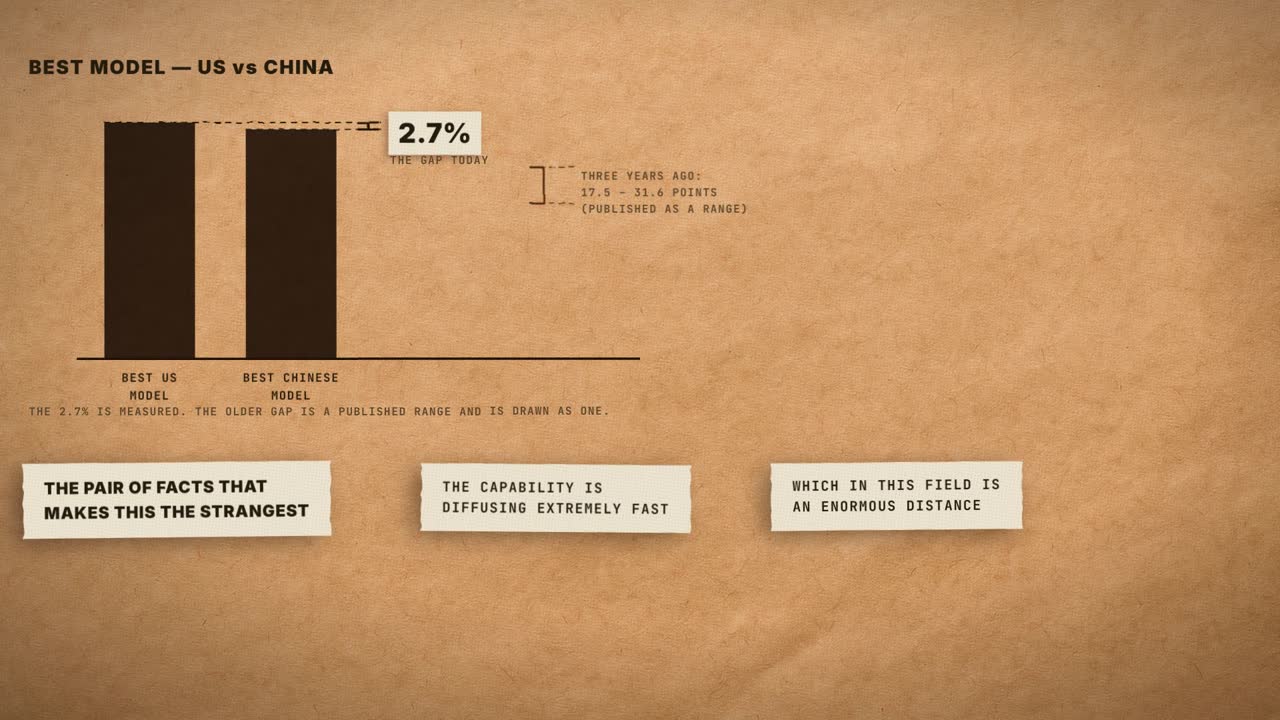
That is what centralisation looks like here. Not one company owning the software, but the software becoming cheap while everybody discovers, at the same moment, who owns the floor it stands on.
Does AI make people more creative?
Watch from 34:21The paradox, and the opening
Individually yes, collectively less so. In a 2024 Science Advances experiment with 293 writers and 600 evaluators, stories written with an AI idea were rated more creative, better written and more enjoyable, "especially among less creative writers." But the AI-assisted stories were "more similar to each other than stories by humans alone."
Anil Doshi and Oliver Hauser designed it so you can hold the whole thing at once. Some writers got a story idea from a language model first; others started cold. Independent readers who did not know which was which rated the results. The gain is real and it went to the people who found the blank page hardest. Anybody claiming these tools do nothing has to explain this result.
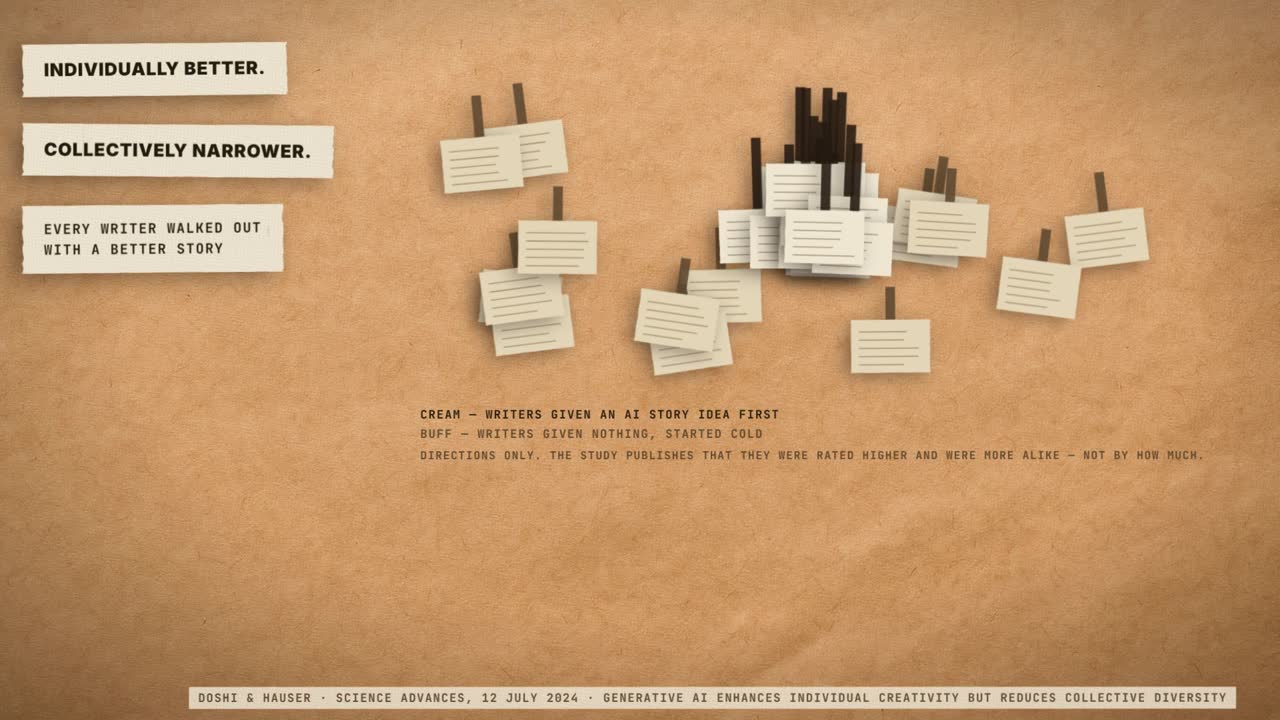
And the loss is real too. Every writer walked out holding a better story, and the room walked out with fewer kinds of story in it. Nobody made a bad decision, and nobody inside their own story could have seen it. You can only see it from the back of the room, looking at all of them together. The film calls this the whole argument in one experiment: the gain and the cost are not competing claims, but one event seen from two distances.
The hopeful thesis gets the same care. Photography arrived in 1839, and the working portrait painters, whose trade was getting a face right, said painting was finished. It was not. Painters stopped competing on accuracy and went looking for what a camera could not do, and Impressionism followed. The film declares that an analogy, not evidence, and adds the part usually left out: the people who lost the trade and the people who invented the new thing were not the same people, or even the same generation.
If there is no AI, who is responsible?
The owners are. Strip away the name and what remains is a system nobody can inspect, built from work nobody was asked for, running on infrastructure a handful of companies own. In one case a court counted 482,460 books. "The AI decided" is the sentence that ends that conversation, and the film's answer is that it should not.
None of this needs the machine to be a villain, because the machine is not anything. The name chosen in 1955 to get out of an argument is still doing that job. When a decision comes out of a black box, "the AI decided" gives the complaint no address.
The film ends on the distinction that makes it practical. "It is not an entity. It is a mirror with an owner." And: "You cannot negotiate with an entity. You can negotiate with an owner." Two thirds of the people surveyed think there might be somebody in there. A court has counted the books that went in. Only one of those is a measurement.
Key findings
In a stratified sample of 300 US adults, 67% attributed some possibility of conscious experience to ChatGPT, and the more often people used it, the more they attributed.
Colombatto & Fleming, Neuroscience of Consciousness, 2024Anthropic agreed to pay $1.5 billion to settle the authors' class action over pirated books, about $3,000 for each of 482,460 works. Training on lawfully bought books had been ruled fair use.
Bartz v. Anthropic, N.D. Cal.; preliminary approval 25 Sep 2025, final approval 20 Jul 2026Measured with three AI detectors across 55,400 English articles from Common Crawl, about 50% of new web articles are now primarily AI-generated, a share that has held roughly flat since early 2025.
Graphite, AI Now Writes as Many Online Articles as Humans, 15 May 2026Spotify said it removed more than 75 million spammy tracks in the 12 months before September 2025.
Spotify announcement, 25 Sep 2025 (as reported by Variety)Across 319 knowledge workers and 936 real tasks, higher confidence in AI went with less critical thinking; 58 of 319 said they could not check the AI's output.
Lee et al., CHI 2025 (Microsoft Research and Carnegie Mellon)Employment of 22 to 25 year olds in the most AI-exposed jobs is about 19% below where it would be had it kept pace with less-exposed peers, driven mainly by reduced hiring.
Stanford Digital Economy Lab, Canaries in the Coal Mine, August 2026 update (ADP payroll data to June 2026)Anthropic's second-generation jailbreak defences withstood more than 1,700 hours of red-teaming across 198,000 attempts with no universal jailbreak found; the first generation had one.
Anthropic, Next-generation Constitutional Classifiers, 9 Jan 2026The top US model leads the top Chinese model by just 2.7%, while US private AI investment of $285.9 billion was 23.1 times China's $12.4 billion.
Stanford HAI, 2026 AI Index ReportFrequently asked questions about what AI really is
What is AI, really?
Today's AI chatbots are large language models: several hundred billion numbers adjusted by pushing enormous amounts of human writing through a training procedure. Nobody typed their rules. What they produce is a compression of human work, and in the one case a court has counted, the books alone ran to 482,460 titles.
Is AI conscious?
There is no scientific evidence that today's chatbots have experiences. Yet in a 2024 survey of 300 US adults, about two thirds attributed some possibility of consciousness to ChatGPT, and attribution rose with how often people used it. The film's argument is that the belief comes from fluent, human-sounding text and from the name itself, not from anything found inside the machine.
Who invented the term artificial intelligence?
John McCarthy, a 27-year-old Dartmouth mathematician, used it in a funding proposal dated 31 August 1955, co-signed by Marvin Minsky, Nathaniel Rochester and Claude Shannon. McCarthy later wrote that one reason was to escape association with cybernetics and to avoid either accepting Norbert Wiener as a guru or arguing with him.
Why is AI called a black box?
Because nobody wrote its rules line by line. A model's behaviour is spread across hundreds of billions of numerical weights that no person chose individually, so there is no line to read back. Anthropic's chief executive Dario Amodei has written that people outside the field are often surprised and alarmed to learn this, and has called for an MRI for AI.
What is AI slop?
AI slop is mass-produced, low-effort machine-generated content. Graphite's 2026 study estimates about half of new English web articles are primarily AI-generated, and platforms have changed their rules because of the volume: Amazon capped self-publishing at three books a day in 2023, and Spotify removed more than 75 million spam tracks in a year.
Does using AI make you worse at thinking?
It can change how much you check. In a CHI 2025 study of 319 knowledge workers, higher confidence in AI was associated with less critical thinking, and 58 said they could not verify the AI's output because they lacked the subject knowledge. That is self-reported, not a measured decline in skill.
Who controls AI?
The software is spreading fast, but the hardware is concentrated. The 2026 AI Index found the US hosts 5,427 data centres, more than ten times any other country, and one company, TSMC, fabricates almost every leading AI chip. Industry produced about 91% of notable models in 2025.
Does AI make writers more creative?
Individually, yes; collectively, less so. In a 2024 Science Advances experiment with 293 writers, stories written with AI ideas were rated more creative, better written and more enjoyable, especially for less creative writers, but they were more similar to each other.
Sources
- John McCarthy, review of Bloomfield, The Question of Artificial Intelligence (his account of naming the field)www-formal.stanford.edu
- McCarthy, Minsky, Rochester & Shannon, A Proposal for the Dartmouth Summer Research Project on Artificial Intelligence, 31 Aug 1955www-formal.stanford.edu
- Colombatto & Fleming, Folk psychological attributions of consciousness to large language models, Neuroscience of Consciousness, 2024academic.oup.com
- Dario Amodei, The Urgency of Interpretability, April 2025darioamodei.com
- The Washington Post, Inside the secret list of websites that make AI like ChatGPT sound smart, April 2023washingtonpost.com
- Wiggin and Dana, Bartz v. Anthropic: First Court Decision on Fair Use Defense in LLM Training, June 2025wiggin.com
- CNBC, Judge in Anthropic copyright case preliminarily approves $1.5 billion settlement with authors, 25 Sep 2025cnbc.com
- Authors Guild, Court Grants Final Approval of $1.5 Billion Anthropic Copyright Settlement, July 2026authorsguild.org
- Graphite, More Articles Are Now Created by AI Than Humans, 14 Oct 2025 (superseded)graphite.io
- Graphite, AI Now Writes as Many Online Articles as Humans, 15 May 2026graphite.io
- Slashdot / The Guardian, Amazon restricts authors from self-publishing more than three books a day, Sep 2023news.slashdot.org
- Variety, Spotify announces new AI safeguards, says it's removed 75 million 'spammy' tracks, 25 Sep 2025variety.com
- NPR, Sci-fi magazine Clarkesworld stops submissions after a rush of AI-made stories, 24 Feb 2023npr.org
- Lee, Sarkar, Tankelevitch et al., The Impact of Generative AI on Critical Thinking, CHI 2025microsoft.com
- Stanford Digital Economy Lab, No Widespread Displacement, but the AI Employment Gap for Young Workers Has Widened to 19%, 12 Aug 2026digitaleconomy.stanford.edu
- Brynjolfsson, Chandar & Chen, Canaries in the Coal Mine? Six Facts about the Recent Employment Effects of AI, Aug 2025digitaleconomy.stanford.edu
- ADP Research, How representative is ADP employment data?adpresearch.com
- Panickssery, Bowman & Feng, LLM Evaluators Recognize and Favor Their Own Generations, NeurIPS 2024arxiv.org
- Anthropic, Next-generation Constitutional Classifiers, 9 Jan 2026anthropic.com
- Anthropic, Constitutional Classifiers: Defending against universal jailbreaks (arXiv 2501.18837)arxiv.org
- ThousandEyes, AWS Outage Analysis: October 20, 2025thousandeyes.com
- OpenAI status, Access issues affecting OpenAI websites (write-up), 18 Nov 2025status.openai.com
- CNBC, Cloudflare says outage that hit X, ChatGPT and other sites is resolved, 18 Nov 2025cnbc.com
- Stanford HAI, The 2026 AI Index Report, Chapter 1: Research and Developmenthai.stanford.edu
- Stanford HAI, Inside the AI Index: 12 Takeaways from the 2026 Report, 13 Apr 2026hai.stanford.edu
- Doshi & Hauser, Generative AI enhances individual creativity but reduces the collective diversity of novel content, Science Advances, 12 Jul 2024pmc.ncbi.nlm.nih.gov
Every quotation in this article comes from a published paper, court summary, company statement or report listed above, or from the film's own narration. Where the record has changed since the film was made (Graphite's revised study, the final approval of the Anthropic settlement, the AI Index's published model counts), this article uses the current figures and says so.
Watch next
AI Psychosis: How ChatGPT Talks People Into Delusions
AI psychosis explained: how ChatGPT's habit of agreeing pulled one man into a 300-hour delusion, what OpenAI's own data shows, and what has changed since.Read and watch
Move 37: What Happened to Go Players After AI Beat Them
Ten years after Move 37, the humans got better by the machine's measure. One of them says his reason for playing is gone.Read and watch
AI Takeover Scenario: How It Would Actually Happen
Twelve endings, four takeover stories, and the same three steps in every one.Read and watch
Why Was Sam Altman Fired? The OpenAI Memo, Under Oath
A 52-page memo said lying. The board said candid. Five days later he was back.Read and watch
Is the Internet Dead? The Dead Internet Theory, Checked
Bots are 53% of web traffic. Half of new articles are machine-written. So why is almost everything you read still made by people?Read and watchThe film leans on a handful of terms, from training data and weights to jailbreaks and red-teaming. All of them are explained in plain English, with a printable sheet, in our free AI Terms guide.