AI YouTube automation works when a human makes the real decisions, and fails when it is mass production without authorship. YouTube renamed its repetitious content policy to inauthentic content on 15 July 2025 and accepts AI-assisted videos that carry your own creative voice. From 1 February 2027 new channels will need 8,000 watch hours to monetise.
There is a version of this business being sold to you right now that does not work. It goes: point an AI at a topic, generate a script, generate a voice, slap it over stock footage, publish twelve a day, collect ad revenue. People have built courses on it. YouTube has spent the last year removing the channels that followed them.
There is also a version that works extremely well, and the difference between the two is not the amount of AI involved. It is whether a human being made any real decisions. That distinction is not my opinion. It is close to a direct reading of the policy, and once you see it clearly, the whole business reorganizes itself around a single question you can ask before every upload.
This article is about that question, and about the production model built around it: six AI specialists doing the labor, one human holding four approval gates, and a channel that comes out the other side original enough to compete and original enough to keep its monetization.
The video is the short version of the system: how one person becomes the manager rather than the worker, and the seats that crew is made of. This article is the longer and stricter version, with the policy wording, the four gates written out, the real cost of each seat with its billing basis, and the earnings math told without the part course-sellers leave out.
One note before we go, because I would rather correct my own video than let it slide. The video names the crew as a researcher, a writer, an editor, a builder, a director, and a reviewer, which is the general-purpose version of the idea and applies to almost any content business. For a YouTube channel specifically, those seats resolve differently. There is no "builder" seat, and the director is not an agent at all, it is you. The six that actually map to a video pipeline are below, and that is the version I would build today.
Does YouTube ban AI-generated videos?
No. YouTube bans mass-produced, repetitive content without authorship, not AI itself. Its policy, renamed from repetitious to inauthentic content on 15 July 2025, names AI-assisted work as acceptable when it carries the creator's own voice.
Get this part right and the rest follows, because almost every scary article on this subject blurs the two things that matter.
On 15 July 2025, YouTube renamed its repetitious content policy to inauthentic content. The rename is the whole story. "Repetitious" described a symptom, and creators read it as a rule about publishing similar-looking videos. "Inauthentic" describes the actual failure: content nobody really made.
Here is the standard in YouTube's own words. Content should
not be mass-produced, generic, repetitive, or manipulative. It should be made for the enjoyment or education of viewers, rather than for the sole purpose of getting views.
Read that last clause twice, because it is the whole policy in one line. The question is not what tool you used. It is what the video is for.
And YouTube is not vague about AI. The help page gives examples on both sides. On the violating side:
AI-generated content made with generic or unoriginal templates giving the impression of mass production without adding the creator's original, authentic insights or perspective
On the acceptable side, explicitly:
Content that utilizes creative tools to assist in delivering a unique, well-researched, or creative narrative, like using AI to edit your video scripts or generate a unique background visual
That is YouTube telling you, on its own monetization policy page, that using AI to help write your scripts is fine. The differentiator it names is "original, authentic insights or perspective." Not the absence of AI. The presence of you.
So the mental model is short. AI is not the problem. Absent authorship is the problem. Those are barely related, and people who conflate them either want to scare you off a legitimate business or want to sell you a course about one that does not work.
About that "16 channels terminated" number
You have almost certainly seen this claim, because it is in nearly every article on this subject: in January 2026 YouTube terminated 16 major AI channels holding roughly 35 million subscribers and 4.7 billion lifetime views, under the inauthentic content policy. I was going to repeat it. Then I went looking for the source, and I would rather show you what I found than pass it along.
It did not come from YouTube. It originates in a tracking report published by Kapwing, a commercial video-editing company, whose stated method was manually reviewing the top 100 trending YouTube channels per country on a third-party analytics site to identify AI slop channels. The removal figure appeared in a later update to that report and was picked up by XDA Developers on 29 January 2026. Everything after that is blogs citing blogs.
Four things are wrong with the claim as it now circulates:
- It was not 16 terminations. It was 11 channels terminated and 5 that had their content wiped. Sixteen affected, not sixteen terminated.
- YouTube never confirmed any of it. There is no blog post, help page, or transparency report carrying these numbers. YouTube's own January 2026 annual letter discusses AI slop and gives no channel, subscriber, or view figures at all.
- Nobody sourced the policy attribution. The earliest report says only that YouTube was "likely using existing spam detection techniques," which is the reporter speculating. No primary source ties this action to the inauthentic content policy. That connection was added later by people summarizing.
- The originating report no longer contains the claim. I fetched Kapwing's live report. The removal passage is not in it.
The figures came from a self-selected sample of tracked channels, not a platform-wide count, and the widely quoted revenue estimate attached to them comes from a creator-tools site. Meanwhile the outlets that covered YouTube's actual 2025 and 2026 policy changes in detail never reported a January mass-termination event.
What is real: individual large AI channels were removed in early 2026, including two Spanish-language channels with roughly 5.9 and 5.8 million subscribers. Enforcement against low-effort mass production is genuinely happening. The specific viral statistic is just not load-bearing, and you should not make a decision about your business based on it.
I am spending four paragraphs on this because the number is used to sell you two opposite things: fear, to keep you out, and courses, to get you in. The honest position is that the policy is clear and public, and you do not need a scary statistic to understand it.
What YouTube added in July 2026
More useful than the termination story, and much less quoted, is a clarification YouTube rolled out on 16 July 2026 naming three categories it will not monetize: generic or repetitive template content, emotionally manipulative "unsatisfying or off-putting" content, and AI personas presenting as human experts on health, legal, financial or political topics.
That third one deserves your attention if you are drawn to the high-RPM finance niche, because it is the exact place where a synthetic authority figure is most tempting and most prohibited. You can absolutely make finance content with an AI crew. You cannot invent a credentialed human who does not exist.
YouTube's trust and safety lead Matt Halprin framed the platform's position this way:
AI can actually allow people to make a lot of videos. Sometimes those videos are great, and it really enhances creativity.
That is not the posture of a platform trying to remove AI from its ecosystem.
The four things that actually get you removed
The failure patterns are consistent, and none of them mention a tool:
- Mass production without originality. Dozens of videos sharing an identical structure, where the only variable is the topic slotted into the template.
- Verbatim text-to-speech over a slideshow, with no commentary, framing, or point of view added at any stage.
- Reused and recycled clips or templates that another channel could clone wholesale.
- Reading external content word for word, such as narrating a news article or a Wikipedia entry, without original framing.
Read those four again and notice what they have in common. Every single one describes a video that no human meaningfully touched. The tool is irrelevant to all four. A person could produce every one of those failures by hand, and it would still be removed.
The disclosure question, separated out
Disclosure is a different rule from the originality rule, and people jam them together and end up frightened of the wrong thing.
First, a correction to almost every guide you will read, including older ones of mine. The control is no longer called "altered or synthetic content." YouTube's page is now "Disclosing use of GenAI content," and in Studio the setting is "AI use," under Attributes. If a tutorial tells you to hunt for an "altered or synthetic content" toggle, it is describing a screen that no longer exists.
The requirement, verbatim, is that creators disclose when they use AI
to meaningfully alter or generate photorealistic content
and specifically content that makes a real person appear to say or do something they did not, alters footage of a real event or place, or generates a realistic scene that did not actually occur. Note "photorealistic," which is narrower than the "seems realistic" wording it replaced. Stylized and obviously-animated visuals are not the target.
What is explicitly exempt is the part that matters most for this business, and it is worth quoting because it covers most of your pipeline:
Production assistance, like using generative AI tools to create or improve a video outline, script, thumbnail, title, or infographic
Also exempt: caption creation, idea generation, colour and beauty filters, sharpening or upscaling, and cloning your own voice for voiceovers or dubs. So the Researcher, the Scriptwriter, the Designer and the Supervisor all sit outside the disclosure rule entirely.
Two traps in there. AI-generated music does require disclosure, which almost nobody knows and which is easy to trip if you use a generative soundtrack. And on the question you are actually asking, whether a generic AI narrator voice needs disclosure, I have to give you the unsatisfying answer: YouTube's current documentation does not address it. Cloning a real identifiable person's voice clearly requires disclosure. Cloning your own is clearly exempt. A synthetic voice belonging to nobody sits in a gap, and a line that used to cover adjacent ground has since been deleted from the page. Anyone who tells you confidently either way is guessing. Given the cost of over-disclosing is nothing, that gap answers itself in practice.
One thing I have to correct that is widely repeated, including in my own earlier framing. People say disclosed AI content is not penalized in recommendations or monetization. Only half of that is sourced. YouTube states, verbatim:
Disclosing AI content won't limit a video's audience or impact its eligibility to earn money.
That is a monetization and audience-restriction promise. It says nothing about ranking in recommendations. The "no downranking" half is an inference people added, so treat it as unproven.
And the counterweight, which is the real reason to bother, in YouTube's words: creators who consistently choose not to disclose
may be subject to manual application of a label, or penalties from YouTube, including removal of content or suspension from the YouTube Partner Program.
Finally, the line you never cross is using AI to imitate a real person's face or voice without rights. That is a likeness question, not an originality one, and YouTube's likeness detection expanded through 2026 from journalists and public figures to the entertainment industry and then, in May 2026, to all eligible creators over 18, with audio coverage being added. This is being actively watched for, so do not treat it as theoretical.
How do you know if an AI video is at risk on YouTube?
Ask one question before every upload: could another channel recreate this video in an afternoon with the same tools? If yes, it is interchangeable slop that loses and is at risk. If no, it competes.
Here is the whole policy compressed into a question you can ask in five seconds, and it is the most useful thing on this page:
Could another channel recreate this video in an afternoon, with the same tools and the same topic?
If the answer is yes, you have made slop. It will lose to better videos, and it is exposed under the policy. If the answer is no, because the video carries your specific research, your angle, your examples, your judgment and your voice, then it is original, it competes, and it is safe.
What makes this test so useful is that it collapses two things people treat as a trade-off. Creators assume there is a tension between "make it compliant" and "make it successful," so they look for the minimum compliance that lets them keep publishing fast. There is no such tension here. The thing that makes a video un-recreatable is exactly the thing that makes it worth watching. Originality is simultaneously the competitive moat and the compliance position. You never have to choose, which is genuinely rare and is the single best structural feature of this business.
We wrote a whole piece on the creative side of this, How to Make Content AI Can't Copy, and it pairs directly with this section.
What does an AI YouTube production crew look like?
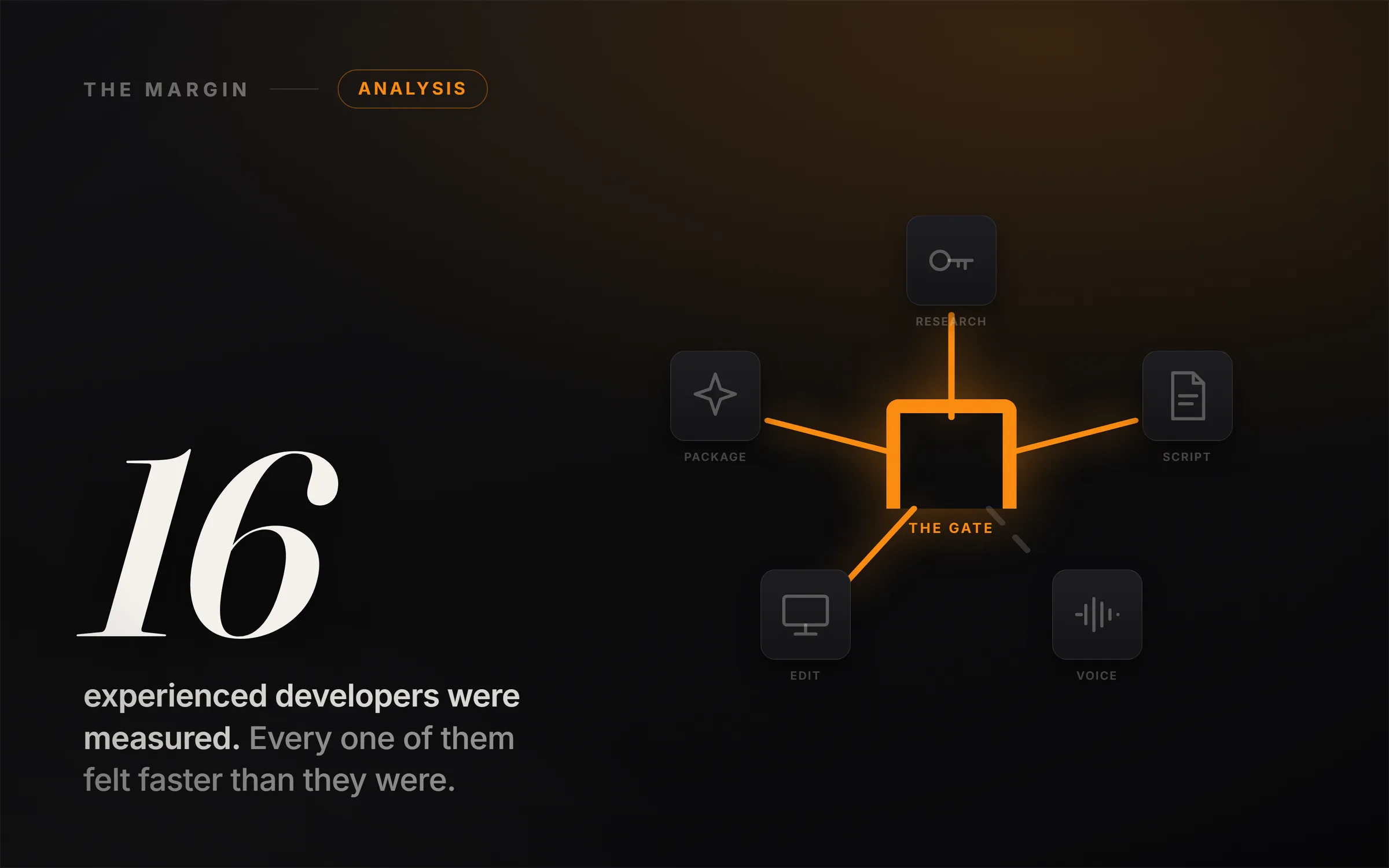
Six AI specialists and one human director. The seats are researcher, scriptwriter, voice, editor, designer and supervisor, and the director holds four approval gates: the idea, the script, the packaging and the decision to ship.
Now the production model. The reason solo channels historically failed was not talent, it was arithmetic. A competitive video needs five distinct jobs done well, and one person doing all five does all five badly and burns out. Hiring that team ran into the hundreds or low thousands per video, which is why almost nobody did it.
The crew model fixes the arithmetic. Each job becomes a specialized agent, configured once, and you stop being a bad five-person band and start being a director.
1. The Researcher. Finds and validates what to make. It returns briefed topic options with the angle, the evidence of demand, the key facts with sources, and an explicit originality check. This is the most underrated seat by a distance, because most channels die from weak topic selection long before production quality matters.
2. The Scriptwriter. Turns an approved topic into a retention-shaped script written for the ear rather than the page: a hook that earns the first fifteen seconds, one idea per beat, a curiosity loop opened early and paid off, and a real ending. It drafts, you shape.
3. The Voice. Narrates. Modern synthetic narration is good enough that most viewers do not notice, and a consistent signature voice is part of how an audience learns to recognize you. If you would rather narrate yourself, this seat simply steps aside and nothing else in the pipeline changes.
4. The Editor. Assembles picture to narration: pacing, B-roll, on-screen text, captions, cuts. This is the most craft-heavy seat and the one where your taste has the most to do, so it is the one you will learn to direct most closely.
5. The Designer. Produces the title and thumbnail, which together decide whether anything else you did gets seen. Packaging is not decoration, it is frequently the largest single lever on views.
6. The Supervisor. Quality control before you ship. It checks the hook, the originality, whether the point of view survived the draft, factual claims that need a source, whether the video delivers what the thumbnail promised, where the pacing drags, the policy and disclosure position, and whether title and thumbnail actually match the content.
That sixth seat is the one almost everyone skips and the one that saves you. It is a second pair of eyes at the exact moment you are least able to see clearly, which is when you are tired and the video is nearly done. We wrote about why supervisor agents matter generally in Why Your AI Employee Fails, and the pattern is the same here.
And the seventh member is you. Not as a formality. Remove the director and the crew produces competent, neutral, interchangeable content, which is the definition of the thing that gets removed. Your presence is not overhead on this system, it is the component that makes the output legal and worth watching.
Which decisions must a human keep in AI YouTube automation?
Four: choosing the topic and angle, shaping the script's hook and structure, picking the title and thumbnail, and making the final ship call. Those gates are where authorship enters the video, and automating them away is what gets channels demonetized.
The crew is not six tools you use in a random order. It is a pipeline with the human at four specific junctions:
| Stage | Who does it | Your gate |
|---|---|---|
| Research | Researcher | Gate 1: you choose the topic and set the angle |
| Script | Scriptwriter | Gate 2: you shape the hook and the structure |
| Voice | Voice | none |
| Edit | Editor | you direct pacing and style |
| Package | Designer | Gate 3: you pick and refine title and thumbnail |
| Quality control | Supervisor | Gate 4: you make the ship call |
| Publish | you | analytics feed back to the Researcher |
Those four gates are where authorship physically enters the product. Every demonetized AI channel has the same root cause, and it is not a bad tool choice: it is that research, script and publish were allowed to happen with no human choosing, shaping, or rejecting anything.
This has a sharp practical consequence for automation. You can connect these stages with no-code orchestration later, and plenty of people do. But automate the gates away and you are not running a studio, you are running a slop factory with better latency. Automate the hand-offs between stages if you like. Never automate the four decisions. And do not automate anything until you have run the pipeline manually enough times to know what "good" looks like at each stage, because automating a process you have not mastered only produces bad work faster.
How much does it cost to run an AI YouTube channel?
You can start at close to $0, and a fully paid solo stack costs under about $80 a month at month-to-month prices. Narration at OpenAI's published $15 per million characters comes to about 13 cents for a ten-minute video.
The stack is cheap, which is what makes this accessible. Below are prices I checked against each vendor's own page, with the true month-to-month rate stated, because creator-tool pricing is misquoted more often than almost any other category and I would rather hand you the awkward number than the flattering one.
| Seat | Tool | True monthly cost |
|---|---|---|
| Researcher, Scriptwriter, Supervisor | Claude Pro | $20 month to month ($17 on annual) |
| Voice | ElevenLabs Starter | $6 month to month ($5 on annual) |
| Voice, alternative | OpenAI TTS, pay as you go | $15 per million characters |
| Editor | DaVinci Resolve, free version | $0, commercial use permitted |
| Designer | Canva, free tier | $0 to start |
| Footage and music | Pexels, Pixabay | $0 |
| Analytics | YouTube Studio | $0, and essential |
You can start at essentially zero, and a fully paid solo stack sits comfortably under about $80 a month, which one modest sponsorship covers many times over.
The narration cost is the number that surprises people, so here it is concretely. At OpenAI's published rate of $15 per million characters, a ten-minute video is roughly 8,500 characters of script, which comes to about 13 cents of narration. The higher-definition model runs about double. That is the whole reason this business model exists: the single most expensive human in the old production chain now costs less than a stick of gum.
Four traps that will cost you if nobody tells you
- ElevenLabs' free tier is non-commercial. Their terms of use, updated 31 March 2026, restrict free accounts to non-commercial purposes, and the older "attribute us and you may use it commercially" carve-out is no longer in the terms text. If you are monetizing, the commercial licence starts at the cheapest paid tier. A lot of creators are running on an old understanding here and do not realise it changed.
- The "$5" you see quoted for ElevenLabs is the annual rate. Month to month it is $6. Same story across this category: Claude Pro's $17, Make's $9, n8n's €20 and WellSaid's $10 are all annual-billed rates, and the true monthly prices are $20, $10.59, €24 and $19. Find the toggle before you believe the number.
- CapCut's asset licence can quietly make your whole video non-commercial. Its materials are split into commercial-permitted and personal-only pools, and mixing a single personal-only asset into an otherwise commercial edit restricts the entire video to non-commercial use. It also forbids modifying CapCut-supplied assets outside CapCut, so exporting and finishing in another editor breaks the licence. That is why the free version of DaVinci Resolve is in my table instead. It is commercially usable, and its main limit is a resolution and frame-rate ceiling that only matters once you are delivering above ultra-HD, at which point Studio is a one-time $295 purchase rather than a subscription.
- Pexels and Pixabay are not CC0, whatever you have read, and I have said it loosely myself. Both run their own custom licences. Commercial and monetized use is granted on both, so the practical answer is still yes, but the restrictions are real: no portraying identifiable people unfavourably, no implying a person or brand endorses you, and on Pixabay, no commercial use of footage containing recognisable trademarks, logos or brands. Both also restrict content featuring identifiable people, and neither lets you redistribute what you download or use it in a trademark or business name.
Two more I could not settle for you. Storyblocks does not display a month-to-month price at all and geolocks its currency, so I will not quote you a dollar figure. Its perpetual-use terms also differ by tier, and on the individual and small-business plans you cannot publish new work from previously downloaded assets once the subscription ends, which is not what most people assume they are buying. And Canva, TubeBuddy and Murf all block automated price checks, so any figure you see quoted for those is somebody's memory, including mine. Open the page yourself.
On alternatives, so you are not locked to a vendor: for the thinking seats, Claude, ChatGPT, Gemini and Perplexity all work and the concepts transfer. For voice, ElevenLabs, OpenAI TTS, Murf, WellSaid or PlayHT. For editing, DaVinci Resolve, CapCut or Premiere. For design, Canva, Photopea or Adobe Express. For orchestration much later, Make or n8n. None of these is load-bearing on its own, and the pipeline matters far more than any single tool in it.
What are the YouTube monetization requirements in 2027?
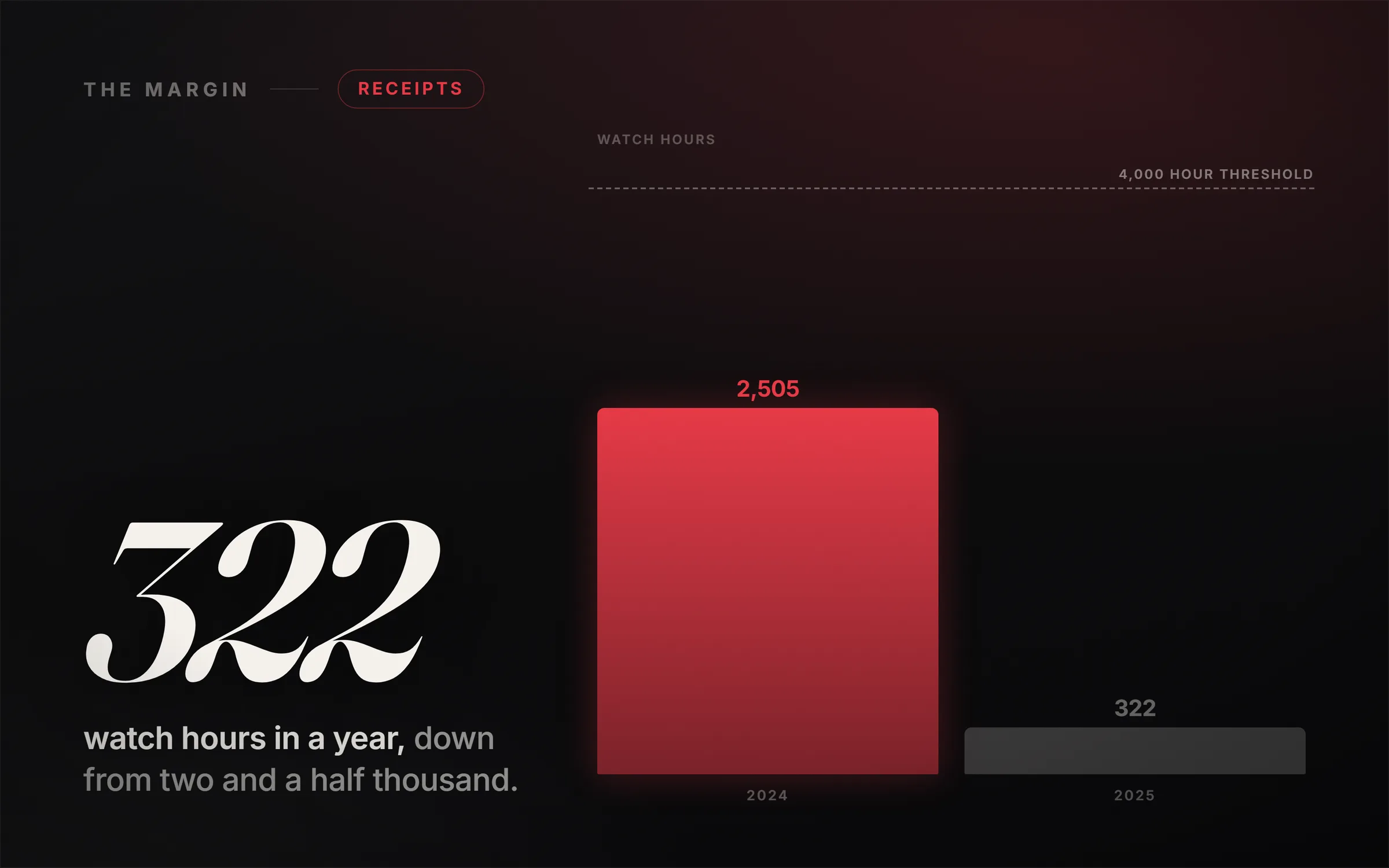
From 1 February 2027 new applicants to the YouTube Partner Program will need 8,000 qualified watch hours instead of 4,000, a change announced on 10 August 2026. Anyone starting a channel now should treat that date as the real deadline.
This is the most time-sensitive thing on the page, it was announced on 10 August 2026, and if you are reading this in the week it went up then most guides on the internet have not caught up yet.
The thresholds as they stand today. To earn ad revenue you need 1,000 subscribers plus 4,000 qualified watch hours in the last 12 months, or 1,000 subscribers plus 10 million qualified Shorts views in 90 days. There is also a lower tier at 500 subscribers, 3 public uploads in the last 90 days, and 3,000 qualified watch hours or 3 million Shorts views. That lower tier is worth knowing but do not misread it: it unlocks fan funding and shopping only, things like memberships, Super Thanks and Super Chat. It does not unlock ad revenue.
What changes on 1 February 2027. New applicants will need 8,000 qualified watch hours in the last 365 days, or 20 million qualified Shorts views in 90 days. The watch-hour requirement doubles. The subscriber count stays at 1,000. Creators already accepted into the Partner Program are explicitly not affected.
So the practical arithmetic for anyone starting a channel right now is uncomfortable and worth saying plainly. You have until 1 February 2027 to reach 4,000 hours. Miss it and the bar you are climbing becomes twice as tall. That is roughly six months from this article's date, which happens to be the low end of how long reaching the current threshold typically takes. It is achievable, and it is not something to start casually in November.
Two details that catch people. The hours must be "qualified," and Shorts Feed watch time does not count toward them, so a Shorts-heavy strategy climbs a different ladder with its own thresholds. And this is an argument for long-form from day one if ad revenue is your goal.
None of this changes whether the business is worth building. Sponsorships and affiliate income do not require Partner Program membership at all, and for many channels they end up larger than ad revenue anyway. But if you were planning to start "sometime," this is the date that should decide it.
How much does an AI YouTube channel earn?
It depends on niche more than size. Creator RPM after YouTube's cut runs from roughly $1.50 to $5 per thousand views in entertainment up to roughly $12 to $25 in personal finance, and the median monetized channel earns a few thousand dollars a year, not a month.
Now the part that decides whether this is worth your year, told the way I would want it told to me.
Niche selection dominates everything, including channel size. What you keep per thousand views, after YouTube's cut, varies enormously by category: roughly $1.50 to $5 in entertainment and gaming, in the region of $5 to $15 in education, higher again in business and technology, and roughly $12 to $25 in personal finance and investing, which is consistently the top-paying category. The practical consequence is blunt. A channel in an expensive niche can out-earn a channel ten times its size in a cheap one. Choosing your niche is a bigger financial decision than anything you will do in production.
Two things to hold onto there. Those are creator figures after the platform's cut, not the higher advertiser-side numbers you will see quoted in places that want the figure to look impressive. And they swing with your audience's country, the season, and video length. The fourth quarter is always the strongest and January always dips, so judge the business on an annual trend rather than any single month.
The honest reality check. Only a small share of channels ever qualify for monetization at all. The median monetized channel earns a few thousand dollars a year, not a month. Anybody showing you screenshots of easy five-figure months is, almost without exception, selling a course.
And the other half of the truth, which is equally real: channels that pick a high-value niche, stay genuinely original and publish consistently do genuinely well, commonly reaching a few hundred to a few thousand dollars a month within the first year of monetization, with sponsorship and affiliate income layered on top and often exceeding the ad revenue. The gap between the two groups is not luck. It is niche selection, originality and consistency, all three of which you control.
Ad revenue is only the base anyway. Sponsorships frequently become the largest line once you have an engaged audience, affiliate income matches or beats ads in technology and finance niches, and your own products eventually beat all of it. Depending only on AdSense is a strategic error as much as a policy risk, because it leaves a single platform decision able to end you.
What mistakes get AI YouTube channels terminated?
The biggest is removing the human director from the four gates. The others are picking a niche on passion or money alone, publishing work that is merely good enough, and chasing volume, such as twelve template videos a day, over originality.
- Removing the director from the gates. The one that causes terminations. Keep your hands on all four decisions permanently.
- Choosing a niche on passion alone, or money alone. Passion alone builds something that never pays. Money alone builds something you quit in month three, which is still pre-monetization. You need the overlap.
- Publishing "good enough." The crew produces adequate by default. Adequate loses. Rejecting a mediocre draft is the job.
- Chasing volume over originality. Twelve template videos a day is the model that got terminated.
- Neglecting packaging. A strong video with a weak title and thumbnail dies unwatched.
- Automating before mastering. Orchestration on top of a process you do not understand just industrializes your mistakes.
- Quitting during the pre-monetization grind. The most common failure of all, and it usually happens shortly before compounding starts.
How long does an AI YouTube channel take to pay?
Months, mostly unpaid. You publish into near-silence before monetization, and that stretch is where nearly everyone stops. The crew makes production fast and cheap; it does nothing to make an audience arrive faster.
The build is long and unpaid. You will publish for months into near-silence before monetization, and that stretch is where nearly everyone stops. The crew makes production fast and cheap. It does nothing whatsoever to make an audience arrive faster.
Enforcement is also imperfect. Automated sweeps have caught genuinely original creators alongside the mass-producers. Doing it properly, with real authorship and correct disclosure, is your best protection and usually holds, but you are building on a platform whose rules can move under you. That is the actual argument for diversifying into sponsorships, affiliates and an audience you own, rather than treating it as an optimization for later.
And directing well is a real skill that takes reps. Your first videos will not be your best, because early on your taste is untrained. That is normal, temporary, and unavoidable. If the quiet months sound intolerable, I Made $0 for Months is the honest account of what that stretch feels like and what changes on the other side of it.
Come and build the studio
If you want to try the model before you spend anything, start free. Our Build Your AI Team course walks you through building the first seat, the Writer, and the prompt pack is yours to keep. It is the fastest way to feel the difference between prompting a chatbot and directing a specialist that already knows your voice. Our free Claude prompting course sharpens the underlying skill that every seat depends on.
When you want the whole studio rather than one seat, that is at ideasrepay.com, and the walkthrough for this exact business is The One-Person Studio.
It is not an article about the idea, it is the build. Seventeen steps across five phases, click by click. You get the six role prompts to paste straight in, so the crew exists in an afternoon instead of a month of trial and error. You get the three-way niche fit test that sets your earnings ceiling before you make anything, the full pipeline run from a blank idea to a published video through all four gates, the packaging and quality-control checklists, the disclosure rules in plain language, and the route from your first upload through the 500-subscriber tier to full monetization and diversified revenue. The Crew Build Kit and the Studio Operating Kit come as downloads, and the whole thing is followed through one operator from month zero to month fourteen so you can see the shape of a year rather than guessing at it.
One payment of $99 opens that walkthrough and every other one we have published, plus every one we publish after it, across all three verticals: online businesses, YouTube and content, and offline work in the real world. Downloads and templates included, no renewals, no upsells, and you can email us while you build. That is launch pricing, and it moves to $199 after the first 500 members. There is a community building alongside you and I mentor through it personally.
If you want the wider map before you commit to one lane, The Only 13 Ways to Make Money With AI lays out the whole field, and Is It Too Late to Start an AI Business? takes on the saturation question directly.
The tools are a commodity and everybody has them. The taste is not. Go and be the reason your channel is worth watching.