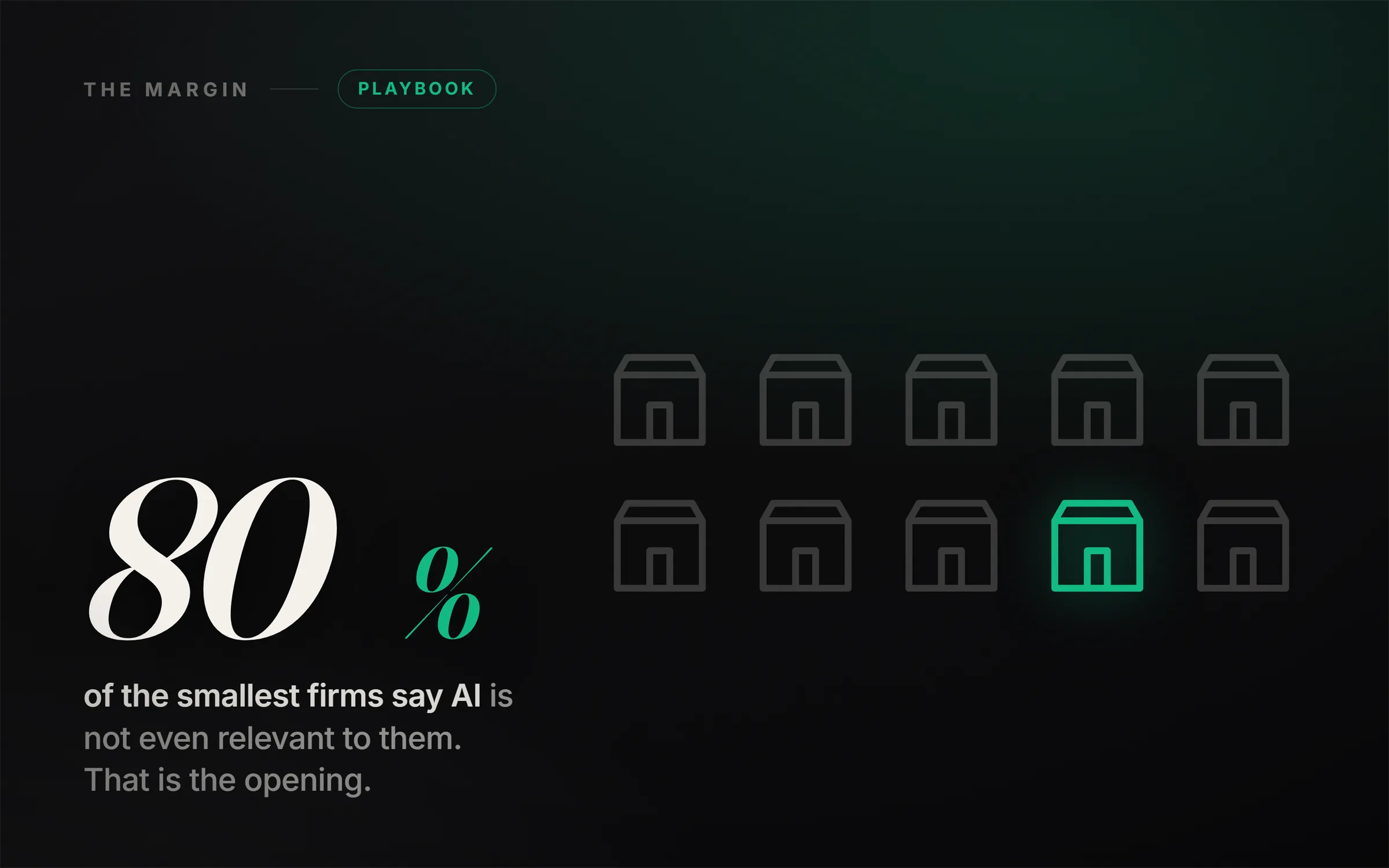
No, it is not too late to start an AI business, and the numbers say almost the exact opposite of what the panic says: the US Census Bureau finds only about one in five US businesses actually use AI to produce anything. Of the five fears that stop people, four are false and one, being noticed, is true.
Five fears stop most people before they send the first message: it is too late, I cannot code, it is a bubble, it is moving too fast, and no one will ever notice me. Those fears deserve to be taken seriously, so we did. We ran every one of them against the actual data. Four turned out to be lies the internet keeps repeating to itself. One is completely true, and it happens to be the one almost nobody warns you about.
I am writing this from inside the exact bet. We built IdeasRepay with no audience to lean on, a cold start from zero, in the middle of all five of these fears at once. So this is not a pep talk from someone selling a course about a business they never ran. It is the honest map: which four fears to ignore, and the single one to plan your whole business around. Every number below is attributed to a real source.
The video runs the same five fears in about six minutes with the numbers on screen. The written version below stands on its own and goes deeper on the sourcing and the honest trade-offs. Read it, watch it, or both.
Is it too late to start an AI business in 2026?
No. It is embarrassingly early, and the loudest evidence is being misread. The US Census Bureau's Business Trends and Outlook Survey, which asks real companies whether they use AI to produce their goods and services, has consistently put actual usage at roughly one in five businesses through 2025 and into 2026. Break it down and it gets more lopsided: larger firms sit around 27%, while small businesses come in under 20%. So four out of five companies in your own town are not using this in their operations at all.
It gets starker. McKinsey's most recent State of AI work found that only about 6% of AI adopters qualify as high performers actually capturing meaningful value from it. Almost everyone else is dabbling. The number people quote back at you, that ChatGPT has around 900 million weekly users, is real but it is measuring the wrong thing. Personally typing into a chatbot is not the same as a business running on AI, any more than everyone owning a phone meant everyone had built an app. The gap between "people who touch AI" and "businesses that operate on it" is the entire opportunity, and it is enormous.
Do you need to know how to code to start an AI business?
No, and the people telling you otherwise are usually the ones still charging to teach syntax. Google's own CEO, Sundar Pichai, has said on Alphabet's earnings calls that AI now writes around half of the company's new code, up from roughly a quarter and then thirty percent over the prior year. If the most technical company on the planet is letting AI write half its code, the barrier you are afraid of is already gone. Gartner has projected that about 70% of new applications would be built with low-code or no-code tools by 2025, and we are there.
You can see it in who is building. Lovable, one of the AI app builders, reported roughly $500 million in annual recurring revenue with around 80% of its builders being non-technical, and it is one of several in the same lane, alongside tools like Bolt, Replit, and v0. The honest caveat comes straight from developers themselves: in Stack Overflow's 2025 survey, 84% said they use or plan to use AI tools, but their top complaint is code that is "almost right, but not quite." That is the tell. The skill that pays in 2026 is not typing code. It is judgment: knowing what to build, for which buyer, and catching the "not quite" before the customer does. We made that argument in full in The Moat Moved.
Is AI a bubble that is about to pop?
Partly yes, and it still does not change your plan. Let us concede the froth honestly, because pretending it is not there costs you credibility. MIT researchers found that about 95% of enterprise AI pilots delivered no measurable return to the bottom line. The four biggest tech companies are spending north of $300 billion a year in combined capital expenditure on AI infrastructure. That is real bubble behavior, and some of these valuations are going to hurt when they correct.
Here is the split that matters: a valuation bubble and a useless technology are not the same thing. Look at the dot-com crash. The Nasdaq fell about 78% from its peak. Amazon's stock dropped roughly 90%. And the internet went on to quietly become the entire economy. The stock bubble popped; the utility compounded straight through it. AI's utility is already measurable in controlled studies, not just decks. A randomized trial of customer support agents (published through the NBER) found about a 14% productivity gain, and a controlled trial of software developers across Microsoft and Accenture found roughly a 26% gain. A bursting valuation bubble wipes out speculators betting on hype. It does not wipe out an operator solving a real problem cheaply for a real customer. That is the side of the line you want to be on.
Is AI moving too fast to start a business now?
No, and "too fast" is a fear aimed at the wrong layer. Yes, the frontier is sprinting. The gap between major model releases has shrunk to a matter of weeks. If you were trying to build the foundation models, that pace would be terrifying. But you are not building on the frontier. You build on the durable layer above it: the part that turns a model into an outcome for one specific buyer. That layer is not shrinking, it is exploding.
The market for AI services and consulting is growing fast. Upwork has reported demand for AI-related skills up about 109% year over year. Faster models do not make that business obsolete, they make it better. The person who helps a local bakery put this month's tools to work does not get replaced when next month's model ships. They get a sharper tool to deliver the same outcome. Speed is only a threat if your entire business is being slightly ahead on the model. Build on the customer instead, and every release is a tailwind.
Will anyone actually notice you? The one fear that is true
This is the real one, and every honest map has to say so. Four of the five fears are lies. This one is not. No algorithm is going to hand you customers, no product markets itself, and most people who start quit in month two because the silence is louder than they expected. But notice what the true fear actually is. It is not that the customer does not exist. It is that reaching them is genuinely hard work that nobody does for you.
The demand is not the problem. In PayPal's 2025 small business research, 66% of owners said AI is now essential to stay competitive, and Thryv reported that small business AI adoption jumped about 41% in 2025. Two in three owners feel the pressure. And their number-one blocker, over and over, is having no one in-house who can actually do it. Read those two facts together: the customer is real, reachable, feeling urgency, and openly admitting they cannot do this themselves. "No one will notice me" is true only in the sense that you have to go to them. It is false in the sense that they are already looking for you. The wall is distribution, and distribution is a problem you can plan your way over.
What actually works when starting an AI business?
If four fears are lies and one is true, then the whole strategy is simple: stop wasting energy on the lies, and pour all of it at the one true wall. That means being deliberate about being noticed, from day one, instead of assuming a good product sells itself.
The shape that works is narrow on purpose. One niche, so you know exactly whose problem you solve and can speak their language. One reachable customer inside that niche, ideally a local business or a specific role you can actually get in front of this week, not "everyone." One channel to reach them, worked consistently rather than ten channels done once. And the discipline to keep going past month two, which is precisely where the people who would have made it usually quit. That is the honest anti-hype version of starting: not a viral launch, but one clear customer reached through one clear channel, over and over, until it compounds. For a concrete menu of which businesses fit this shape, we broke down five in Realistic AI Side Hustles for Beginners and five more in Small Business Ideas for 2026. And if the "can't code" fear is the one holding you specifically, Vibe Coding Won't Make You Money. This Will. is the honest breakdown of where the money actually is.
What are the five fears about starting an AI business?
| # | The fear | Verdict | The number that settles it |
|---|---|---|---|
| 1 | It is too late | Lie | Only ~1 in 5 US businesses use AI to produce anything (US Census Bureau) |
| 2 | I cannot code | Lie | ~50% of Google's new code is AI-written; Gartner projects ~70% of new apps use low/no-code |
| 3 | It is a bubble | Half true, does not matter | 95% of AI pilots show no return (MIT), yet the utility compounds like the post-crash internet |
| 4 | It is moving too fast | Lie | AI services market projected ~$11B → ~$91B by 2035; AI-skill demand +109% YoY (Upwork) |
| 5 | No one will notice me | True | 66% of SMB owners say AI is essential (PayPal), but reaching them is on you |
Start before you feel ready
Here is the honest close. The product was never the wall. In 2026 the building is the easy part, which is exactly why four of these five fears are lies. The one real wall is being noticed by the one customer who already needs you. That is not a reason to wait. It is the specific thing to build your plan around.
Two in three small business owners are telling researchers they need AI and cannot do it themselves. That is not a bubble. That is a customer, standing in your town, describing the person they are looking for. A blueprint on ideasrepay.com does not build the product for you, because that part is no longer hard. It hands you the reachable customer, the channel to get in front of them, and the exact words to say when you do. Pick the one that fits you, and go be the person they were looking for.