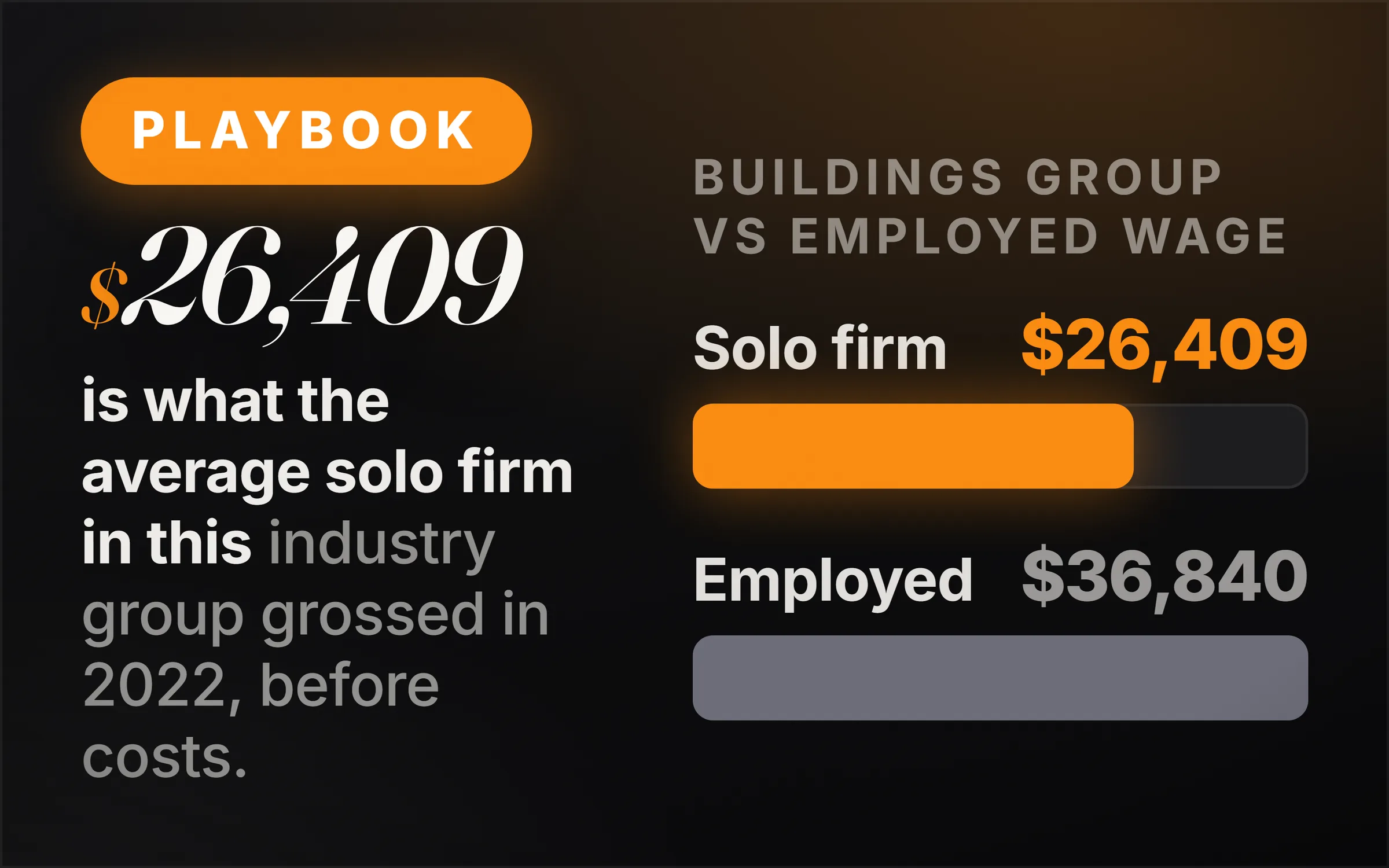
No. You can legally operate a service business as a sole proprietor from the day you take your first payment, and in the United States nothing about your tax obligations waits for you to form anything. The IRS threshold for self-employment tax is $400 of net earnings, and it applies to a sole proprietor and an LLC owner identically.
That single fact removes most of the reason people form an LLC before they have a client. The LLC is sold as two things it is not: a way to pay less tax, and the moment a hobby becomes a real business. It is one specific thing instead, and that thing is genuinely valuable to some people and close to irrelevant to others. Which one you are depends on questions nobody in this genre asks you.
Do you need an LLC to start a service business?
No. A sole proprietorship is the default, it requires no formation step, and you are operating as one the moment you start doing business for money. There is no filing that precedes your first client, and the $400 self-employment tax threshold applies to you either way.
This is worth being blunt about because the belief that you need one is doing real damage. People spend weeks on entity selection, registered agents and operating agreements before they have spoken to a single prospect, and they experience that as progress because it feels like the sort of thing a serious business does. It is the most comfortable possible way to avoid the only thing that matters early, which is finding someone willing to pay you.
There are real reasons to form one, and they are covered below. None of them is "so I can start." A business that has never had a client does not yet have the exposure an LLC exists to contain, and the structure can be added later, in an afternoon, once you know what you are protecting. A worked example of starting this way, with free tools and no formation step, is how to start a cleaning business with no money.
Does an LLC lower your taxes?
No, not by itself. The IRS treats a single-member LLC as a "disregarded entity," and its page on single-member LLCs states that an individual owner operating a trade or business "is subject to the tax on net earnings from self employment in the same manner as a sole proprietorship."
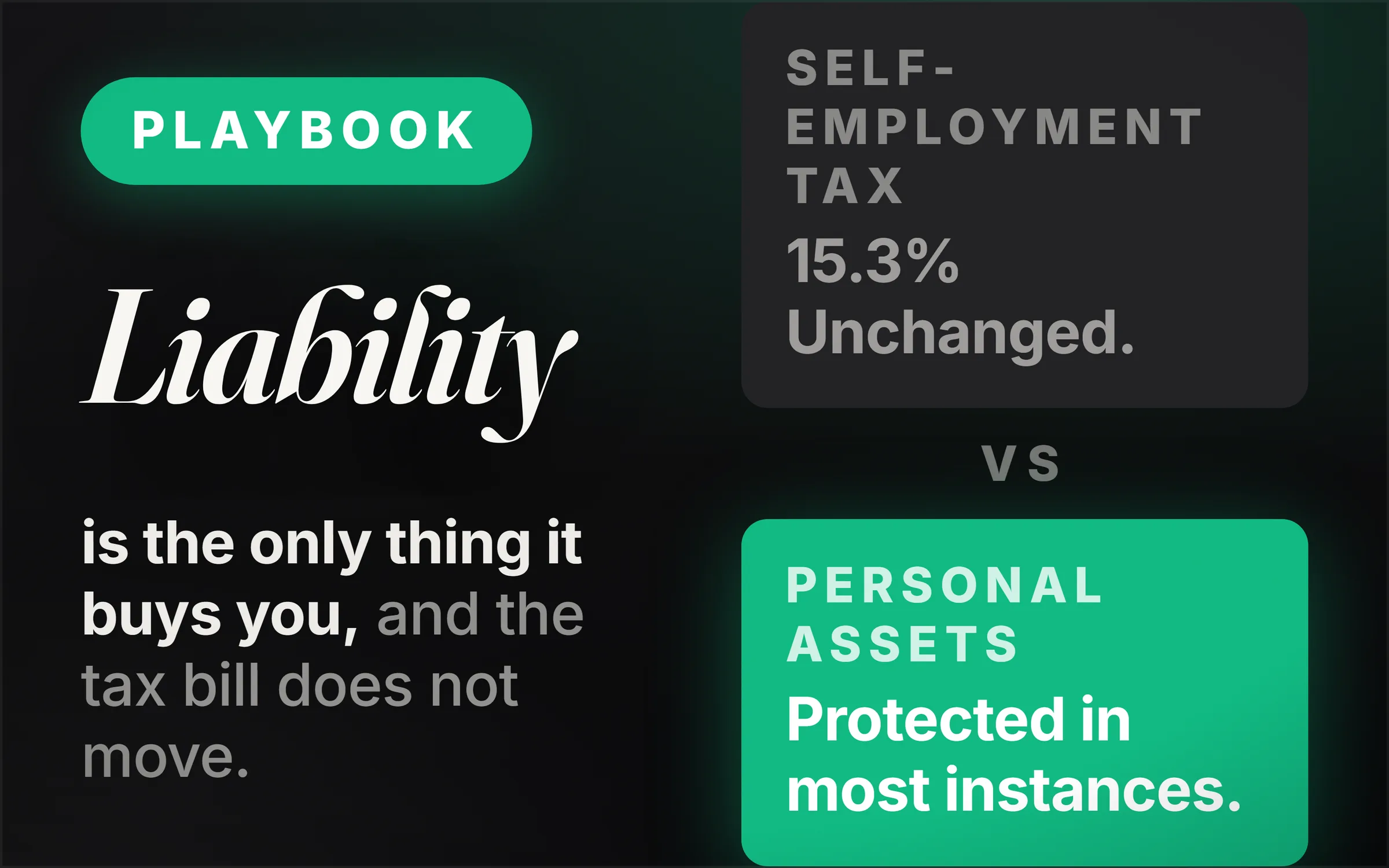
The SBA says the same thing from the other direction: members of an LLC "are considered self-employed and must pay self-employment tax contributions towards Medicare and Social Security." Business income still lands on Schedule C of your Form 1040. Self-employment tax still runs at 15.3 percent of net earnings. Nothing in the default federal treatment moves.
The claim survives anyway, and the reason is that it is a garbled version of something true. There is a tax election, made on Form 8832, that changes how the entity is classified, and there are circumstances at higher income levels where a different classification changes what is owed. That is a genuine strategy with genuine tradeoffs, extra filings and a payroll obligation attached. It is also not what the beginner is being sold. What the beginner is being sold is that forming an LLC lowers their tax, and it does not. We took the underlying numbers apart in side hustle tax explained.
What does an LLC actually protect you from?
Personal liability for the debts and obligations of the business, in most instances. The SBA states that LLCs "protect you from personal liability in most instances" and that personal assets such as a vehicle, a house or savings would not be at risk if the LLC faced bankruptcy or a lawsuit.
Hold on to the qualifier, because it is the most important phrase on this page and it is exactly the bit that gets dropped when this is repeated. "In most instances" is not decoration. Protection is not automatic and it is not absolute. It can fall away where the owner personally guaranteed a debt, which is routine for a lease or a business loan. It does not cover your own negligent act in performing the work. And it can be undermined by running the entity as an extension of your personal finances rather than as a separate thing with its own account and its own records.
That last point is the one people underestimate. The protection is a consequence of the separation being real, not of the paperwork existing. An LLC whose bank account is also where the owner's groceries come from is describing itself accurately to anyone who later looks.
What is a sole proprietorship, legally?
It is you. The SBA puts it in one sentence: sole proprietorships "do not produce a separate business entity," which means "your business assets and liabilities are not separate from your personal assets and liabilities."
There is no veil, because there is no second thing for a veil to sit between. The business's obligations are your obligations, and a claim against the business is a claim against you and what you own. That is the entire distinction being bought when someone forms an LLC.
Whether that distinction is worth buying depends on a question this genre never asks, which is what a claim would actually reach. Someone with a house, savings and a family has a different answer from someone whose entire net worth is a laptop and three months of rent. The second person is not being reckless by trading as a sole proprietor. They are correctly observing that the structure protects assets they do not have, and that the money is better spent on the work.
When does an LLC start to make sense?
At the point your work can cause a loss somebody would sue over, or you have assets a claim could reach. Those are the two triggers, and revenue is not one of them.
Some concrete versions, because the abstract test is hard to apply to yourself. If you go into other people's homes or premises, you can damage them. If you handle client money, client data or client access credentials, you can lose them. If your advice or your build is something a business will run on, it can fail expensively and the failure is traceable to you. If you hire anyone, even one subcontractor, you have taken on their conduct as well as your own. And if you sign anything with a term longer than the job, you have created an obligation that outlives the work.
Against that, the case for waiting is genuine and rarely made honestly. Forming early costs money and attention at the stage when you have least of both, and it adds a permanent administrative tail: a separate account to maintain, a separate set of records, and filing obligations that recur whether or not the business earns anything. That tail is trivial for a business with clients. It is a real drag on a business that has not started.
What does an LLC cost to keep?
We are not going to give you a number, because the honest answer is that it depends entirely on your state and we could not verify a specific fee schedule to the standard we hold on this site.
What we can tell you is the shape of it, which is more useful than a wrong figure anyway. There is a one-time formation fee paid to the state when you file. There is usually a recurring obligation, annually or biennially, which may be a report, a fee, a franchise tax or some combination. There may be a registered agent cost if you do not act as your own. And there is the ongoing cost that never appears on anyone's list, which is the separate bank account, the separate bookkeeping and the time both consume.
Those amounts vary by state by an order of magnitude, and some states carry an annual charge large enough to change the decision on its own. Look up the state you will actually register in, on that state's own Secretary of State site, before you commit. The aggregator sites that rank for this question are selling formation services, which is worth remembering while reading their numbers.
Does an LLC make clients take you more seriously?
Occasionally, and much less than people expect. In business-to-business service work the things that move a buyer are demonstrated competence, references and how you handle the first conversation, none of which appear on a formation certificate.
There are narrow cases where it genuinely matters. Some larger organisations have procurement rules about who they can contract with. Some sectors expect it as a baseline. If you are pursuing that kind of client, the requirement will surface early and explicitly, and you should believe it when it does.
For everyone else the credibility worry is usually a proxy for a different anxiety, which is the feeling of not yet being a real business. Forming an entity is a very effective way to make that feeling go away for about a week. It does not produce a client. As we argued in how to get your first client without asking for one, the thing that converts a stranger is finished work in front of them, and nobody has ever asked to see the certificate first.
Should you get insurance instead?
For a lot of service businesses, insurance is the more urgent purchase, and it addresses something an LLC does not: it pays. An LLC limits which assets a claim can reach. Insurance provides money to handle the claim in the first place, and typically a defence with it.
The two are complements rather than alternatives, and the failure they cover is different. An LLC will not help with your own negligence in performing the work, which for a service business is the most likely thing to go wrong. Insurance is aimed squarely at that.
Published pricing exists and is worth checking rather than assuming. Next Insurance advertises general liability "Starting at $19/month" with a footnote, and the qualifier attached to it is "for some low-risk businesses," which is the part that gets quoted away when this figure travels. Treat published starting prices as the floor for the safest possible customer, not as your quote. Get an actual quote for your actual trade, and read what the policy excludes, because the exclusions are the product.
The honest hard part
The difficulty here is not legal, it is that the question is a comfortable one to research. Entity selection has clear categories, definite answers and an obvious moment of completion, and it can absorb an unlimited amount of time that is not being spent on the uncomfortable work of finding someone who will pay you.
The decision itself is not close for most people reading this. If you have no clients, no assets and no exposure, trade as a sole proprietor and revisit it when any one of those changes. If you have a house, employees or work that can go expensively wrong, form the entity and stop reading. The genuinely difficult part sits either side of that: getting the first client before the structure, and running the separation properly afterwards so the protection you paid for is real rather than notional.
If you want the wider vocabulary around this, we defined it in startup finance terms explained, and the shape of running the whole thing alone is in the one person company.