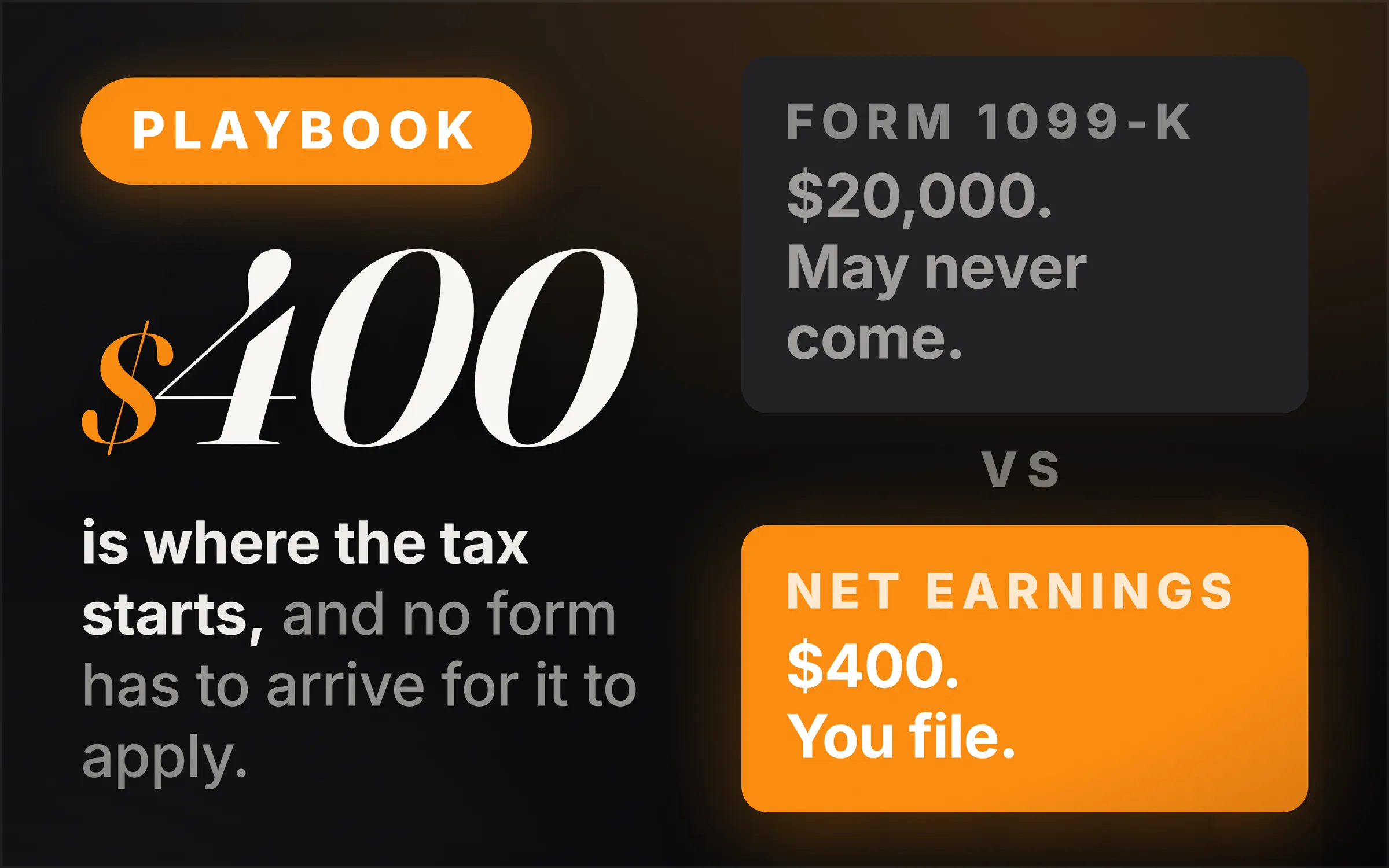
You owe federal tax on side hustle income once your net earnings from self-employment reach $400, and that threshold has nothing to do with whether anyone sends you a form. The IRS states it plainly on its own self-employment tax page: you must file if your net earnings from self-employment, excluding church employee income, "were $400 or more." Four hundred dollars of profit, not four hundred dollars of revenue, and not four hundred dollars reported by a platform.
That gap between profit and paperwork is where most side hustle tax advice goes wrong, and it goes wrong in both directions at once. People panic about forms that will never arrive, and they relax about a liability that already exists. This piece separates the two using the IRS's own published pages, and flags the one number we could not verify rather than guessing at it.
Do you have to pay tax on a side hustle?
Yes, once your net earnings from self-employment reach $400 for the year. The IRS sets that threshold on its self-employment tax page, which states you must file if your net earnings from self-employment were "$400 or more." That is a remarkably low bar and it is the single most misunderstood number in this subject.
Read the wording carefully, because two words are doing the work. Net means after deductible business expenses, not gross receipts. If you took in $2,000 and spent $1,700 on things genuinely required to earn it, your net earnings are $300 and this particular threshold is not met. And earnings from self-employment means work you did as an independent operator, which is different from selling personal possessions at a loss or from a hobby that never intended to profit.
What the threshold is not is a permission slip. Below $400 you may still have a filing obligation for other reasons, because the self-employment tax threshold and the general income tax filing thresholds are separate tests with separate numbers. The safe reading is that $400 of profit is the point at which self-employment tax enters the picture, not the point at which tax in general begins to exist.
What is self-employment tax and how much is it?
Self-employment tax is 15.3 percent of net earnings, and the IRS breaks it into 12.4 percent for Social Security and 2.9 percent for Medicare. It is separate from, and additional to, the ordinary income tax you pay on the same money.
This is the number that ambushes people, and the reason is structural rather than mathematical. In a job, these contributions are split: your employer pays half and you pay half, and the half you pay is already gone before the money reaches your account. Working for yourself, you are both parties, so you carry the whole 15.3 percent. Nothing has been withheld. The full amount is sitting in your bank account looking like income right up until the moment it is not.
There is a further band for higher earners. The IRS notes an additional Medicare tax of 0.9 percent that applies above threshold amounts which depend on filing status, and the page gives a range of $125,000 to $250,000 depending on how you file.
Will you get a 1099-K for a side hustle?
Only above $20,000 and more than 200 transactions. The IRS's Understanding your Form 1099-K page states that payment apps and online marketplaces are required to report "when the total amount of payments you receive for goods or services through the platform exceeds $20,000 in more than 200 transactions."
That matters because a great deal of side hustle content still runs on a $600 figure and the alarm that goes with it. The threshold has been changed, delayed and changed again over several years, which is exactly how a superseded number survives in circulation: the panic articles were written once and never revisited, and they outrank the correction. The operative rule is whatever the IRS page says now, and right now it says $20,000 and more than 200 transactions.
One honest caveat, because it is the sort of thing this genre skips. The IRS page does not state which tax year that threshold attaches to, and thresholds in this area have moved before. Treat it as the current published rule rather than a permanent one, and re-check it in the year you are actually filing. It is also worth knowing that platforms may issue a form voluntarily below any threshold, and that some states set their own lower reporting thresholds independently of the federal one.
Do you owe tax if nobody sends you a form?
Yes. A 1099 is an information return. It tells the IRS about money that was already taxable, and its absence changes nothing about what you owe.
This is worth stating bluntly because the opposite belief is extremely common and it is expensive. The reasoning goes: no form arrived, therefore the IRS does not know, therefore there is nothing to declare. Every step of that is wrong, and the first step is wrong in a way that compounds. Cash from a neighbour, bank transfers from a client, money that moved through a platform below the threshold, and money that arrived in a currency or wallet nobody reported are all income if you earned them by working.
The practical version of this is simple. Your obligation is measured by what you earned, and it is your own records that establish that, not the forms that happen to land in your mailbox in January. That is the entire reason the boring habit of recording income as it arrives is not optional. If you want the operator's view of what that record-keeping actually looks like day to day, we wrote it out in how to start a bookkeeping business with no experience, which is the same discipline seen from the side of the person who charges for it.
When do you have to pay estimated taxes?
When you expect to owe $1,000 or more in tax for the year. The IRS estimated taxes page states that individuals "generally have to make estimated tax payments if they expect to owe tax of $1,000 or more when their return is filed." For corporations the equivalent figure is $500.
The concept trips people up because employment trains you out of it. In a job, tax is withheld from every payment automatically, so the system collects continuously and you never think about it. Self-employed, nobody withholds anything, so the law asks you to do the withholding yourself, in instalments, across the year. The IRS divides the year into four payment periods with their own due dates, and points to Form 1040-ES and Publication 505 for the schedule.
The failure mode is predictable and it is not usually greed. Somebody has a good year, spends what looked like profit, and discovers in April that a meaningful share of it was never theirs. The money was always the government's. It simply arrived in their account first, which is a genuinely difficult thing to feel about a bank balance.
How do you avoid an underpayment penalty?
By hitting one of two safe harbours. The IRS describes paying the lesser of "90% of the tax for the current year, or 100% of the tax shown on the return for the prior year." Meet either and you are protected from the underpayment penalty even if your final bill turns out higher.
The prior-year route is the one worth understanding, because it converts an unanswerable question into an arithmetic one. Forecasting a variable freelance income is genuinely hard, and being wrong about it is penalised. Last year's total tax, by contrast, is a known number sitting on a filed return. Paying that amount across four instalments gives you a defined target that does not move as your year turns out better or worse than expected.
Two caveats the IRS states directly. There are "special rules for farmers, fishermen, and certain higher income taxpayers," and the higher-income rule raises that prior-year percentage above 100 percent. The page does not give the AGI level or the raised percentage in its main text, so we are not going to invent them here. If your income is high enough for that to plausibly apply, the figure is in Publication 505 and it is worth ten minutes of your time.
And note what the penalty is actually for. It is for paying late, not for underpaying overall. Someone who pays their entire liability in a single lump in April can still owe a penalty, because the money was due in instalments across the year.
Does forming an LLC lower your side hustle tax bill?
No, not by itself. The IRS treats a single-member LLC as what it calls a "disregarded entity," and its page on single-member LLCs says an individual owner of one that operates a trade or business "is subject to the tax on net earnings from self employment in the same manner as a sole proprietorship."
Read that again, because it is the plainest possible refutation of one of the most confidently repeated claims in this genre. Business income still goes on Schedule C of your Form 1040. Self-employment tax still applies at the same rate on the same earnings. The default federal tax treatment of your side hustle is identical the day after you form an LLC to the day before.
An LLC can be a good idea. It is a liability structure, and liability is a real thing worth managing. But it is sold as a tax move, and as a tax move on its own it does nothing. The classification only changes if you file Form 8832 and affirmatively elect to be treated as a corporation, which is a different decision with its own consequences and its own paperwork. We take that whole question apart in do you need an LLC to start a service business.
What should you set aside from every payment?
A fixed percentage of every payment, moved to a separate account on the day it arrives, before you have had a chance to think of it as yours.
We are not going to tell you the percentage, because the honest answer depends on your total income, your filing status, your state, and your deductible expenses, and anyone who gives you a single confident number across all of those is guessing. What we will say is that 15.3 percent is the floor of what self-employment tax alone takes from net earnings, and ordinary income tax and any state tax sit on top of that. A figure that only covers the 15.3 percent is not a reserve, it is half of one.
The mechanism matters more than the number. A separate account works because it removes the decision, and removing decisions is the whole trick with money that is not yours. Somebody who transfers a share of every payment on the day it lands never has to exercise discipline in April, because there is nothing left to exercise it over. Somebody keeping it all in one balance is making a small judgement call every single time they check it.
The honest hard part
The genuinely difficult thing about side hustle tax is not the arithmetic. Every rule above is a published number on a government page, and the calculations are addition and multiplication. The difficulty is that the system assumes a discipline that employment specifically trained out of you.
A salary is a finished number. It arrives already reduced, and everything in the account is spendable. Self-employment inverts that: every payment arrives gross, carrying an obligation that will not be collected for months, and nothing about the balance tells you which part is yours. Most people who get into trouble here are not evading anything. They are applying an employee's instincts to a business owner's bank account.
The fix is boring and it is entirely mechanical. Record income as it arrives, hold back a share on the day it lands, pay in instalments, and check your figures against the tax year you are actually filing rather than against a blog post written three years ago. Do that and this becomes an administrative task. Skip it and it becomes a bad afternoon in April, every year, forever.
If you want the wider vocabulary that surrounds this, we defined the terms plainly in startup finance terms explained, and the shape of running everything solo is in the one person company.