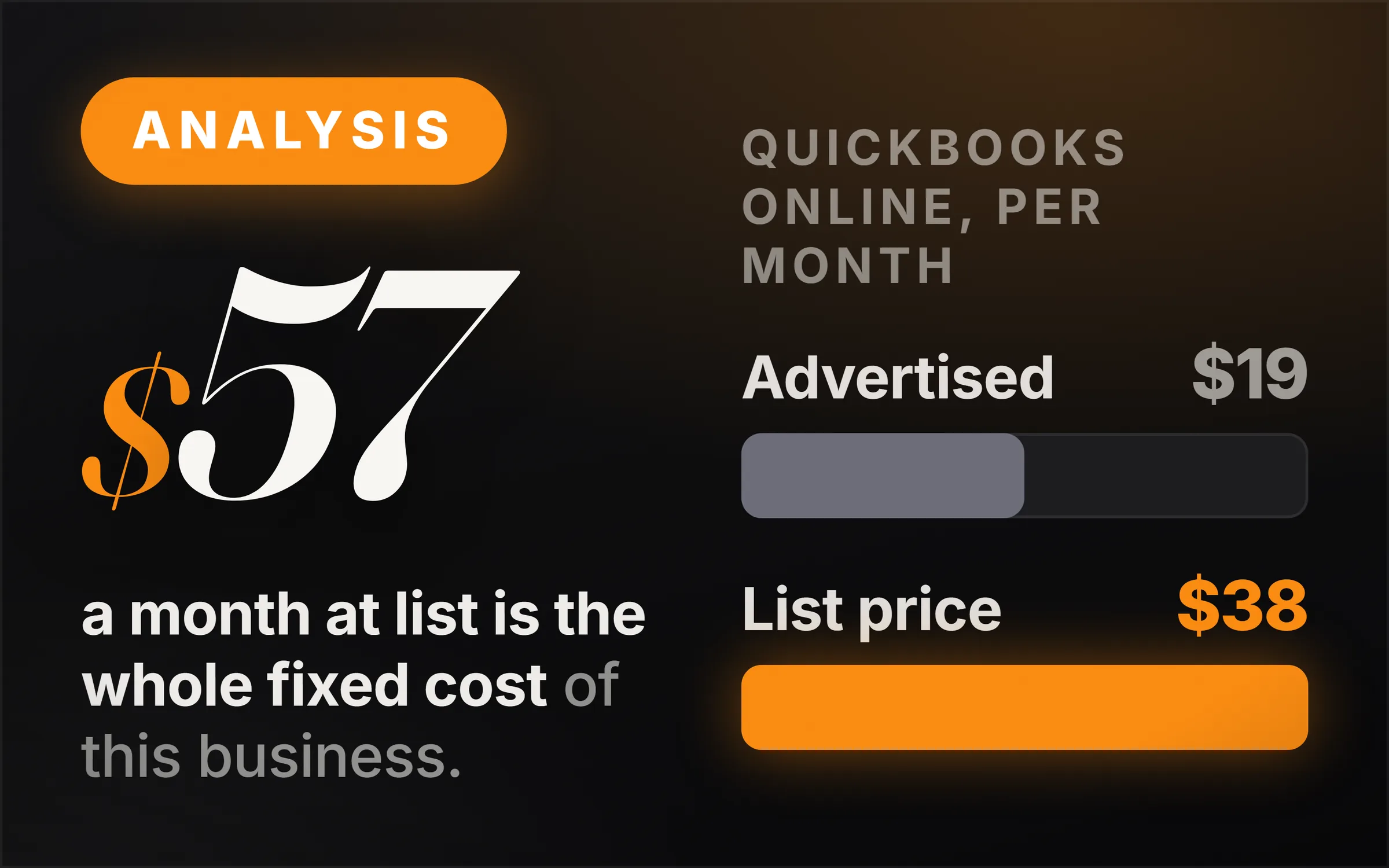
A bookkeeping business can be started for about $57 a month at list price, and that is genuinely the whole fixed cost: accounting software and liability insurance. There is no equipment, no vehicle, no stock and no premises. It is the cheapest real business in the data we have pulled, by a wide margin.
The number to be careful with is the software. QuickBooks Online Simple Start advertises at $19 a month, and that is 50 percent off for three months. The list price is $38. Every cost guide to this business quotes the promotional figure, which means every one of them is wrong for the reader from month four onward.
How much does it cost to start a bookkeeping business?
About $57 a month, and close to nothing up front. Here is each recurring line, read from the vendor's own page.
The monthly stack, at list price
- QuickBooks Online, Simple Start: $38 a month list. Advertised at $19, which is 50 percent off for three months. One user.
- General liability insurance: from $19 a month, per Next Insurance's published floor, qualified in their own footnote as "for some low-risk businesses."
- Everything else is optional at the start. A scheduling link, a contract signing tool and a professional email address all have workable free tiers while you have one or two clients.
The one-off costs are close to zero. There is no equipment beyond a computer you already own, no vehicle, no premises and no inventory. The QuickBooks ProAdvisor certification, which is the credential clients actually look for in this trade, costs nothing and is covered in how to start a bookkeeping business with no experience.
Registration is a sole proprietorship by default, with no filing required to begin. Whether to form an LLC is a genuine question but not an urgent one, and it turns on what you own rather than on revenue, as we set out in do you need an LLC to start a service business.
Want the whole business, not just this answer? The QuickBooks Bookkeeping Service walkthrough lays it out step by step, click by click.
Why is the QuickBooks price different from what you have seen?
Because the number on the pricing page is a three-month introductory discount and the number you will actually pay is twice it. Simple Start lists at $38 a month and advertises at $19, which is 50 percent off for three months. Essentials lists at $85, Plus at $140, Advanced at $340.
This is the same pattern we found across this whole category and it is worth recognising because it distorts every cost guide in the genre. Jobber's field service software advertises $29 a month, which requires twelve months paid up front, against $49 with no commitment. Housecall Pro advertises $59 billed annually against $79 billed monthly. The published headline is always the most favourable number the vendor can defend, and it is always conditional.
For budgeting a new business the honest figure is the no-commitment list price, because that is what you pay while finding out whether the business works, and committing twelve months up front to a business with no clients is the wrong risk.
There is also a free QuickBooks tier, limited to one user and two invoices a month. Two invoices is not a practice, but it is enough to work through the certification and to handle a first client while you decide, and it means the software cost can genuinely be zero for the first month or two.
What does it cost to get paid?
Almost nothing, if you collect the right way. Square's published rates are 1 percent with a $1 minimum and a $5 cap for bank transfer via invoice, against 3.5 percent plus 15 cents for a manually keyed card and 3.3 percent plus 30 cents online.
On a monthly retainer that difference is substantial and recurring. A $400 monthly fee collected by bank transfer costs $4 to process. The same fee taken on a keyed card costs about $14.15. Over a year, across five clients, that is roughly $610 of difference on identical revenue, which is more than a year of your accounting software.
This is one of the clearest margin decisions available in a retainer business and it is usually made by accident, because card payment is what gets set up first. Offering bank transfer as the default for recurring fees, with card as the exception, is a five-minute decision worth several hundred dollars a year. The wider mechanics of terms, deposits and collection are in how to invoice clients and actually get paid.
Do you need insurance to do bookkeeping?
You should have it, and it starts at $19 a month on Next Insurance's published floor, qualified as being "for some low-risk businesses." Get a real quote rather than assuming the floor applies.
The exposure here is different from a trade. You are not going to damage someone's floor. You are handling financial records that other decisions get made on, with access to bank data, in a relationship built entirely on trust. The relevant risks are errors and omissions, and confidentiality, rather than physical damage, and the appropriate cover reflects that.
There is also a commercial reason. Business clients handing over access to their financial systems increasingly ask what cover you carry, and having an answer is part of looking like a practice rather than a person. At $19 a month against a client paying several hundred, it is not a cost worth optimising.
The boundary that keeps this simple is the one covered in the main guide: you record and organise, you do not calculate or file tax liability. Staying on your side of that line is what keeps both the compliance and the insurance question straightforward.
What does the industry actually average?
The Census group this business sits in, accounting, tax preparation, bookkeeping and payroll services, averaged $33,441 per solo firm in 2022, across 393,674 establishments with no employees.
Two comparisons make that figure legible. The median wage for an employed bookkeeping, accounting and auditing clerk was $50,670 as of May 2025, so the average solo firm in this group grosses about 34 percent below the employed wage, before costs. And the group is growing modestly: firms up 2.3 percent and average revenue per firm up 12.5 percent between 2019 and 2022.
The caveat is that NAICS 5412 includes tax preparation and payroll alongside bookkeeping, and like every Census average it contains a large tail of part-time and abandoned registrations. It is the population this business sits inside, not a forecast for a full-time practice.
What it does establish is the shape of the opportunity. At $57 a month, the fixed cost of this business is about 2 percent of that average revenue. Cost is not the constraint here and optimising it is not where the returns are. The constraint is client count, and the honest version of that is in the main guide.
What costs appear later?
Three, and none of them arrives in the first months. More QuickBooks capacity, if a client needs a plan tier above Simple Start, which is a cost you pass on rather than absorb. Practice management or document collection tools, once chasing paperwork from several clients by email becomes the bottleneck, which is usually somewhere past five clients. And self-employment tax, which is not a business cost but is the largest single deduction from what you earn.
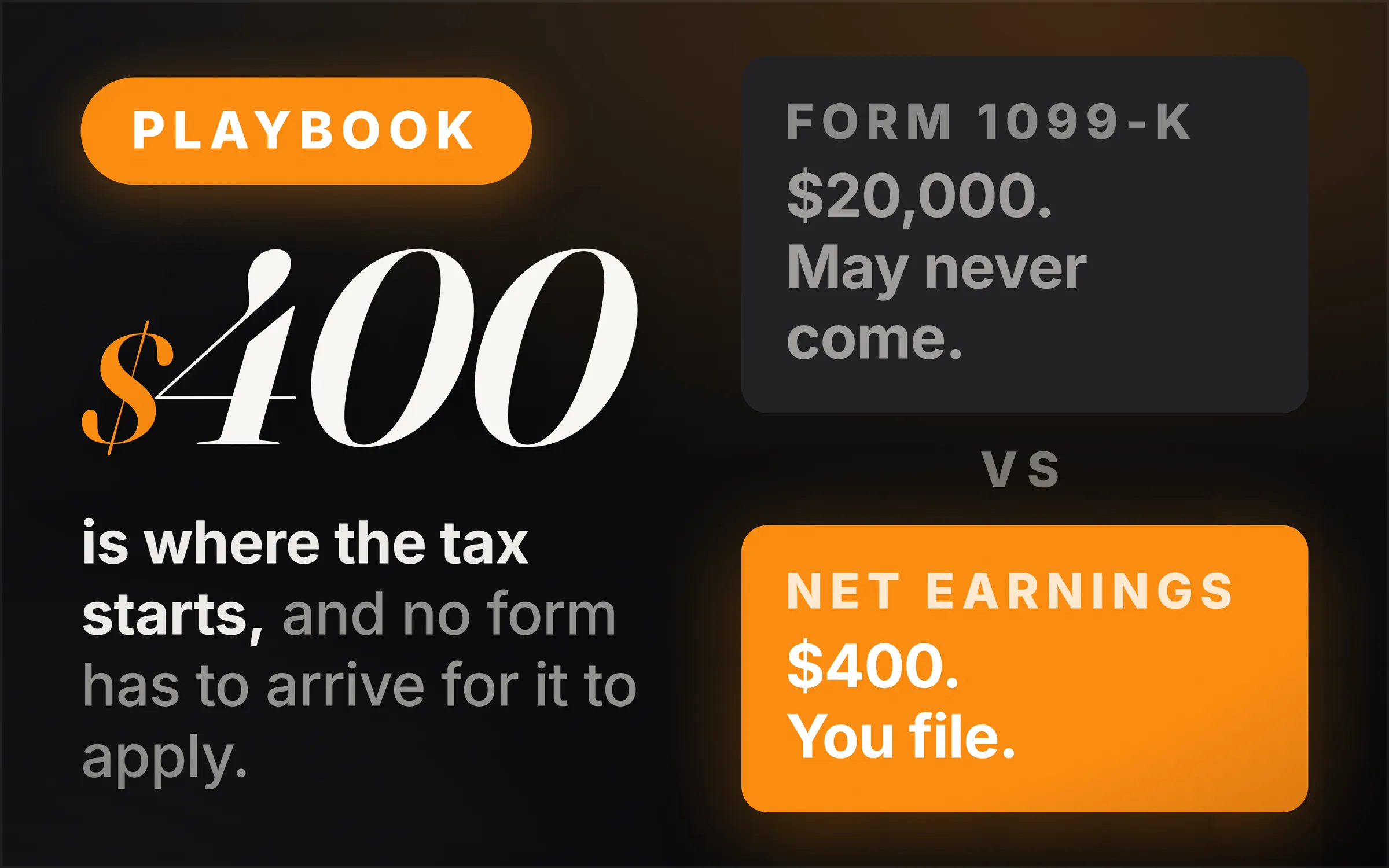
That last one catches people and it is worth stating plainly. Self-employment tax runs at 15.3 percent of net earnings, made of 12.4 percent Social Security and 2.9 percent Medicare, and it applies once net earnings reach $400. Nothing is withheld, so it has to be set aside as payments arrive. Estimated payments start when you expect to owe $1,000 or more for the year. The full treatment is in side hustle tax explained.
What does not appear later, unusually, is a step change in fixed costs. This business scales from one client to fifteen on essentially the same stack, which is the structural reason it works: revenue grows and overhead barely moves. That is the opposite of the trades, where more work means more fuel, more consumables and eventually more vehicles.
The honest hard part
The hard part is that the low cost is exactly what makes this business easy to start and hard to finish. When entry costs $57 a month there is no financial pressure forcing you to find a client quickly, and no sunk investment making you persist. A great many people certify, subscribe, and then stop.
The second hard part is that cost is not the number that decides anything here. Whether this works is determined entirely by client count and monthly fee, and both are sales outcomes rather than cost outcomes. An operator agonising over which software tier to buy is optimising 2 percent of revenue while the other 98 percent sits untouched, and the agonising is frequently a way of not doing the outreach.
The third is the one genuine ongoing cost that never appears on a stack list, which is the time spent chasing clients for their paperwork. It is the real work of this business month to month, it is unbillable, and it is why fee structures and onboarding matter more than tooling. The version that solves it is a defined process every client goes through, which we set out in how to onboard a new client.