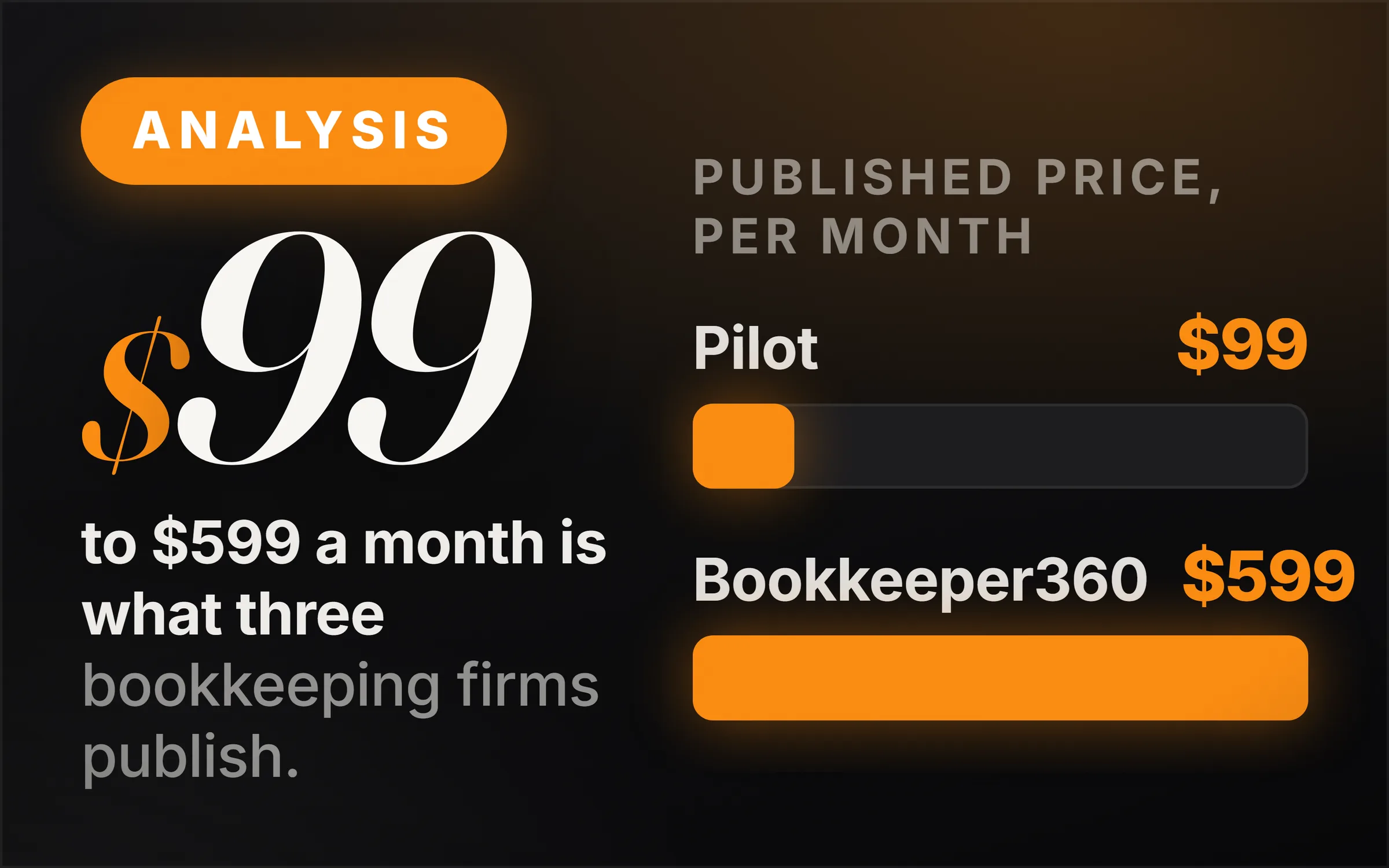
Bookkeepers who publish their prices charge between $99 and $599 a month for a small business. Three firms put a number on their own pricing page: Pilot at $99, Merritt Bookkeeping at $250 and Bookkeeper360 from $399, rising to $599 for weekly books. These are prices anyone can check. A firm that quotes only after a call cannot be compared, which is one reason guides to this question disagree.
The spread is not random. Each price buys something different: software doing the categorising, a person closing the books once a month, or a person closing them every week. Once you can see which is which, both halves of the question get easier: what a business should expect to pay, and what a new bookkeeper can charge.
How much do bookkeepers charge per month?
Published prices run from $99 to $599 a month. Pilot's Essentials plan is $99 a month for up to $100,000 in monthly expenses. Merritt Bookkeeping charges a flat $250 a month. Bookkeeper360 starts at $399 a month for books closed monthly and $599 for books closed weekly.
What each firm publishes, read from its own pricing page
- Pilot, Essentials: $99 a month. "Up to $100,000 in monthly expenses." The plan description says AI categorizes transactions, reconciles accounts, and closes books monthly.
- Merritt Bookkeeping: $250 a month. One price, and the page says "No pricing tiers".
- Bookkeeper360, Monthly: starting at $399 a month. Books closed each month.
- Bookkeeper360, Weekly: starting at $599 a month. Books closed each week, marked as their most popular plan.
Two of those four prices say "starting at", so they are floors. A business with more accounts, more transactions or messy history pays more. The honest reading of the market is a floor of about $100 for software-led books and $250 to $400 for a person doing the work each month.
Why do bookkeeping prices vary so much?
Because the three firms sell three different things at three prices: $99 buys software-led categorising, $250 buys a person on a flat fee, and $399 to $599 buys a person closing the books monthly or weekly. The price follows who does the work and how often.
The cheapest plan is the clearest example. Pilot's $99 plan describes AI doing the categorising, the reconciling and the monthly close. That is a real product and a good one for a business with simple books, but it is a different product from a named person who knows the client's business and answers their questions.
The frequency of the close is the other lever. Bookkeeper360's starting price is $200 a month higher for books closed weekly instead of monthly. That is the same work, done four times as often, and it is worth it only to a business that makes decisions weekly from its numbers.
For a new bookkeeper this is the useful part. You are not competing with the $99 software plan on price. You are selling the thing it does not do: a person, a relationship, and books a small business owner does not have to think about.
How much do bookkeepers charge per hour?
The employed median is $24.36 an hour, from the BLS figure for bookkeeping, accounting and auditing clerks in May 2025. That is a wage, not a rate. A self-employed bookkeeper has to charge well above it, because the rate also has to pay the tax an employer would pay.
The gap is bigger than most people expect. Self-employment tax is 15.3%, in the IRS's own words "12.4% for social security (old-age, survivors, and disability insurance) and 2.9% for Medicare (hospital insurance)." An employee pays half of that and the employer pays the other half. A self-employed bookkeeper pays all of it.
Then come the hours nobody pays for: finding clients, chasing paperwork, holidays and sick days. A freelancer who bills 25 hours in a 40-hour week has to earn the whole week's pay in those 25 hours.
The honest way to set an hourly rate is to work backwards from the income you need, not forwards from a wage. Our free freelance hourly rate calculator does exactly that, and it takes about a minute.
How much should a new bookkeeper charge a small business?
$300 to $800 a month per client is a defensible range for a new bookkeeper, and it is the range our bookkeeping walkthrough prices to. It sits above Merritt Bookkeeping's flat $250 and brackets Bookkeeper360's $399 starting price, which is where a person-led monthly service sits in the published market.
Charging monthly, not hourly, matters more than the exact number. A monthly fee is predictable for the client and it rewards you for getting faster, where an hourly rate punishes you for it. It is also how every one of the three firms above charges.
The case for not starting at the bottom is simple. A client who chose you over $99 software chose a person. Pricing yourself next to the software tells them they made the wrong choice. The start-up side of this business, including the free certification that clients look for, is in how to start a bookkeeping business with no experience.
Do bookkeepers charge per transaction?
None of the three firms we checked prices per transaction. Pilot prices by monthly expense level (its $99 plan covers up to $100,000 in monthly expenses). Merritt Bookkeeping charges a flat $250. Bookkeeper360 prices by how often the books are closed.
Transaction count still matters, because it is what makes a set of books quick or slow. It shows up in the price indirectly: as a higher tier, as a "starting at" that rises, or as a separate clean-up fee for months that are behind. Merritt's page, for example, prices catch-up work separately from the monthly fee.
For a new bookkeeper, the practical version is to ask about volume before quoting. A rough count of monthly transactions and accounts tells you which tier a client belongs in, and it stops a busy client from being priced like a quiet one.
What does a bookkeeping client actually earn you?
At $300 a month, it takes about 14 clients to gross the BLS median bookkeeping wage of $50,670 a year. At $700 a month, it takes about 6. The fixed cost of running the practice is about $57 a month, so almost all of that is margin before tax.
The arithmetic: $50,670 divided by 12 is about $4,222 a month. That is 14.1 clients at $300, or 6.0 clients at $700. The $57 fixed cost is the software and insurance stack we priced at list in what it costs to start a bookkeeping business.
That comparison is gross against gross, and the tax point above still applies: self-employment tax comes out of the self-employed figure. How to set that money aside as it arrives is in side hustle tax explained. What the comparison shows is the lever: at the top of the range, the number of clients you need falls by more than half.
The honest hard part
The price is the easy decision. The hard part is that a monthly fee only works if the client stays, and clients stay when the books arrive on time without being chased. The price you can charge in month twelve depends on how reliable you were in months one to eleven.
The second hard part is the first client. With no track record, the pull to charge less is strong, and a low first price is hard to raise later. A clearly defined service at a clear monthly price is easier to sell than a cheap one, because it answers the question the client is really asking: what exactly do I get?
The third is admitting what the published prices do not tell you. Three firms is not the market: firms that quote only after a call are not in it, and local rates vary. Treat the $99 to $599 range as the visible part of the market, not all of it.