Yes, you can start a bookkeeping business with no degree or experience. Get the free QuickBooks ProAdvisor certification over a weekend, run about $71 a month of software, and charge small businesses a fixed $300 to $800 a month each. Eight to ten clients is $3,000 to $4,000 a month part-time, and your first client is usually someone you already know.
It is one of the most beginner-friendly recurring-income businesses you can start in 2026, and the income stacks: each client stays on retainer, so a handful of them replaces a full salary while the work stays part-time.
The part that trips people up is not the software or the numbers. It is the belief that you need to be an accountant, or good at math, or known in your town before anyone would trust you with their books. None of that is true, and the rest of this piece takes each objection apart in order.
The video walks the whole model start to finish in one sitting, including the real numbers one operator ran. The written breakdown below stands on its own. Read it, watch it, or both.
What is a bookkeeping business?
A bookkeeping business is a service. Small companies generate financial transactions every day, which is sales, expenses, invoices, and receipts. Someone has to record those accurately, reconcile the bank accounts, and produce a clean monthly report so the owner knows where they stand. That someone is a bookkeeper, and most small business owners do not want to be that person.
There is a distinction that matters, because people confuse it constantly. Bookkeeping is not accounting. An accountant interprets the numbers, gives strategic advice, and files tax returns. A bookkeeper records and organizes the data that makes all of that possible. You are not competing with the accountant. You are the reason the accountant can do their job in an hour instead of a day, which is exactly why accountants refer clients to bookkeepers they trust.
You also are not doing taxes. That line is the whole legal boundary of this business, and your engagement letter states it plainly. You record transactions. You do not calculate or file anyone's tax liability. Stay on your side of that line and the compliance side of this stays simple.
Can you start a bookkeeping business with no experience?
Yes, and this is the version of the business that suits a beginner best. The reframe that changes everything is this: bookkeeping is not a finance job, it is an operations job. The person who thrives here is not the one who loves numbers. It is the one who loves a clean system, a tidy inbox, and a process that runs the same way every month.
If you can manage a calendar, follow a checklist, and send a professional email, you are already more organized than the average small business owner drowning in their own receipts. That gap is the business. The software does every calculation for you. Your job is to categorize a transaction correctly, notice when something looks off, and ask a clear question when you need one. That is closer to filing than it is to math.
Plenty of people who now run full bookkeeping practices started with no background in finance at all. What they had was reliability. The bookkeeper who delivers the same clean report on the same date every month, and replies to messages within a few hours, is the one clients keep for years. Reliability is a habit, not a qualification, and you already know whether you have it.
Do you need a degree or a certification?
No degree. The certification is the credential that replaces it, and the industry-standard one is free.
The QuickBooks ProAdvisor certification is offered by Intuit at accountants.intuit.com. It is self-paced, costs nothing, and most people finish it in six to ten hours spread across a weekend. It is the first thing a small business owner looks for when they are deciding whether to trust you, and it is taken by people with zero prior accounting experience every day. It does not make you an expert. It makes you competent to do the job you are selling, which is all it needs to do.
QuickBooks Online is the platform most of your clients will be on. It now has more than seven million subscribers globally, which is what makes remote bookkeeping possible in the first place: you can work for a client in another city without ever setting foot in their office. If a client happens to use Xero instead, Xero offers its own free advisor certification and the logic carries over, so pick up that one when a client needs it rather than upfront. Start with QuickBooks and get good at it.
There is a bonus most beginners never hear about. Once you are certified, you can build a free profile in the QuickBooks Find-a-ProAdvisor directory, which fields over 600,000 searches a year from owners actively looking to hire a bookkeeper. It is passive lead generation that runs in the background from day one while you go find your first client the direct way.
How much does a bookkeeping business make?
The money in bookkeeping is not one big payday. It is a stack of small, recurring ones that do not go away.
You charge a fixed monthly retainer per client, typically somewhere between $300 and $800 depending on the size and complexity of their books. The key word is fixed. As you get faster, and you will, your effective hourly rate climbs while the client's bill stays the same. An established client with moderate volume takes two to four hours a month once the system is running.
How the income stacks
- 1 client: roughly $350 a month, about $4,200 a year. Enough to prove it works.
- 5 clients: around $2,000 a month. This is the number most people call salary replacement, and it is where the business stops being an experiment.
- 8 to 10 clients: roughly $3,000 to $4,000 a month, for part-time hours concentrated in the back half of each month.
- 15 clients: the comfortable ceiling for a solo operator, often $6,000 or more a month before you either raise prices or hire help.
Two things make this different from ordinary freelancing. First, the income recurs. A client you sign today is often still paying you in three to five years, because bookkeeping relationships are long and churn is low. Second, the work compounds in your favor. The first client might take eight hours to set up. The sixth takes two, because you have built the system once and now you reuse it. Revenue stacks while your hours barely move. That gap is the entire engine.
How much does it cost to start?
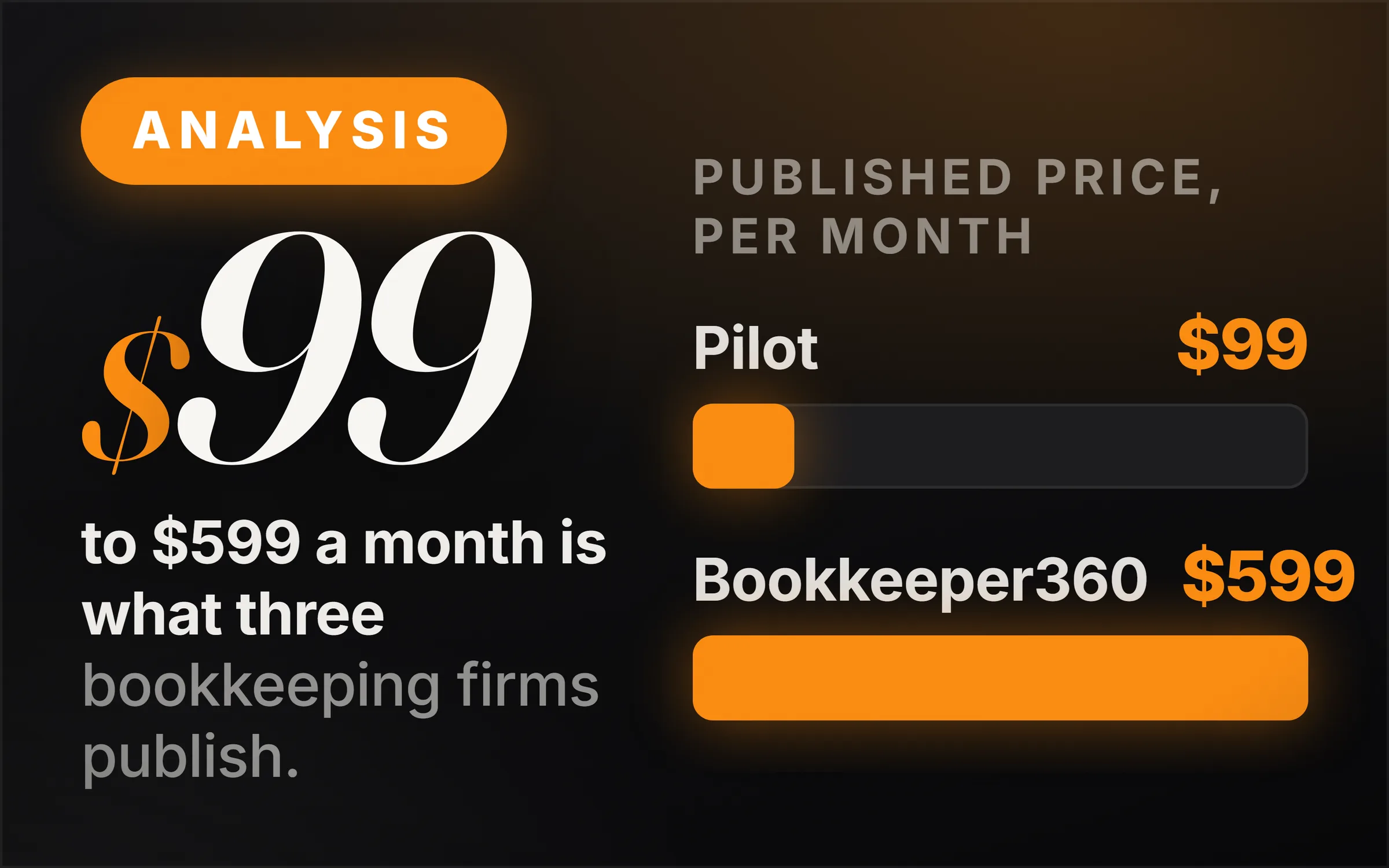
Less than a single client pays you in a month. Your full software stack runs about $71 a month: QuickBooks Online, a receipt-capture tool, a scheduling link, a contract-signing tool, and a professional email address. There is no inventory, no office, and no upfront capital beyond your own time.
And you can start before you spend anything. QuickBooks offers a free trial, several of the tools have free tiers for new ProAdvisors, and Calendly is free. Your first client can be signed and onboarded before a single dollar leaves your account. Two clients at $300 each cover the whole stack with room to spare. Everything after that is profit.
How do you get your first bookkeeping client?
Here is the part that matters most, and the part almost everyone gets backwards. They picture cold-emailing a hundred strangers and getting ignored ninety-eight times. That works eventually, but it is the slow road, and it is not where your first client comes from.
Your first client is usually already in your phone.
Not a stranger. Someone who already knows you. Scroll your contacts and you will find business owners you have lost track of: a cousin who runs a salon, a friend from your old job who started a trades company, the guy from your gym who opened a food truck. Every one of them generates transactions they are behind on, and every one of them trusts you already, which is the single hardest thing to earn from a cold prospect. A warm conversation with someone who knows you converts many times better than a cold pitch to someone who does not.
This is why beginners with no reputation and no portfolio still land a first client fast. You are not asking a skeptical stranger for a leap of faith. You are telling people who already trust you what you are now doing, and asking a simple question: do you, or does anyone you know, need this handled? A few family and friends on board is steady income to start from, and their referrals travel inside their industry. One happy plumber tells the next plumber. That is how a roster fills.
The mechanics of the exact conversation, the first-client offer that removes all the risk from their side, and the sequence that turns a free first month into a multi-year retainer, are what the QuickBooks bookkeeping walkthrough lays out step by step. Naming the move is easy. Running it well is the part worth doing carefully.
A page of warm names is about two weeks of outreach, and at the bottom of it everybody left is a stranger. For what to do then, we wrote out the whole sequence in how to get your first client without asking for one.
Is bookkeeping a good business to start in 2026?
It is one of the few beginner businesses where the timing genuinely favors you right now, for reasons that have nothing to do with hype.
Cloud bookkeeping went mainstream, so geography stopped being a constraint on your client list. A historically high number of small businesses have launched since 2020, most run by first-time owners who know their craft but have never managed business finances and do not want to. Remote service providers became normal, so a business owner no longer blinks at hiring a bookkeeper they have only met on a video call. And the global bookkeeping services market is measured in the tens of billions of dollars, which is to say the demand is not a trend that can evaporate.
There is one more thing worth being honest about, because it is the real edge. As we argued in The Moat Moved, the durable advantages left in a world full of cheap software are trust, relationships, and reliability, none of which were ever gated behind a technical skill. Bookkeeping is almost pure trust: a stranger hands you access to their bank account and their financial history. Win that, deliver consistently, and you are close to impossible to replace with a tool. That is the same reason a beginner can win an AI receptionist business or any other service where the human accountability is the product. The machine does the arithmetic. You are paid for the judgment and the reliability on top of it.
The market is not saturated. A bookkeeper with ten clients in your city is not your competition, they are proof the demand is real. It is underleveraged by people with exactly your profile.
What is hard about starting a bookkeeping business?
No business worth starting is free of a catch, and this one has two.
The first is the first client. Building the skill takes a weekend. Earning enough trust to get paid is the real work, and it is where the weeks go. That is not a flaw in the plan, it is the plan. The warm-outreach move shortens it dramatically, but it does not erase it. You still have to send the first message.
The second is that the work is repetitive by design. The monthly cycle runs the same way every time because consistency is the product. You are not solving novel puzzles, you are executing a reliable process for people who are paying you precisely because they cannot execute it reliably themselves. Most people who reach month four find the predictability is what they actually came for. If you need constant novelty to stay motivated, go in with your eyes open about that.
And your first client's books will almost certainly be a mess. The owner who hires a bookkeeper is rarely the one who kept perfect records. It is the one who has been avoiding it, dumping receipts in a drawer, dreading tax season. That is not a crisis, it is the job, and there is a clean method for cleaning it up month by month and charging a separate fee for the catch-up. The blueprint has a whole section on the messy first client, because it is the moment beginners panic and the moment they do not need to.
None of this is a reason not to start. It is a reason to start with a system instead of hope. The certification is free and takes a weekend. Your first outreach list is already in your phone. The bookkeeper with ten clients and a replaced salary started exactly where you are now, with a certification and a decision to send the first message.
Your first client is closer than you think.