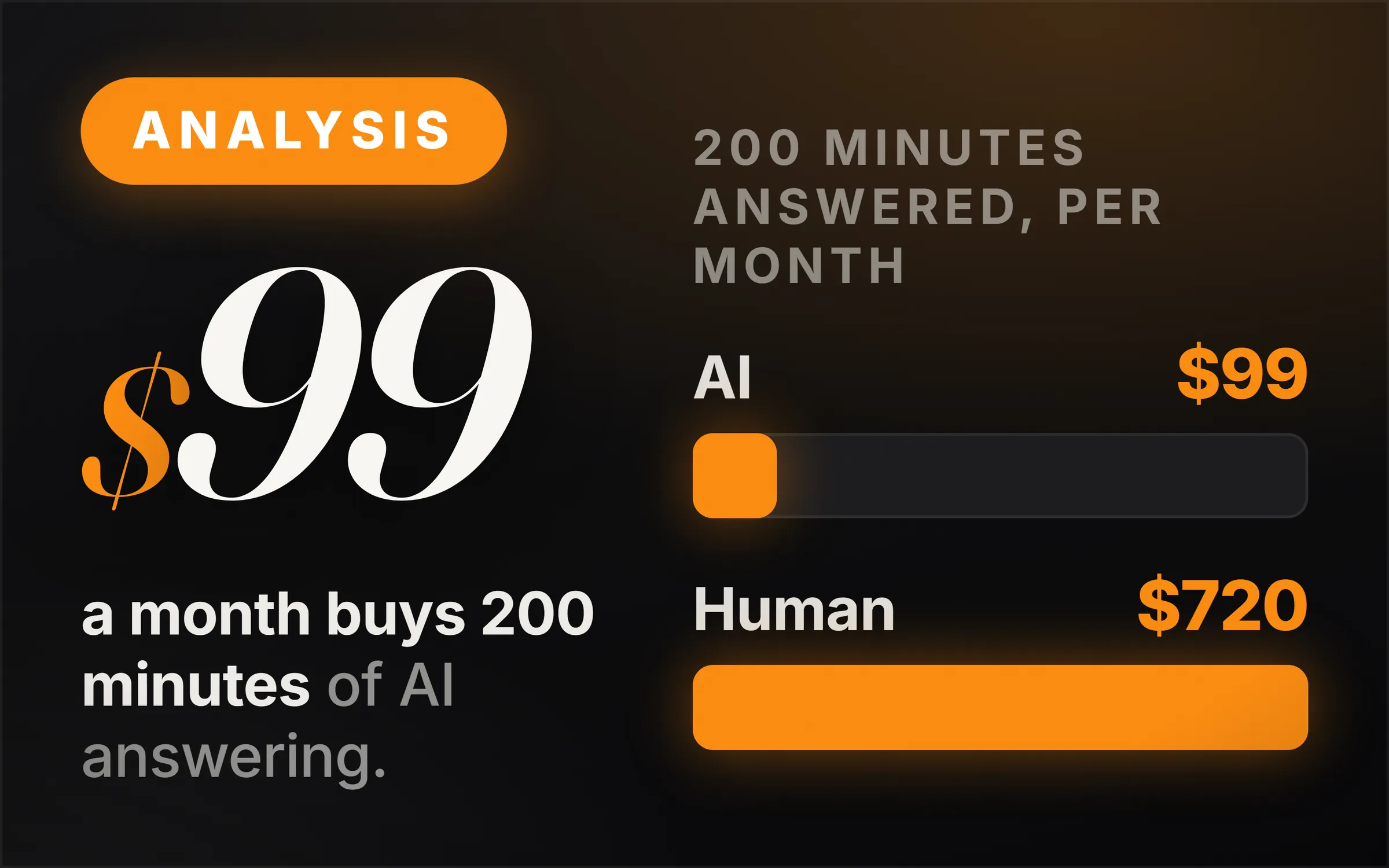
An AI receptionist costs $79 to $249 a month on the plans that publish a price. Goodcall charges $79, $129 or $249 a month per agent, with unlimited minutes. My AI Front Desk charges $99 a month for 200 voice minutes. A human answering service costs far more: Ruby charges $250 a month for 50 minutes and $720 for 200.
That gap is the useful number. For a small business owner, it is the saving. For anyone thinking of selling AI receptionists to local businesses, it is the room you are working in, and it also sets a ceiling on what a client will pay for answering alone.
How much does an AI receptionist cost?
Published plans run from $79 to $249 a month. Goodcall lists three plans at $79, $129 and $249, each per agent with unlimited minutes. My AI Front Desk lists $99 a month, or $79 billed annually, for 200 voice minutes.
What each product publishes, read from its own pricing page
- Goodcall: $79 a month per agent. "unlimited minutes and tokens", with 100 unique customers a month and $0.50 per customer after that.
- Goodcall: $129 a month per agent. Unlimited minutes, 250 unique customers a month.
- Goodcall: $249 a month per agent. Unlimited minutes, 500 unique customers a month.
- My AI Front Desk, Business-in-a-Box: $99 a month, or $79 billed annually, with 200 voice minutes a month.
The two products count usage differently. Goodcall does not charge by the minute; it charges by the number of different callers, and each plan includes a set number. My AI Front Desk includes minutes and charges for extra ones. A business with a few long calls and one with many short ones will find a different plan cheapest.
How much does a human virtual receptionist cost?
Ruby, a live virtual receptionist service, charges $250 a month for 50 minutes, $395 for 100, $720 for 200 and $1,725 for 500. That is $5.00 a minute on the smallest plan and $3.45 on the largest.
The per-minute figures are simple division of Ruby's published prices: $250 over 50 minutes, $395 over 100 ($3.95), $720 over 200 ($3.60), and $1,725 over 500 ($3.45).
This is the comparison a small business owner actually makes. A person answering the phone is warmer and handles the unexpected better. An AI receptionist answers at any hour and costs a fraction as much per minute. Which one is right depends on how complicated the calls are, not only on the price.
What does an AI receptionist cost per minute?
The raw platform cost is $0.07 to $0.31 a minute on Retell, which publishes "$0.07-$0.31 / min for AI Voice Agents" on its pay-as-you-go plan. My AI Front Desk charges 25 credits a minute for extra voice minutes, at $0.01 a credit, which is $0.25 a minute.
Retell is a platform for building your own voice agent rather than a finished receptionist. It is the right number for anyone building agents for clients, because it is the cost underneath the product.
At those rates, 200 minutes costs $14 to $62 in platform fees on Retell. The same 200 minutes costs $99 as a finished product from My AI Front Desk, and $720 from a human service. Each step up adds something real: a finished product adds the setup and the dashboard, and a person adds judgement.
How much should you charge a business for an AI receptionist?
Enough to be clearly more than the $79 to $249 a business could pay for software itself, which means selling more than answering. Our AI Automation Agency walkthrough prices a done-for-you agent at a $3,000 to $5,000 monthly retainer; that is our model, for a service that books, integrates and is maintained, not a market survey.
The reason for the gap is what the retainer includes. A business can buy a receptionist that answers. It is harder to get one that books straight into their calendar, follows up on missed leads, knows their services and prices, and gets fixed the day something changes. That work is the product. The phone answering is only the part the caller hears.
The honest test before quoting: if everything you are offering could be bought for $249 a month, the client will eventually find that out. Price the service, not the software, and be able to say exactly what the client gets for the difference. How other AI services are priced is covered in how much to charge for AI services.
Is an AI receptionist cheaper than a human receptionist?
Yes, by a wide margin on published prices. 200 minutes a month costs $99 on My AI Front Desk and $720 on Ruby's human service, so the AI plan is about 14 percent of the human price for the same minutes.
That is a like-for-like comparison of minutes, not of quality. A person handles an upset caller, an unusual request or a sale that needs judgement better than any current AI. An AI receptionist is better at being there at 2am and, on an unlimited-minute plan, costing the same in a busy month as a quiet one.
For many small businesses the practical answer is both. The AI handles the routine calls and the out-of-hours ones, and a person takes what the AI hands over. The cost comparison above is what makes that split affordable.
What does the monthly price not include?
Setup and upkeep, which none of the four published plans prices. Someone has to write the agent's instructions, connect the calendar, test it on real calls and change it when the business changes. On a $79 plan that someone is the owner. On a retainer it is you.
The other costs that sit outside the plan price are a phone number, if the plan does not include one, and extra usage above the plan's limit. Goodcall charges $0.50 per extra unique customer, and My AI Front Desk charges $0.25 per extra minute on its $99 plan.
For someone selling this service, the unpriced setup and upkeep is the opportunity. It is also the work that takes the time, so it belongs in the price. Starting the business itself, and what it takes to land the first client, is in how to start an AI receptionist business.
The honest hard part
The hard part is that the software keeps getting cheaper and better, and the business owner can see the $79 price as easily as you can. A service built on answering calls alone gets squeezed from below every year.
The second hard part is proving the value to a small business owner who has never measured their missed calls. Until they know how many calls go unanswered and what one of those calls is worth to them, $99 and $3,000 are both just numbers. The first job is usually to measure that with them.
The third is honesty about what the AI cannot do yet. Oversell it, and the first frustrated caller undoes the relationship. Sell it as what it is, the first line that never misses a call and hands the hard ones to a person, and it keeps its place.