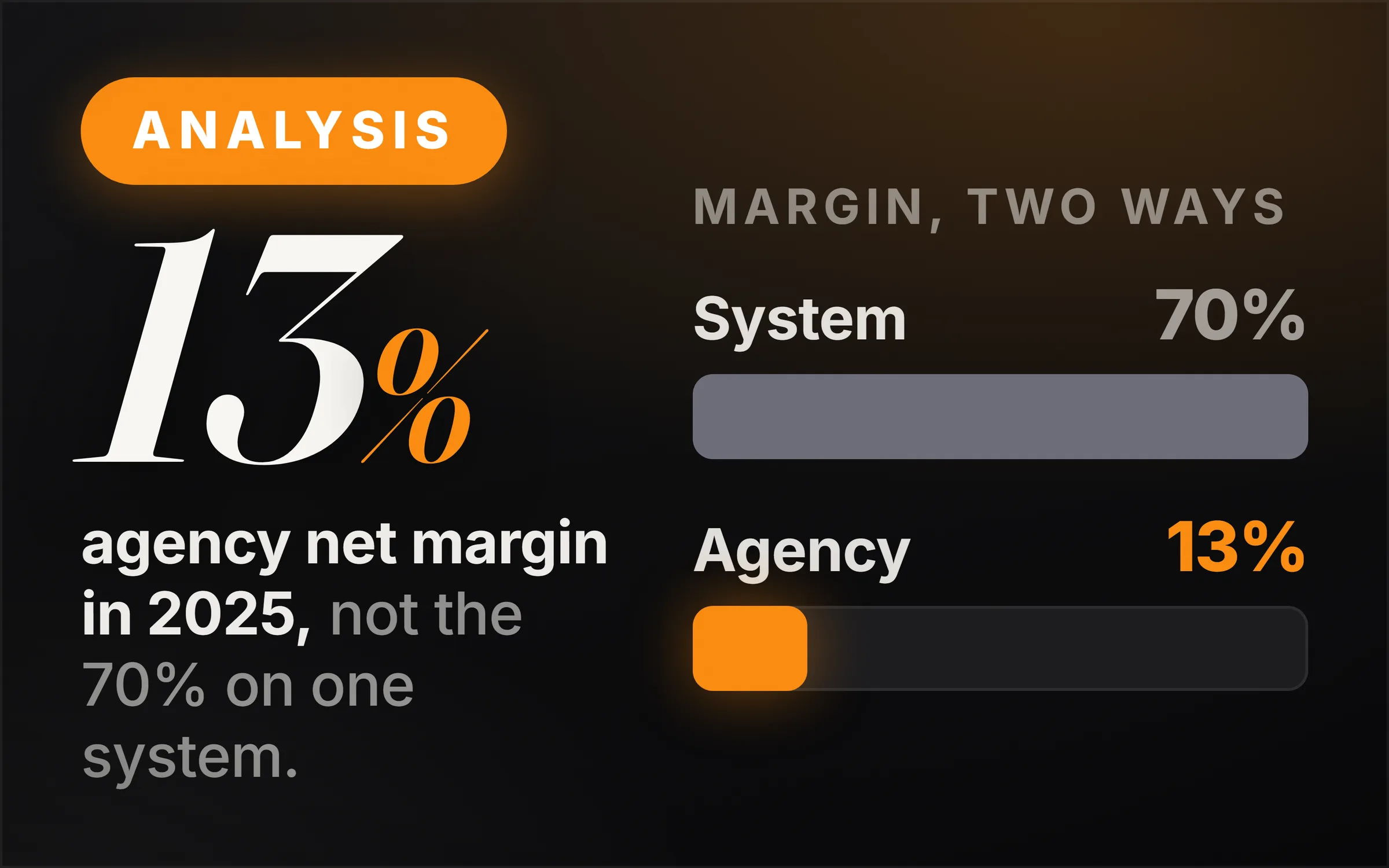
It can be, under one condition: a client must be worth more than the cost of finding them, across the months they stay, after what it costs to keep them. Promethean Research's February 2026 survey of 119 digital agency owners found an average net margin of 13% for 2025, far below the 60% to 80% often quoted for these businesses, including on our own site.
Both numbers are true and they measure different things. Sixty to eighty per cent is the margin on one running system in a month when nothing broke. Thirteen per cent is a whole company's year, after finding clients, keeping them and paying for your own time. This article builds the second number from the first, one row at a time, on published prices and published research.
The 24-minute film builds one profit and loss sheet for one client and one month, filling a row per chapter. Every figure on screen is a captured page from a real company, so you can check it rather than take it on trust. The verdict is in the first minute.
Is an AI automation agency profitable?
It is profitable only when one client's value, across the months they stay, exceeds what it cost to win and keep them. Promethean Research found digital agencies averaged 13% net margin in 2025 against a long-run 15%, with studios under ten people at 19% and value-priced firms at 18%. The 60% to 80% figure describes one system, not a business.
The 60% to 80% number is not a lie. Take the monthly operations bill for one automation on a platform like Make, set it beside what a dental practice pays in retainer, and the gap really is that wide. What it leaves out is the voice minutes and telephony, the platform you build on, the cost of getting the client, and your own hours. Add those and the real margin is what is left.
So the question is never simply yes or no. It is four terms: what one client pays, how long they stay, what they cost to find, and what they cost to keep. Every argument about this business is about one of those four.
Is the AI automation agency market saturated?
Yes, for anything a vendor can switch on from a settings page. The competition is not other operators who watched the same course. It is funded product companies with published prices. Podium sells an AI salesperson, AI scheduler and AI reputation specialist direct to small businesses, and Dealroom reports its AI agents passed $100 million in annual revenue within two years.
Those are the same three products an automation agency sells, offered with a sales team, a support desk, no setup fee and a monthly cancellation. GoHighLevel shipped an AI appointment setter, voice AI and an AI employee through 2026, each turning something operators charged to build into something customers can switch on.
That splits the business into two shapes. Reselling a white-labelled platform means one client leaves you short of the agency tier's cost and two puts you barely ahead, while every vendor release improves their product, not your position. Charging to build and run a system, with the platform as a cost you absorb, means the client pays for what it produces. The vendor's weak spot is that its agents run predefined roles and flows, which fail when a practice does not match the template. That gap is the remaining business, and it is narrower than a year ago.
Which AI automation services still make money?
Three: search and content work, AI visibility, and appointment setting. Review generation and missed call text back are finished as standalone products because vendors bundle them. AI phone answering and AI customer support are alive but now priced by vendors. The survivors share one trait: they are priced on an outcome.
Review generation is the first thing a local business buys, and Birdeye, Podium and NiceJob all publish prices for it, so it survives only as an add-on, sold per location to multi-branch clients. Missed call text back was an afternoon's build sold for hundreds a month two years ago and is now a checkbox inside Podium's core plan. Both died the same way: they were sold as the work, and the work became free.
AI phone answering still has money in it against a receptionist's salary and published services like Ruby and Smith.ai, but only in the version wired into the practice's own calendar and records, telling a new patient from a cancellation from an emergency. AI customer support is contested: Intercom charges per resolution, the same unit you would sell, and a per-resolution price is not a budget, since a busy month costs the client more.
Search and content is the least fashionable and the most telling. Ahrefs surveyed 439 search professionals and found an average monthly retainer above $3,000. AI took 20% to 30% out of the cost of routine work and the retainers barely moved, because the service was always priced on the ranking, not the labour. AI visibility, getting a business named when someone asks an assistant for a recommendation, has no settled market price yet, so whoever prices it well sets the market; the basics are in how to get recommended by ChatGPT. Appointment setting is the largest, with retainers in the thousands or a few hundred per booked meeting, and it is the purest outcome price on the list, because you carry the cost of getting meetings in someone else's market.
How much does it cost to get an AI agency client?
More than everything else on the sheet combined, for the first client. Instantly's 2026 cold email benchmark puts an average campaign at about 7 meetings per 1,000 emails and a good one at 8 to 15, with about 5 touches to a first reply and 7.5 to a meeting over three to four weeks. So one meeting takes 50 to 150 emails, each sent several times.
A meeting is not a client. It leads to a pilot, the pilot runs for a week while you watch and fix it, and the results conversation is where the retainer happens or does not. Every stage loses people. The honest shape of one client is a few hundred contacts, a month of follow-up, a handful of meetings, two or three pilots and one signature. Price it in hours first, because hours are what you actually have.
It is the only row that shrinks. The second client costs less because you have a result to show, and the fifth costs less again because someone referred them. The outreach that beats the benchmark hands over a fact the owner cannot argue with, such as: I called at two o'clock on a Tuesday and it rang out. That is not a pitch; it is already a result. The mechanics of that first client are in how to get your first client.
How much do AI voice agents cost per minute?
More than the advertised platform fee. Vapi's own cost estimator, set to 1,000 minutes a month, itemises transcription, the language model, the voice and transport on top of its platform fee, and Retell publishes an all-in range of about $0.07 to $0.31 per minute. The voice is the expensive part, and it is the part callers hear.
That cost moves with success. A practice whose phone rings all day is a practice whose agent talks all day, so your happiest client costs you the most in minutes. The fix is in the contract: an included band of minutes with a rate above it, the way every answering service already prices. Without it, growth punishes you. What to charge overall is covered in how much to charge for AI services.
What does it cost to keep an AI automation client?
Less in technical work than in change management. A stable system takes a few hours a month: reading transcripts, adding questions the agent got wrong, updating services. The larger cost is getting a front desk that has answered the phone for years to trust the system, plus handling breakages such as model updates, unannounced holiday hours and expired integrations.
Most months that is nothing. Some months it is six o'clock on a Friday, and being reachable then is most of what the retainer buys. There is also staying current, which never arrives as an invoice: the pricing on the platform under this business moved three times in a year, and part of what you sell is that the client never has to know.
What is the churn rate for AI agency clients?
Focus Digital's 2026 agency churn report puts retainer agencies at 18% annual churn with a 56-month average client lifespan, against 42% and 24 months for project work. Execution-focused agencies, paid to do rather than decide, run 6 to 12 points higher because clients are bringing the same AI in-house. Running an automation is execution work.
Three more findings in the same report matter more than the headline. Delivery is the reason departing clients cite most, at 48%, up 14 points in a year, while agency owners rank it seventh. Eight per cent of retainer clients leave in the first six months, so the risk sits on the client you spent most to win. And soft churn, clients cutting the retainer by 20% to 30% without cancelling, hides from any dashboard that counts clients.
The mechanism is that a working automation becomes invisible. In month one the owner remembers the missed calls. By month nine the phone has always been answered, and a line item for something that never fails looks like an unused subscription. That is why the monthly report is part of the product: it puts the client back in front of what the system produced.
How do AI agencies get higher margins?
By offering less. In Promethean Research's survey of 119 digital agency owners, firms that reduced their service list grew 13% and posted 30% net margins, the highest in the survey. Value-priced firms averaged 18% and studios under ten people 19%, against a 13% overall average for 2025.
That is the same finding the seven services give from the other direction. Every service that died, died when a vendor learned to measure it, because a thing that can be measured can be priced, and a thing that can be priced can be sold from a page without you. The durable question is how long what you sell stays unmeasurable.
So if you are deciding whether to give this three months, the months do not go on the build, which you can learn in a fortnight. They go on finding out whether you can send fifty emails a day into a market you chose and sit through the meetings that come back. If that sentence makes you want to stop, better to learn it now than in month three. Which services businesses keep paying for, with the ROI worked out, is in the AI automations businesses actually pay for.