Price an AI service by where the money comes from. Custom builds sell for about $25,000 to $60,000; published lead generation retainers run $2,000 to $10,000 a month; vertical software sells for $49 to $599 a month per location; and a one-day AI training class has a US government-awarded price of $1,700 to $2,900.
The fastest way to work out what to charge for an AI service is to stop asking what the work is worth and start asking where the money is coming from. There are only five answers to that, and they are not equally hard to sell.
Some of these businesses have to invent a budget line that does not exist yet. Some borrow one that already pays for itself. And one of them is paid out of money the company has already spent, on licences and training that are currently buying almost nothing. Nobody argues about whether that invoice is real. They have been signing it for a year.
The film runs these five in the same order, from money that does not exist yet to money already leaving the building. Every figure below is published by the vendor, the agency or the government that set it.
How do you decide what to charge for an AI service?
Work out which budget the money comes out of, then price against what that budget is currently buying.
That single question sorts the whole category, and it sorts it into a difficulty order:
- Money that does not exist yet. A custom software build. There is no line item for it, so you have to create one, which is the hardest sale on this list.
- Money that already pays for itself. Lead generation, bought out of a sales budget where the argument about whether outreach is worth doing was settled before you arrived.
- Small amounts from many buyers. Vertical software, where nobody makes a big decision and a lot of people make a small one.
- A bill already leaving the building. Bookkeeping, redirected rather than created.
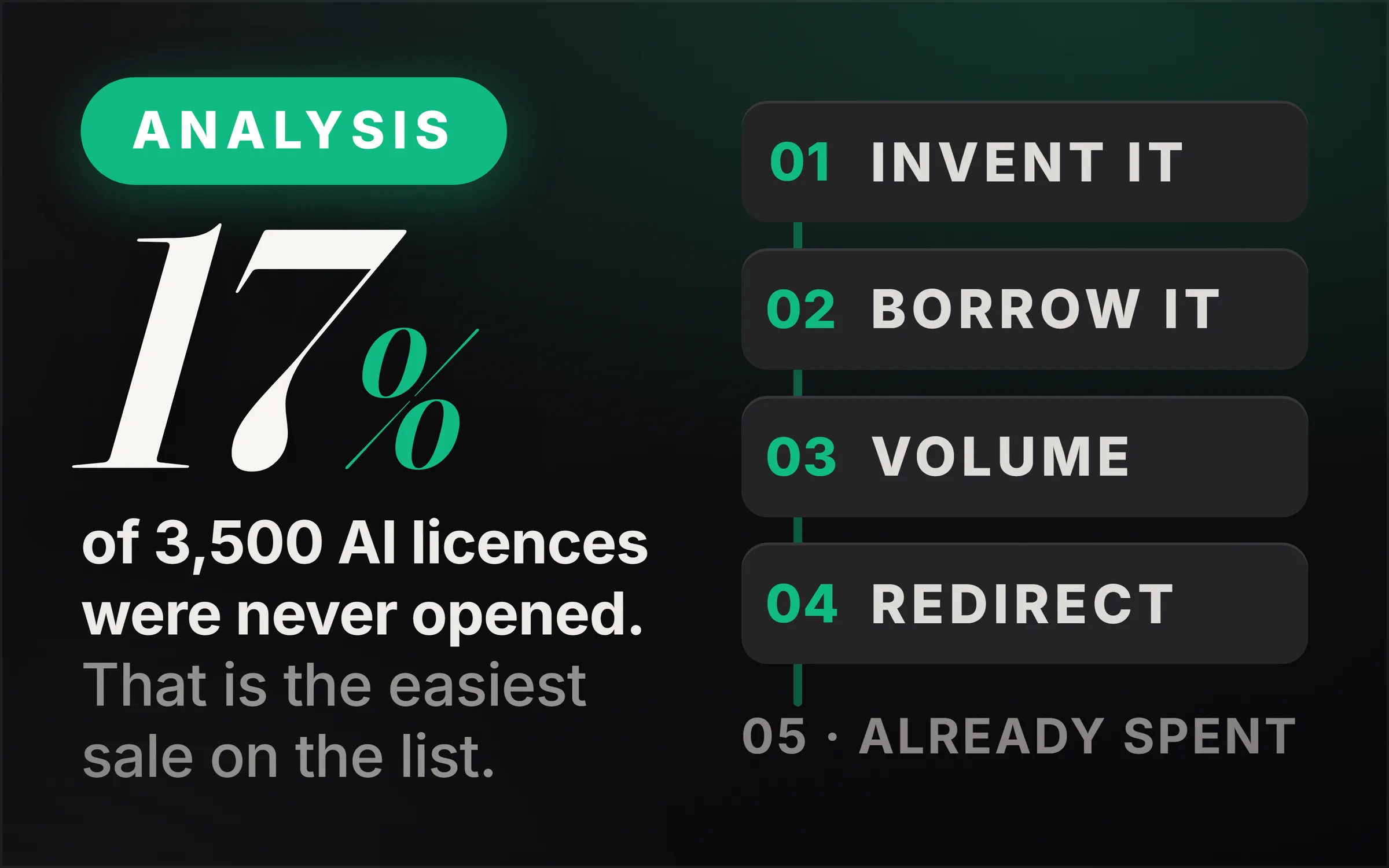
- Money that has already gone and is buying nothing. Seats and training already paid for, which is where the last section of this page ends up, and it is the easiest sale in the category by a distance.
Everything below prices one of those five.
What do custom AI software builds actually sell for?
The bands are public, and they are wider than people expect.
Agencies list their minimum project size at $5,000, $10,000 and $25,000. A build shop that publishes real numbers puts a working product at $25,000 to $60,000, with most landing near $30,000. Touch payments or personal data and the same shops quote $50,000 to $150,000.
What it costs you to deliver climbs with real use, and there is one honest published ceiling worth knowing. Anthropic publishes what working teams spend on Claude Code: roughly $13 per developer per active day, and $150 to $250 a month. That is heavy usage, and it is still less than one billable hour. The rest of the stack is cheap and flat. Google AI Studio is free of charge in every region it runs in, Claude Pro is $20 a month, Cursor $20, Replit Core $25, v0 $30. The whole professional stack sits between $20 and $30 a month, and the only thing that changes as you climb is where the finished thing ends up living.
So why does the work cost thirty thousand dollars when the tools cost thirty? Because of the last twenty percent, which is the part nobody films.
Ask thirty-one thousand developers what actually goes wrong with AI-assisted building and the number one answer, ahead of everything else, is code that is almost right but not quite: sixty-six percent of them. The second is that debugging what the model wrote takes longer than writing it. And when researchers gave sixteen experienced developers two hundred and forty-six real tasks, the ones allowed to use AI took nineteen percent longer, and came out of it convinced they had been twenty percent faster.
The first hour feels like magic and produces a prototype. Their calendar, their payment provider, their logins, the invoice that has to be right on the thirty-first: that is the twenty percent. It is most of the work, all of the risk, and the entire reason anybody pays a person to do this. Somebody showing you a finished app in twenty minutes is showing you the eighty.
The first move is to not build an app. Ask one business you already know to show you the spreadsheet everybody complains about, the one in a file that breaks the week its owner goes on holiday, and rebuild that file as something with a login. You will find out quickly whether the last twenty percent is something you can finish.
How much do AI lead generation agencies charge?
Among those that publish, Cience sells a strategy seat at $2,000 a month on a $5,000 setup, EBQ lists $5,000 a month for half a person and $10,000 for a whole one, and SalesRoads asks $9,950 for four weeks. Belkins, Martal and SalesHive publish no prices.
The published rates first, because they set the shape of the market:
| Agency | Published price |
|---|---|
| Cience | $2,000 a month for a strategy seat, on a $5,000 setup |
| EBQ | $5,000 a month for half a person, $10,000 for a whole one |
| SalesRoads | $9,950 for four weeks |
Now the more interesting half. The three names most recommended in this entire category, Belkins, Martal and SalesHive, publish nothing at all. Every one of them says get in touch.
Read that as pricing information, because it is. The leaders have decided the number is a secret. A secret number is a negotiable number, and a negotiable number gets set by whoever is less frightened in the room. If you are selling, that is an argument for naming yours early and confidently. If you are buying, it is an argument for asking three of them and watching the spread.
What it costs you to deliver runs on two meters, not one, and almost everybody models this wrong. Clay bills data credits for buying the information, and separately bills actions for everything you then do with it. Credits start at five cents each, actions at under a penny. Launch starts at $167 a month and Growth at $446, and both are floors with a slider behind them. So you price a client after you have run one real list, never before.
And there is one mistake that ends the business rather than slowing it down. Google and Yahoo both draw the line at a spam complaint rate of three in a thousand, and Google's own guidance is to run below one in a thousand and never once reach three. Microsoft does not warn you, it rejects the message and hands you an error code. Enforcement starts around five thousand messages a day, which is what one person running three clients is already sending. Cross that line on a client's real domain and you have not lost a campaign, you have stopped their invoices reaching their customers. A separate sending domain, warmed slowly, gets built before the first send, not after the first complaint.
The first move is one list of fifty, free. Fifty rows for a business you already know, with the reason to call this week filled in on every single one. Send nothing. Hand over the file and watch which row they click first. That row is the trigger their whole market runs on, and you learned it on their time.
How much should vertical AI software cost per month?
The published ladder runs $49 to $99 a month for a solo operator or single location, $149 to $299 for an established location, and $599 at the top. Price above the software the business already owns: Slang.ai charges $399 per location, and Tekmetric runs a whole auto repair shop for $199.
Point the same build at one industry forever and the money arrives from a lot of small buyers rather than one big decision. The ladder for that is published:
- Solo operator or single location: $49 to $99 a month.
- Established location: $149 to $299 a month.
- The ceiling: $599 is the highest published flat price anywhere in vertical software.
- Where the profession bills by the hour (law, veterinary), it goes per seat, and $100 per user is the anchor.
The counterintuitive rule is that you price above the software they already own. Everybody arrives as the cheap option and it is the wrong instinct. Slang.ai charges $399 per location. Tekmetric runs an entire auto repair shop, unlimited users, unlimited jobs, for $199. The AI tool costs double the system sitting next to it and sells anyway, because it is not competing with software. It is competing with the booking nobody answered.
Narrow does not mean empty, and this is where the strategy gets oversold. Open Capterra today and there are six hundred and six AI writing tools. There are also fifty-four funeral home tools, two hundred and thirty-one in dental, and two hundred and seventy-nine in trucking. Narrow buys you a few times fewer competitors, not zero.
What narrow does buy is concentration of capital. Look at what happened to plaintiff-side personal injury law, one slice of one profession: EvenUp $385 million, Eve $164 million, Supio $85 million, Darrow $63 million. That is $682 million, around seventy-one percent of all disclosed legal AI funding, aimed at the people who write demand letters for injury claims.
And the clearest single example is HappyRobot, which started by answering one question for freight: where is my truck. Not logistics software, not an assistant. One phone call, one industry, over and over. Series A of $15.6 million, Series B of $44 million, then $150 million at a $1.2 billion valuation. Roughly $200 million across three rounds in twenty months, with DHL, Uber and Kuehne and Nagel among a hundred and fifty enterprise customers.
The honest ending to that story is the part worth copying. HappyRobot is not staying narrow. Their own announcement says they are expanding into insurance, energy, telecoms and airlines. Narrow was how they got in and how they got priced. The billion was paid for the leaving.
The first move is to open the directory for the industry you already have a reason to be in. Not the biggest one. The one whose vocabulary you already speak, because you will need it in the first meeting. Read the two hundred products already listed and write down what every one of them does. The gap is never a feature nobody built. It is the job all two hundred of them politely refuse to do, and it is usually the phone call.
How much should an AI bookkeeping service charge?
The published tiers, which is where your price comes from:
| Provider | Published price |
|---|---|
| Pilot | $99 a month for an AI-only tier, no human involved |
| Bench | $199 up to $599 a month |
| Bookkeeper360 | $399 a month, or $599 for weekly |
| Xendoo | $395 to $995 a month |
Put any of those next to a bookkeeper on payroll at $50,670 a year and you are no longer having a price conversation.
The software underneath is ordinary and cheap. Xero is $25, $55 or $90 a month. Dext reads the paperwork for about $25. Hubdoc is $12. AutoEntry starts at $13. The margin is not in the tooling.
Now the part the excitement leaves out, and it is the most important thing on this page for anybody entering this category. Botkeeper was the original AI bookkeeping company, founded in 2015 and backed by roughly $90 million, and it closed in February 2026 after eleven years, with its founder describing a perfect storm of macroeconomic shifts. Bench had thirty-five thousand customers and collapsed two days after Christmas, then was bought out of the wreckage. Bench's own founder has since raised ten million dollars to attempt fully autonomous bookkeeping again, and in the same announcement conceded the vision may not yet be technologically possible.
Then look back at the price table above and notice who bought Botkeeper's platform. Xendoo. The company whose published $395 to $995 tier is sitting on that list acquired the technology built by the AI-first company that could not make the economics work.
That is the whole lesson in one transaction. This is not an AI product. It is a service with AI inside it, and the difference is the entire business.
And there is a legal line to look up before you start, because almost nobody does. In the United States, bookkeeping is unlicensed, and California's statute says it about as plainly as law ever says anything: you may keep books, make trial balances, prepare statements and prepare reports, provided those reports do not go out over your name as a certified public accountant. The line is the report and the title, not the work. Filing federal tax returns for money needs a preparer number costing $18.75, and holding one gives you no authority to represent anybody to the tax authority. In Britain there is no exam either, but you must be registered for money laundering supervision before you take a single client: £300 to register, £400 per premises, £400 a year after that, and not registering is a criminal offence carrying up to two years.
The market is both bigger and smaller than it looks. About three hundred thousand American firms already sell this work, $38 billion between them, and eighty-four percent of those firms are one person averaging around $30,000 a year.
The first move is to close one month for free, backwards. Take a month that already closed, do it again yourself, and hand back a single page on what came out different. You are not pitching a service. You are showing somebody what their current books were hiding, and that conversation does not need a pitch at the end of it.
How much can you charge for AI training?
The US government's awarded price for a private one-day class of 15 to 20 people is $1,700 to $2,900. It sells easily because it is paid from licences already bought: the UK tax authority found 17% of 3,500 AI licences had never been opened.
The last model has no tool, no subscription and nothing to build, and it is paid out of money the company has already spent and is currently getting almost nothing for.
Start with what they are already spending. A ChatGPT business seat is $20 to $25 a month. Claude Team is the same. Microsoft's Copilot is $30. So forty seats is about $1,000 a month and $12,000 a year, and that is before the training budget, which in America runs to $102.8 billion and about $874 per employee per year.
Now what it bought. Gartner forecasts that more than forty percent of agentic AI projects will be cancelled by the end of 2027, and reckons that out of the thousands of vendors selling agents, roughly a hundred and thirty are genuine. Deloitte asked 3,235 leaders: seventy-four percent expect AI to grow their revenue, and twenty percent say it already has. Asked what was in the way, the top answer was that their people do not have the skills. Microsoft's own research puts the share of AI users who think their leadership is aligned on any of this at twenty-six percent.
And then the single number that makes this sale for you. When the British tax authority measured a rollout of three and a half thousand licences properly, seventeen percent of them had never been opened once.
What you can charge has a published floor. The US government's own awarded price for a private one-day class of fifteen to twenty people is $1,700 to $2,900. A British training provider publishes £1,600 for a private group day, and charges the same £1,600 for a half day. Section sells seats at $750 for teams under a hundred. Berkeley charges $6,500 a head for three days in a room.
What it costs you is your preparation and nothing else. No platform fee, no per-seat rate, no allowance, nobody in the middle. Whatever you charge, you keep all of it.
And the one thing that decides whether the engagement holds: you do not leave as the expert, you leave one named person inside who owns it. That is not a preference, it is how the tools are built. Anthropic's own documentation says custom Skills are individual to each user, are not shared across an organisation, and cannot be centrally managed by an administrator, so every person has to load their own. ChatGPT Enterprise ships with apps switched off by default, so the company knowledge feature does nothing until somebody with admin rights turns it on. There is no version of this where you set it up once from outside and it spreads on its own. Choose that internal owner out loud on the first morning.
The first move costs nothing and takes ten minutes of somebody else's time. Ask them to open their admin console and read you two numbers: how many people hold a licence, and how many used it last month. That gap is already sitting in there, nobody has looked at it, and you have not made a single claim of your own. You just read them their own number.
Which AI service is easiest to sell?
The first model has to invent a budget line that does not exist. The second borrows one that already pays for itself. The third takes small amounts from many people rather than one big decision from one. The fourth redirects a bill that was leaving the building anyway. The fifth is money that has already gone.
So the hardest sale is the one where you have to create the money, and the easiest is the one where you point at something they already pay for and show them what it is not doing. That ordering is more useful than any rate card, because it tells you which conversation you are walking into before you name a number.
One more thing the table above quietly proves: in this category, published prices cluster and unpublished prices do not. Wherever a vendor publishes, you can price with confidence and defend it. Wherever the market leaders publish nothing, the price is a negotiation and you should walk in with your own floor written down.
For the other side of this, we priced what five AI businesses actually cost to start from the same vendors' pages. And for the models individually, we have starting an AI consulting business, starting a bookkeeping business with no experience, and making money vibe coding.