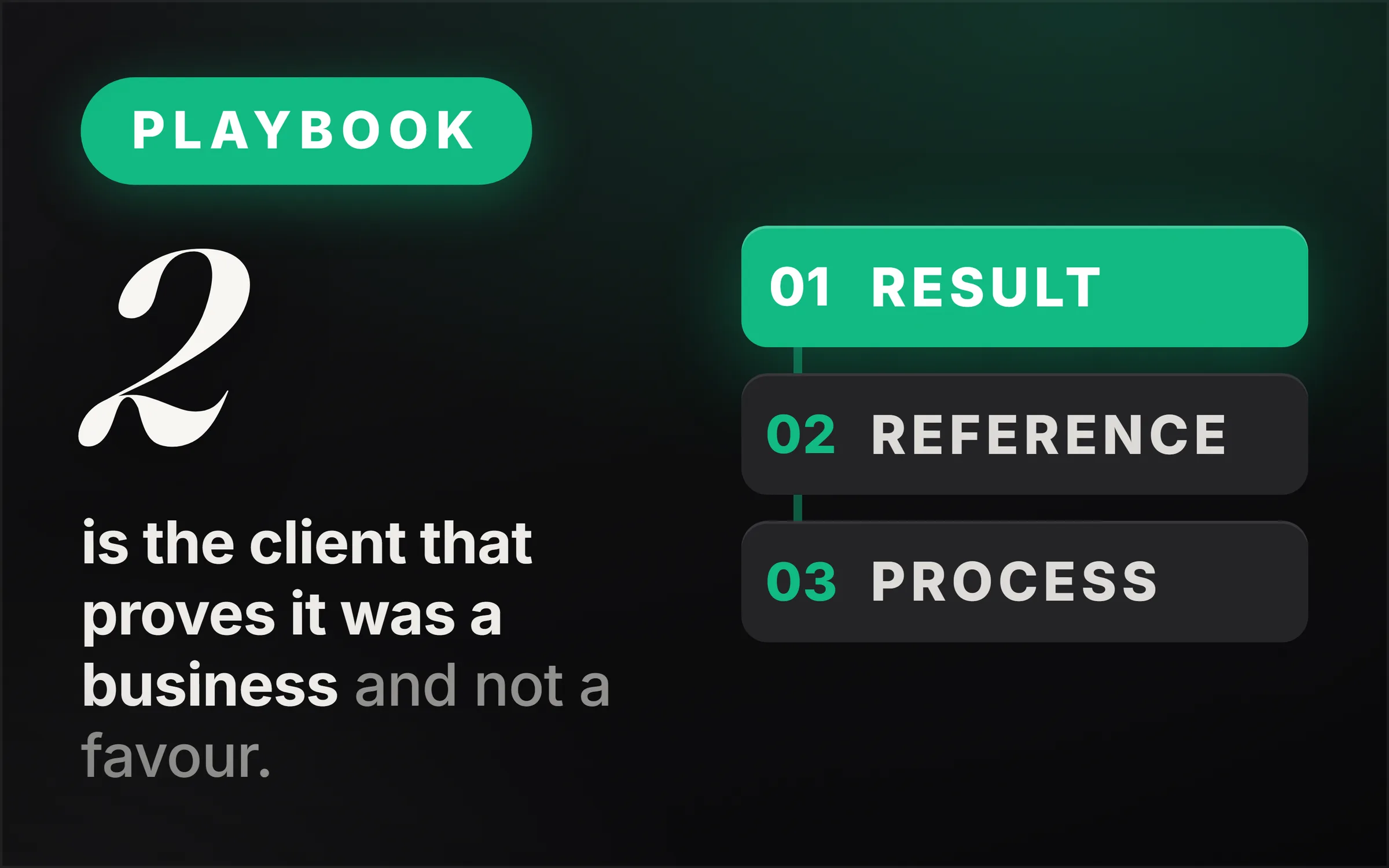
You get your second client by using the three assets the first job produced, which are a measurable result, a person willing to vouch for you, and a process you now know how to repeat. The first client came from goodwill, proximity or luck. None of those three things scale, which is exactly why the second one feels harder than the first and why so many people stall here.
This is the least written-about moment in starting a service business, and it is the one where most attempts quietly end. Not with a failure, but with a month of no income after a successful project, followed by the conclusion that it was a fluke. It was not a fluke. It was an unconverted asset.
Why is the second client harder than the first?
Because the first one did not come from a system. It came from somebody who already knew you, a piece of unusually good timing, or a favour, and none of those can be run again on demand. When you go looking for the second, you are for the first time actually selling to strangers, and that is a genuinely different activity.
There is a second reason and it is psychological. After one success the stakes feel higher, not lower. The first job could be framed as an experiment, and failing at an experiment costs nothing. Once you have delivered real work for real money, a run of rejections starts to feel like evidence about you rather than about the process, and people slow down at exactly the point where volume matters most.
What makes this recoverable is that the first job left you materially better equipped than you were, in ways that are easy to miss because none of them look like a lead. You know what the work actually takes. You know what to charge and what you underpriced. You have one real outcome to point at. Most people go looking for the second client with the same empty hands they had before the first, when in fact they are holding three things they were not holding a month ago.
What are the three assets your first job produced?
A quantified result, a reference, and a repeatable process. Everything below is about converting those three into a second client, and they convert in that order of value.
The three assets, and what each one is for
- The result. The specific change your work produced, stated with a number if one exists and with a concrete before and after if it does not. This is the only proof that matters to a stranger.
- The reference. A person who will confirm you were competent and easy to work with. Worth more than any portfolio piece, because it answers the risk question rather than the ability question.
- The process. What you actually did, in order, including what went wrong. This is what lets you quote the next job accurately and deliver it in less time.
The mistake is treating the first two as things that will happen naturally later. They do not. A result that is not written down within a week becomes vague, because you stop remembering the starting state. A reference that is not requested at the moment of delivery becomes awkward to ask for a month later. Both decay quickly, and both are free at the right moment and expensive at the wrong one.
When should you ask for a referral?
At the moment the client is most pleased, which is when the finished work first lands in front of them and beats what they had in their head. That window is hours, not weeks, and it is never the invoice.
The reason is simple and it is about what they are feeling rather than what they owe. At delivery they are experiencing the value. At the invoice they are experiencing the cost. The same request lands completely differently across those two moments, and most people ask at the second one because it feels more procedurally correct.
The second thing that goes wrong is the phrasing. "Do you know anyone else who might need this?" hands the client a research task: search their memory, guess at what your business is, sort people into categories. They say they will have a think, and nothing happens, and they are not being rude. You gave them homework. Give them one specific picture to react to instead, narrow enough that a name surfaces immediately, and take the introduction off their hands by offering to make contact yourself and say who sent you.
How do you turn one job into a case study?
Write down the starting state, what you did, and the end state, in that order, while you can still remember the starting state accurately. That is the entire method, and the first element is the one everyone skips.
A case study fails when it only describes the work. "I built them a booking system" tells a stranger nothing about whether they need one. What persuades is the situation before: what was broken, what it was costing, what the client had tried. A reader recognises themselves in the before, not in your process, and recognition is the whole mechanism. Nobody buys because your method is elegant. They buy because the starting state sounded like theirs.
Numbers help and their absence is not fatal. If you have a measurable change, use it. If you do not, a concrete qualitative before and after is still far stronger than an abstraction: calls going unanswered after five o'clock, three hours a week spent copying figures between two systems, a quoting process that took four days. Specificity does the persuading, and specificity does not require statistics.
One length note. This document is not a marketing page. It is one page, honest, including what was harder than expected, and it is more useful sent directly to a single prospect than published anywhere. The most valuable version of it is the one you attach to an email.
Where does the second client actually come from?
The neighbours of the first one. Same industry, same size, same problem, same vocabulary, and a reference they are likely to recognise or at least respect.
This is the highest-return targeting decision available and it is counterintuitive, because the instinct after one job is to broaden. Broadening throws away everything you just earned. Your result is legible to people in that specific situation, your reference carries weight in that specific network, and your process was built for that specific problem. Move to a different industry and all three assets reset to zero while your confidence does not, which is a bad combination.
Ten to fifty comparable businesses is the right size of list, small enough to research each one properly. And the research is the leverage: a first line that shows you looked at their specific situation is what separates a message that gets read from one that does not, which we set out in how to write cold emails with Claude that get replies. One caution worth carrying, since an empty inbox is ambiguous evidence: a filtered message and an uninterested reader look identical, and why your cold emails go to spam explains how to tell them apart before you conclude the offer failed.
Should you raise your price for the second client?
Usually yes, modestly, and the reason is not confidence. It is that you now know what the work costs you in hours, and the first quote was almost certainly made without that information.
Nearly everyone underprices the first job, for a defensible reason: they were buying a proof point and a reference, which are genuinely worth a discount. The error is treating that introductory number as a rate rather than as a one-off purchase of credibility. It was a price paid for something you already own now.
The practical adjustment is to price the second job from your actual delivery time plus the parts you discovered were harder than expected, rather than by taking the first number and adding a small percentage. And there is no need to justify it or reference the previous price to a new client, because a new client has no idea what the last one paid. The awkwardness only exists when you go back to the same client, which is a separate problem covered in how to raise your rates without losing clients.
What if the first client wants more work?
Take it, and treat it as a bonus rather than as the answer. A second project from the same client is real revenue and it is a good sign, but it is not a second client, and confusing the two is how people end up with a single-customer business.
The distinction matters because concentration is a risk that stays invisible while things go well. One client providing all your income holds every card: on price, on scope, on timing, and on whether you have an income at all next quarter. That is not a business, it is employment with none of the protections, and it usually ends abruptly when their budget or their staffing changes for reasons that have nothing to do with you.
The correct move is to do both at once. Take the follow-on work, and continue the outreach anyway while you have the income to do it calmly. Prospecting from a position of not needing the money is far more effective than prospecting from desperation, and the window where you have revenue and capacity at the same time is short. Most people spend it entirely on delivery, which is exactly why the gap arrives a month later.
The honest hard part
The hard part is that this stage has no external validation and takes longer than the first. The first client produced a rush of confirmation. The second is preceded by a stretch of research, outreach and silence, during which nothing arrives to tell you it is working.
That stretch is where most attempts end, and they end with a reasonable-sounding conclusion: the first one was luck, this is not viable, better to stop before wasting more time. The conclusion is drawn from a sample far too small to support it, usually a few dozen messages, and the person drawing it has no way to tell the difference between an offer nobody wants and an offer nobody has properly seen yet.
The counter is to measure the stages rather than the outcome. Count how many researched names you added, how many messages went out, how many got a reply, how many became conversations. Those numbers move every week even when no client appears, and they tell you which part is actually broken. A total of zero clients tells you nothing at all except that you are not there yet, which you already knew.
And it does get structurally easier, though not for motivational reasons. At two clients you have two references, two results and a process run twice, and the third conversation is meaningfully different from the second because you can name two situations instead of one. That compounding is real, and it starts working the moment there is a second name to say.
If you have not landed the first one yet, the sequence for that is in how to get your first client without asking for one.
And when a conversation does turn into a request for something in writing, keep it short and ask for a decision, which we set out in how to write a proposal that closes.