You start a junk removal business with a truck or trailer, a disposal plan worked out before your first job, and pricing by volume rather than by hour. The disposal plan is the part that separates this from a man-with-a-van operation, and it is why the trade pays what it does.
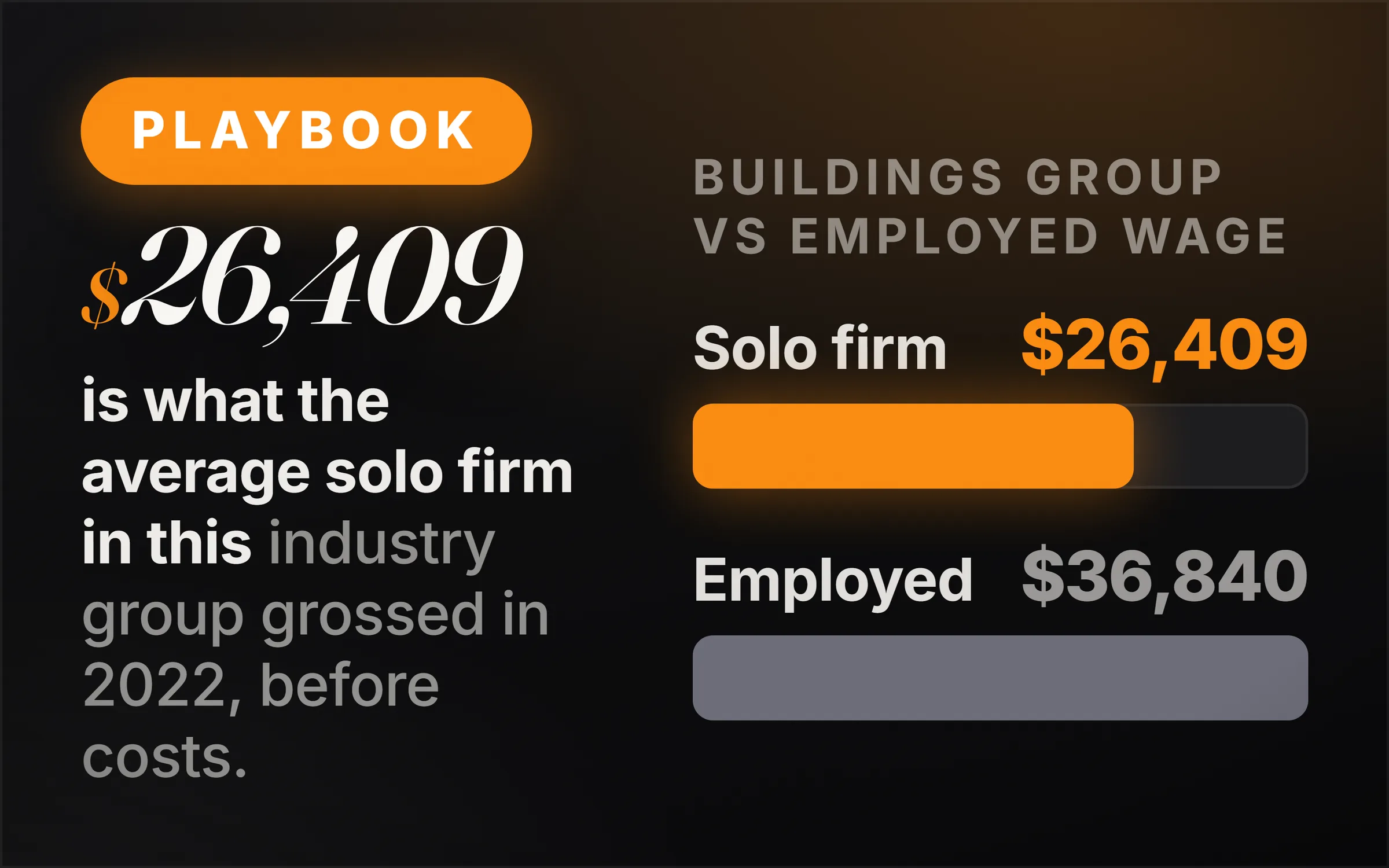
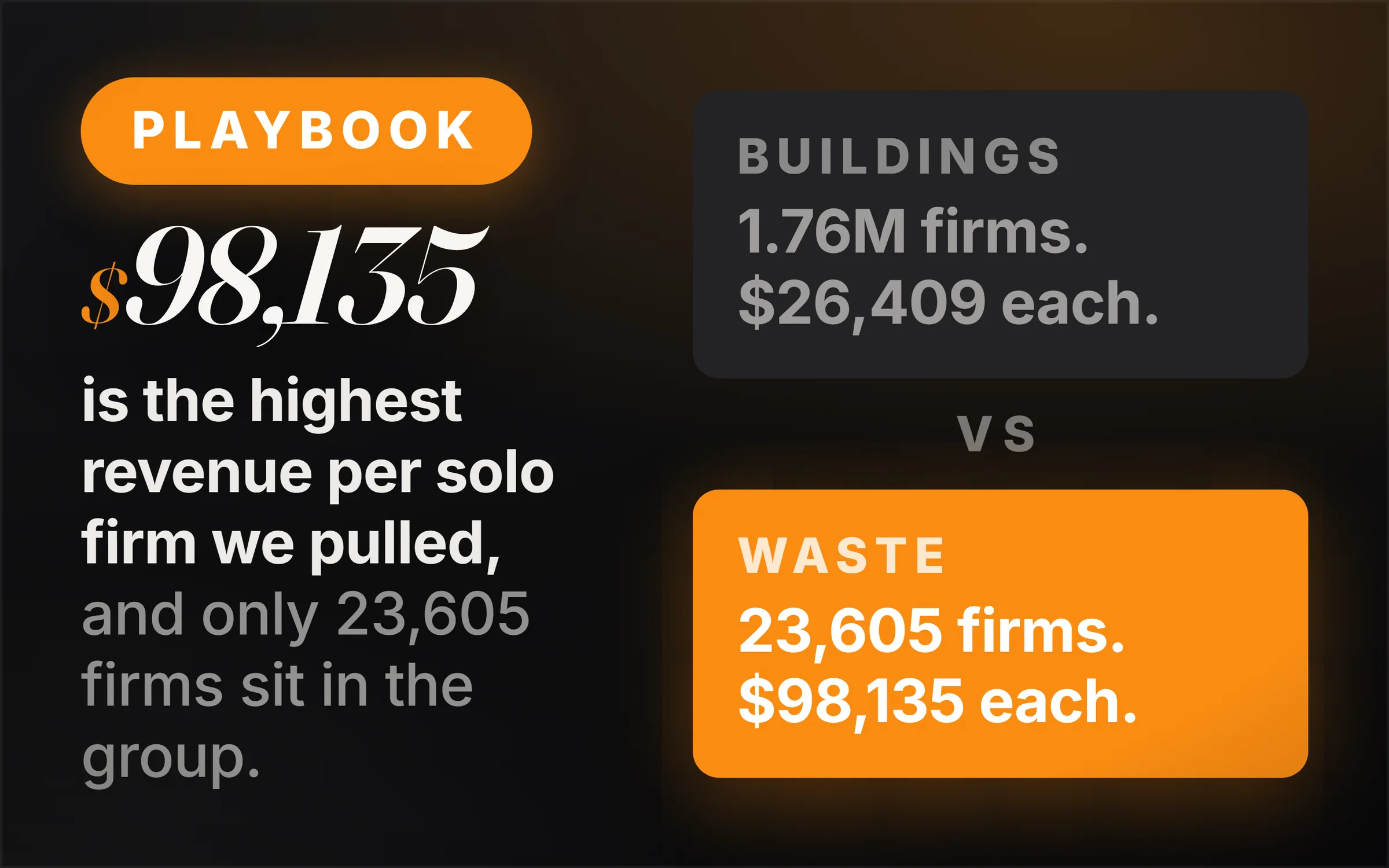
In 2022 the average solo firm in the Census Bureau's waste management category took in $98,135, across just 23,605 establishments with no employees. That is the highest revenue per solo operator of any industry we have pulled, and it sits in one of the least crowded. For comparison, cleaning and landscaping has 1,757,318 solo firms averaging $26,409.
Roughly seventy-four times fewer operators, and nearly four times the revenue each. That gap is the opportunity, and the rest of this article is about why it persists.
How much does a junk removal business make?
The average solo operator grossed $98,135 in 2022. That is Census Bureau Nonemployer Statistics for NAICS 562, waste management and remediation services, covering 23,605 establishments with no paid employees and $2.32 billion in receipts.
The caveat is that NAICS 562 is broader than junk removal: it includes waste collection, treatment, disposal and remediation services generally, some of which are specialised and higher-value than hauling household clearances. It is the published category this trade sits inside rather than a junk-removal-specific figure, and it likely runs above what a hauling-only average would be.
What the figure does establish reliably is the comparison. This category has roughly 1.3 percent as many solo operators as services to buildings and dwellings, and nearly four times the revenue per operator. Whatever the exact junk removal number is, it sits in a category that is dramatically less crowded and dramatically better paid than the trades usually recommended to beginners.
Revenue is not profit here, and the costs are heavier than in cleaning: a vehicle, fuel, and disposal fees on every single job. But the gap is wide enough that it survives a lot of subtraction.
Why is this business less crowded than cleaning?
Because three real barriers sit in front of it, and each one filters out a large share of would-be entrants.
A vehicle is mandatory. You cannot start this with equipment from a hardware store and a hatchback. A truck or a substantial trailer is the minimum viable asset, and that alone removes most of the people who start a cleaning business on a whim.
Disposal access is not automatic. Every job ends at a transfer station, landfill, recycling facility or scrap yard, each with its own rules, hours, accepted materials and fees. Some require accounts. Some restrict commercial waste. Working that out is unglamorous administrative research that has to happen before the first job, and it is where casual entrants stall.
The work is genuinely heavy. Not tiring in the way cleaning is tiring, but load-bearing, awkward and occasionally hazardous, involving furniture on staircases and appliances through doorways. That is a physical filter and it is a real one.
Those three barriers are why 23,605 operators serve a market that 1.76 million serve in cleaning, and they are exactly why the revenue per operator is what it is. As we found across the whole dataset in boring businesses: which ones actually make money, ease of entry and revenue per operator move in opposite directions with striking consistency.
What do you actually need to start?
A vehicle that can carry volume, a way to load it, protective equipment, insurance, and a researched disposal route. That is the list, and the order matters.
We are not publishing vehicle or equipment figures, because they depend on market and condition and we could not verify current pricing to the standard used elsewhere here. What can be said is the decision structure: if you already have access to a suitable truck or trailer, this business starts cheaply. If you are acquiring one, that single line dominates everything else on the list, and financing it before you have proven local demand is the same mistake we set out in how to start a lawn care business.
The item that is genuinely non-optional is insurance, and the exposure here is broader than in most trades. You are lifting heavy objects in other people's property, carrying loads on public roads, and disposing of material you did not generate. Next Insurance publishes general liability "Starting at $19/month" with a footnote reading "for some low-risk businesses," which is a floor for the safest possible customer and plainly not a quote for hauling work. Get a real quote, and check what it says about vehicle use and about the material you carry.
The unglamorous starting task is the one most people skip: spend a day identifying every disposal point within reasonable distance, what each accepts, what each charges, and when they are open. That document is the business.
How should you price junk removal?
By volume, meaning the fraction of your truck a load occupies, plus surcharges for items that cost more to dispose of. Never by the hour.
Hourly pricing fails here for a specific reason: the customer is not buying your time, they are buying the disappearance of a problem, and the value of that is unrelated to how long it takes you. A garage clearance that takes ninety minutes and a single sofa collection that takes fifteen have very different values to the customer and very similar costs to you. Volume pricing captures that. Hourly pricing gives it away and, worse, penalises you for being efficient.
The pricing input that new operators miss is disposal cost, and it varies enormously by material. General waste has one fee. Mattresses, tyres, appliances containing refrigerant, electronics and construction material frequently have their own charges or their own facilities. A job quoted on volume alone, containing three mattresses and a fridge, can eliminate its own margin at the transfer station.
So the quote needs two components: the volume, and the specific items that carry a disposal surcharge. Operators who learn this after a few painful jobs are the ones whose pricing eventually works. Those who never itemise disposal keep wondering why busy months are not profitable. If you have no basis for a first number, derive it from your costs and capacity rather than by copying local competitors, using the method in how to price a service with no track record.
Where does the material actually go?
Down several routes, and the operators who sort make materially more than the operators who dump everything.
The default assumption is that a full truck goes to one place and you pay by weight. That is the most expensive possible way to run this business. Metal and appliances have scrap value and there are yards that will pay for them rather than charge you. Reusable furniture and working goods can go to charitable reuse organisations, which frequently costs nothing and sometimes produces a receipt with tax value. Electronics have their own recycling channels. Construction material often has a separate and cheaper stream. Only what is left is general waste at full cost.
That sorting is where a meaningful part of the margin in this trade lives, and it is invisible to the customer, who is paying the same either way. Two operators quoting identically on the same job can have very different outcomes depending on what happens after they drive away.
It is also the compliance dimension. Waste is regulated, and what you may transport, where you may take it, and what documentation is required varies by state and by material. Some jurisdictions require registration or a licence to haul waste commercially. Verify your own state's requirements with the issuing authority before you take paid work, because this is the one area of this trade where getting it wrong carries penalties rather than just costs.
Who are the best customers?
Repeat commercial buyers: letting agents, property managers, small builders, estate clearance firms and retailers. Households are the visible market and the less valuable one.
The distinction is the same one that decides every local service business. A household clears out once every few years, decides emotionally, compares quotes, and never buys again. A letting agent clears a property between every tenancy, has a schedule to keep, and cares far more about a reliable operator who answers the phone than about the last ten percent of price.
Builders are the strongest version of this. Construction and renovation generate material continuously, the volumes are predictable, and a builder who finds a hauler that turns up when promised will simply keep calling. That relationship is worth more than any amount of consumer advertising, and it is won by direct contact and reliability rather than by marketing.
The route in is the same as every trade in this series: identify twenty of them within a tight radius, make contact, and be available. The sequence is in how to get your first client without asking for one, and turning that first one into a pipeline is in how to get your second client.
The honest hard part
The hard part is physical and it does not improve with experience. This is lifting heavy, awkward, sometimes filthy objects down staircases and through doorways, in all weather, and the wear is cumulative and permanent. The revenue per operator in this trade is the highest in our data partly because of that, and anyone comparing it to a desk business on revenue alone is not comparing the same thing.
The second hard part is that you cannot sell while you are working. A one-person hauling business has a structural conflict: the hours when customers call are the hours when your hands are full, and every missed call goes to whoever answers first. That is a real constraint on growth and it arrives early, well before hiring makes sense.
The third is disposal cost volatility. Fees change, facilities change what they accept, and a route that worked last year can become expensive without warning. An operator pricing from last year's disposal costs is quietly losing margin on every job, and because the loss is at the back end rather than the front, it takes a while to notice.
None of that outweighs the numbers. This trade sits in the least crowded, highest-revenue category we have pulled, for reasons that are structural rather than temporary, and the barriers that keep it that way are ones a determined person can clear in a fortnight.
What it costs to get going is priced in what it costs to start a junk removal business. Two adjacent trades worth comparing are moving, which overlaps on the vehicle, and car rental, which is the cautionary one.