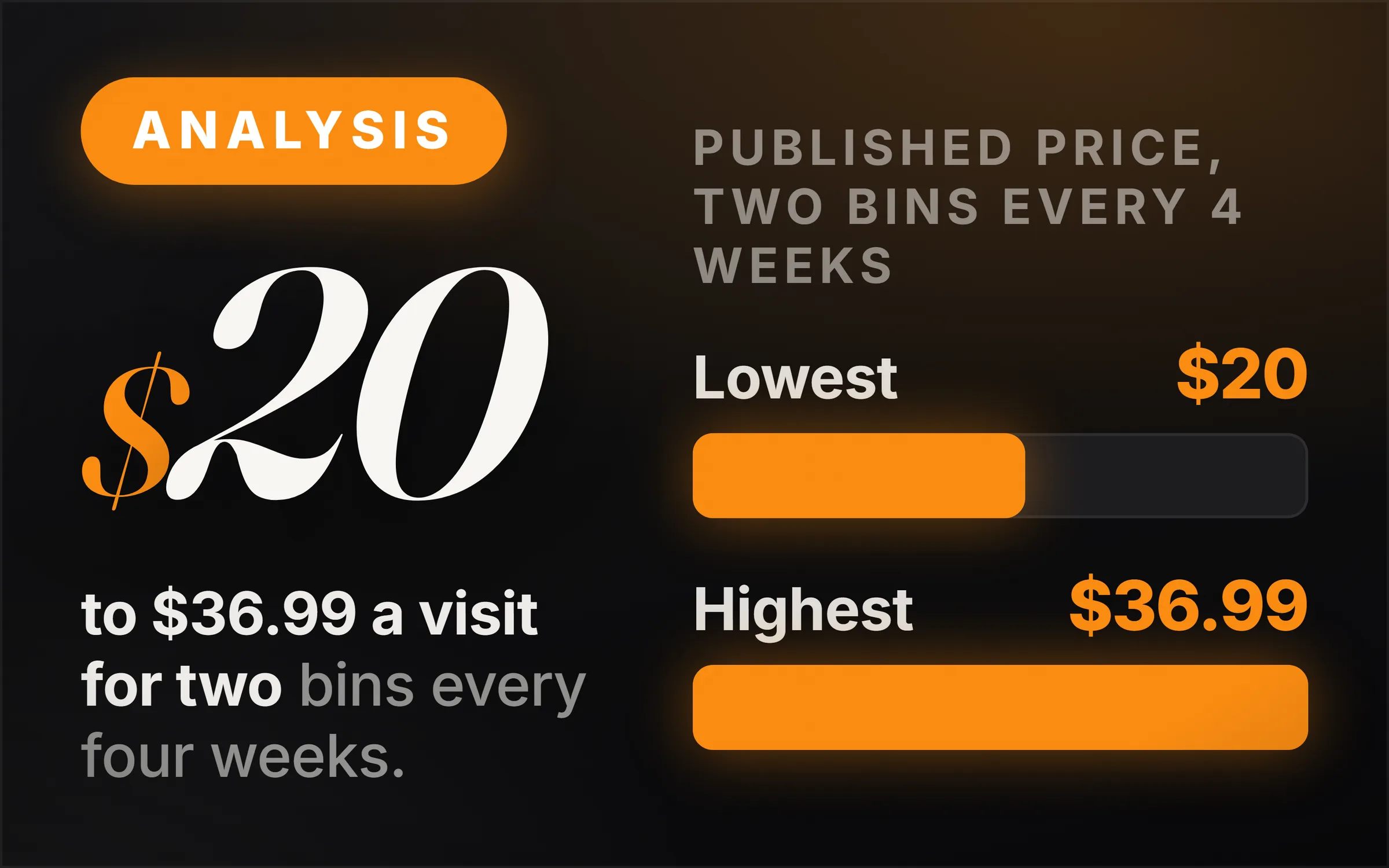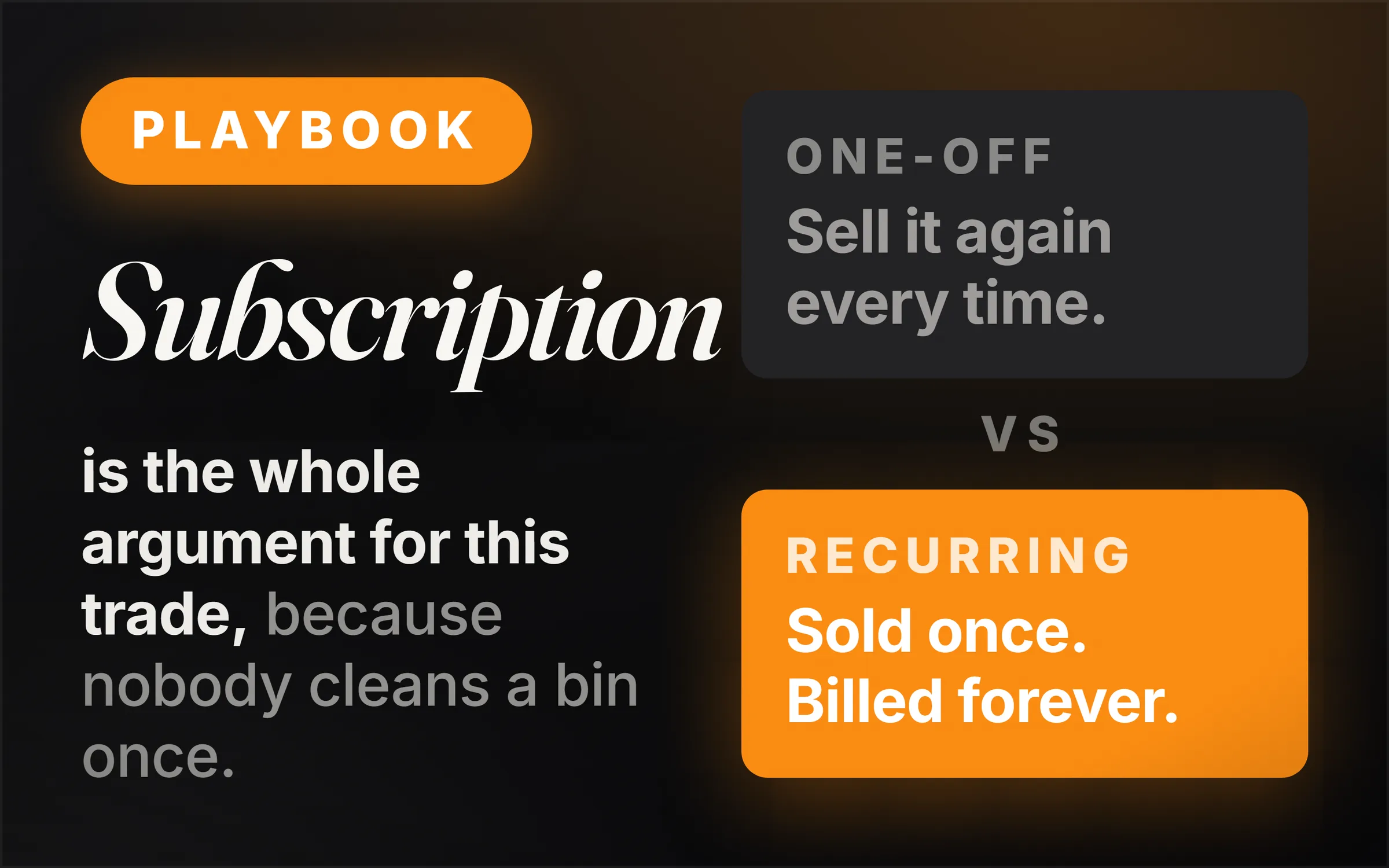
You start a bin cleaning business by selling a recurring monthly or quarterly service to a tight cluster of houses on the same street, timed to the day after collection, with a water and wastewater plan sorted before the first job. The subscription is not a growth tactic here, it is the entire business model, and an operator selling one-off cleans has misunderstood the trade.
The industry group this sits in, the Census category for services to buildings and dwellings, averaged $26,409 per solo firm in 2022 across 1,757,318 establishments with no employees. That is the lowest of any group we pulled, less than half the next one up.
The reason to look at bin cleaning anyway is that it is the one trade in that low-revenue category with recurrence built into the product. Cleaning and lawn care have to sell recurrence against a customer who could plausibly buy once. Nobody buys a single bin clean.
How much does a bin cleaning business make?
There is no published figure for bin cleaning specifically. It sits inside Census NAICS 5617, services to buildings and dwellings, which averaged $26,409 per solo firm in 2022 across 1,757,318 establishments with no paid employees and $46.4 billion in receipts.
That category also contains janitorial services, landscaping, carpet cleaning and pest control, so it is the population this trade lives in rather than a measurement of it. The Census does not publish six-digit detail for solo firms at national level, and we checked.
What the category tells you is the competitive environment rather than the income. It is the most crowded and lowest-earning group in our entire dataset, and the reason, as we found across everything we pulled in boring businesses: which ones actually make money, is that low barriers to entry and low revenue per operator travel together with striking consistency.
The honest way to model this trade is from the unit economics rather than from the category. Revenue is the number of subscribers multiplied by the monthly fee, and both of those are things you can estimate for your own area far more usefully than any national average.
Why is the subscription the whole business?
Because a bin that is cleaned today is dirty again in a fortnight, and that is not true of the products the other low-barrier trades sell.
A house can be cleaned once before a party. A lawn can be cut once before a viewing. Both of those trades spend enormous effort converting one-off buyers into recurring ones, and most operators never manage it, which is a substantial part of why the category average is $26,409.
Bin cleaning inverts that. The service has no meaningful one-off use case, so the sale is a subscription from the first conversation, and the customer understands that immediately. You are not persuading anyone to commit to something they might buy once. You are selling the only version that makes sense.
That changes the shape of the business completely. Revenue is predictable, the selling effort is front-loaded and then stops, and the value of a customer is measured in years rather than in a single job. It also means the metric that matters is not jobs completed but subscribers retained, and an operator tracking the former is watching the wrong number.
Why does route density matter more here than anywhere else?
Because the revenue per stop is small, so unpaid driving destroys the economics faster than in any other trade.
Consider the arithmetic. A stop takes a few minutes. If the next customer is ten minutes away, you have spent more time driving than working, and the drive is unpaid. In a cleaning business a long drive is amortised over a two-hour job; here there is no job long enough to absorb it.
That makes geographic concentration not merely helpful but structurally necessary. A viable bin cleaning round is a street or a neighbourhood where you service many bins in sequence, stepping between houses rather than driving between them. A scattered customer list at the same subscriber count is not a smaller version of the same business, it is a business that does not work.
The consequence for how you sell is direct. You do not advertise across a city and accept whoever responds. You pick a street, sign as many houses on it as possible, then move to the next street. Turning down a customer three neighbourhoods away is correct even though it feels like turning down money, which is the same discipline that decides lawn care and is set out in how to start a lawn care business.
What about the water and the waste?
The water that comes off a bin contains food residue, bacteria and whatever else was in there, and discharging it to a storm drain is the same regulatory problem that governs mobile vehicle washing.
Storm drains generally discharge to natural water rather than to treatment, which is why non-stormwater discharges into them are the specific thing municipal stormwater rules restrict. Requirements vary by state and municipality, and we are not going to summarise a rule that differs everywhere.
What that means practically is that the equipment question and the compliance question are the same question. A system that captures and contains wash water lets you operate wherever the rules require containment. A system that simply sprays and lets the runoff go where it will is cheaper and may not be permissible for commercial operation in your area.
This should be researched with your own city's stormwater or environmental services department before any equipment is bought, because the answer determines what you buy. It is also, usefully, one of the few real barriers in this trade, and an operator who has solved it properly has something a casual competitor does not.
Water supply is the other half: you need to carry it, which means tank capacity sets the number of stops you can complete before refilling, which feeds directly back into route planning.
How do you get customers?
Street by street, in person or by leaflet, selling the round rather than the service. The pitch is easier than in most trades because the problem is visible and slightly embarrassing, and the price point is low enough to be an easy yes.
The most effective mechanism is the one the density requirement demands anyway: work a single street thoroughly. A neighbour seeing the service being performed next door is the strongest possible advertisement, and it arrives at exactly the moment they are thinking about their own bin. Working while visible is doing your marketing at the same time as your job.
Timing the approach to just after collection day, when bins are back on driveways and at their worst, is a small optimisation that meaningfully improves conversion.
Beyond households, the commercial version is worth knowing about: restaurants, cafes, food retailers and property managers have larger bins, worse contents, and in some cases hygiene obligations that make cleaning a requirement rather than a preference. Those contracts are larger, more stable and less price-sensitive than residential ones, and they are reached the way every commercial contract is reached, which is in how to get your first client without asking for one.
The honest hard part
The hard part is that the working week is compressed by something you do not control. The job only makes sense in the window after bins are emptied, which means your available hours are dictated by the collection schedule in each area, and a customer whose collection day does not fit your route is a customer you cannot efficiently serve.
That constraint interacts badly with the density requirement. You need many customers close together, and they need to share a collection day, and those two conditions together are much harder to satisfy than either alone. Operators who plan a round on geography alone discover this in the first month.
The second hard part is that the barrier to entry is close to nothing, which is the same problem that produced the $26,409 category average. Nothing prevents someone starting on your streets next season, and the defence is not price, it is being established: subscribers who are happy do not switch to save a small amount on a small bill. Churn is your real competitive metric, and it is decided by never missing a scheduled visit.
The third is that this is unpleasant work in an obvious way, and the pleasantness does not improve with scale. It is also, unusually for this series, work where the customer never watches you do it and mostly judges you on whether you came. That is a low bar, and clearing it consistently is worth more here than any amount of technique.