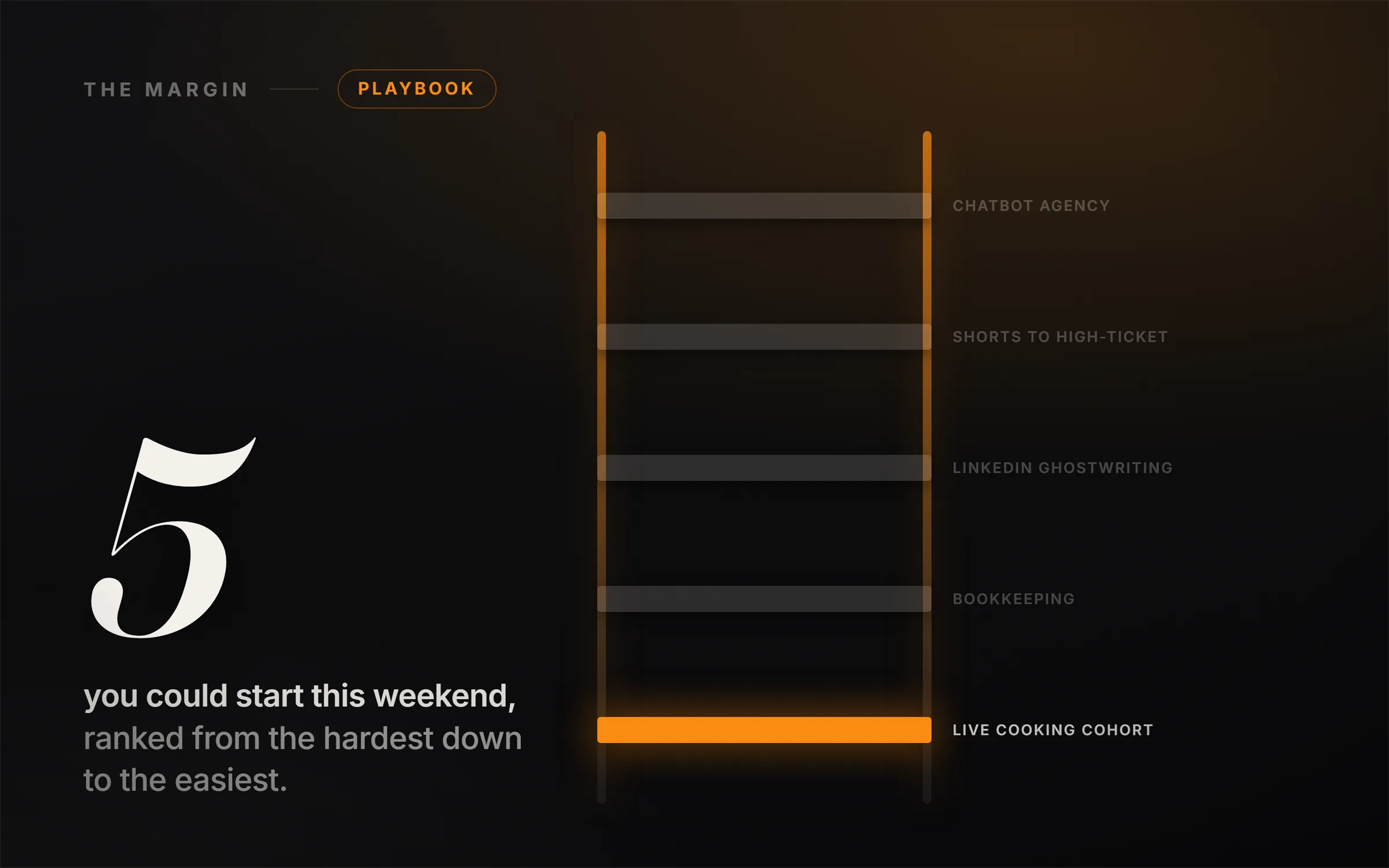
Five small businesses you can start in 2026 with no money or experience are an AI chatbot agency for local businesses, Shorts to high-ticket clients, a LinkedIn ghostwriting service, a QuickBooks bookkeeping service and a live cooking cohort. None needs a loan, a degree or code. The cooking cohort pays fastest, because you pre-sell the seats.
Can you actually start a real business in 2026 with no money and no experience? Yes, and you have more genuine options than the internet's tired list of "sell on Etsy" suggests. Below are five real businesses, all of them buildable this weekend, none of them needing a loan, a degree, or a single line of code you wrote yourself. I have ranked them the way our video does, from the highest barrier of the five down to the lowest, so the easiest thing you could start is the last one you read.
These are not ideas I made up for a listicle. Each one is a complete, click-by-click walkthrough we have already built and published, which means every number below is checkable against the real thing, not rounded up for a headline. Where a business asks for more time or a little more skill than the cheerful version implies, I have said so plainly. That honesty is the point.
The video counts all five down from five to one in about four minutes. The written breakdown below stands on its own and goes deeper on the honest trade-offs. Read it, watch it, or both.
What makes a business genuinely "start this weekend" doable in 2026?
Three things have to be true at once, and for these five they are.
First, the cost to begin has to be near zero. Not "cheap once you scale," but low enough that your first client or first cohort covers it with room to spare. Every business here clears that bar. Second, the skill has to be learnable in a weekend or already sitting in your hands. Nobody has time to spend two years qualifying for a side business. Third, and this is the one most lists skip, the thing you sell has to be something a buyer already understands and already wants. A vague promise to "help with AI" dies in the inbox. A phone that stops missing calls, or a clean set of books, or a founder's LinkedIn feed that finally sounds like them, sells because the buyer can picture it instantly.
The deeper pattern underneath all five is worth naming now, because it changes how you'll read the list. As we argued in The Moat Moved, the durable edge in a world full of cheap software is no longer knowing how to drive the tools. It is trust, relationships, and reliability, none of which were ever gated behind a technical skill. Each of these five is, at its core, a trust business wearing a different outfit. That is precisely why someone with no track record can still win.
What is an AI chatbot agency for local businesses?
The outcome: you build and run AI chatbots that answer calls and inquiries for local businesses, day or night, and charge each one a setup fee plus a monthly retainer to keep it running.
Every dentist, plumber, and law office in your town quietly loses customers to missed calls and after-hours inquiries. The blueprint's own research puts the average home-services company at missing 35% of after-hours calls. You become the person who plugs that leak. You are not coding any of it, you are wiring together tools that already exist, using a visual drag-and-drop builder like Voiceflow (the blueprint's recommended starting point, with alternatives it names if you prefer a different stack).
Why it is beginner-doable in 2026: it is tagged Beginner-Intermediate, explicitly needs no code, and runs on about $115 a month in tools plus roughly ten hours a week. Clients pay a $500 to $2,000 setup fee and a $299 to $799 monthly retainer, so the first client recoups your entire stack. Be clear-eyed on the timeline, though: the blueprint's own math puts you at $5,000 a month in retainers somewhere between months four and seven, not month one. This is the most "tech" of the five, which is exactly why it sits at number five.
What is inside the AI Chatbot Agency blueprint: the full bot build with worked examples, the five channels for landing your first client, a starter workbook with a niche scorecard and twelve-month MRR projection, the cold-outreach scripts and service agreement, and a client onboarding and QA checklist. If the idea of a phone that answers itself is what pulls you, we go deeper on that exact model in How to Start an AI Receptionist Business.
How do Shorts turn into high-ticket clients?
The outcome: you make simple short-form videos, without showing your face at the start, and turn that attention into booked calls with people who pay real money, rather than chasing pennies from ad views.
Most people making Shorts hit a million views and discover the payout is a few hundred dollars. This flips the model: Shorts become the cheapest attention-acquisition tool on the internet, and you point that attention at something you own and can monetize properly. The blueprint breaks it into three layers, the hook that stops the scroll, the destination that converts the click, and the ladder that ends in a paid conversation worth about $400 a booked call.
Why it is beginner-doable in 2026: it starts on roughly $0 to $60 a month and about eight hours a week, and it works with no existing audience and no face until you choose to show it, because the platform pushes short-form to strangers based on the content itself, not your subscriber count. Full honesty: this is the only one of the five tagged Intermediate, and it is the slowest to your first dollar because you are building a funnel over roughly ninety days rather than pre-selling. In exchange, it has the highest ceiling of the five.
What is inside the Shorts to High-Ticket blueprint: the hook and script swipe file, the five-block landing page that converts a hard-won click, the high-ticket offer builder, the five-phase strategy-call kit that closes without pitching, a funnel and booking tracker with a ninety-day revenue projection, and the launch field manual with the exact free tool stack and per-Short publishing routine.
What is a LinkedIn ghostwriting service?
The outcome: you write LinkedIn posts for busy executives who know they should be posting but have zero time and quietly hate writing, and you charge a monthly retainer to sound like them online.
That gap, between the executives who want to post and the ones who actually do, is the entire business. You do not need a writing degree, an audience, or any prior experience. You need a repeatable system for capturing another person's voice, which is the part the blueprint treats as the whole job.
Why it is beginner-doable in 2026: the startup capital is literally none, and the blueprint promises no writing degree, no audience, and no experience required. Retainers run about $800 to $2,500 per client per month, and because the work is recurring, each client stacks on top of the last. The honest catch is time, not money: this one asks fifteen to twenty hours a week once you have a few clients, so it rewards people who want to trade real hours for a compounding client base rather than a quick flip.
What is inside the LinkedIn Ghostwriting blueprint: the voice-capture interview kit that pulls a client's stories, opinions, and content pillars in one call, the client-finding system, a content calendar and post tracker that runs across all your clients, and a full onboarding kit with the intake form, approval workflow, and scope agreement.
What is a QuickBooks bookkeeping service?
The outcome: you keep the books for small businesses, who almost universally dread doing it themselves, and bill each one a fixed fee every single month.
This is not accounting school and it is not a four-year degree. It is one tool and a repeatable monthly routine you can learn in a single focused weekend using a free certification. Every small business on earth generates transactions someone has to record, reconcile, and report, and most owners will happily pay to never be that person.
Why it is beginner-doable in 2026: it is tagged Beginner, the tagline is "learn it in a weekend, bill it every month," and it needs no degree, no experience, and no office. Retainers run $300 to $800 per client per month, and the income is the quiet, steady, recurring kind that beginners rarely hear about. Startup cost is low (a small monthly software stack) and the time is ten to fifteen hours a week that concentrates in the back half of each month. We wrote a full standalone piece on this one: How to Start a Bookkeeping Business (No Experience).
What is inside the QuickBooks Bookkeeping blueprint: the free certification path, the niche selection system, three-tier pricing, a client onboarding kit and engagement-letter template, an income and client tracker, and the messy-first-client playbook for the moment beginners panic and do not need to.
What is a live cooking cohort?
The outcome: you teach a skill you already have, live, to a small paid group. The worked example throughout is Indian home cooking, but the method is the point, so swap in whatever you cook well.
Here is the beautiful part: you already have the skill. If friends text you when their dal turns out flat, that is a business, not a hobby. And the model has the lowest barrier of all five for one reason: you sell the seats before you cook a single thing. Ten buyers at a $150 founding price is $1,500 for four live sessions taught from your own kitchen, and you collect it before you build the curriculum, so you never spend weeks making something nobody wanted.
Why it is beginner-doable in 2026: it is tagged Beginner, it is the lowest time commitment at six to eight hours a week, it starts for about $0 to $60, and the skill is one you already own. The blueprint notes most people who actually do the validation step land their first paid cohort within three to five weeks. This is the number-one climax of the video for a reason: the barrier is as close to zero as a real business gets.
What is inside the Live Cooking Cohort blueprint: how to find your teachable skill, how to prove strangers will pay before you build, a cohort planning workbook with a four-session curriculum planner and break-even projection, the pre-sell landing page and outreach kit with the deposit-link setup, and the per-session run-sheet and testimonial-capture template for running it live without freezing on camera.
How do you pick between them?
Pick by what you already have, in this order.
Start with the skill question. If you already cook, bake, or make one thing well enough that people ask you how, the Live Cooking Cohort is the shortest path, because your product already exists. If you already write clearly, LinkedIn Ghostwriting turns that into a retainer. If you have neither and want the most learnable new skill, bookkeeping is the cleanest weekend to a credential.
Then ask about time. Two of these (LinkedIn and bookkeeping) genuinely ask ten to twenty hours a week. If you can only spare an evening or two, the Cooking Cohort at six to eight hours, or Shorts at eight, fits your life better than a service that bills by the month.
Finally, ask about temperament. The three service businesses (chatbot, ghostwriting, bookkeeping) reward people who like reliability and a routine that runs the same way every month. Shorts rewards people who enjoy the creative reps and can wait ninety days for the machine to pay. The Cooking Cohort rewards people who like teaching a room.
Which is fastest to your first dollar?
The Live Cooking Cohort, without much competition. It is the only one of the five where you collect money before you deliver anything, because you pre-sell the seats. That single structural choice is why it can pay within a few weeks while the others are still onboarding a first client.
After that, the two warm-network services are next, because your first bookkeeping or ghostwriting client is usually someone who already knows and trusts you. The AI Chatbot Agency typically lands a first client in thirty to forty-five days. Shorts to High-Ticket is the slowest of the five to your first dollar, because you are building a funnel that reaches strangers over about ninety days, and it is also the one with the highest ceiling once it is running. Fastest to pay and highest ceiling are simply not the same business, and knowing which you need is half the decision.
What do all five have in common?
Strip away the surface and the same three traits sit underneath every one.
Near-zero overhead. No inventory, no office, no upfront capital beyond your time. That is what makes "no money" literally true rather than marketing.
Recurring or repeatable income. Three of them (chatbot, ghostwriting, bookkeeping) bill a monthly retainer, so revenue stacks while your hours barely move. The Cooking Cohort is repeatable on demand, and Shorts builds an owned funnel you keep. None of them is a one-off gig you have to re-earn from scratch each time.
They sell trust, not technology. A business owner is not paying for software they could technically buy themselves. They are paying for the person who understood their problem, made the judgment calls, and stands behind the result. That human layer is the part buyers reliably pay extra for once the cheap tools are everywhere, and it is the reason a determined beginner beats a faceless app. It is the same argument we made in The Moat Moved, and it is why 2026 is a genuinely good year to start any of these.
How do the five businesses compare?
| # | Business | Start cost | Time / week | Difficulty | What you earn |
|---|---|---|---|---|---|
| 5 | AI Chatbot Agency | ~$115/mo | ~10 hrs | Beginner-Intermediate | $299–$799/mo retainer per client |
| 4 | Shorts to High-Ticket | ~$0–60/mo | ~8 hrs | Intermediate | ~$400 per booked call |
| 3 | LinkedIn Ghostwriting | None | 15–20 hrs | Beginner-Intermediate | $800–$2,500/mo retainer per client |
| 2 | QuickBooks Bookkeeping | Low | 10–15 hrs | Beginner | $300–$800/mo retainer per client |
| 1 | Live Cooking Cohort | ~$0–60 | 6–8 hrs | Beginner | ~$150 per seat, ~$1,500 first cohort |
Every figure in that table is pulled straight from the blueprint it links to, not estimated.
Start one this weekend
Here is the honest close. Not one of these five needs experience, a big budget, or permission from anybody. What they need is for you to pick one and send the first message. The building is the easy twenty percent of any of them; getting the first client or the first ten seats is the real work, and it is entirely doable from where you are sitting right now.
Every one of these is a complete, click-by-click blueprint on ideasrepay.com, with the tools named, the prices listed, and the exact steps laid out, so you are building with a map instead of hope. Pick the one that made you lean in, and go start it this weekend.