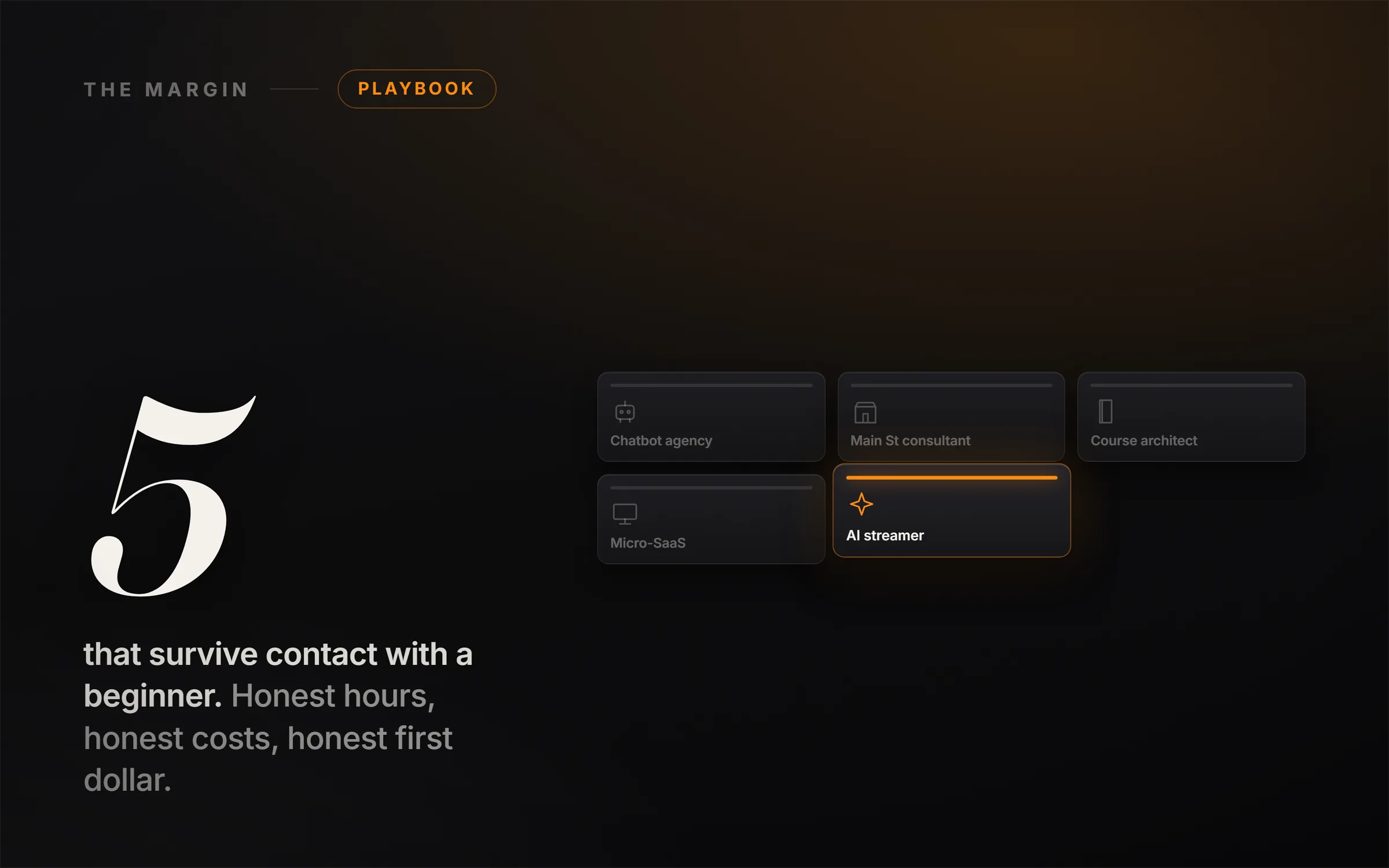
Five realistic AI side hustles for beginners in 2026 are an AI chatbot agency for local businesses, a Main Street AI consultancy, course architecture, a vibe-coded micro-SaaS and an AI streamer. None needs code, a degree or an audience, four start for under $500, and the chatbot agency is fastest to a first client, typically 30 to 45 days.
Most of the AI side hustle advice online is quietly lying to you. Somebody films a screen, promises ten thousand dollars a month from a chatbot they supposedly built in an afternoon, and then never shows a single real client or a single real dollar. So here is the honest version. These are five AI side hustles that are genuinely realistic for a beginner in 2026, with the true money to start, the real hours, the honest time to your first dollar, and exactly where the AI carries the load. I threw out everything that only works inside a thumbnail.
Every one of these is a complete, click-by-click blueprint we have already built and published, which means every number below is checkable against the real thing, not rounded up for a headline. Where an idea asks for more time, more skill, or a longer runway than the cheerful version implies, I have said so plainly. That honesty is the entire point, because the fastest way to lose money with AI in 2026 is to believe the people who are only making money by selling you the dream.
The video runs the same anti-hype filter over all five in about six minutes. The written breakdown below stands on its own and goes deeper on the honest trade-offs. Read it, watch it, or both.
What makes an AI side hustle realistic instead of hype?
Three things have to be true at once, and this is the filter I ran every idea through.
First, it has to solve a problem a real buyer already understands and already pays to fix. A vague promise to "help with AI" dies in the inbox. A phone that stops missing calls, a course an expert could never build alone, a tool a niche will pay monthly to keep using: those sell because the buyer can picture them instantly. Second, the AI has to do a specific, nameable piece of the work, not decorate a slide. If you cannot say the exact sentence "the AI does this," it is hype. Third, the honest numbers have to survive daylight: a real starting cost, real hours, and a real timeline that includes the slow weeks nobody in a thumbnail mentions.
Here is the test stated as a rule. If an idea needs a fake screenshot to sell it, if the only person making money is the one selling the course about it, or if the whole plan is basically post and pray, it is not a business. Everything below passes all three. And because we build on Claude, for every idea I can point at exactly where the AI carries the load. That specificity is the opposite of the generic "make money with AI" pitch, and it is the single clearest signal that separates a real 2026 opportunity from a recycled dream.
How does an AI chatbot agency make money?
The outcome: you build and run AI chatbots that answer calls and inquiries for local businesses, day or night, and charge each one a setup fee plus a monthly retainer to keep it running.
Every dentist, plumber, and law office in your town quietly loses customers to missed calls. The blueprint's own research puts the average home-services company at missing 35% of after-hours calls. You become the person who plugs that leak. You are not coding any of it, you are wiring together tools that already exist using a visual drag-and-drop builder like Voiceflow (the blueprint's recommended starting point, with named alternatives if you prefer a different stack). This is the most grounded idea on the list because you are selling a boring problem owners already pay to solve.
The honest reality check. It is tagged Beginner-Intermediate, explicitly needs no code, and runs on about $115 a month in tools plus roughly 10 hours a week. Clients pay a $500 to $2,000 setup fee and a $299 to $799 monthly retainer, so the first client recoups your entire stack. Be clear-eyed on the timeline: most operators land a first client in 30 to 45 days, and the blueprint's own math puts you at $5,000 a month in retainers between months four and seven, not month one. Where the AI works: it answers every call and chat, 24/7, so the AI is literally the product you sell. This is the fastest of the five to a real paying client, which is why it opens the list.
What is inside the AI Chatbot Agency blueprint: the full bot build with worked examples, the five channels for landing your first client, a starter workbook with a niche scorecard and a twelve-month MRR projection, the cold-outreach scripts and service agreement, and a client onboarding and QA checklist. If a phone that answers itself is what pulls you, we go deeper on that exact model in How to Start an AI Receptionist Business.
What does a Main Street AI consultant do?
The outcome: you become the trusted guide who helps local businesses (a salon, an accountant, a dental practice, a vet) adopt AI before their competitors do. You sell it as an audit and a short implementation project, and it naturally becomes a monthly retainer.
This is quietly one of the biggest openings of 2026. Every business on your Main Street knows it is supposed to be using AI by now, and almost none of them have any idea where to begin. You do, because you are one honest weekend of learning ahead of them. It is realistic precisely because the demand is real and rising, not invented in a sales pitch.
The honest reality check. It is tagged Intermediate but genuinely learnable, starts for about $0 to $500, and asks 10 to 20 hours a week to build an engagement (more once you are running several). You charge a project fee first (an audit around $1,500), deliver a 60 to 90 day implementation, then keep a retainer around $4,000 a month, for a realistic path to $3,000 to $20,000+ a month. It works across 10+ Main Street verticals. Where the AI works: it does the client's actual work (their marketing, their scheduling, their admin) while you are the guide who chooses and installs it. This is not the fastest to a first dollar, but the demand is the most durable on the list.
What is inside the Main Street AI Consultant blueprint: the audit workbook and client-deliverable template, the proposal and engagement-letter templates, the entire sales conversation written out with the twelve objections and their exact responses, the 60-to-90-day implementation playbook, the practice-building kit with 2026 pricing, and two full worked examples (Maya building a salon practice, David building an accounting practice) so you can watch the same framework flex across genuinely different kinds of businesses.
What is a course architect?
The outcome: you turn an expert's trapped knowledge into a sellable course, and get paid a flat fee, a share of every sale, or both. The surprising part that makes this work: you do not need to be the expert yourself.
Experts are everywhere with something valuable locked in their heads and no idea how to turn it into something they can sell. You are the person who pulls that knowledge out, structures it, and builds it into a real course. Turning what is in someone's head into a teachable, sellable product is a completely different skill from having the knowledge, and almost nobody is filling that gap well.
The honest reality check. It is tagged Intermediate, capital is Low, and it asks 20 to 35 hours a week while you are building a course. You earn $5,000 to $25,000 per course, as a fee, a revenue share, or both, with a realistic path to $5,000 to $50,000+ a month as courses stack. Where the AI works: it does an enormous amount of the heavy build, helping you extract, structure, script, and assemble the whole course far faster than was possible a few years ago. This is the "surprising angle" idea, because being an outsider to the topic often makes you the better builder: you ask the beginner questions the expert forgot they needed to answer.
What is inside the Course Architect blueprint: the extraction toolkit (the interview scripts that pull a course out of an expert's head), the format and production guide with the format decision tree, the deal kit covering both the upfront-fee and revenue-share models with the math, the client-acquisition field manual for finding and landing experts, and the launch playbook that turns a finished course into sales.
What is a vibe-coded micro-SaaS?
The outcome: you build a small software product by describing it in plain English while the AI writes the actual code, then charge a niche a monthly subscription to keep using it.
This sounds the most impossible for a beginner, and it is genuinely more real today than it has ever been. In the first quarter of 2026, more than a third of all new micro-SaaS products were built by founders with no prior programming experience, and around two in three people using these AI building tools have no development background at all. You describe the software you want, the AI writes it, and a small niche pays you every month. The ceiling is high because software is the rare thing you build once and sell over and over.
The honest reality check, and this is the credibility anchor of the whole list. It is tagged Intermediate and it is the most ambitious idea here. You can scaffold a working app in a weekend, but reaching real paying revenue is a focused couple of months, not a weekend, and anyone who tells you otherwise is selling you the dream. Capital is Low (a tool stack of roughly $0 to $20 a month), time is 20 to 30 hours a week, and the ceiling is a $5,000 to $50,000 MRR business (250 customers at $20 a month is $5,000). Where the AI works: it writes the actual code, using an AI coding tool like Claude Code (the blueprint's pick, with Cursor named as the main alternative). The non-negotiable discipline the blueprint drills: validate that people will pay before you build a single feature.
What is inside the Vibe-Coded Micro-SaaS blueprint: the validation kit and its ten-payment rule, an idea bank of two dozen vetted directions, the full build prompt library (the exact Claude Code prompts for scaffold, core feature, auth, payments, and deploy), and the launch kit for your first ten customers. If you want the myth-busting version of this one first, read Vibe Coding Won't Make You Money. This Will.
How does an AI streamer earn money?
The outcome: you build an AI character that goes live on stream 24 hours a day, talks to its audience in real time, remembers its regulars, and earns through subscriptions, tips, and ads while you sleep. You are never on camera.
This one sounds like a scam, which is exactly why it is the most surprising on the list, and it is quietly the realest. If it sounds made up, understand that one of the most-subscribed channels on all of Twitch is an AI character doing exactly this. You are not the streamer. You direct the AI to build each piece: the personality, the voice, the face, and the live-chat brain.
The honest reality check. It is tagged Intermediate and needs no code. It starts on almost nothing, about $0 to $60, and takes 8 to 12 hours to build, then runs mostly hands-off. It earns through subs, tips, and ads for a realistic $200 to $8,000+ a month, and it runs 24/7. Where the AI works: it is the streamer, reacting to chat around the clock while you sleep. The honest catch is that this is the least predictable of the five on income, because it depends on building a genuine audience for a character. But the barrier to start is nearly zero and the ceiling is real.
What is inside the AI Streamer blueprint: the character bible and personality designer, the build kit with every prompt in order to direct the AI to build the brain, voice, face, and chat listener, the go-live launch checklist, the moderation and safety kit that keeps your character from getting banned, and the growth and monetization kit with the interaction-to-money ladder.
How do you pick between these five AI side hustles?
Pick by what you already have, in this order.
Start with your runway and your appetite for risk. If you want the shortest honest path to a paying client, the AI Chatbot Agency is it, because you are selling a problem owners already pay to fix. If you want the most durable, rising demand and you do not mind learning to sell, the Main Street AI Consultant has the biggest opening. If you are patient and want an asset you can eventually sell, the Micro-SaaS has the highest ceiling and the longest runway.
Then ask about temperament. The chatbot and consultant businesses reward people who like a reliable monthly routine and talking to local owners. The Course Architect rewards a curious outsider who enjoys pulling structure out of a mess. The AI Streamer rewards someone who genuinely enjoys building a character and can wait for an audience to find it. None of these is better than the others in the abstract. The best one is the one you will actually still be working on in month three.
Which AI side hustle is fastest to your first dollar?
The AI Chatbot Agency, without much competition, typically lands a first paying client in 30 to 45 days, because the buyer already knows they have the problem. After that, the Main Street AI Consultant is next, since your first client is often a local business you can walk into. The Course Architect pays per project, in weeks, once you land your first expert. The AI Streamer pays only after it is live and has built a little audience. The Micro-SaaS is the slowest of the five, a focused couple of months to real revenue, and also the one with the highest ceiling. Fastest to pay and highest ceiling are simply not the same business, and knowing which you need is half the decision.
How do the five AI side hustles compare?
| # | AI side hustle | Start cost | Time / week | Difficulty | Where the AI works |
|---|---|---|---|---|---|
| 1 | AI Chatbot Agency | ~$115/mo | ~10 hrs | Beginner-Intermediate | Answers every call/chat, 24/7 |
| 2 | Main Street AI Consultant | ~$0–500 | 10–20 hrs | Intermediate | Does the client's actual work |
| 3 | The Course Architect | Low | 20–35 hrs | Intermediate | Extracts, structures, builds the course |
| 4 | Vibe-Coded Micro-SaaS | ~$0–20/mo | 20–30 hrs | Intermediate | Writes the actual code |
| 5 | AI Streamer (Live 24/7) | ~$0–60 | 8–12 hrs* | Intermediate | It is the streamer, 24/7 |
*8 to 12 hours to build, then mostly hands-off. Every figure is pulled straight from the blueprint it links to, not estimated. Earnings ranges: chatbot $299–$799/mo retainer per client; consultant ~$4,000/mo retainer; Course Architect $5–25k per course; micro-SaaS $5–50k MRR ceiling; AI Streamer $200–$8,000+/mo.
What do all five have in common?
Strip away the surface and the same three traits sit underneath every one.
The AI does a specific, nameable job. Not "use AI to make money," but a concrete task you could point at: it answers the call, it builds the course, it writes the code, it runs the stream. That specificity is the difference between a real 2026 business and a recycled hype video.
Near-zero overhead and no gatekeeper. No inventory, no office, no degree, no permission from a course guru. Four of the five start for under $500. The barrier is finding the first buyer, not funding a launch.
They sell trust and judgment, not just a tool. A business owner is not paying for software they could technically buy themselves. They are paying for the person who understood their problem and stands behind the result. That human layer is exactly what buyers pay extra for once the cheap tools are everywhere, which is the argument we made in The Moat Moved, and it is why a determined beginner can still win in 2026. If you want the same anti-hype rundown for offline-friendly options, see 5 Small Business Ideas for 2026.
Start one this weekend
Here is the honest close. Not one of these five needs experience, a big budget, or anyone's permission. What they need is for you to pick one and send the first message. The building is the easy part of any of them. Getting the first client, the first expert, or the first ten paying users is the real work, and it is entirely doable from where you are sitting right now.
Every one of these is a complete, click-by-click blueprint on ideasrepay.com, with the tools named, the real prices listed, the honest timelines, and the AI prompts already written out for you. Pick the one that made you lean in, and go build something real.