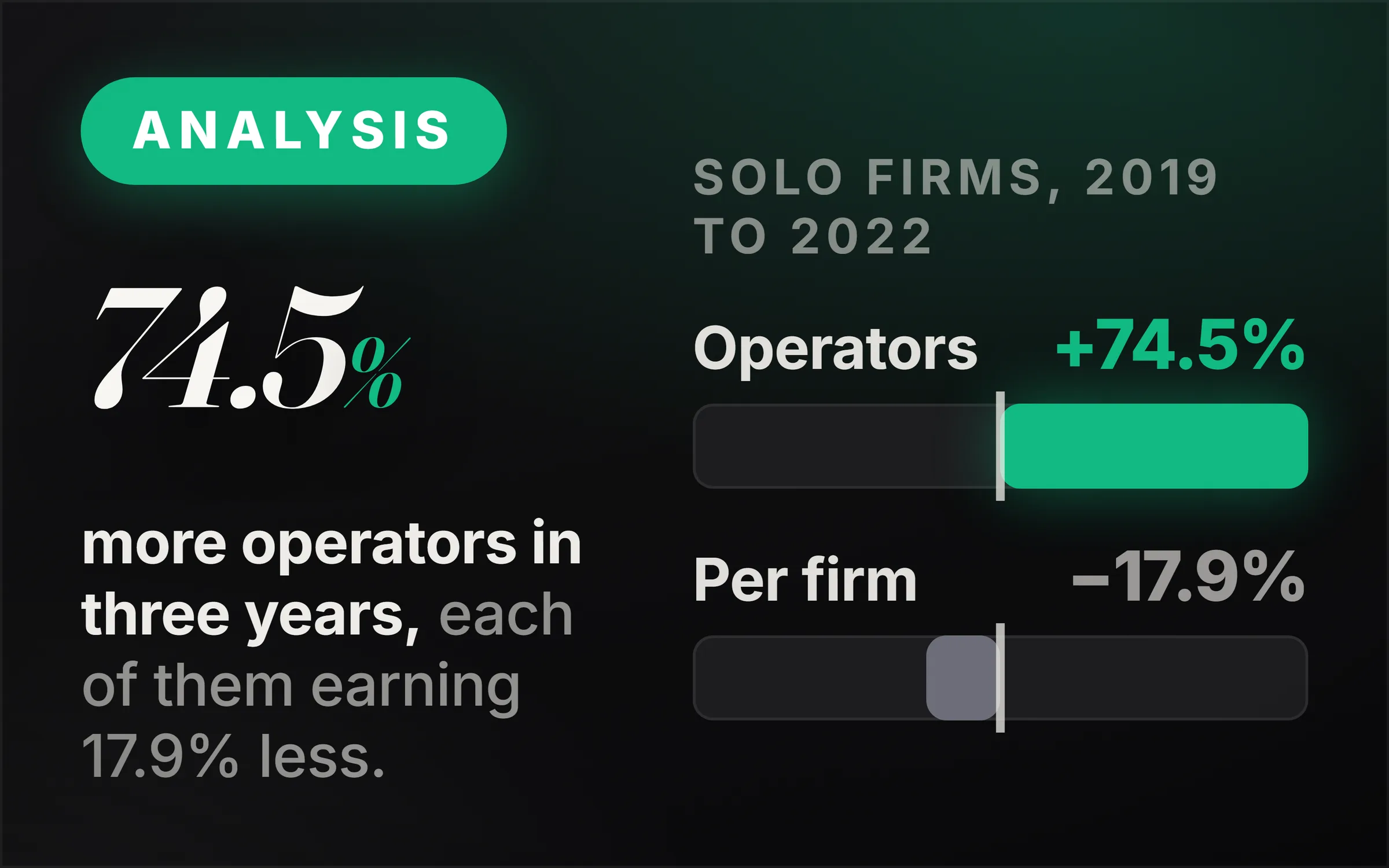
To start a car rental business, verify local demand before buying anything, get commercial insurance in place, and start with a vehicle you can afford to hold through quiet weeks, because utilisation decides everything. Know the market first: solo car rental firms rose 74.5% from 2019 to 2022 while average revenue per firm fell 17.9%, to $51,588.
Before anything else, the number that should govern this decision. Between 2019 and 2022 the count of solo firms in automotive equipment rental and leasing rose 74.5 percent, from 21,719 to 37,891, while average revenue per firm fell 17.9 percent, from $62,849 to $51,588.
That combination appears in no other industry we have pulled. Cleaning, painting, web design, photography, handyman work, detailing and moving all showed revenue per operator rising. This one is the exception, and the pattern is unambiguous: entrants arrived far faster than demand, and each operator now takes less than they did before the rush.
You can still start this business. But you should start it knowing you are entering the one market in the published data that is visibly filling up, and that the entry ticket here is a financed asset rather than a few hundred dollars of equipment.
Is the car rental market saturated?
By the clearest measure available, it is filling up fast. The Census Bureau's Nonemployer Statistics for NAICS 5321, automotive equipment rental and leasing, recorded 21,719 solo establishments in 2019 and 37,891 in 2022, a rise of 74.5 percent. Over the same three years, average receipts per firm fell from $62,849 to $51,588, a drop of 17.9 percent.
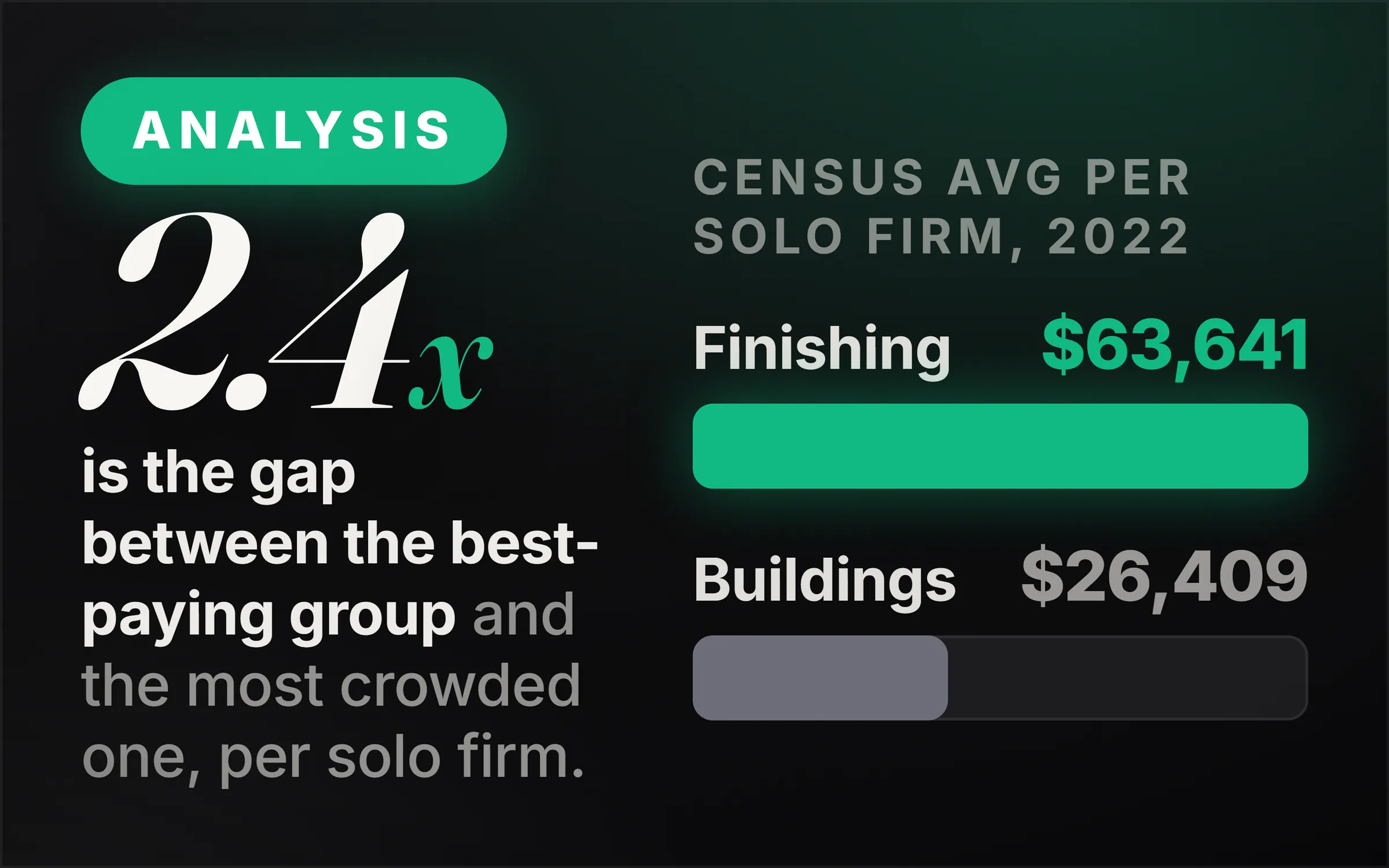
That is the textbook signature of supply outrunning demand, and it is worth appreciating how unusual it is in this data. Every other industry group we pulled moved the other way: services to buildings up 18.9 percent per firm, computer systems design up 18.4, building finishing up 20.6, automotive repair up 23.8. Revenue per operator rose almost everywhere. Here it fell, and it fell while the operator count went up by three quarters.
Two honest caveats. NAICS 5321 covers vehicle rental and leasing broadly rather than peer-to-peer car sharing specifically, and 2019 to 2022 spans a period of extraordinary disruption to both travel demand and the used car market. Some of this is that disruption rather than a permanent structural shift.
But the direction is the direction, and it is the only one of its kind in the dataset. Anyone telling you this is an underserved opportunity is not looking at the same numbers.
How much does a car rental business make?
The average solo operator grossed $51,588 in 2022, across 37,891 establishments with no paid employees and total receipts of $1.95 billion.
That figure needs handling carefully, more than in any other trade we have covered, because the relationship between revenue and income is unusually weak here. In a cleaning business, revenue minus a small overhead is roughly what you have. In vehicle rental, the vehicle itself has to be paid for out of that revenue, along with insurance, maintenance, cleaning, tyres and depreciation, and depreciation is a real cost that does not appear as a payment until you sell.
So $51,588 of revenue on a fleet of two or three financed vehicles can easily be a loss, and the same revenue on one owned outright can be a decent income. The published number tells you the size of the pot and nothing about whether it covers the asset.
It is also the average of a distribution that includes both single-car operators and small leasing outfits, and it fell 17.9 percent in three years. Planning against a figure that is currently trending downward requires more margin of safety than planning against one that is rising.
What actually determines whether this works?
Utilisation, and almost nothing else. The number of days a vehicle is earning divided by the number of days you are paying for it is the entire business, and it does not appear in any published statistic.
The arithmetic is unforgiving in a way that hourly service work is not. Your costs are close to fixed: finance or the opportunity cost of capital, insurance, registration, and a large part of maintenance accrue whether the car moves or not. Revenue is entirely variable. A vehicle rented twenty days a month and one rented eight days a month cost you almost exactly the same and earn wildly different amounts.
This is why location and vehicle choice dominate the decision, and why they should be researched before any purchase rather than after. Demand is intensely local and intensely seasonal, and the vehicle that rents constantly in one city sits idle in another. The operators who do well are not the ones who found a clever pricing trick, they are the ones who correctly guessed what their specific market wanted to rent.
The practical consequence is that this business rewards research and punishes enthusiasm more than most. Every other trade we have written about can be tested for the cost of your time. This one requires you to buy the asset before you learn whether the demand is there.
What does it cost to start?
More than any other business in this series, and the cost is concentrated in one irreversible decision. We are not publishing vehicle figures because they depend entirely on market, model and condition, and we could not verify current pricing to the standard used elsewhere on this site.
What can be said is the shape. There is the vehicle, acquired outright or financed. There is commercial insurance, which is the item most commonly underestimated. There is maintenance and cleaning between rentals, which scales with utilisation. There is platform commission if you rent through a marketplace. And there is depreciation, which is invisible month to month and entirely real when you sell.
The insurance point deserves emphasis because getting it wrong is catastrophic rather than expensive. A personal auto policy generally does not cover commercial rental use, and discovering that after an incident is the failure mode that ends these businesses. What cover is required, and what a rental marketplace's own protection does and does not include, varies by state and by platform, and both need reading in full before a vehicle is listed rather than after.
The general principle from every cost article we have written applies with more force here: the advertised price of anything in this category is the most favourable number the vendor can defend. We set out the pattern across software, insurance and payment processing in the hidden costs nobody puts in a startup cost list.
Is peer-to-peer car sharing different from traditional rental?
Operationally yes, economically less than people assume, and the Census category does not separate them. Renting through a marketplace removes the need to find customers and hands you demand, which is genuinely valuable at the start.
What it does not remove is the fundamental problem, which is that your cost is fixed and your revenue is not. It also introduces dependencies that the traditional model does not have: the platform sets the commission, controls the pricing tools, adjudicates damage disputes, and can change any of those unilaterally. You are building on rented ground, which is the same structural issue we wrote about in the moat moved.
The 74.5 percent increase in operators is also, in part, exactly this: marketplaces lowered the barrier to entry, a great many people entered, and revenue per operator fell 17.9 percent. That is what a lowered barrier does to a market, and it is the mechanism we found across the whole dataset in boring businesses: which ones actually make money, where the most crowded industry pays the least per operator.
None of that makes it unworkable. It means the easy version of this business, listing a car and waiting, is the version that competed the average down, and that anything worth doing here has to be more specific than that.
Should you start one anyway?
Only with a vehicle you can afford to hold through low utilisation, in a market whose demand you have verified rather than assumed, and with commercial insurance in place before the first rental.
The case for it is real. Demand exists, marketplaces provide distribution, and an operator with the right vehicle in the right city can do well. The 2019 to 2022 window also spans a genuine shock to travel, so some of the revenue decline is cyclical rather than structural, and a more recent dataset may look different.
The case against is that this is the only business in our data where the trend is against the operator, the entry cost is an asset rather than an afternoon, and the downside of being wrong is a financed vehicle you cannot rent and cannot easily sell for what you owe. Every other trade in this series can be tested cheaply and abandoned cheaply. This one cannot.
If the appeal is a local business with recurring income rather than vehicles specifically, the same data points somewhere better: handyman work, junk removal and detailing all showed rising revenue per operator and require no financed asset to test. Those are covered in how to start a handyman business and how to start a junk removal business.
The honest hard part
The hard part is that this business asks you to make the largest, least reversible decision first, before you have learned anything.
In cleaning, painting or handyman work you can take one job, discover what the market pays and what the work is actually like, and adjust or stop having risked almost nothing. Here the sequence runs backwards: buy the asset, arrange the insurance, list it, and then find out whether anyone in your city wants that vehicle at that price. There is no cheap version of that experiment, which is why the research has to substitute for the experience.
The second hard part is that the wear is invisible until it is not. Depreciation, tyres, servicing and the gradual decline of a vehicle used by strangers accrue silently while the monthly revenue looks fine, and the reckoning arrives in a single moment when the car is sold or a major component fails. Operators who track revenue and not the asset's decline are frequently doing worse than they think for a long time before they find out.
And the third is the one this article opened with. You would be entering the only market in our published data where more people arrived and each of them made less. That is not a reason to refuse. It is a reason to require a much better plan than the people who entered before the numbers turned.