To start an AI consulting business for small businesses, you pick one local vertical you can genuinely understand, learn the handful of AI tools that solve its most expensive problem, and sell a paid audit that turns into an implementation project and then a monthly retainer: typically a $1,500 to $3,000 audit, an $8,000 to $15,000 project and $1,500 to $4,000 a month.
The opportunity is real: the tools finally work, they are cheap, and almost no small business has anyone whose actual job is to install them. But the honest version of this business is not the one being sold to you in ads, and the difference is the whole article. Most small business owners do not believe AI applies to them at all. Your skill is not the technology. It is making a specific, expensive problem concrete enough that the objection disappears.
I am writing this from inside the same bet I am describing. We built IdeasRepay as a cold start with no audience, so I have no interest in the "AI agency in 30 days" hype, and I am not going to pretend this is easy money. What follows is the honest map: the real adoption data including the number that undercuts the usual pitch, what you actually sell, what it honestly pays, and the failure rate nobody selling this course will show you. Every number is from a named source.
The video makes the case in about five minutes. The written breakdown below stands on its own and goes considerably deeper on the sourcing, the pricing, and the honest failure rate. Read it, watch it, or both.
What does an AI consultant for small businesses actually do?
An AI consultant for small businesses is the person who walks into a real business, finds the one expensive thing that AI can genuinely fix, sets it up properly, trains the staff to use it, and stays on to keep it working. That is the whole job, and every word of it matters. You are not a prompt engineer, you are not a reseller, and you are not there to give a talk about the future of AI. You are there to stop a specific business from losing a specific amount of money.
Concretely, the work looks like this. A salon is losing after-hours booking enquiries because nobody answers the phone at eight in the evening, so you set up an AI receptionist that captures them. An accounting practice is drowning in manual document handling in the run-up to filing season, so you implement document-extraction AI and rebuild the workflow around it. A dental practice never follows up on no-shows, so you automate the follow-up. None of this is exotic. All of it is worth real money to the owner, because it plugs a hole that was quietly bleeding revenue.
The distinction that sets your fee is that you own the outcome, not the tool. Anyone can forward a business a link to a chatbot. What no small business owner can find is a person who will assess their operation honestly, choose correctly on their behalf, install it, train their staff, and be accountable when it misbehaves. You are selling the sentence "this is handled, and someone competent is watching it." That is a fundamentally different product from software, and it is priced differently.
Want the whole business, not just this answer? The Main Street AI Consultant walkthrough lays it out step by step, click by click.
Do small businesses actually want AI, or is that just hype?
They want it, and the honest data is more interesting than either side of the argument admits. The two numbers most often quoted are both true and they measure completely different things, which is exactly where the opportunity hides.
The US Chamber of Commerce, in its "Empowering Small Business" report with Teneo Research (3,870 US small businesses under 250 employees, surveyed June 2025), found that 58% of small businesses say they use generative AI, up from 40% in 2024 and roughly 23% in 2023. That is the fastest technology uptake the Chamber says it has tracked since social media. On its face, it sounds like the market is already saturated and you are too late.
Now look at what the US Census Bureau measures. Its Business Trends and Outlook Survey, which asks whether a business actually used AI in any business function in the past two weeks, has found overall AI use hovering between 17% and 20% through May 2026. Firms with 250 or more employees are at about 37%. Firms with four or fewer employees are under 20%. And the line that should make you sit up: Census reports that AI use increased among firms with at least 20 employees but did not change significantly among firms with fewer than 20 employees.
The two numbers, and what they really mean
- 58% "use generative AI": the owner has a ChatGPT tab open and uses it to write emails and social posts. Personal productivity. (US Chamber / Teneo, 2025)
- Under 20% use AI in a business function: the business itself runs on it. Operations. (US Census Bureau BTOS, through May 2026)
- The smallest firms are stuck. Census finds no significant change in AI use among firms under 20 employees, even as bigger firms pull ahead.
- The gap between those two numbers is the work. Owners are dabbling personally while the business itself runs exactly as it did before.
Read together, the picture is that owners are dabbling and businesses are not changing. Which sounds like a queue of eager buyers waiting for you to knock. It is not, and the next section is the one most articles about this business will never show you.
Why do most small businesses say no to AI?
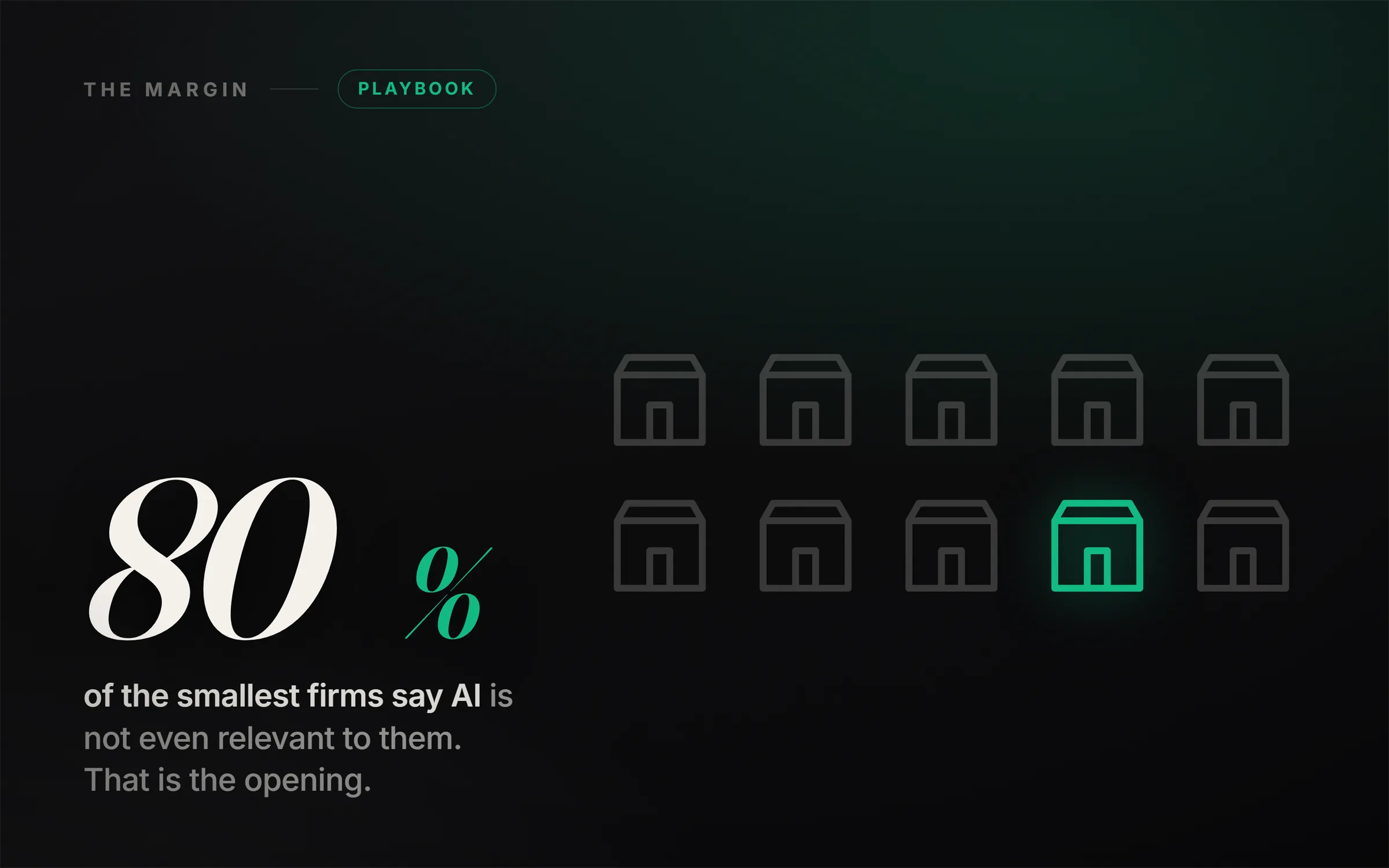
Because they do not think it applies to them, and this is the single most important thing to understand before you quit anything. The US Small Business Administration's Office of Advocacy, in its September 2025 research spotlight "AI in Business: Small Firms Closing In" (analyzing the Census BTOS data), found that about 82% of businesses with fewer than five employees said AI was simply "not applicable" to their business. Not too expensive. Not too confusing. Not relevant. Across non-adopters generally, roughly 77% saw no applicable use case. Lack of knowledge was cited by under 7%, and privacy concerns by about 6%.
That finding should puncture the fantasy the AI-agency course economy is selling you, and I would rather you hear it from me now than discover it in month three. Your prospect is not sitting there frustrated, wishing someone would come and install AI. Your prospect mostly believes this has nothing to do with running a salon. You are not an order-taker for a market that is already convinced. You are the person who has to make it concrete.
Now here is why that is good news rather than bad. The SBA does not treat that 82% as a verdict on reality. It explicitly frames it as an education gap, not a reality gap, and when it looks at where small firms fall furthest behind large firms in AI investment, the top three are: training staff (an 8.6-point gap), hiring vendors or consultants to integrate AI (5.2 points), and changing how they collect and manage data (4.2 points). The federal government's own small-business research arm is, in effect, describing a missing profession and pointing at the hole where it should be. Separately, of the small firms that do use AI, about half made no investment in it at all.
So the real shape of the market is this. A small minority have adopted AI and under-resourced it, and they are your fastest, warmest clients. A large majority have not adopted it and do not think they need to, and they are a real market too, but only if you stop selling AI to them.
The sales lesson hiding in that data. If 82% of tiny businesses think AI is not applicable to them, then the word "AI" is a liability in your first sentence, not an asset. You never walk in offering artificial intelligence. You walk in saying: "You are losing roughly forty percent of your after-hours booking enquiries because nobody answers the phone at eight in the evening. I can fix that, and here is what it is currently costing you." Nobody thinks a missed booking is irrelevant to their business. The AI is just how you fix it, and it belongs in the second half of the conversation, not the first.
Why can't small businesses just set up AI themselves?
Because the hard part was never choosing the model, and the biggest companies in the world are failing at exactly the same thing. MIT's NANDA initiative, in its 2025 report "The GenAI Divide: State of AI in Business," analyzed 300 public AI deployments alongside 150 leader interviews and found that roughly 95% of enterprise generative-AI pilots delivered no measurable impact on the profit and loss statement, with only about 5% achieving real revenue acceleration. Crucially, the researchers concluded the failure was not caused by model quality. It was caused by what they called the learning gap: organizations could not integrate AI into their actual workflows, structures, and habits.
Be careful with that statistic, and be honest about it when you quote it. It studied enterprises, not corner shops, and it is an industry report rather than peer-reviewed research. But that is precisely why it matters to you: if companies with entire innovation departments and seven-figure budgets fail at integration 95% of the time, a dentist with eleven staff and no IT person has no chance alone. Not because she is not smart. Because integration is a job, and nobody in her building has it.
That is your entire value proposition, and it is durable. The tools keep getting better and cheaper, which does not threaten you, it helps you. The scarce thing is not the software. The scarce thing is the human who picks the right one, wires it into a real workflow, trains a skeptical receptionist to use it, and comes back when it breaks. Software gets commoditized. Judgment and accountability do not.
What do you sell, and how much can you charge?
You sell a three-step ladder, and each step pays for itself while it sells the next one. This is the structure that separates a real practice from a person doing favors and calling it a business.
- The audit ($1,500 to $3,000). You assess the business, find where AI can genuinely help, score its readiness, and hand over a real written deliverable. It is paid from the very first one, because a free audit attracts people who will never buy, and it is the trojan horse that earns you the project.
- The implementation project ($8,000 to $15,000). Sixty to ninety days of actually setting it up: choosing the tools, wiring the workflow, training the staff, fixing what breaks. This is where the value is delivered and where your reputation is made.
- The retainer ($1,500 to $4,000 a month). AI does not stand still, the staff turns over, and the owner wants someone she trusts watching it. The project becomes recurring revenue, and recurring revenue is what turns a series of gigs into a business.
The practice math is simple and it is not fantasy. Four retainers at $2,500 a month is $10,000 a month, or $120,000 a year, recurring, before you take on a single new project. Independent consultants in the AI space commonly bill $150 to $250 an hour, and those ranges are consistent with the day-rate math behind a $12,000 project. Our own Main Street pricing research puts audits at $1,500 to $3,000, projects at $8,000 to $15,000, and Main Street retainers at $1,500 to $4,000 a month, deliberately at the conservative end of the wider market, because a local salon is not an enterprise client and pricing as if it were is the fastest way to close nothing.
The startup cost is close to nothing against those numbers. An entity, a simple website, and one or two AI subscriptions you use for your own learning. Under $500 in most cases. Your first client covers a year of overhead. The real investment is the two to four months you spend getting genuinely good before you charge anyone.
Do you need to be technical to start an AI consulting business?
No, and the reason is worth understanding, because "I can't code" is the objection that stops most of the people who would be excellent at this. Almost none of the tools you will implement for a Main Street business require code. They are configured, not programmed. What the work actually demands is a different and rarer stack: enough fluency with AI tools to recommend one with real authority, enough business sense to read where a company is losing money, enough patience to train a sixty-year-old receptionist without condescending to her, and enough nerve to say your price out loud without flinching.
That last one is the real filter. The sales conversation, not the technology, is where nearly every aspiring consultant stalls. It is entirely learnable, but it has to be learned, and no amount of tool knowledge substitutes for it. If you are the kind of person who would rather spend six more weeks studying tools than have one uncomfortable conversation with a business owner, this business will punish that instinct until you fix it.
What genuinely disqualifies you is not a lack of a computer science degree. It is not being willing to actually learn the vertical. A consultant who recommends the wrong tool, oversells what AI can do, or sets it up badly does not get a retainer. He gets a refund request and a bad review in a small town where everyone talks. The competence has to be real. The good news is that it is a few months of honest work away, not four years.
How do you get your first AI consulting client?
You start with three case-study clients, priced low or delivered free, chosen deliberately rather than desperately, and you never open with the word "AI." This is the part people skip and it is the part that works. You have no proof, so you buy proof with your time, once, in a controlled way. You do excellent work for three local businesses in one vertical, you document exactly what changed with real numbers, and you walk out with three references, three case studies, and a genuine understanding of that vertical's problems. Then you charge.
The opening line is where most beginners lose the deal before it starts, and the SBA data explains exactly why. If four in five small owners think AI is not applicable to them, then "I help businesses adopt AI" is a sentence that gets you politely dismissed, because it asks the owner to care about a technology. "I noticed you do not answer the phone after six, and I think that is costing you around three thousand dollars a month, want me to show you the numbers?" asks the owner to care about his own money, which he already does. Same service. Completely different conversation. Lead with the leak, never with the tool.
Everything after that is easier than it sounds, because you are selling into a vertical that talks to itself. Salon owners know other salon owners. Accountants refer accountants. Once you are the person who fixed the booking problem for a well-known local salon, you are not cold-calling anymore, you are being introduced. The narrowness is not a limitation, it is the entire distribution strategy. A generalist AI consultant is a stranger everywhere. A specialist in one vertical in one city is a known quantity, and known quantities get paid.
Naming that path is easy. Running it well is the part worth doing carefully, and it is where the Main Street AI consultant blueprint does the real work: the ten verticals and how to choose between them, the skill stack with exactly where to learn each piece, the audit workbook and the deliverable you hand over, every word of the sales conversation including the twelve objections you will actually hear and the exact response to each, the implementation playbook, and the bridge from three case studies to a stack of retainers. This article gives you the shape. The blueprint gives you the build.
Is AI consulting already saturated?
The loud end of it is, and the useful end of it is not. There is a genuine flood of people calling themselves AI consultants on the internet, selling AI-agency courses to each other, running the same cold-email templates into the same inboxes. That market is crowded, cynical, and unpleasant, and if that is the business you are picturing, the criticism is fair.
The local, physical, unglamorous end looks nothing like that. The Census data says it plainly: firms under 20 employees have not moved. If this space were saturated, that number would be climbing, and it is not. Nobody with the skills to do this work wants to drive to a vet clinic in a strip mall and spend a Tuesday teaching three people how to use a scheduling assistant. It is not scalable, it does not make a good screenshot, and it cannot be automated into a course. Which is precisely why it stays open and why the fees hold.
If you are weighing this against other paths, it belongs in the same family as the grounded, relationship-led businesses we covered in Realistic AI Side Hustles for Beginners, and it answers the fear we took apart in Is It Too Late to Start an AI Business?. The short version of both: the crowd is competing for attention online, while the customer is sitting in a shop three blocks away and nobody has ever shown her what this would actually do for her.
What is hard about AI consulting for small businesses?
This business has real catches and you should hear them before you start, not after. The biggest one is the objection you now know is coming: most small owners do not think AI is for them. That means every deal starts uphill, and it means the pitch has to be about their money and not your technology. If you cannot handle being told "I don't really see how that applies to us" and calmly showing someone why it does, this business will be miserable, because you will hear that sentence more than any other.
It is also slow at the front. Your first paid client is realistically two to four months out, and a stacked set of retainers is nine to eighteen months out. The quiet stretch in between, where you are learning and reaching out and hearing "let me think about it," is where almost everyone quits.
Local businesses are also not enterprise clients, and it is a mistake to price or plan as if they were. They pay less than you would like. They ghost sometimes. They occasionally cannot afford the thing they genuinely need, and you will have to walk away from work rather than take a retainer too cheap to deliver on. The economics work because you stack retainers and run a tight practice, not because any one deal is large.
And the work is real work. This is not "install a tool and disappear." It is on-site time, staff who are frightened of the technology, and moments where the AI does something wrong in front of a client and you own it and fix it. The retainer is earned every single month.
None of that is a reason not to start. It is a reason to start with a system instead of hope, because the barrier here is diligence and nerve rather than capital or credentials, and those are exactly the filters keeping this space open while everyone else fights over the loud end. Every shop on your street has been told it needs AI. Almost none of them can set it up. The whole build, from choosing your vertical to your first paid audit to a practice of retainers, is laid out end to end in the Main Street AI consultant blueprint on ideasrepay.com.
One practical warning before you start knocking by email rather than in person. A cold email that gets filtered produces no bounce, which means an empty inbox is not evidence that the offer failed. We set out what actually governs delivery to a business mailbox, sourced to Google's own documentation, in why your cold emails go to spam.
They already know they need you. Nobody has knocked yet.