Marketing terms make sense when you watch them happen to one business. This glossary follows a cleaning company through its first year and explains 38 terms as each starts to matter, from ICP and churn to CAC, payback and last-click attribution. The one number to work out today is blended CAC: all marketing spend divided by all new customers.
Three of the most quoted terms in marketing are not one number each. They are two, and nobody says which one they mean.
LTV is either what a customer pays you or what a customer leaves you, and those can differ by more than half. ROAS is either the return on this month's advertising or the return on the whole business including everybody who joined last year. CAC is either what one channel's report says a customer cost or what every dollar you spent divided by every customer you got says it cost. In each pair, both numbers are true, both are calculated correctly, and only one of them is answering the question you asked.
That is the actual problem with marketing vocabulary. Not that the words are hard, but that two people in the same meeting can use the same word for completely different numbers and neither of them is lying.
So this page runs one business, a residential cleaning company modelled across twelve months, and introduces each term at the moment it starts costing money. The film does the same thing with the numbers on screen.
What is an ideal customer profile (ICP)?
Ideal customer profile (ICP) is a written description of who you are for. In the model, that is a woman who owns her home, works full time, has two children, and would rather pay somebody monthly than spend a Saturday cleaning.
The useful part of an ICP is not who it lets in. It is who it leaves out. Once that description exists, a lot of work disappears: not offices, not one-off deep cleans, and never anybody shopping purely on price.
Positioning is how you get described when you are not in the room. Ask her neighbour and she says it is the one that comes every month, on the same day, with the same cleaner. She does not say it is the cheapest, and she does not say it is the most thorough. Most of the work in positioning is deciding what you are not going to be.
The offer is not the product. The product is a clean house. The offer is the precise deal on the table: one standard clean, about two and a half hours, at a fixed price, once a month. Change any part of it and every number in the rest of this page moves with it.
What are ARPU, COGS, gross margin and contribution?
ARPU is average revenue per user, which you get by dividing all revenue by all customers. Here everybody buys the same thing, so it is simply the monthly price. The thing to understand about ARPU is that it tells you what comes in and nothing about what you keep.
COGS is cost of goods sold: what it costs to deliver the thing you just sold. In the model that is the cleaner's two and a half hours, payroll tax, workers compensation, supplies and fuel. Most of the price goes straight back out.
Notice what is not in there. Rent is not, and neither is the phone bill, the software, or the owner's own time. COGS has one test: if you do one more clean tomorrow, does this cost happen again?
Gross margin is what is left, and it is almost always quoted as a percentage, which is why it is quietly useless on its own. A percentage cannot pay anybody.
Contribution is the same thing turned back into money: what a single sale contributes towards everything the sale did not pay for. Rent, software, advertising, and eventually the owner. Hold that number, because most of what follows is this number wearing a different name.
How do you calculate churn and customer lifetime value?
Churn is the share of paying customers who stop each month. Divide 1 by the monthly churn rate to get average customer life, so churn of about 1 in 9 means about 9 months. Lifetime value comes in 2 versions, revenue and contribution, and only the smaller one should pay for anything.
Churn is the share of paying customers who stop each month. In the model it is roughly one in nine. People move house, money gets tight, or they decide to do it themselves for a while.
A percentage is a strange way to think about it, because what churn is really telling you is how long somebody stays. Divide one by the churn rate and you get the average customer life, which here is a little over nine months.
Lifetime value is then the monthly price multiplied by those nine months. Except the business never sees that, because more than half of every payment went straight back out to the cleaner.
So run it a second time using contribution instead of price. Same customer, same nine months, and a far smaller number.
Both of those are lifetime value. The first is revenue LTV, the second is contribution LTV, and the gap between them is enormous. Only the smaller one is allowed to pay for anything, which is why the first question about any quoted LTV is which of the two it is.
What is CAC, and why does payback matter more than LTV?
CAC, customer acquisition cost, is money spent divided by the customers it produced. Payback, the months a customer takes to repay their CAC, matters more than the LTV to CAC ratio, because LTV is a promise about next year and payback is a fact about your bank account.
CAC is customer acquisition cost: money spent, divided by customers it produced.
It is the most quoted number in marketing and the easiest to flatter. You can leave a channel out of the total. You can count a customer who was coming anyway. You can forget the fee you pay your agency. All three happen constantly.
The LTV to CAC ratio divides one by the other, and you will hear three to one repeated as the healthy figure. Nobody has ever produced the study it came from. Treat it as a habit rather than a rule.
And a ratio hides the thing that actually closes small businesses, which is time. The money went out today. The customer pays it back a month at a time.
Payback period is what a customer cost divided by what a customer contributes each month. In the model she has her money back before the next invoice goes out, which is what makes it safe to spend more next month.
Put it plainly: lifetime value is a promise about next year, payback is a fact about your bank account, and businesses die of payback long before they die of lifetime value.
ROAS, return on ad spend, has the same two-numbers problem as LTV. One version counts only revenue from customers acquired this month. The other counts everything that came in this month, including everybody who joined earlier and is still paying. Neither is a lie. The first measures the advertising, the second measures the business, and ROAS is the term most likely to be quoted at you without anybody saying which.
What is an ad impression?
An impression is one advert appearing once on one screen. Not read, not noticed, just put in front of somebody.
Reach is how many different people saw it at all, and this is the pair people mix up most. In month one the model has roughly twice as many impressions as people.
Frequency is impressions divided by reach, so the average person saw the advert about twice. Hold onto it, because in a couple of months it does something.
CPM is the cost per thousand impressions. The M is not a typo: mille is Latin for a thousand, and attention gets priced in thousands.
CTR, click-through rate, is clicks divided by impressions. A little over one in a hundred is normal here.
CPC is spend divided by clicks. And CPM and CPC swap places depending on which platform you are standing on. On Facebook you are buying impressions and the cost per click falls out at the end. On Google Search you buy clicks and the cost per thousand falls out instead. Neither is a setting you choose. Both are results of an auction you are bidding in.
What is creative fatigue?
Creative fatigue is an ad wearing out through repetition alone. Same ad, same audience, bigger budget: frequency climbs, click-through falls by about a quarter and cost per click nearly doubles, with nobody making a mistake.
In month four, nothing changes. Same advert, same audience, bigger budget.
Frequency climbs, so the average person now sees the advert far more often. The share of people clicking falls by about a quarter. The cost of a click nearly doubles, and the cost of a customer doubles right along with it.
That is creative fatigue. The audience has seen the advert often enough to stop reacting, and the auction charges more for putting it in front of them again. Nothing broke and nobody made a mistake. Repetition on its own did all of it.
An A/B test is how you choose the replacement: two versions at the same time, to the same kind of people, on the same budget, changing exactly one thing. One thing is not fussiness. Change the headline and the picture together and a win tells you only that something worked, which is not knowledge you can use again.
The new advert works. Frequency drops back, people click again, cost per customer comes down. But look at where it comes back to, because it does not come back to where it started, and it never will. The cheapest and most interested slice of that audience was used up in the first three months, and a new video does not bring those people back.
A lookalike audience is the usual next move: hand the platform your customer list and it finds people who resemble them using signals it will never show you. It does work. It is also why a tired account often gets more expensive after it expands, because a lookalike of a used-up audience is a slightly worse audience.
How do you improve conversions after the click?
Fix the page before buying more traffic. In the example, cutting an enquiry form from 9 fields to 4 nearly doubled the enquiry rate and almost halved the cost per customer on identical ad spend.
In month six the model gets slightly more clicks than the month before and almost a third fewer bookings. Nothing changed in the ad account. The problem moved onto the website.
Bounce rate is the share of people who land on a page and leave without doing anything measurable. Put it in people rather than percentages and it stings, because every one of them was paid for.
Retargeting is advertising to those people again. They are cheaper to reach and book better, because they are not strangers any more. They are also a fixed pool, which is why retargeting can never be the whole plan.
Conversion rate is the share of people who do the thing you wanted. On this page it happens in two steps: not bouncing, then finishing the form. Multiply the two and you have the share of clicks that become an enquiry, which had fallen by about a third with identical adverts, audience and offer.
Friction is anything sitting between wanting the thing and having the thing. On inspection the causes were not technical: the page loaded slowly, the form asked for nine separate things, and it wanted a phone number before it would give anybody a price. Every piece of that is a small tax, paid by a person who did not ask to be there.
A lead magnet is what you give away for contact details, and the promise at the top of that form is the only reason anybody fills it in. Here it is a fixed price for your house in under a minute, with nothing to pay. A good lead magnet is not a discount and not a gift. It is the smallest useful thing the person already wanted.
Then month seven. The page is made faster and the form is cut from nine questions to four. The share of visitors who become enquiries nearly doubles. Advertising spend, adverts and audience are identical in both months, and the cost of getting a customer almost halves.
That is CRO, conversion rate optimisation: improving the share of the traffic you already have instead of buying more. It is the cheapest lever on the whole board, and it is almost always the last one anybody pulls, because there is nothing to announce at the end of it.
Deliverability is the quiet one at the end of the form. A booking confirmation has to actually arrive, and whether it does comes down to unglamorous things like domain authentication and how many people have marked you as spam before. A confirmation in the spam folder becomes somebody who does not show up, and no screen in the business will ever tell you that is what happened.
Why does search traffic convert better, and what are UTMs?
Search traffic arrives with intent, so in the example it booked at nearly double the rate of Facebook traffic on the same page in the same month. UTM tags on each link are how you see which channel each customer came from.
In month eight the model adds Google Search alongside Facebook, and the two channels behave differently immediately. Same page, same offer, same month, and the search traffic books at nearly double the rate.
Intent is the whole explanation. Somebody typing house cleaning near me has the problem right now and is trying to solve it. Somebody scrolling Instagram was interrupted while thinking about something else. That one word covers most of the gap between search and social on every dashboard you will ever open.
Channel mix is not a strategy word, whatever anybody tells you. It is how the money is split and what each channel gives back. And the moment there is more than one channel, there is a new problem: deciding which one gets the credit.
UTMs are the extra pieces stapled to the end of a link that tell your analytics where a click came from. The name stands for Urchin Tracking Module, after a company Google bought in 2005, which is why it makes no sense to anybody now. They are useful and you need them. But notice what they are capable of describing: only the click that carried somebody in.
What is wrong with last-click attribution?
It is biased the same way every time: it credits the channel that harvests demand and punishes the 1 that creates it, so cutting the channel that looks worst can shrink the one that looks best.
This is the part worth the whole page, because it is a decision that looks obviously correct and is not.
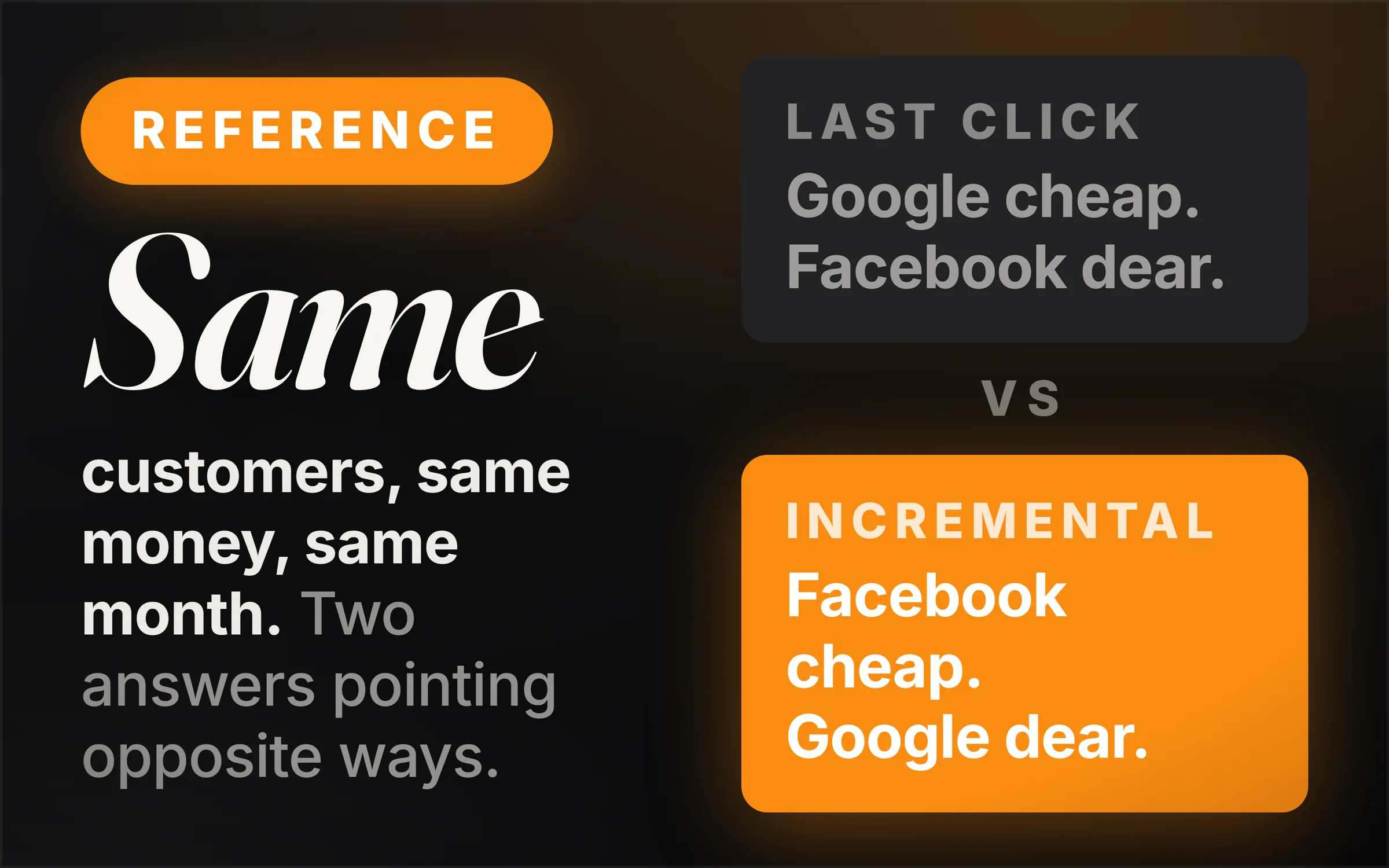
Month nine. The report says Google customers are a good deal cheaper than Facebook ones. The method behind it is the default in almost every tool: whichever channel delivered the last click before the booking gets the entire customer. That is last click attribution. It is the default because it is simple and nobody can argue with it, which is not the same as being right.
Month ten. Read on its own, the decision is obvious. Google is cheaper, so the Facebook budget is cut by roughly two thirds and most of it moves to Google.
Month eleven. Google customers immediately start getting more expensive. Inside two months they cost twice what they used to. The cheap channel stopped being cheap the moment it was asked to work on its own.
The explanation was in a row nobody had looked at: the people typing the company's name into Google. Brand searches are cheap to reach and book far better than anything else, and Google is very happy to sell you those clicks. But nobody types a cleaning company's name into Google unless something put that name in their head first.
Spend the same on Google the following month and the customers arriving through the company's own name fall by almost half again. Nothing changed on Google. What changed was the Facebook budget, two months earlier. Those customers were being handed to Google by last click and being created by Facebook.
An assisted conversion is a customer touched by one channel and closed by another. Every analytics tool has that report sitting in it, and almost nobody opens it.
So count month nine a second time, giving the customers who searched by name back to the channel that put the name there. Facebook customers turn out to be far cheaper than the report said, and Google customers far more expensive. Same customers, same money, same month, and two answers pointing in opposite directions.
Incrementality is the second way of counting. It does not ask who was last. It asks what would have happened if that channel had never run at all.
And the sharpest way to say the problem: last click is not a bad method because it is inaccurate. It is a bad method because it is wrong in the same direction every single time. It flatters whichever channel harvests demand and punishes whichever channel creates it, which means the correction it invites is always to cut the thing that was working.
What is blended CAC?
Blended CAC is every dollar spent on marketing anywhere, divided by every new customer from anywhere.
Across those two months it went up by almost half while both individual channel numbers still looked reasonable. It is a blunt number and it will never tell you where to spend. It is also the only number on the whole board that cannot be improved by relabelling anything, which is exactly why it should be the one you check first.
Month twelve. Facebook goes back in, higher than ever. The platform charges more per thousand people, fewer of them click, and fewer of the ones who enquire go on to book. All three move against the business at once, and none of it is a mistake. That is simply what it costs to buy more of the same audience.
A customer now costs more than twice what one cost in month one, and payback has roughly doubled. It is still inside two months, which means none of the numbers on this page is what stops the business next.
What stops it is six cleaners. Somebody has to find them, train them and keep them, and there is no dashboard anywhere that shows that.
One thing to do today
Work out your own blended CAC for last month. All your marketing spend, divided by all your new customers. Not one channel's number. All of it.
If that takes you more than a minute to find, you have learned something more useful than the number itself, which is that nobody in your business currently owns the only figure that cannot be gamed.
For the neighbouring glossaries, we have every AI term explained with its source, automation terms sorted by the failure each one names, the YouTube terms that decide if you get clients, and the startup finance terms that cost founders money.