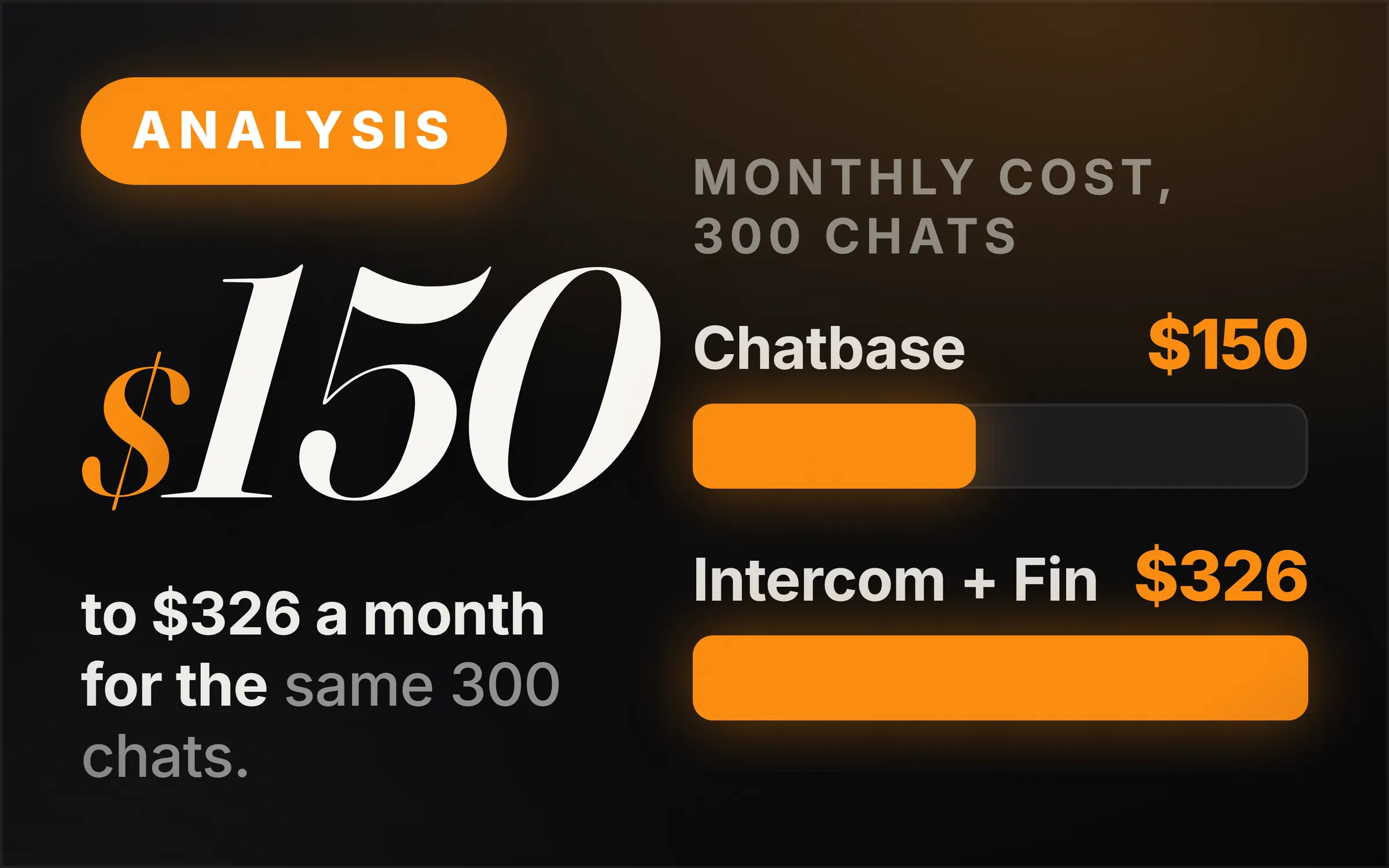
An AI chatbot costs a small business between $150 and about $326 a month to answer around 300 website chats, on the platforms that publish their prices. Free plans exist but stop at 50 to 100 conversations a month. Paid plans charge in one of three ways: per seat (Intercom, $29 a seat), per conversation (Botpress, $0.65 for each one over the plan) or per outcome (Intercom's Fin, from $0.99 for each one).
Done for you, the price changes shape. An agency that builds and looks after the bot typically charges a setup fee plus a monthly retainer, and our walkthrough prices that at $500 to $2,000 to set up and $299 to $799 a month.
How much does an AI chatbot cost per month?
Published prices run from $0 to $500 a month for the plans a small business would use. Chatbase charges $40, $150 or $500 a month by message credits. Botpress Plus is $150 a month billed annually with 250 conversations. Intercom is $29 a seat plus from $0.99 for each outcome its Fin AI agent delivers.
| Platform | Published price | What is included | How it is priced |
|---|---|---|---|
| Chatbase Free | $0 | 50 message credits a month | By message credits |
| Chatbase Hobby | $40 a month | 700 message credits a month | By message credits |
| Chatbase Standard | $150 a month | 4,000 message credits a month | By message credits |
| Botpress Plus | $150 a month, billed annually | 250 conversations and $25 of AI usage a month | By conversations; extra packs of 100 for $65 |
| Tidio Growth | From $49.17 a month, billed annually | From 250 billable conversations | By conversations; Lyro AI conversations priced separately |
| Intercom Essential + Fin | $29 a seat, plus from $0.99 per outcome | A help desk seat; Fin charged per outcome | By seat and by outcome |
Prices from each platform's own pricing page, 11 October 2026. US dollars. Tidio and Botpress figures shown are annual-billing prices.
The table hides the real question, which is volume. A plan that looks cheap can cost more than one that looks expensive once a business has more chats than the plan includes.
Want to sell chatbots, not just buy one? The AI Chatbot Agency for Local Businesses walkthrough lays out the business step by step.
What does a chatbot cost for 300 chats a month?
For 300 website chats a month, the published prices put Chatbase Standard at $150, Botpress Plus at $215 and Intercom Essential with Fin at up to $326. The spread is $176 a month for the same 300 chats, and it comes entirely from what each platform counts.
The arithmetic, line by line, so you can redo it for your own volume:
- Chatbase Standard: $150. 4,000 message credits. If a chat uses around 5 to 10 credits, 300 chats use 1,500 to 3,000, inside the plan. How many credits a chat uses depends on the model and the length of the chat, so test with real traffic.
- Botpress Plus: $215. $150 covers 250 conversations. The next 50 need one pack of 100 at $65, because Botpress sells extra conversations in packs of 100. That pack covers months up to 350.
- Intercom Essential with Fin: up to $326. One seat at $29, plus $0.99 for each outcome. Intercom counts an outcome only when Fin resolves a conversation or completes a workflow, so 300 is the ceiling, not the bill.
Below about 50 to 100 chats a month, a free plan can cover it, which is where the $0 at the bottom of the range comes from.
Why do AI chatbot prices vary so much?
Because platforms price three different units: a seat (a person using the help desk), a conversation (any chat, answered well or not), and an outcome (a chat the AI actually resolved). The same 300 chats cost $150 on one unit and up to $326 on another.
Per-outcome pricing sounds expensive and is the only model where a bad bot costs less. Intercom's page says "You're only charged once per conversation, even if multiple questions are answered." It counts an outcome when the customer confirms the issue is resolved, when they ask for no more help after Fin answers, or when Fin completes a workflow. A chat that ends in a handoff after the bot gives up is not an outcome unless a workflow handed it off.
Per-conversation pricing is predictable and charges for every chat, including the ones the bot handles badly. Per-credit pricing, Chatbase's model, depends on how long chats run and which AI model answers them.
The practical rule: a business with a few hundred simple, repetitive questions a month is usually cheapest on a flat plan with enough conversations included. A business with a large help desk team already paying for seats is the one per-outcome pricing is designed for.
Is there a free AI chatbot for a small business?
Yes, but the free plans are small: Botpress Free covers 100 conversations a month and Chatbase Free covers 50 message credits a month. Tidio has a free plan, and its Starter plan includes 50 Lyro AI conversations once, not every month.
That is enough to build a bot, test it on real questions and show it to a client. It is not enough to run a busy website. A plumber or a dental practice answering 10 chats a day passes 100 conversations in about ten days.
The honest use of a free plan is as a trial with no clock on it: build the bot, put it on a page that gets a little traffic, and read the transcripts before paying for anything.
How much does a chatbot agency charge to set one up?
In our agency model, $500 to $2,000 to set up and $299 to $799 a month to run and maintain. That is the pricing in the IdeasRepay AI Chatbot Agency walkthrough, and it is a model, not a market survey: agencies that publish fixed prices are rare, and we could not verify a market-wide range.
The gap between that and $150 of software is the work. Software gives you an empty bot. Someone has to write the answers to the business's real questions, connect the booking calendar, decide what the bot must never say (exact prices for medical treatments, for example), test it, and fix it when the business changes its hours.
For the business owner, the comparison that matters is not $299 against $150. It is $299 against the jobs lost to chats nobody answered at 9pm. In the walkthrough's example, a single emergency HVAC job is worth $500 to $2,000, which is why after-hours trades are among the first niches it targets.
Is an AI chatbot cheaper than a person answering chats?
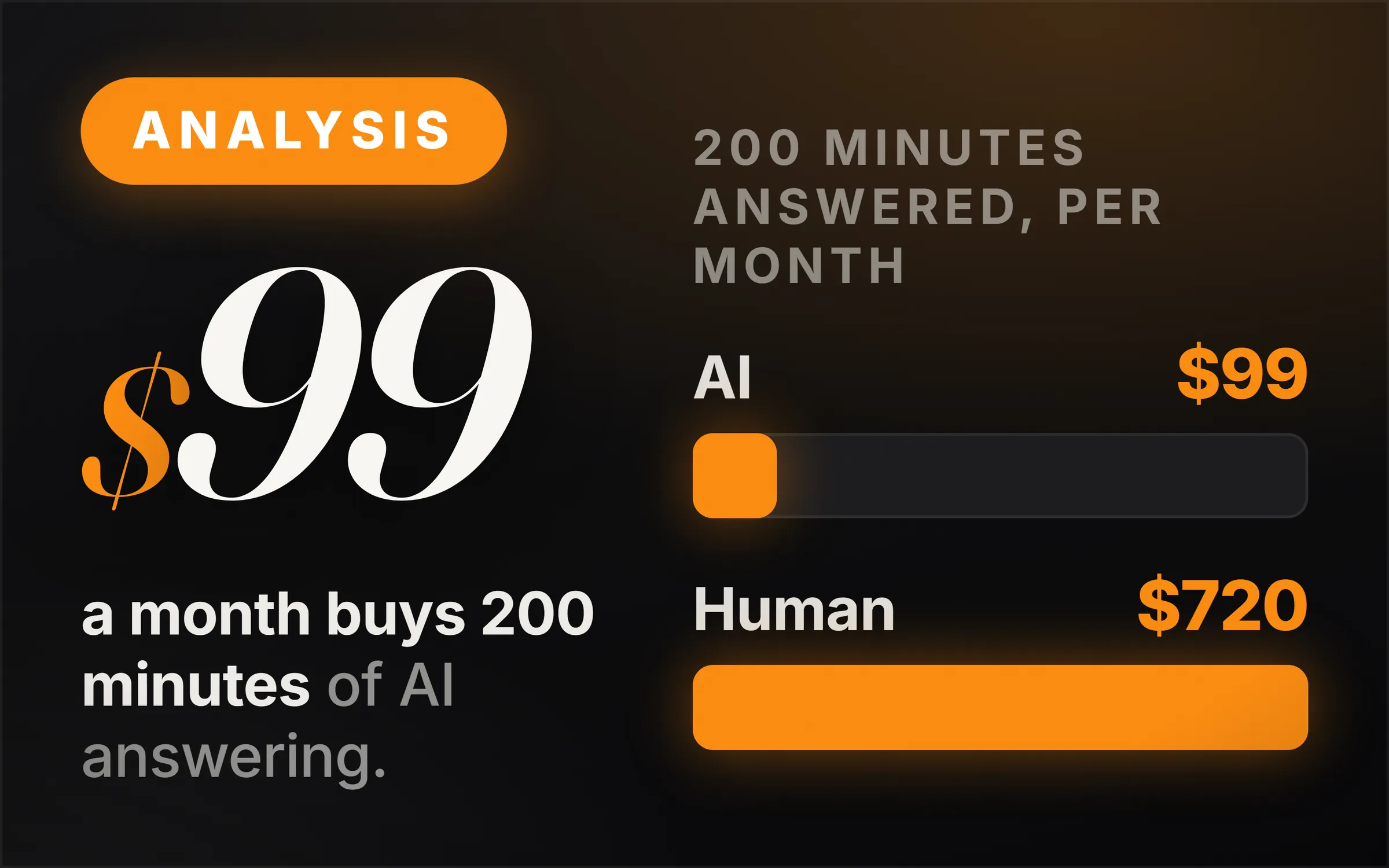
At small volume, yes, by a wide margin: the highest software figure above, up to $326 a month for 300 chats, buys about 45 hours of a person's time at the US federal minimum wage of $7.25 an hour, and a website's chats arrive across all 720 hours of a month. But a chatbot and a person do different jobs.
A chatbot answers instantly at any hour, which is the part a small business cannot staff. It answers the same ten questions without getting tired of them. It does not handle an angry customer, a complaint or a judgement call well, and every serious platform builds in a handoff to a person for that reason.
The same trade, for phone calls rather than chats, is in how much an AI receptionist costs. The deeper version of the cost question, with wage data, is in is AI cheaper than human labour.
The honest hard part
The price on the pricing page is the smallest cost. The real cost is the hours spent writing good answers, and the risk of a bot that confidently says something wrong in the business's name.
The second hard part is that prices change. Two of the platforms above show annual-billing prices by default, one counts outcomes rather than chats, and one stopped publishing prices at all: Voiceflow's pricing page now asks agencies to start a free trial and businesses to request pricing, so we could not verify a current Voiceflow price.
The third is that five platforms is not the market. Many chatbot vendors quote only after a demo, and they are not in this table. Treat the figures as the visible part of the market, checked on one day.