You start a mobile detailing business by choosing one vehicle segment, sorting out water supply and runoff before your first job, pricing packages rather than hours, and selling repeat maintenance plans instead of one-off deep cleans. The water question is the one that separates a business from a hobby, and it is the one nobody mentions.
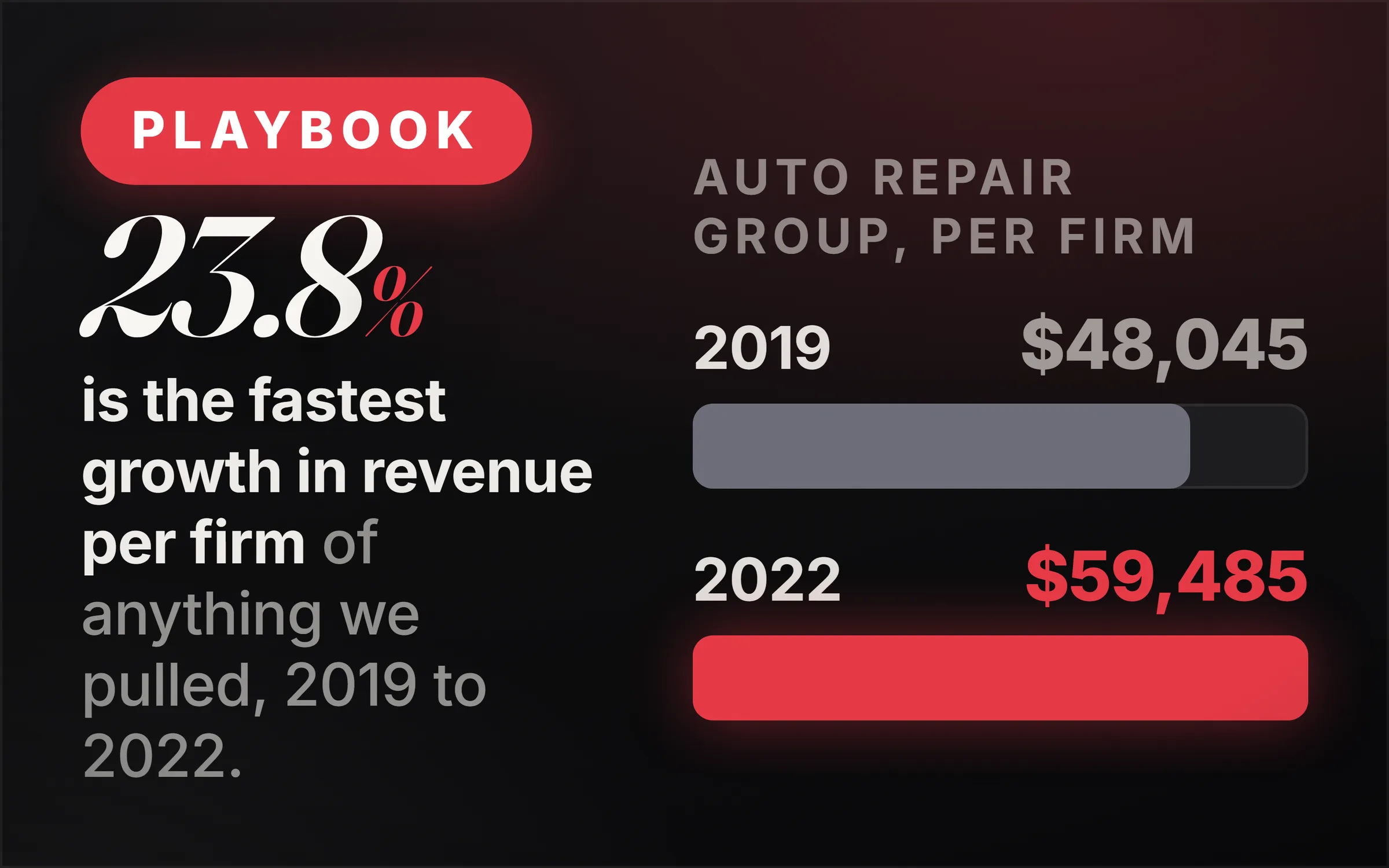
In 2022 the average solo firm in automotive repair and maintenance, the Census category detailing sits in, took in $59,485, across 357,163 establishments with no employees. What makes this trade interesting is the trend: revenue per operator rose 23.8 percent between 2019 and 2022, from $48,045, while operator numbers rose 10.6 percent.
That is the fastest growth in revenue per operator of any industry in our dataset, and it happened while more people were entering. Demand grew faster than supply, which is the most attractive condition a market can be in.
How much does a mobile detailing business make?
The average solo operator grossed $59,485 in 2022. That is Census Bureau Nonemployer Statistics for NAICS 8111, automotive repair and maintenance, covering 357,163 establishments with no paid employees and $21.2 billion in receipts.
The category is wider than detailing: it includes mechanical repair, bodywork and other automotive services alongside cleaning and detailing. It is the published population this trade sits inside rather than a detailing-specific figure, and mechanical work likely pulls the average above what detailing alone would show.
The trend is the more reliable signal and it is unusually strong. Revenue per operator rose 23.8 percent in three years, the largest increase we found in any industry, and it did so while the operator count grew 10.6 percent. Compare that with vehicle rental over exactly the same period, where operators rose 74.5 percent and revenue per operator fell 17.9 percent, and the difference between a growing market and a filling one is immediately visible.
What that means practically is that this is a good moment to enter, and that the condition is temporary. Markets where revenue per operator rises this fast attract entrants, and eventually the entrants catch up.
What are the water and runoff rules?
This is the compliance question that defines mobile detailing and almost no guide covers it. When you wash a vehicle on a driveway or a street, the water carrying detergent, oil and road grime runs into a storm drain, and storm drains generally discharge to natural water rather than to treatment.
That makes it a discharge, and discharges of anything other than stormwater into a storm sewer system are the specific thing that municipal stormwater rules exist to prevent. Many jurisdictions prohibit it outright for commercial operations, and require that wash water be contained, captured and disposed of appropriately.
The requirements vary substantially by state and by municipality, and we are not going to summarise a rule that differs everywhere. What we will say is that this is the item to research before your first paid job, with your own city's stormwater or environmental services department, and that the answer determines your entire equipment list. An operator who needs to capture and contain wash water has a materially different setup from one who does not.
Waterless and rinseless products exist substantially because of this, and they are a legitimate answer rather than a compromise. They also remove the need to source water at every job, which is the other practical constraint of working mobile. Many established operators run rinseless as standard for this reason alone.
What should you charge?
Packages, priced by vehicle size and condition, sold as a menu rather than quoted per job. Never by the hour.
Detailing is unusually well suited to packaged pricing because the outcomes are legible: a customer understands the difference between an exterior wash, a full interior, and a paint correction, and can choose. A menu also does your selling for you, since the middle option gets picked far more often than the cheapest when three exist.
The variable that wrecks quotes is condition. A neglected interior can take three times as long as a maintained one for the same nominal service, and it looks similar in a photograph. Experienced operators price by condition tier, or inspect before confirming, and new ones learn this by losing a Saturday to a vehicle they quoted from a description.
The economics improve dramatically with repeat work. A customer on a monthly maintenance package is a fraction of the effort per visit, because the vehicle never returns to a neglected state, while the revenue recurs without further selling. That single structural choice is the difference between a detailing business and a sequence of detailing jobs, and it is the same lesson every trade in this series teaches.
Who should you sell to?
Pick one of three segments, because they are genuinely different businesses. Fleets and commercial vehicles buy on schedule, in volume, and care about consistency and invoicing rather than perfection. Dealerships need volume turnaround at a price point and are demanding on both. Private enthusiasts pay the highest per-vehicle rates and want craft, but they are individual sales that must be won repeatedly.
The fleet route is the strongest for someone building predictable income. A small business with a handful of vans needs them presentable continuously, the work is scheduled rather than reactive, and one relationship produces recurring revenue for years. It also solves the discovery problem, since a fleet operator is a business you can identify and approach directly rather than a consumer you have to attract.
The enthusiast route produces better content and better photographs, which matters more in this trade than most because the results are so visually compelling. That is a genuine asset and it is routinely wasted: a before-and-after shot of a restored interior is among the most watchable content any trade produces.
Whichever you pick, pick one first. The equipment, the pricing, the scheduling and the marketing all differ, and trying to serve all three at once produces a business that is mediocre at each. The general sequence for landing the first customer is in how to get your first client without asking for one.
Is mobile better than a fixed location?
For starting, yes, decisively. Mobile removes the largest fixed cost in this trade, which is premises, and replaces it with a variable one, which is travel. That is the right trade when you have no customers and no certainty.
It also sells better than it costs. Convenience is a genuine part of the value for a customer who does not want to give up their car for a day, and for a fleet operator whose vehicles cannot leave the yard. You are not just cheaper to run, you are offering something the fixed-location competitor cannot.
What mobile costs you is control and routing. You work in whatever conditions the customer's location provides, including weather, access, power and water, and you spend part of every day driving. That last one is the same tax that produces the low averages in cleaning and lawn care, and it is managed the same way: cluster your work geographically and treat a scattered day as a pricing failure rather than an inconvenience.
The fixed location becomes worth considering when you are turning away work you cannot fit, and when the throughput of not driving would exceed the rent. That is a later decision, and it should follow a full calendar rather than precede it.
The honest hard part
The hard part is that this trade is weather-dependent and season-dependent in a way that is easy to underestimate when you start in spring.
Rain cancels outdoor jobs. Cold restricts what products cure properly. Winter suppresses demand for exterior work in much of the country while doing nothing to your fixed costs. An operator whose entire customer base is enthusiast exterior work discovers this in November, and the answer has to be built in advance: interior-led services that are weather-independent, fleet contracts that run year-round, or an explicit seasonal plan.
The second hard part is physical and chemical. This is repetitive, kneeling, reaching work, performed around solvents and abrasives, and the wear on hands, back and shoulders is real. It looks pleasant on video and it is significantly harder than it looks over a full week.
The third is that the results, which are the whole product, are invisible three weeks later. That is precisely why maintenance plans matter so much: they convert a customer's fading memory of a good result into a recurring relationship, and without them you are re-selling the same person the same transformation forever.
For how this trade compares with the others in the published data, see boring businesses: which ones actually make money.